Just another Reality-based bubble in the foam of the multiverse.

Friday, June 27, 2008

Stormy Weather

via Cryptogon, the London Telegraph:

Barclays Capital has advised clients to batten down the hatches for a worldwide financial storm, warning that the US Federal Reserve has allowed the inflation genie out of the bottle and let its credibility fall "below zero".

"We're in a nasty environment," said Tim Bond, the bank's chief equity strategist. "There is an inflation shock underway. This is going to be very negative for financial assets. We are going into tortoise mood and are retreating into our shell. Investors will do well if they can preserve their wealth."

Barclays Capital said in its closely-watched Global Outlook that US headline inflation would hit 5.5pc by August and the Fed will have to raise interest rates six times by the end of next year to prevent a wage-spiral. If it hesitates, the bond markets will take matters into their own hands...


Meanwhile, the Pole is anticipated to melt completely this year, 50 years ahead of schedule.

But it's all good, you know:

(CNN) -- The North Pole may be briefly ice-free by September as global warming melts away Arctic sea ice, according to scientists from the National Snow and Ice Data Center in Boulder, Colorado.

"We kind of have an informal betting pool going around in our center and that betting pool is 'does the North Pole melt out this summer?' and it may well," said the center's senior research scientist, Mark Serreze.

It's a 50-50 bet that the thin Arctic sea ice, which was frozen in autumn, will completely melt away at the geographic North Pole, Serreze said.

The ice retreated to a record level in September when the Northwest Passage, the sea route through the Arctic Ocean, opened briefly for the first time in recorded history.

"What we've seen through the past few decades is the Arctic sea ice cover is becoming thinner and thinner as the system warms up," Serreze said.

Specific weather patterns will determine whether the North Pole's ice cover melts completely this summer, he said.

"Last year, we had sort of a perfect weather pattern to get rid of ice to open up that Northwest Passage," Serreze said. "This year, a different pattern can set up. so maybe we'll preserve some ice there. We're in a wait-and-see mode right now. We'll see what happens."

The brief lack of ice at the top of the globe will not bring any immediate consequences, he said.

"From the viewpoint of the science, the North Pole is just another point in the globe, but it does have this symbolic meaning," Serreze said. "There's supposed to be ice at the North Pole. The fact that we may not have any by the end of this summer could be quite a symbolic change..."


Of course, it's only symbolic.

...There are some positive aspects to the ice melting, he said. Ships could use the Northwest Passage to save time and energy by no longer having to travel through the Panama Canal or around Cape Horn.

"There's also, or course, oil at the bottom of the Arctic Ocean," he said. "Now, the irony of that is kind of clear, but the fact that we are opening up the Arctic Ocean does make it more accessible."


You see, it's all good.

After the Pole melts, the heat sink buffer to the North will be gone.

Greenland's next. There's a real symbolism when a subcontinent covered with ice a mile high melts, and Wall Street, and Manhattan, and Singapore, and Hong Kong, and Tokyo, and London, and Washington D.C., and all the old halls of Power lie under the wave.


Meet the new climate, same as the old climate.

Ah, the Bu$hCo-installed new generation of climate scientists. You might notice that wasn't James Hansen being quoted. He's much too concerned about circumstances that obviously could be turned to the advantage of Right-thinking people.

Me, I'm down with it. I'm planting Bald Cypress and Metasequoia in the swamps of Michigan, trees that are resistant to the emerald borer and the Japanese beetle, in their new habitat, now 1000 feet above sea level today, perhaps soon to be 600 feet above sea level when the ice is gone.

Thursday, June 26, 2008

Concern Trolling is a Lucrative Occupation

They're very concerned about his turnaround on public financing, but could give a rat's ass about his turnaround on telcom immunity.

This is a great example of framing the story.

But they aren't alone, as Greenwald reports.

According to Olberman, what was

...a "shameless, breathless, literally textbook example of Fascism -- the merged efforts of government and corporations that answer to no government."


when Dear Leader first suggested it is now

..."Senator Obama also refusing to cower even to the left on the subject of warrantless wiretapping"...


So it looks like Olbermann is about to Unity with Coulter and Obama is about to Unity with Mc$ame in declaring the lefty blogosphere traitors and Terra'ists.

But it's like Digby points out, DINOcrats like Hoyer and Pelosi and HHHillary and the Unibama are relatively cheap dates.

I suppose $500 is a lot of money to a $50 dollar whore.

Without Mind: the Replicators


If you have

Variation

Selection

and

Heredity

You MUST get design out of Chaos
without mind.

And that is dangerous.

"My God, It's Full of Stars..."

Or maybe those are just wormhole event horizons:


...the NYT's Floyd Norris points to what can only be described as the single most absurd commentary on Sentiment data you will likely read in your lifetime.

"Consumer confidence is unusually low, at its fifth all time worse reading in 40 years of Conference Board data. The Conference Board's consumer confidence index literally plunged in June, down nearly 8 points to 50.4. The expectations component is at a record low of 41.0, down more than 7 points, with the present situation at 64.5, down nearly 10 points for its worst reading since the early part of the ongoing expansion in 2003. But there is an expansion still underway and this is not a time of war, which makes the results difficult to figure."


Normally at this point in our conversation, I would be railing about whether the economy is expanding, given the negative readings in jobs creation, manufacturing, income, and consumption, and how understated inflation makes GDP look better than it is regardless.

But considering that this is not a time of war, I must have another explanation. It seems I have fallen thru a tear in the fabric of spacetime into an alternate universe. Back in my universe, where the US is likely in a recession, there is also two wars going on, one in Afghanistan and one in Iraq.


This tear in the fabric of spacetime does explain some of the more absurd commentary we have heard over the past few years: That the credit crisis is contained, or the economy was doing well, that real estate has bottomed, etc. We are simultaneous inhabiting two separate universes, one where everything is going swimmingly -- and this one.

The disagreements about the state of the economy, the housing debacle, and the credit crisis seem to come about when someone from THAT universe -- the one where the economy is expanding and there is no war -- accidentally falls into OUR universe -- but keeps discussing their universe.

Other than that, I can find no other explanation for the Barron's Econoday commentary. Can you?


Could be the Mc$ame old reason: just a hole full of worms.

Nothing Like the Smell of Fresh Change in the Morning


I think they're on to something at the Poor Man Institute.

Wednesday, June 25, 2008

The motivations run a few inches deeper...

I don't think money alone explains why the telcom corporations are so adamant about getting retroactive immunity for their illegal deeds...

I don't think so, either. I think the desire for raw power has a lot to do with it.


The sooner we get rid of that musty old Constitution, the sooner a real Romulan Warlord can move into the driver's seat.

So Override It

June 24, 2008
Senate increases help for veterans but Bush likely to veto

As Appropriations season opens on Capitol Hill, both the House and Senate are approving increases in veterans causes such as construction and programs.

The bill runs the risk of being vetoed by President Bush.


So override the veto, you spineless blowhards.

Just sayin'.

No Wonder They Ignored Him

June 24, 2008

Remarks as Prepared - Mr. President: I rise—once again—to voice my strong opposition to the misguided FISA legislation before us today. I have strong reservations about the so-called improvements made to Title I. But more than that, this legislation includes provisions which would grant retroactive immunity to telecommunications companies that apparently have violated the privacy and the trust of millions of Americans by participating in the president’s warrantless wiretapping program. If we pass this legislation, the Senate will ratify a domestic spying regime that has already concentrated far too much unaccountable power in the president’s hands and will place the telecommunications companies above the law.

I am here today to implore my colleagues to vote against cloture in the morning.

And let me make clear, at the outset of this debate, that this is not about domestic surveillance itself. We all recognize the importance of domestic surveillance – in an age of unprecedented threats. This is about illegal, unwarranted, unchecked domestic surveillance.

And that difference—the difference between surveillance that is lawful, warranted and that which is not—is everything...


[tip o'teh tinfoil to Atrios]

Tuesday, June 24, 2008

Cyberspace Mockingbirds


Is Democratic Underground really a right-wing front organization, or is something else altogether going on?

Two comments I ran across on these threads struck me as insightful.

nathan28 wrote
You know what the problem is? A lot of historical facts, like "the CIA ran drugs through Mena AK" or "Money to fund two 9/11 hijackers was funneled through less than five people from Bandar bin Sultan's wife's bank account at Riggs Bank" are "lunatic." The gate-keeping at DU strikes me more as an example of the success of Public Fantasyland and "truthiness" over reality than it does a deliberate machination. So a couple right-wingers have successfully passed themselves off as democrats. Wow. Big surprise. Or not.


nomo
Well, I'm just baffled that anyone would think that a site called "Democratic Underground" and serving as an adjunct to the Democratic Party would not be tightly controlled by the establishment, i.e. said Democratic Party. To believe that DU is actually "underground" strikes me as terribly naive.


Sometimes what's going on with the media isn't so obvious...


All it takes is a handful of Company men to ruin any community in realspace or cyberspace.

Right wing is not the most accurate description of what's going on there and elsewhere, but it seems there are undeniably some people working more than one side of issues posting and monitoring. But DU's far from alone in that respect.

Monday, June 23, 2008

Welcome to the Desert of the Real. Again.


Lots of ripples in the left end of the Matrix, as various progressives realize that Obama bin Bought.

A good comparison and contrast is over at Chris Floyd's place.

...The FISA compromise bill is abominable, without question; anyone who supports it cannot possibly be regarded as a serious believer in constitutional democracy. Yet behind this truth is another one, noted above: the FISA system itself is an abomination for a free people. And behind this comes yet another, grimmer truth: the FISA system, either old-style or the new Obama-abetted version, is just a miniscule part of the "endless array of weapons" at the disposal of the National Surveillance State...

... Obama has taken some heat for his embrace of the Democrat's deadly FISA farce. Disappointment, even anger, is certainly rife across the progressosphere. For some stalwarts, it has induced a new sense of grim realism, ranging from "ya gotta do what ya gotta do, and I'm glad our guy's got the balls to do what he gotta do" offered by Jonathan Leigh Solomon, to the strange blast produced by Digby, which Silber, in another piece, rightly describes as "We're 2% less shitty than Pure Evil! It's all we've got!"

Digby too has criticized Obama's FISA move, albeit with the usual "I just can't figure out why he would do such a thing" trope, which she has had to apply to virtually every action taken by the Democrats in recent years. [The answer, of course, as Silber has often noted, is plain: they "do it" – sell out to corporations, to warmongers, to authoritarianism and unaccountable power – because they want to do it. It's what they believe in.] ...


It's the folly of thinking you can use a Ring of Power for good. The Power always ends up using you for its own ends.

But really I can no more support Barak bin Lyin than I could John Mc$ame. Nor will I throw a quatloo into Digby's and Greenwald's Stange Bedfellows alliance, nor Al Gore's, nor Silber's tiny hat. Nor would I suggest you do so either.

To financially support the Powers in the quest for Dominion is pure idiocy. Unless you've got several million to toss in the pot, they never even read your email. Nor am I willing to waste my money on other bloggers, nor pro-Constitutional left-right coalitions. Unity? Don't let's be silly.

I'll vote Democratic this time around, and suggest you do too. Because these crooks continue to seem to be the ones most capable of muddling onwards without precipitating global thermonuclear conflagration. They seem to be the ones most likely to think about the development of alternative energy to fossil fuels. There's list of issues the Democrats are more likely to act on than the Republicans- because a world people can survive in is better for business. The Republicans can't see any further than the next paycheck.

But end the Empire? Destroy the Ring of Power? Don't be silly. The Democrats won't do it, not in this age of this world.

But whether the Dominionists like it or not, every day their Armageddon is postponed is one day closer to the time the species gets off the surface of this world.

It took thousands of years for the human race to spread out of Africa. Ever since, the hold of the alpha male apes on the human race has tended to wane. Ever since, as bloody a path as we've cut, it's no more bloody than our ancestors, and in many ways less for some of us.

Maybe when the Earth is in the rear view mirror, those of us able to look back at it will be a better species. Maybe not. But the choice now is between certain stagnation and decay under the same autocracy, or a possible new deal.

My business is to ensure the survival of human sapience for its own sake.

In the desert of the real, one travels at night, and learns the stars.

Like Indicting Satan

Good luck with getting the Barons of Hell for damages:

Dr. James Hansen, who warned Congress 20 years ago today that human-induced global warming had begun, will “call for the chief executives of large fossil fuel companies to be put on trial for high crimes against humanity and nature, accusing them of actively spreading doubt about global warming in the same way that tobacco companies blurred the links between smoking and cancer.”


Read him rage against the machine today here.

Market Farces


Energy Secretary Samuel W. Bodman, left, said there was no evidence that speculators are driving futures prices.


... Rather than finding areas of agreement, participants in the one-day meeting in this coastal city on the Red Sea illustrated the sharply diverging views on what has caused oil prices to double in the past year to the $130 to $140 per barrel range.

Consumer nations, led by the United States, Britain and Japan, see more supply as the answer to higher prices. But most producing nations are either reluctant to or unable to pump more oil, and they say a big reason for the price inflation is speculation. Everyone agreed that surging demand in the developing world was a major factor.

That point was punctuated last Thursday when China, the world’s fastest-growing consumer of oil, announced it was sharply raising the subsidized prices that its own citizens pay. The price of oil temporarily dropped more than 3 percent on that news alone because of expectations that demand from China would slow. ..


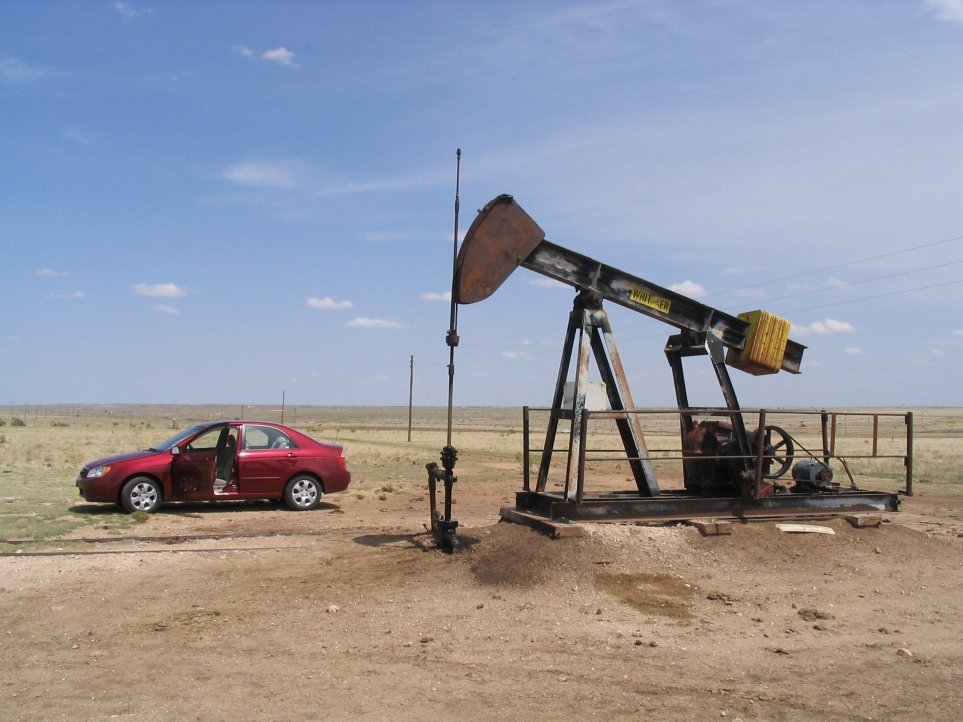
Dear Leader sez "Drill Everywhere!


"Blood and Soulz for ExxonMobil!"

Sunday, June 22, 2008

Remember, It's Not What You Know to Be Fact

...it's what the perpetrators believe to be Truth.

Me? I sincerely doubt it was the United States government.

But I really think it was many people who think L'etat, c'est moi.

I think they were (and are) a silly, superstitious lot. Just like the Zodiac killer, but on an international scale. And I think the idiots on trial now are simple willing fools with martyr complexes and not the real masterminds at all.

Future Rememberance

A few million years from now they'll be an interesting fossil record for our android inheritors.


Sea of Trash

...A 55-year-old lawyer with a monkish haircut, glasses that look difficult to break, an allergy of the eyes that makes him squint and a private law practice in Anchorage, Pallister spends most of his time directing a nonprofit group called the Gulf of Alaska Keeper, or GoAK (pronounced GO-ay-kay). According to its mission statement, GoAK’s lofty purpose is to “protect, preserve, enhance and restore the ecological integrity, wilderness quality and productivity of Prince William Sound and the North Gulf Coast of Alaska.” In practice, the group has, since Pallister and a few like-minded buddies founded it in 2005, done little else besides clean trash from beaches. All along Alaska’s outer coast, Chris Pallister will tell you, there are shores strewn with marine debris, as man-made flotsam and jetsam is officially known. Most of that debris is plastic, and much of it crosses the Gulf of Alaska or even the Pacific Ocean to arrive there.

The tide of plastic isn’t rising only on Alaskan shores. In 2004 two oceanographers from the British Antarctic Survey completed a study of plastic dispersal in the Atlantic that spanned both hemispheres. “Remote oceanic islands,” the study showed, “may have similar levels of debris to those adjacent to heavily industrialized coasts.” Even on the shores of Spitsbergen Island in the Arctic, the survey found on average a plastic item every five meters.

Back in the 1980s, the specter of fouled beaches was a recurring collective nightmare. The Jersey Shore was awash in used syringes. New York’s garbage barge wandered the seas. On the approach to Kennedy Airport, the protagonist of “Paradise,” a late Donald Barthelme novel, looked out his airplane window and saw “a hundred miles of garbage in the water, from the air white floating scruff.” We tend to tire of new variations on the apocalypse, however, the same way we tire of celebrities and pop songs. Eventually all those syringes, no longer delivering a jolt of guilt or dread, receded from the national consciousness...


I'm sure a little corporate Mockingbird had something to do with that.

...Not even oceanographers can tell us exactly how much floating scruff is out there; oceanographic research is simply too expensive and the ocean too varied and vast. In 2002, Nature magazine reported that during the 1990s, debris in the waters near Britain doubled; in the Southern Ocean encircling Antarctica the increase was a hundredfold. And depending on where they sample, oceanographers have found that between 60 and 95 percent of today’s marine debris is made of plastic.

Plastic gets into the ocean when people throw it from ships or leave it in the path of an incoming tide, but also when rivers carry it there, or when sewage systems and storm drains overflow. Despite the Ocean Dumping Reform Act, the U.S. still releases more than 850 billion gallons of untreated sewage and storm runoff every year, according to a 2004 E.P.A. report. Comb the Manhattan waterfront and you will find, along with the usual windrows of cups, bottles and plastic bags, what the E.P.A. calls “floatables,” those “visible buoyant or semibuoyant solids” that people flush into the waste stream like cotton swabs, condoms, tampon applicators and dental floss.

The Encyclopedia of Coastal Processes, about as somniferously clinical a scientific source on the subject as one can find, predicts that plastic pollution “will incrementally increase through the 21st century,” because “the problems created are chronic and potentially global, rather than acute and local or regional as many would contemplate.” The problems are chronic because, unlike the marine debris of centuries past, commercial plastics do not biodegrade in seawater. Instead, they persist, accumulating over time, much as certain emissions accumulate in the atmosphere. The problems are global because the sources of plastic pollution are far-flung but also because, like emissions riding the winds, pollutants at sea can travel.

And so, year after year, equipped with garbage bags and good intentions, the volunteers in the International Coastal Cleanup fan out, and year after year, in many places the tonnage of debris is greater than before. Seba Sheavly, a marine-debris researcher who ran the I.C.C. until 2005, says the Ocean Conservancy’s cleanup “has never been about curing the problem of marine debris.” It has always been, she told me, “a public awareness campaign.” Now a private consultant to the plastics industry and the United Nations Environment Program, among other clients, Sheavly says she believes that the primary value of coastal cleanups lies in the lesson they teach volunteers — “that what they’re picking up comes from them.” On Alaska’s outer coast, however, only a fraction of the debris washing in comes from local litterbugs. On much of Alaska’s 33,000-mile shoreline, in fact, there are no local litterbugs. On much of Alaska’s shoreline there are no people at all.

When Pallister took me there last July, a GoAK crew had been at work for two weeks cleaning up Gore Point (population: 0), part of a 400,000-acre maritime wilderness at the heart of the Kenai Fjords. Despite the pretty scenery, few nature lovers bother to visit. You can travel to Gore Point only by helicopter, seaplane or boat, and then only when weather permits, which it often does not. In the lower 48, beach cleanups tend to involve schoolchildren gleaning food wrappers and cigarette butts left by recreational beachgoers. GoAK’s cleanups, by contrast, are costly expeditions into the wild. The group’s volunteers must be 18 or older, and all must sign a frightening waiver in which they agree not to hold the organization liable for perils like “dangerous storms; hypothermia; sun or heat exposure; drowning; vehicle transportation and transfer; rocky, slippery and dangerous shorelines; tool and trash related injuries; bears; and” — in case that list left anything out — “other unforeseen events.”

The windward shore of Gore Point is what’s known among beachcombers and oceanographers as “a collector beach.” In 1989, according to The Anchorage Daily News, more of Exxon’s spilled oil ended up there than on any other beach on Alaska’s outer coast, but unlike the oil, the incoming debris never ended. Every tide brings more. Over the course of several decades, ever since the dawn of the plastics era, a kind of postmodern midden heap accumulated behind the driftwood berm. To beachcombers in the know, Gore Point was a happy hunting ground, one of the best places in Alaska to find exotic oddities. To Pallister, it was a paradise lost. Now, subsidized by a $115,000 matching grant from the National Oceanic and Atmospheric Administration (N.O.A.A.), he had embarked upon a possibly quixotic mission to regain it...

In its first summer in action, GoAK managed to clean 350 miles of rugged shoreline, picking up enough trash to fill 46 trash-hauling bins. Pallister wasn’t satisfied. It wasn’t enough to clean beaches near coastal communities. And so, last summer, Gore Point became a front line in the federal government’s campaign against debris. What would it take, Pallister hoped to learn, to clean up one wild beach?

To me, Gore Point seemed like the scene of an unsolved environmental mystery — unsolved and possibly unsolvable. Who, if anyone, can be held accountable for all that plastic trash? What, if anything, does it forebode for us and for the sea?

...Pallister has a theory about where all this trash comes from. “There’s a weather phenomenon we have here,” he told me in Anchorage. “A winter low sets this prevailing wind pattern that will just funnel this way for days on end if not weeks on end. That wind is blowing right across that bunch of plastic out there.” The “bunch of plastic” he was talking about is the flotilla of trash, purportedly at least as big as Texas, that has accumulated at the becalmed heart of the North Pacific Subtropical Gyre, a giant clockwise circuit of currents that revolves between East Asia and North America.

High-pressure systems like the one that predominates over the North Pacific Subtropical Gyre force currents to spiral inward. Oceanographers call these spirals “convergence zones.” Low atmospheric pressure systems like the one that predominates over the Gulf of Alaska have the opposite effect, creating “divergence zones” where the surface currents move outward toward shore. Divergence zones tend to expel debris. Convergence zones collect it.


In 2001 a peer-reviewed scientific journal called The Marine Pollution Bulletin published a study, whose undramatic title, “A Comparison of Plastic and Plankton in the North Pacific Central Gyre,” belied its dramatic findings. The lead author — a sailor, environmentalist, organic farmer, self-trained oceanographer and onetime furniture repairman named Charles Moore — went trawling in the North Pacific convergence zone about 800 miles west of San Francisco and found seven times as much plastic per square kilometer as any previous study.

“As I gazed from the deck at the surface of what ought to have been a pristine ocean,” Moore later wrote in an essay for Natural History, “I was confronted, as far as the eye could see, with the sight of plastic. It seemed unbelievable, but I never found a clear spot. In the week it took to cross the subtropical high, no matter what time of day I looked, plastic debris was floating everywhere: bottles, bottle caps, wrappers, fragments.” An oceanographic colleague of Moore’s dubbed this floating junk yard “the Great Pacific Garbage Patch,” and despite Moore’s efforts to suggest different metaphors — “a swirling sewer,” “a superhighway of trash” connecting two “trash cemeteries” — “Garbage Patch” appears to have stuck.

The Garbage Patch wasn’t merely a cosmetic problem, nor merely a symbolic one, Moore contended. For one thing, it was a threat to wildlife. Scientists estimate that every year at least a million seabirds and 100,000 marine mammals and sea turtles die when they entangle themselves in debris or ingest it. “Entanglement and ingestion, however, are not the worst problems caused by the ubiquitous plastic pollution,” Moore wrote. Plastic polymers, as has long been known, absorb hydrophobic chemicals, including persistent organic pollutants, or POPS, like dioxin, P.C.B.’s and D.D.T. Highly controlled in the U.S. but less so elsewhere, such substances are surprisingly abundant at the ocean’s surface. By concentrating these free-floating contaminants, Moore worried, particles of plastic could become “poison pills.” He also worried about toxins in the plastic itself — phthalates, organotins — that have been known to leach out over time. Once fish or plankton ingest these pills, Moore speculated, poisons both in and on the plastic would enter the food web. And since such toxins concentrate, or “bioaccumulate,” in fatty tissues as they move up the chain of predation — so that the “contaminant burden” of a swordfish is greater than a mackerel’s and a mackerel’s greater than a shrimp’s — this plastic could be poisoning people too.


...The hardest question to answer about the Garbage Patch, it turns out, isn’t whether plastic threatens animals and ecosystems, but what, if anything, can be done about it. “We haven’t been able to hatch up any good ideas,” Flint admitted. Albatross chicks don’t forage on land, she said. In fact they don’t forage at all. Their parents do, flying far and wide across the Pacific, swooping down to snatch morsels off the surface, which they bring back home and regurgitate into a hungry chick’s mouth. That’s where all the detritus in that Greenpeace ad came from. Even if we were to clean every beach in the world, it wouldn’t keep albatrosses from stuffing their offspring full of plastic. “You’d have to clean the entire ocean,” Flint said...

“That’s not unusual,” Charles Moore told me, when I described the midden at Gore Point. “Any windward side of an island’s going to have situations like that. The question is, how much can we take? We’re burying ourselves in this stuff.” Moore sympathized with Pallister’s motives, and said that GoAK’s efforts could help “raise awareness.” But if Pallister thought he was saving Gore Point from plastic pollution, he was fooling himself. “It’s just going to come back,” Moore said.

This, in Moore’s opinion, is why the 2006 Marine Debris, Research, Prevention and Reduction Act is likewise doomed to fail. “It’s all been focused on cleanups,” he says of federal policy. “They think if they take tonnage out of the water, the problem will go away.”

In the Northwestern Hawaiian Islands, whose shores are washed by the southern edge of the Garbage Patch, federal agencies are staging one of the biggest marine-debris projects in history. Since 1996, using computer models, satellite data and aerial surveys, they have located and removed more than 500 metric tons of derelict fishing gear in hopes of saving endangered Hawaiian monk seals from entanglement. The results have been mixed at best. Biologists are now finding fewer monk seals entangled in debris; but they are also finding fewer monk seals, period. Meanwhile, an estimated 52 tons of fresh debris inundates the Northwestern Hawaiian Islands every year.

Along with financing and volunteers, corporate sponsors of the International Coastal Cleanup contribute homilies about saving the planet. “Working together we help keep our coasts clean,” ran Coca-Cola’s contribution to the I.C.C.’s 2006 report. Marine debris, declared Dow Chemical, is a “people problem that we, the citizens of the world, have the power to stop.” Is it? Yes, says Moore, but “there is no magic bullet,” and the solutions may require sacrifices that the citizens, governments and corporations of the world are reluctant to make. Eventually we will have to abandon planned obsolescence, and instead manufacture products that are durable, easily recyclable or both, Moore said. And we will have to overcome our addiction to conspicuous consumption...


Fat chance of that occurring...

...As nearly everyone I spoke to about marine debris agrees, the best way to get trash out of our waterways is, of course, to keep it from entering them in the first place. But experts disagree about what that will take. The argument, like so many in American politics, pits individual freedom against the common good. “Don’t you tell me I can’t have a plastic bag,” Seba Sheavly, the marine-debris researcher, says, alluding to plastic-bag bans like the one San Francisco enacted last year. “I know how to dispose of it responsibly.” But proponents of bag bans insist that there is no way to use a plastic bag responsibly. Lorena Rios, an environmental chemist at the University of the Pacific, says: “If you go to Subway, and they give you the plastic bag, how long do you use the plastic bag? One minute. And how long will the polymers in that bag last? Hundreds of years.”

“The time for voluntary measures has long since passed,” says Steve Fleischli, president of Waterkeeper Alliance, a network of environmental watchdogs to which, it should be noted, the Gulf of Alaska Keeper does not belong. (Waterkeeper officials have objected to GoAK’s use of their brand, but Pallister insists that their objections are without legal merit. “They’ve trademarked ‘Riverkeeeper,’ ‘Soundkeeper,’ ‘Baykeeper,’ ” he told me, “but not ‘Alaska keeper.’ ”) Fleischli would have us tax the most pervasive and noxious plastic pollutants — shopping bags, plastic-foam containers, cigarette butts, plastic utensils — and put the proceeds toward cleanup and prevention measures. “We already use a portion of the gasoline tax to pay for oil spills,” Fleischli says. Such levies shouldn’t be seen as criminalizing the makers and sellers of plastic disposables, he argues; they merely force those businesses to “internalize” previously hidden costs, what economists call “externalities.” This market-based approach to environmental regulation, known as extended producer responsibility, is increasingly popular with environmental groups. By sticking others with the ecological cleaning bill, the thinking goes, businesses have been able to keep the price of disposable plastics artificially low. And as Pallister learned at Gore Point, the cleaning bill may be greater than we can afford.

We still have limited tax dollars to spend and scarier nightmares to fear. No one — not Pallister, not Moore — will tell you that plastic pollution is the greatest man-made threat our oceans face. Depending whom you ask, that honor goes to global warming, agricultural runoff or overfishing. But unlike many pollutants, plastic has no natural source and therefore there is no doubt that we are to blame. Because we can see it, plastic is a powerful bellwether of our impact upon the earth. Where plastics travel, invisible pollutants — pesticides and fertilizers from lawns and farms, petrochemicals from roads, sewage tainted with pharmaceuticals — often follow. Last June, shortly before my voyage in the Opus began, Sylvia Earle, formerly N.O.A.A.’s chief scientist, delivered an impassioned speech on marine debris at the World Bank in Washington. “Trash is clogging the arteries of the planet,” Earle said. “We’re beginning to wake up to the fact that the planet is not infinitely resilient.” For ages humanity saw in the ocean a sublime grandeur suggestive of eternity. No longer. Surveying the debris on remote beaches like Gore Point, we see that the ocean is more finite than we’d thought. Now it is the sublime grandeur of our civilization but also of our waste that inspires awe...


"Sublime grandeur..."?

Set Up

Atrios:

As I've written before, Democrats will regret embracing the expansion of executive power because a President Obama will find his administration undone by an "abuse of power" scandal. All of those powers which were necessary to prevent the instant destruction of the country will instantly become impeachable offenses. If you can't imagine how such a pivot can take place then you haven't been paying attention.


Of course, the real Company abuses of power under an Obama administration- which looks increasingly submissive to the will of the 4th branch of government- will come from an entirely different set of directions than what Obama will get nailed for.

It's entirely unclear that Obama will win this, whatever his lead over Mc$ame. Issues like the requirement the FISA court oversight of eavesdropping should have and could have been used to rally the progressive Democratic base.

Instead, Obama's advisers have him going along with the Bu$h line, taking the wind out of the sails of his campaign.

Saturday, June 21, 2008

Photographing the Photographers

A little education is a dangerous thing, because as Jeff Wells says, what you don't know can't hurt them.

Photographer Documents Secret Satellites — All 189 of Them
By Bryan Gardine

BERKELEY, California -- For most people, photographing something that isn't there might be tough. Not so for Trevor Paglen.


His shots of 189 secret spy satellites are the subject of a new exhibit -- despite the fact that, officially speaking, the satellites don't exist. The Other Night Sky, on display at the University of California at Berkeley Art Museum through September 14, is only a small selection from the 1,500 astrophotographs Paglen has taken thus far.

In taking these photos, Paglen is trying to draw a metaphorical connection between
"I think that some of the earliest ideas in the modern period were actually from astronomy," Paglen explains. "You look at Galileo: He goes up and points his telescope up at Jupiter and finds out, hey, Jupiter has these moons."


More significant than the discovery itself, Paglen says, was the idea that anyone with a telescope could verify it and see the same exact thing that Galileo saw -- an idea Paglen is trying to re-create in his own photographs.

"It really was analogous to a certain kind of promise of democracy," says Paglen, who sees a similar anti-authoritarian premise running through his own work...

To capture his images, the researcher and "experimental geographer" employs a motorized mount with various combinations of telescopes and digital and large-format film cameras. Paglen uses spy-satellite data compiled by Ted Molczan -- a renowned amateur astronomer profiled by Wired magazine in 2006 -- to predict where a given "black satellite" will be in the sky. Then he decides how he wants to compose the image.

"I'll find where a star will be in the compositional plane," he says. "Then I'll use one telescope, which is attached to a webcam, to focus on that star."

With the help of a computer program that controls the mount of the telescope and keeps it focused on the heavenly body, Paglen says he can get the telescope to swivel with the Earth's rotation.

He then uses another telescope attached to a high-end digital camera for his deep-sky shots, similar to the rig he used for his desert shots.

"I'll see the satellite in the sky, kind of know where it's going to be in the frame, then I'll open the shutter and take a long exposure of the satellite passing through."

Paglen's initial interest in the government's so-called "black projects" took shape while combing through U.S. Geological Survey archives of satellite prison photos in 2002. He noticed that many of the photo frames of prison sites were missing or, in some cases, heavily edited...


While the budget for black military operations has more than doubled in the last 10 years and the government continues to espouse the virtues of secrecy, it can't prevent interested amateur astronomers from calculating the orbital paths of spy satellites.

"The National Reconnaissance Office cannot classify Kepler's laws of planetary motion," Paglen says. "They just work ... and they're unbelievably accurate."

Priorities


[tip o'teh tinfoil to orz]

No, We Can't

Robert Parry

House Speaker Nancy Pelosi claims that a key positive feature of the new wiretap "compromise" is that the bill reaffirms that the President must follow the law, even though the same bill virtually assures that no one will be held accountable for George W. Bush's violation of the earlier spying law. Share this article

In other words, in the guise of rejecting Bush's theories of an all-powerful presidency that is above the law, the Democratic leadership cleared the way for the President and his collaborators to evade punishment for defying the law.

So, why should anyone assume that the new legislative edict demanding that the President obey the law will get any more respect than the old one, which established the Foreign Intelligence Surveillance Act of 1978 as the "exclusive" means for authorizing electronic spying?

It wasn't that Bush and his team didn't understand the old law's language; they simply believed they could violate the law without consequence, under the radical theory that at a time of war -- even one as vaguely defined as the "war on terror" -- the President's powers trump all laws as well as the constitutional rights of citizens...


So Bu$hie was right. They are walking.

And the DINOcrats seemed determined to lose this $election. Again. But Obama's gonna raise one whole helluva lot of money, and it's gonna go somewhere...

The Best $election Money can Buy

Greenwald:

...The Democratic Congress is more popular with Republicans than with Democrats. And that doesn't even include yesterday's events, so I'm sure the Democratic Congress will become even more popular among Republicans...


The people that own the DINOcrats figure they have a captive constituency. Either vote Dem or you get the really destructive policies of Dear Leader. It's sugar coated poison or simple bitter arsenic.

Aren't you glad you're Amerikan? At least you know you're Free®.

Friday, June 20, 2008

Blood and Souls for ExxonMobil

I agree with Chris Floyd. They might have no-bid contracts, but the oil companies paid for Iraq.


With everyone else's.