...Such is the anger at the occupation that many Iraqis think the US was behind Thursday's attack. This belief is dismissed as conspiratorial, but it is widely held. There is a reason for this. Apart from the horrific violence committed directly by the occupation forces and Pentagon-contracted mercenaries, the US also created Iraqi secret militia, and smuggled tens of thousands of weapons and tons of explosives into Iraq through private firms in Bosnia. Bremer was unable to tell a congressional committee how he spent an unaccounted-for $8.8bn dollars, but many Iraqis suspect that it was used to fund violent sectarian forces. Indiscriminate killings and terrorist attacks were a permanent feature of the US-led occupation, and to many ordinary Iraqis, Thursday's bloodshed is just more of the same.
Similarly, ordinary Iraqis see their current rulers, who arrived with the occupation, as self-seeking, corrupt politicians who use religious and ethnic differences to perpetuate sectarianism as a means of creating power bases. Though no angel himself, the cleric Muqtada al-Sadr spoke for many when he described the current so-called sectarian divisions as "a conflict of the powerful", and the terrorist attacks as the product of "continued US influence and presence in Iraq".
Saturday, December 31, 2011
the usual suspects
Among the Iraqis, anyway:


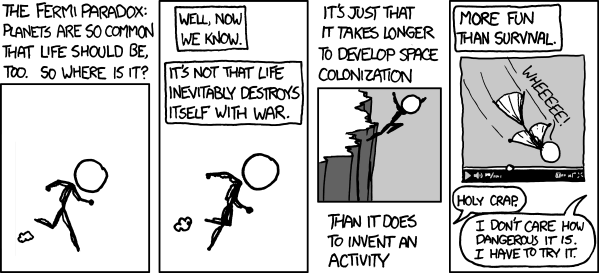
there is no paradox that can't be paradoctored
Craphammer discovers the Fermi paradox and tries to use it as a reason for the endless war on Terra.
Then there's this: if a Federation-style culture ever could get over its reluctance to say hi to those of us living on the planet of the apes, would the self-appointed Men in Black ever allow the message to get out to the rest of us monkeys?
Then there's this: if a Federation-style culture ever could get over its reluctance to say hi to those of us living on the planet of the apes, would the self-appointed Men in Black ever allow the message to get out to the rest of us monkeys?
Friday, December 30, 2011
say it again with feeling
Dr. Krugman:
Another thing: deficit spending on war doesn't bring about recovery. WWII allowed Roosevelt to pull the nation out of the Depression not because of military spending, but because it finally enabled him to act despite the Republicans who were blocking his economic policies: progressive taxation and enforcement of legistlation like the Glass–Steagall Act.
“The boom, not the slump, is the right time for austerity at the Treasury.” So declared John Maynard Keynes in 1937, even as F.D.R. was about to prove him right by trying to balance the budget too soon, sending the United States economy — which had been steadily recovering up to that point — into a severe recession. Slashing government spending in a depressed economy depresses the economy further; austerity should wait until a strong recovery is well under way...
Another thing: deficit spending on war doesn't bring about recovery. WWII allowed Roosevelt to pull the nation out of the Depression not because of military spending, but because it finally enabled him to act despite the Republicans who were blocking his economic policies: progressive taxation and enforcement of legistlation like the Glass–Steagall Act.
Wednesday, December 28, 2011

Tuesday, December 27, 2011
priorities of the Austerian
Reich:
...A smaller government that’s still dominated by money would continue to do the bidding of Wall Street, the pharmaceutical industry, oil companies, big agribusiness, big insurance, military contractors, and rich individuals.
It just wouldn’t do anything else...
angst of the terrible lizards
All the hand-wringing about those who point out the obvious.
I like this comment:
As Mosely says, worst-case scenarios can be met with effective responses only if you think about them ahead of time. However, Newt should well know that the collapse of Civilization with said springing barbarians does not accompany the loss of power to his favorite vibrator.
Barbarians tend to spring regardless. The Nazis proved that quite effectively. Very tech-savvy those boys and girls were and are.
Yet worst case scenarios do sometimes play out, surprising all sides with their outcomes. Steam punk, anyone?
I like this comment:
Not to have done this research would hardly have protected us. If only a "handful" of apparently naturally occurring mutations were required to turn the H5N1 flu virus airborne, one must assume that the lethal mutations would have occurred outside the lab sooner or later (probably sooner, given the infinite capacity of flu viruses to mutate and thrive). Ignorance cannot defend us; knowledge and forethought can. Now we all recognize the priority the world must give to surveillance and, most crucially, the development of a vaccine. Ignorance is not bliss.
As Mosely says, worst-case scenarios can be met with effective responses only if you think about them ahead of time. However, Newt should well know that the collapse of Civilization with said springing barbarians does not accompany the loss of power to his favorite vibrator.
Barbarians tend to spring regardless. The Nazis proved that quite effectively. Very tech-savvy those boys and girls were and are.
Yet worst case scenarios do sometimes play out, surprising all sides with their outcomes. Steam punk, anyone?
Wednesday, December 21, 2011
Captain Tripps' revenge
Stephen King warned you.
One wonders at what point the Homeland realizes there are hundreds of thousands of people with training in molecular biology with the capability of producing viruses that could end the world as we know it.
Think the superflu is a nightmare? How about an oncogenic virus that's airborne?
One wonders at what point the Homeland realizes there are hundreds of thousands of people with training in molecular biology with the capability of producing viruses that could end the world as we know it.
Think the superflu is a nightmare? How about an oncogenic virus that's airborne?
Thursday, December 15, 2011
shadow of a larger world

One by one, the Marines sat down, swore to tell the truth and began to give secret interviews discussing one of the most horrific episodes of America’s time in Iraq: the 2005 massacre by Marines of Iraqi civilians in the town of Haditha.
“I mean, whether it’s a result of our action or other action, you know, discovering 20 bodies, throats slit, 20 bodies, you know, beheaded, 20 bodies here, 20 bodies there,” Col. Thomas Cariker, a commander in Anbar Province at the time, told investigators as he described the chaos of Iraq. At times, he said, deaths were caused by “grenade attacks on a checkpoint and, you know, collateral with civilians.”
The 400 pages of interrogations, once closely guarded as secrets of war, were supposed to have been destroyed as the last American troops prepare to leave Iraq. Instead, they were discovered along with reams of other classified documents, including military maps showing helicopter routes and radar capabilities, by a reporter for The New York Times at a junkyard outside Baghdad. An attendant was burning them as fuel to cook a dinner of smoked carp.
The documents — many marked secret — form part of the military’s internal investigation, and confirm much of what happened at Haditha, a Euphrates River town where Marines killed 24 Iraqis, including a 76-year-old man in a wheelchair, women and children, some just toddlers.
Haditha became a defining moment of the war, helping cement an enduring Iraqi distrust of the United States and a resentment that not one Marine has been convicted.
But the accounts are just as striking for what they reveal about the extraordinary strains on the soldiers who were assigned here, their frustrations and their frequently painful encounters with a population they did not understand. In their own words, the report documents the dehumanizing nature of this war, where Marines came to view 20 dead civilians as not “remarkable,” but as routine.
Iraqi civilians were being killed all the time. Maj. Gen. Steve Johnson, the commander of American forces in Anbar, in his own testimony, described it as “a cost of doing business...”
Galloway:
...The war that was waged – yes, for oil, and yes, also for Israel – was waged above all to terrify the world (especially China) with American power. It turned into the largest boomerang in history. For what has been demonstrated instead are the limits of near-bankrupt America's power. Far from being cowed, America's adversaries – and its enemies – have been emboldened. With shock and awe the empire soon dominated the skies over Iraq to be sure. But they never controlled a single street in the country from the day they invaded until this day of retreat. One street alone – Haifa Street in Baghdad – became the graveyard of scores, maybe hundreds of Americans.
Fortresses like Fallujah entered history alongside Stalingrad as symbols of the unvanquishable power of popular resistance to foreign invasion. Crimes like Abu Ghraib prison – where Iraqis were stripped naked and humiliated, forced to perform indecent acts upon each other and videotaped doing so for the entertainment of their torturers in the barracks afterwards – entered the lexicon of the barbarism of those who invade others, flying the colours of their "civilising" mission. As Chairman Mao once put it: "Sometimes the enemy struggles mightily to lift a huge stone; only to drop it on its own foot." In an America where a third of the population are living in poverty or terrifyingly near it, and where imperial hubris met its nemesis on Haifa Street, China now knows it has nothing to fear from this paper tiger.
I wrote at the time that the invasion of Iraq would be worse than a crime: it would be the Mother of All Blunders. I told Tony Blair – outside the men's lavatory in the library corridor of the House of Commons, to be precise – that the fall of Baghdad would be not the beginning of the end, but merely the end of the beginning. And that the Iraqis would fight them, with their teeth if necessary, until they had driven them from their land. I told Blair that there was no al-Qaida in Iraq, but that if he and Bush were to invade there would be thousands of them.
But two things, as George Bush would put it, I "mis-underestimated". First, that when the tower of lies on which the case for the Iraq war had been constructed was exposed, the credibility of the political systems of the two main liars would collapse under the weight. And second, that the example of the Iraqi resistance would trigger seismic changes in the Arabian landscape from Marrakesh to Bahrain.
Almost nobody in Britain or America any longer believes a word their politicians say. This profound change is not wholly the result of the Iraq war, but it moved into top gear following the war and the militarised mendacity that paved the way to it. In America this malaise has fuelled both the Tea Party phenomenon and the Occupy movement alike, even if the word Iraq seldom crosses their lips. And from the Atlantic Ocean to the Persian Gulf the plates are moving still ...
Somehow, the mindless reaction to the tremor is viewed as a simple codification of what the Company was doing all along instead of fracking under a fault line running through the Constitution through the middle of what has passed for the pinnacle western civilization.
...Barack Obama has abandoned a commitment to veto a new security law that allows the military to indefinitely detain without trial American terrorism suspects arrested on US soil who could then be shipped to Guantánamo Bay.
Human rights groups accused the president of deserting his principles and disregarding the long-established principle that the military is not used in domestic policing. The legislation has also been strongly criticised by libertarians on the right angered at the stripping of individual rights for the duration of "a war that appears to have no end".
The law, contained in the defence authorisation bill that funds the US military, effectively extends the battlefield in the "war on terror" to the US and applies the established principle that combatants in any war are subject to military detention...
Got that? If you aren't with 'em, your agin 'em.
War and Shadow without End, Amen.
Friday, December 09, 2011
not your Big Brother's predator drone

Somebody somewhere in the Company didn't want the existence of drone warfare known. Obama was not allowed to acknowledge it. The CIA has denied it for years much less recently.
Attempting to keep something secret that's being used over a quarter of the globe as well as Der Vaterland over a space of ten years has presented a problem for all the Dr. Strangeloves and General Turgidsons of the Company. Especially when all the contractors building the infernal things are trying to sell it to anyone with the scratch to tender. So lately all the pictures the Company released of their not-so-secret but Highly Classified toys look like something a hobbyist at the Oshkosh fly-in might build. They look nothing like their real money sink.

Of course, the model above is probably much less expensive- and more functional- than the one that was shot down- or cybered down- or that simply fell out of the sky (you didn't really expect something for that billion dollars, did you?).

...which is the result of watching too much Battlestar Galactica

...and seems to fly about as well in the reality-based world.
Of course, secrecy breed corruption, so perhaps in spite of all the multi-billion dollars spent on this top secret technological terror, it's not too surprising somebody in Iran with a good slingshot and a decent aim was able to bring it down. Stealthed to radar isn't stealthed to visual contact, strangely enough.
Wednesday, December 07, 2011
the glass is half occupied: Change is the Hopium of the people
Reich has a lot of good things to say about the speech the Laureate made Monday. It's a good speech. In it the Laureate identifies the source of the economic problems we have. And promises he's gonna deal with it.
Therein, of course, lies the rub.
Yves Smith thinks it's total bullshit.
Both are correct, but then only in the sense that there is no paradox that can't be para-doctored.
Therein, of course, lies the rub.
Yves Smith thinks it's total bullshit.
Both are correct, but then only in the sense that there is no paradox that can't be para-doctored.
Tuesday, December 06, 2011
reality has a liberal bias
“To what extent is this entire movement simply a green Trojan horse, whose belly is full with red Marxist socioeconomic doctrine?”
Well, if the free market was actually, you know, free, fossil fuels would have been abandoned years ago. How long have solar cells been around?
The same way the worst bank$ters would have gone out of business without their $7 trillion in no-interest loans.
The same kind of loans we are about to hand out to the bank$ters yet again- before the first are paid off- to "save" the Euro.
Sunday, December 04, 2011
conflicts of interest
The War on Drugs has a lot in common with the War on Terra, and for a lot of the same reasons.
Priceless quote from an ex-agent:
Noticed that, did he? No wonder he's an ex-agent.
Priceless quote from an ex-agent:
"...the D.E.A. could wind up being the largest money launderer in the business"
Noticed that, did he? No wonder he's an ex-agent.
Thursday, December 01, 2011
Monday, November 28, 2011
Team Obama
...fumbles the ball:
Obviously, if you're not with them, you're against them.
...Apparently it isn't even worthy of mention that Obama's actions in Libya violated the War Powers Resolution, the president's own professed standards for what he can do without Congressional permission, and the legal advice provided to him by the Office of Legal Counsel.
In Chait's telling, expanded drone strikes in Pakistan are a clear success. Why even grapple with Jane Mayer's meticulously researched article on the risks of an drone war run by the CIA, Glenn Greenwald's polemics on the innocent civilians being killed, or Jeff Goldberg and Marc Ambinder's reporting on the Pakistani generals who are moving lightly guarded nuclear weapons around the country in civilian trucks as a direct consequence of the cathartic bin Laden raid.
Chait mentions the Iraq withdrawal, but doesn't point out that Obama sought to violate his campaign promise, and would've kept American troops in the country beyond 2011 had the Iraqis allowed it; that as it is, he'll leave behind a huge State Department presence with a private security army; and that he's expanding America's presence elsewhere in the Persian Gulf to make up for the troops no longer in Iraq. Is any of that possibly relevant to a liberal's assessment?
Perhaps most egregiously, Chait doesn't even allude to Obama's practice of putting American citizens on a secret kill list without any due process, or even consistent, transparent standards.
Nor does he grapple with warrantless spying on American citizens, Obama's escalation of the war on whistleblowers, his serial invocation of the state secrets privilege, the Orwellian turn airport security has taken, the record-breaking number of deportations over which Obama presided, or his broken promise to lay off medical marijuana in states where dispensing it is legal.
Why is all this ignored?
Telling the story of Obama's first term without including any of it is a shocking failure of liberalism. It's akin to conservatism's unforgivable myopia and apologia during the Bush Administration. Are liberals really more discontented with Obama's failure to reverse the Bush tax cuts than the citizen death warrants he is signing? Is his ham-handed handling of the debt-ceiling really more worthy of mention than the illegal war he waged? Is his willingness to sign deficit reduction that cuts entitlement spending more objectionable than the fact that he outsourced drone strikes to a CIA that often didn't even know the names of the people it was killing?
Obviously, if you're not with them, you're against them.
Sunday, November 27, 2011
everybody knows
But they're still not supposed to talk about it:
At least their motivations are transparent.
On Wednesday, Scott Shane wrote in the New York Times:
Speaking hours after the world learned that a C.I.A. drone strike had killed Anwar al-Awlaki in Yemen, President Obama could still not say the words “drone” or “C.I.A.” That’s classified.
Instead, in an appearance at a Virginia military base just before midday Friday, the president said that Mr. Awlaki, the American cleric who had joined Al Qaeda’s branch in Yemen, “was killed” and that this “significant milestone” was “a tribute to our intelligence community.” The president’s careful language was the latest reflection of a growing phenomenon: information that is public but classified.
The passage demonstrates well how classification undercuts meaningful public discussion of vital national-security issues. The CIA’s drone war in Pakistan and Yemen is being talked about around the world; in Pakistan, details about strikes are reported more promptly and deeply than in the United States. Only in the U.S. is the public subjected to stilted, bizarrely passive statements from officials about matters that are common knowledge. The reason: here, the CIA drone program is “covert action.” Officially acknowledging its existence could be grounds for a criminal prosecution...
At least their motivations are transparent.
Saturday, November 26, 2011

cause and effect
Naomi Wolfe in The Guardian:
...Why this massive mobilisation against these not-yet-fully-articulated, unarmed, inchoate people? After all, protesters against the war in Iraq, Tea Party rallies and others have all proceeded without this coordinated crackdown. Is it really the camping? As I write, two hundred young people, with sleeping bags, suitcases and even folding chairs, are still camping out all night and day outside of NBC on public sidewalks – under the benevolent eye of an NYPD cop – awaiting Saturday Night Live tickets, so surely the camping is not the issue. I was still deeply puzzled as to why OWS, this hapless, hopeful band, would call out a violent federal response.
That is, until I found out what it was that OWS actually wanted.
The mainstream media was declaring continually "OWS has no message". Frustrated, I simply asked them. I began soliciting online "What is it you want?" answers from Occupy. In the first 15 minutes, I received 100 answers. These were truly eye-opening.
The No 1 agenda item: get the money out of politics. Most often cited was legislation to blunt the effect of the Citizens United ruling, which lets boundless sums enter the campaign process. No 2: reform the banking system to prevent fraud and manipulation, with the most frequent item being to restore the Glass-Steagall Act – the Depression-era law, done away with by President Clinton, that separates investment banks from commercial banks. This law would correct the conditions for the recent crisis, as investment banks could not take risks for profit that create kale derivatives out of thin air, and wipe out the commercial and savings banks.
No 3 was the most clarifying: draft laws against the little-known loophole that currently allows members of Congress to pass legislation affecting Delaware-based corporations in which they themselves are investors.
When I saw this list – and especially the last agenda item – the scales fell from my eyes. Of course, these unarmed people would be having the shit kicked out of them.
For the terrible insight to take away from news that the Department of Homeland Security coordinated a violent crackdown is that the DHS does not freelance. The DHS cannot say, on its own initiative, "we are going after these scruffy hippies". Rather, DHS is answerable up a chain of command...
...for the DHS to be on a call with mayors, the logic of its chain of command and accountability implies that congressional overseers, with the blessing of the White House, told the DHS to authorise mayors to order their police forces – pumped up with millions of dollars of hardware and training from the DHS – to make war on peaceful citizens.
But wait: why on earth would Congress advise violent militarised reactions against its own peaceful constituents? The answer is straightforward: in recent years, members of Congress have started entering the system as members of the middle class (or upper middle class) – but they are leaving DC privy to vast personal wealth, as we see from the "scandal" of presidential contender Newt Gingrich's having been paid $1.8m for a few hours' "consulting" to special interests. The inflated fees to lawmakers who turn lobbyists are common knowledge, but the notion that congressmen and women are legislating their own companies' profitsis less widely known – and if the books were to be opened, they would surely reveal corruption on a Wall Street spectrum. Indeed, we do already know that congresspeople are massively profiting from trading on non-public information they have on companies about which they are legislating – a form of insider trading that sent Martha Stewart to jail.
Since Occupy is heavily surveilled and infiltrated, it is likely that the DHS and police informers are aware, before Occupy itself is, what its emerging agenda is going to look like. If legislating away lobbyists' privileges to earn boundless fees once they are close to the legislative process, reforming the banks so they can't suck money out of fake derivatives products, and, most critically, opening the books on a system that allowed members of Congress to profit personally – and immensely – from their own legislation, are two beats away from the grasp of an electorally organised Occupy movement … well, you will call out the troops on stopping that advance...
Monday, November 21, 2011
gothic futures

Now that it's demonstrated Goldman-$achs isn't just into financial takeovers, it's into government takeovers as well.
Krugman's feathers are ruffled that the main$tream keeps referring to these people as technocrats when again it's evident they're not.
...If you think that this was a project driven by careful calculation of costs and benefits, you have been misinformed.
The truth is that Europe’s march toward a common currency was, from the beginning, a dubious project on any objective economic analysis. The continent’s economies were too disparate to function smoothly with one-size-fits-all monetary policy, too likely to experience “asymmetric shocks” in which some countries slumped while others boomed. And unlike U.S. states, European countries weren’t part of a single nation with a unified budget and a labor market tied together by a common language.
So why did those “technocrats” push so hard for the euro, disregarding many warnings from economists? Partly it was the dream of European unification, which the Continent’s elite found so alluring that its members waved away practical objections. And partly it was a leap of economic faith, the hope — driven by the will to believe, despite vast evidence to the contrary — that everything would work out as long as nations practiced the Victorian virtues of price stability and fiscal prudence.
Sad to say, things did not work out as promised. But rather than adjusting to reality, those supposed technocrats just doubled down — insisting, for example, that Greece could avoid default through savage austerity, when anyone who actually did the math knew better.
Let me single out in particular the European Central Bank (E.C.B.), which is supposed to be the ultimate technocratic institution, and which has been especially notable for taking refuge in fantasy as things go wrong. Last year, for example, the bank affirmed its belief in the confidence fairy — that is, the claim that budget cuts in a depressed economy will actually promote expansion, by raising business and consumer confidence. Strange to say, that hasn’t happened anywhere.
And now, with Europe in crisis — a crisis that can’t be contained unless the E.C.B. steps in to stop the vicious circle of financial collapse — its leaders still cling to the notion that price stability cures all ills. Last week Mario Draghi, the E.C.B.’s new president, declared that “anchoring inflation expectations” is “the major contribution we can make in support of sustainable growth, employment creation and financial stability.”
This is an utterly fantastic claim to make at a time when expected European inflation is, if anything, too low, and what’s roiling the markets is fear of more or less immediate financial collapse. And it’s more like a religious proclamation than a technocratic assessment.
Just to be clear, this is not an anti-European rant, since we have our own pseudo-technocrats warping the policy debate. In particular, allegedly nonpartisan groups of “experts” — the Committee for a Responsible Federal Budget, the Concord Coalition, and so on — have been all too successful at hijacking the economic policy debate, shifting its focus from jobs to deficits.
Real technocrats would have asked why this makes sense at a time when the unemployment rate is 9 percent and the interest rate on U.S. debt is only 2 percent. But like the E.C.B., our fiscal scolds have their story about what’s important, and they’re sticking to it no matter what the data say.
So am I against technocrats? Not at all. I like technocrats — technocrats are friends of mine. And we need technical expertise to deal with our economic woes.
But our discourse is being badly distorted by ideologues and wishful thinkers — boring, cruel romantics — pretending to be technocrats. And it’s time to puncture their pretensions.
Puncture all the pretensions you want, Dr. Krugman. As long as it doesn't interfere with their flow of
Tuesday, November 15, 2011

Monday, November 07, 2011
the third rock from the sun

It's really irrelevant whether or not sapient aliens use radio. Basically, if they use visible light, they'll spot us.
Subscribe to:
Posts (Atom)