Crashing down doors of suspected Democrats with mass detentions before a single protest.
McCain-Palin '08: mean and stupid [tip o'teh tinfoil to the farmer again].
It's a magical combination.
...his roommate.. went out to talk to talk to the police. She asked the officers why they were there. The officers asked why people were running away from them. Erin reportedly told the officers that their drawn automatic weapons probably had something to do with it. She was detained after asking to see a warrant...


...BP and Conoco will initially spend $600 million in the next three years to drum up support for the project, seek state and federal approval, and secure gas supplies for the pipeline. BP and Conoco said the project would be the largest-ever private sector construction project in North America.
The project, which would include a $5 billion gas-processing facility on the North Slope, would cost about $30 billion and take at least 10 years to complete.
At a time when both energy prices and construction costs are soaring, the endeavor would dwarf the 800 mile trans-Alaska oil pipeline, a momentous project completed in 1977 and that brought jobs and revenue to Alaska. As oil production from the Prudhoe Bay field declines, Alaskans are hoping that natural gas will take over from oil.
An Alaska gas pipeline has long been sought as a critical component of the nation’s energy security. The planned pipeline would have a daily capacity of 4 billion cubic feet of natural gas, or almost 7 percent of current United States consumption.
But the companies will have to overcome some huge hurdles, said Christopher Ruppel, an energy analyst at Execution, a brokerage and research firm.
“We’ve had a long record of Alaska pipeline projects coming out of Alaska and Canada, and they have consistently been delayed because of political opposition and rising costs,” he said. “The United States and Canada desperately need the gas. But the question is, is it doable?”
The companies will need to secure more than 1,000 permits from local, state and federal authorities in both the United States and Canada, a process that will most likely take years. They need to negotiate with native tribes along the pipeline’s route to secure the right of way. If the oil pipeline is any guide, the gas line will also require vast engineering feats.
But with higher prices, and a growing appetite for natural gas, the economics of such a large project are starting to make sense for oil companies. The companies said the initial plan is to build a 2,000-mile pipeline from Alaska’s North Slope to the Canadian province of Alberta; that would add to the total North American gas supply, freeing some Canadian gas for export to the United States. Eventually, the pipeline might be extended 1,500 miles, to Chicago.
“This will be a massive undertaking,” said Doug Suttles, president of BP Alaska. “It is going to take the big team to get this going.”
The plan to build a natural gas pipeline to export the state’s vast gas resources has been tangled in Alaskan politics for years. Today, Alaska’s estimated 35 trillion feet of gas reserves are either re-injected into oil fields or left dormant because of a lack of export facilities to bring them to consumers.
When Governor Palin took office in late 2006, she interrupted pipeline negotiations that her predecessor, Frank H. Murkowski, had been pursuing with the North Slope oil operators, BP, Conoco and Exxon Mobil.
She started from scratch after criticizing the previous talks as not being competitive enough, and sought to bring in new operators in order to secure better terms for Alaska. Her administration is evaluating a proposal made by a Canadian pipeline operator, TransCanada.
But the oil companies complained about the delays and said the governor’s procedure was unrealistic. Eschewing $500 million in potential subsidies from the state, BP and ConocoPhillips declared on Tuesday that the economics of natural gas have reached the point that they can finance the pipeline on their own.
James L. Bowles, the president of Conoco Alaska, said that while the companies would seek no state subsidies, they will try to meet requirements outlined by Alaskan authorities, like offering local delivery points on the pipeline to meet the state’s natural gas requirements.
“This project is moving forward on its own,” he said...
...Vladimir V. Putin, the country’s paramount leader, lashed out at the United States on Thursday, contending that the White House may have orchestrated the conflict to benefit one of the candidates in the American presidential election...
Mr. Putin’s comments in a television interview, his most extensive to date on Russia’s decision to send troops into Georgia earlier this month, sought to present the military operation as a response to brazen, cold war-style provocations by the United States. In tones that seemed alternately angry and mischievous, he suggested that the Bush administration may have tried to create a crisis that would influence American voters in the choice of a successor to President Bush.
“The suspicion would arise that someone in the United States created this conflict on purpose to stir up the situation and to create an advantage for one of the candidates in the competitive race for the presidency in the United States,” Mr. Putin said in an interview with CNN.
He added, “They needed a small victorious war.”
Mr. Putin did not specify which candidate he had in mind, but there was no doubt that he was referring to Senator John McCain, the Republican. Mr. McCain is loathed in the Kremlin because he has a close relationship with Georgia’s president, Mikheil Saakashvili, and has called for imposing stiff penalties on Russia, including throwing it out of the Group of 8 industrialized nations.
...“Even during the cold war, during the time of tough confrontation between the Soviet Union and the United States, we have always avoided direct clashes between our civilians, let alone our servicemen,” Mr. Putin said. “We have serious reasons to believe that directly, in the combat zone, citizens of the United States were present.”
“If the facts are confirmed,” he added, “that United States citizens were present in the combat zone, that means only one thing — that they could be there only on the direct instruction of their leadership. And if this is so, then it means that American citizens are in the combat zone, performing their duties, and they can only do that following a direct order from their leader, and not on their own initiative.”
...A senior Russian defense official, Col. Gen. Anatoly Nogovitsyn, said at a news conference in Moscow on Thursday that Russian forces had found a United States passport in a ruined building near Tskhinvali, the capital of South Ossetia. The position, he said, had been occupied by Georgian Interior Ministry forces.
“What was the gentleman’s purpose of being among the special forces and what he is doing today, I so far cannot answer,” General Nogovitsyn said, holding up what he said was a color copy of the passport. He said members of the Georgian unit had been killed, and the building destroyed.
When the war broke out, the United States had about 130 military trainers in Georgia preparing Georgian troops for service in Iraq. The American Embassy in Tbilisi said these trainers were not involved in the fighting; about 100 remain and are assisting with the delivery of aid to Georgia that is arriving on military planes and ships.
General Nogovitsyn said the passport was in the name of Michael Lee White of Texas, but gave no information on whether Russians believed that he was a member of the United States military. The United States Embassy in Georgia told The Associated Press that it had no information on the matter.
Mr. Putin said in the CNN interview that Russia had thought that the United States would prevent Georgia from attacking South Ossetia, but suggested that he now believed that the Bush administration encouraged Mr. Saakashvili to send in his military.
“The American side in fact armed and trained the Georgian Army,” Mr. Putin said. “Why hold years of difficult talks and seek complex compromise solutions in interethnic conflicts? It’s easier to arm one of the sides and push it into the murder of the other side, and it’s over. It seemed like an easy solution. The thing is, it turns out that it’s not always so.”
The Georgia conflict has become a flash point in the United States presidential campaign, with Senator McCain assailing what he refers to as “revanchist Russia” and asserting that he is far more qualified to handle such a crisis than the Democratic candidate, Senator Barack Obama.
Mr. McCain has long been friendly with Mr. Saakashvili, who has said he talks to Mr. McCain regularly. Mr. McCain’s top foreign policy adviser, Randy Scheunemann, has worked as a lobbyist on behalf of the Georgian government, and Mr. McCain’s wife, Cindy, traveled to the Georgian capital, Tbilisi, this week on a humanitarian aid mission.
All these ties, combined with Mr. McCain’s criticism of Russia, have earned him a kind of notoriety in Moscow. When Parliament passed a resolution this week urging that Russia recognize the independence of the two breakaway enclaves, some lawmakers not only praised the courage of the South Ossetians, but also threw a few barbs at Mr. McCain.
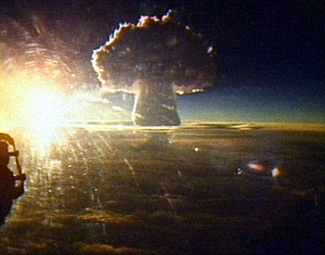
...It is NOT that the Russian Federation thinks the U.S. is weak, it fears that the U.S. is strong.
For some 12 days now, the U.S. has sent some 30-40 tons of equipment by plane to Georgia every day. It additionally unloaded 100+ tons of supply to Georgia from ships. It has some 50 Tomahawks (anti-land missiles) and some 50 Harpoons (anti-ship missiles) on 10+ NATO ships in the Black Sea. Those could sink the whole Russian Black Sea fleet and disable all RF airbases in the wider area within one hour!
There are also strategic non-nuclear U.S. air assets to consider. B1 and B2 stealth bombers could raid Russian airbases and hundreds of U.S. fighter jets stationed in Iraq and Turkey, with some routine refueling, could easily reach the relevant areas.
The Georgian military, with embedded U.S. and Israeli trainers, is still 27,000 men strong. The RF has less than 10,000 men in Abkhazia and South Ossetia. If those hundreds of tons the U.S. unloaded over the last 14 days were Javelin Anti-Armour Missile, Stinger Block2 Anti-Air Missiles and similar stuff, how well would those Georgian troops do with superior numbers and superior weapons? Those pallets were labeled "humanitarian" but did any neutral source ever looked what they really carried?
The Russians really, really fear U.S. troops at their border. Never, ever forget: They lost 20 million people in their last big fight.
In their mindset they assume that if the Russian Federation would look weak now, the neocon nuts in the U.S. might feel free to use the recent capacity build up to retake the now independent areas and, after that, place a direct U.S. presence in the Caucasus. The U.S. empire at the soft belly of the Russian sphere.
The RF strategy to avoid that situation is to now look strong and decisive. Make sure that the U.S. understands that this will escalate if such plans get implemented.
Therefore, the RF acknowledged the independence of those areas and made sure that the world knew the cost of interfering there. The RF feared to look vague about the issue and that looking vague might entice some folks to try something aggressive.
As the last point obviously has not yet been sufficiently noticed, the Russians gave two more big signals today.
900,000 tons of yearly poultry and pork meat imports from the U.S. to the Russian Federation is from now on no longer welcome. Small point you think? Ask the relevant U.S. producer lobbies.
More seriously, the Russian Federation Army today launched an Intercontinental Ballistic Missile.The Topol RS-12M ballistic missile, designed to defeat anti-ballistic missile systems, has hit a designated target at a testing range on the Kamchatka Peninsula, said Alexander Vovk, head of the Russian Strategic Missile Troops press service.
This is the really, really serious signal. The Russian Federation can go nuclear if needed. They do not threaten this because they feel strong. They do threaten this because they feel weak...

Why was Cheney's guy in Georgia before the war?
-James Gerstenzang, Los Angeles Times
What was a top national security aide to Vice President Dick Cheney doing in Georgia shortly before Georgian President Mikheil Saakashvili's troops engaged in what became a disastrous fight with South Ossetian rebels -- and then Russian troops?
Not, according to the vice president's office, what you might think -- if your thinking takes you into the realm of Cheney giving his blessing to the Georgian's military operation.
To be sure, Cheney has been a leader of the hardliners in the administration when it comes to standing up to Russia -- to the point that the man who ran the Pentagon as the Cold War came to an end during the administration of the first President Bush has been seen as ready to renew that face-off with Moscow.
It was Cheney who visited the Georgian embassy in Washington last week to sign a remembrance book as a demonstration of the administration's support.
And yes, Joseph R. Wood, Cheney's deputy assistant for national security affairs, was in Georgia shortly before the war began.
But, the vice president's office says, he was there as part of a team setting up the vice president's just-announced visit to Georgia. (It is common for the White House to send security, policy, communications and press aides to each site the president and vice president will visit ahead of the trip, to begin making arrangements and planning the agenda.)
The White House disclosed on Monday that Cheney would hurry over to Azerbaijan, Georgia, Ukraine and Italy next week, almost immediately after addressing the Republican National Convention on Labor Day.
And so it was that a team from the vice president's office, U.S. security officials and others were in Georgia several days before the war began.
It had nothing to do, the vice president's office said, with a military operation that some have said suggests a renewal of the Cold War.

...We knew then that authorities in suburban Aurora had stopped a pickup truck for swerving between lanes early Sunday morning in what they thought was a routine drunk driving incident.
But in the rented vehicle of Tharin Gartrell, a 28-year-old convicted felon (see photo), they found two high-powered scoped rifles, ammunition, sighting scopes, radios, a cellphone, a bulletproof vest, wigs, drugs and fake IDs.
According to Brian Maass of Denver's KCNC Channel 4, under questioning Gartrell implicated two other men -- Nathan Johnson, who is 32, and Shawn Adolph, who is 33 -- and Johnson's girlfriend, Natasha Gromack. Johnson also reportedly confirmed the plot to FBI and Secret Service interrogators.
One of the men, Adolph, reportedly wore a ring with the Nazi swastika. He was injured when he jumped out of a hotel window fleeing Secret Service agents. All are now in custody on drug and weapons charges.
U.S. Atty. Troy Eid declined to elaborate on Monday but said there is no credible threat to the party's convention or to the freshman Illinois senator, who was campaigning in Kansas City on Monday and traveling to Montana today...
WASHINGTON (CNN) -- Vice President Dick Cheney will travel to Georgia next week as part of a broader visit to "key partners" in Europe and Asia, the White House said Monday.
Cheney, who will depart on September 2, will meet with Georgian President Mikheil Saakashvili, whose country was invaded by Russian forces this month after a Georgian crackdown on separatists in the breakaway region of South Ossetia.
"The president felt it was important to have the vice president consult with allies in the region on our common security interests," White House deputy press secretary Tony Fratto said.
Cheney will "reiterate U.S. commitment" to Georgia during his visit, and he will consult with Saakashvili "on common security interests," an administration official said.
A senior administration official said Cheney's trip had been planned before the Russia-Georgia conflict.
Last week, President Bush telephoned Saakashvili and told him he expects Russia to withdraw its forces from the former Soviet republic and end "their siege of Georgia," a White House spokesman said.
Cheney also will visit the leaders of Azerbaijan, Ukraine and Italy during next week's trip. He also will address the annual Ambrosetti Forum in Lake Como in northern Italy.

TBILISI, Georgia — President Mikheil Saakashvili of Georgia said Sunday that he planned to rebuild his country’s shattered army, and that even after its decisive defeat in the war for control of one of Georgia’s two separatist enclaves he would continue to pursue a policy of uniting both under the Georgian flag.
“It will stay the same,” he said of his ambition to bring the enclaves, South Ossetia and Abkhazia, under Georgian control. “Now as ever.”
Also on Sunday, France called an emergency summit meeting of the European Union for next Monday to discuss “the future of relations with Russia” and aid to Georgia, according to a statement from the French president, Nicolas Sarkozy...
"...I think we should be acquiring and accumulating all the data that is appropriate for possibly bringing criminal charges against members of this administration..."
...Of course there was no evidence available to prove speculation in the commodity markets. That was because the regulators simply never looked for evidence until pressure from some folks in Congress finally made them do something 'unusual':
...The [Commodity Futures Trading Commission], which learned about the nature of Vitol's activities only after making an unusual request for data from the firm, now reports that financial firms speculating for their clients or for themselves account for about 81 percent of the oil contracts on NYMEX, a far bigger share than had previously been stated by the agency. That figure may rise in coming weeks as the CFTC checks the status of other big traders.
[...]
Using swap dealers as middlemen, investment funds have poured into the commodity markets, raising their holdings to $260 billion this year from $13 billion in 2003. During that same period, the price of crude oil rose unabated every year.
[...]
"Business is lousy right now," Bowie said of Goldman Sachs. "Commodities and currencies are clearly the strongest business they have right now."
Originally only people connected to commodities, producers and consumers like farms and airlines plus a few middlemen, were allowed big trades at the commodity exchanges. In 1991 a loophole was created for a Goldman Sachs subsidiary. A second loophole was opened in 2000 with the Commodity Futures Modernization Act of 2000. A main sponsor for that law was Enron. Since then private, unregulated commodity trading platforms have opened in London and in Dubai...

The giant elliptical galaxy NGC 1275, at the centre of the Perseus cluster, is surrounded by a well-known giant nebulosity of emission-line filaments, which are plausibly in excess of 108 years old. The filaments are dragged out from the centre of the galaxy by radio-emitting 'bubbles' rising buoyantly in the hot intracluster gas, before later falling back. They act as markers of the feedback process by which energy is transferred from the central massive black hole to the surrounding gas. The mechanism by which the filaments are stabilized against tidal shear and dissipation into the surrounding extremely hot (4 times 107 K) gas has been unclear. Here we report observations that resolve thread-like structures in the filaments. Some threads extend over 6 kpc, yet are only 70 pc wide. We conclude that magnetic fields in the threads, in pressure balance with the surrounding gas, stabilize the filaments, so allowing a large mass of cold gas to accumulate and delay star formation.
WASHINGTON — A Justice Department plan would loosen restrictions on the Federal Bureau of Investigation to allow agents to open a national security or criminal investigation against someone without any clear basis for suspicion, Democratic lawmakers briefed on the details said Wednesday...
...four Democratic senators told Attorney General Michael B. Mukasey in a letter on Wednesday that they were troubled by what they heard.
The senators said the new guidelines would allow the F.B.I. to open an investigation of an American, conduct surveillance, pry into private records and take other investigative steps “without any basis for suspicion.” The plan “might permit an innocent American to be subjected to such intrusive surveillance based in part on race, ethnicity, national origin, religion, or on protected First Amendment activities,” the letter said. It was signed by Russ Feingold of Wisconsin, Richard J. Durbin of Illinois, Edward M. Kennedy of Massachusetts and Sheldon Whitehouse of Rhode Island...

GAITHERSBURG, Md. — Fires in the 47-story office tower at the edge of the World Trade Center site undermined floor beams and critical structural columns, federal investigators concluded Thursday, as they attempted to curb still-rampant speculation that explosives or fuel fires were responsible for the building’s collapse of Sept. 11, 2001.
The long-delayed report by engineers here at the National Institute of Standards and Technology in suburban Washington is intended to solve one of still lingering central questions about the 2001 attacks: Why did 7 World Trade Center fall, if it was not hit by an airplane.
“Heating of floor beams and girders caused a critical support column to fail,” said Shyam Sunder, the lead investigator. “Video and photographic evidence combined with detailed computer simulations show that neither explosives nor fuel oils played a rule in the collapse of that brought the building down.”
No one died when 7 World Trade Center fell, nearly seven hours after the twin towers came down. But the collapse of the adjacent tower — once home to branch offices of the Central Intelligence Agency, the Secret Service and to the Giuliani administration’s emergency operations center — is cited in hundreds of books and Internet sites as perhaps the most compelling evidence that an insider secretly planted explosives, intentionally destroying the tower...
IN the next day or so, an obscure organization will meet to decide the fate of an Indian nuclear deal that threatens to rapidly accelerate New Delhi’s arms race with Pakistan — a rivalry made all the more precarious by the resignation on Tuesday of the Pakistani president, Pervez Musharraf.
Nonetheless, President Bush is lobbying the Nuclear Suppliers Group, which governs international nuclear commerce, to waive its most crucial rules in order to allow the trade of reactors, fuel and technology to India. If the president gets his way, the Nuclear Nonproliferation Treaty — for 50 years, the bulwark against the spread of nuclear weapons — would be shredded and India’s yearly nuclear weapons production capability would likely increase from 7 bombs to 40 or 50.
India’s nuclear history is checkered at best, and New Delhi has been denied access to the international nuclear market for three decades. The reasons are well known: the country has never signed the nonproliferation treaty or the Comprehensive Nuclear Test Ban Treaty, it misused civilian nuclear technology to produce its first nuclear weapon in 1974, and it continues to manufacture nuclear weapons to this day.
Paradoxically, the Nuclear Suppliers Group was formed in direct response to India’s illegal 1974 nuclear test. Its central purpose is to ensure that no other country exploits foreign nuclear energy assistance to make a bomb, as India did. If the group accedes to President Bush’s dangerous request, countries such as Iran and North Korea would certainly use the precedent to their advantage.
The Indian nuclear deal threatens international security not only by undermining our nuclear rules, but also by expanding India’s nuclear weapons program. That’s because every pound of uranium that India is allowed to import for its power reactors frees up a pound of uranium for its bomb program.
Pakistan, with its unstable government and Al Qaeda sanctuaries, is already ratcheting up its nuclear weapons program in an attempt to keep pace with its regional rival. Just last month, the Pakistani government darkly announced that waiving the nuclear rules for India “threatens to increase the chances of a nuclear arms race in the subcontinent.”
Because changes to these international rules can be made only by unanimous agreement, every country in the 45-nation group has the ability and the duty to insist that this flawed nuclear deal be improved and to ensure that nuclear trade with India cannot benefit New Delhi’s nuclear weapons program.
Thankfully, there is an easy solution. The group can say yes to nuclear trade with India if two simple conditions are met. First, India must sign the Comprehensive Nuclear Test Ban Treaty, a step already taken by 178 other countries and every member state of the Nuclear Suppliers Group. After all, why should the group’s members grant India a huge exemption from the rules that they themselves are supposed to follow?
Second, India must agree to halt production of nuclear material for weapons. That doesn’t mean that India has to give up the weapons it has, or even that it cannot make more weapons with the nuclear material it has already produced. But by closing down its manufacturing of new plutonium and highly enriched uranium, India would prove to the international community that opening up nuclear commerce would not assist, either directly or indirectly, its nuclear weapons program.
This deal was foolish when Pakistan was relatively stable; with Mr. Musharraf gone, an arms race on the subcontinent would likely be more difficult to control. But even if the president continues to insist on the deal, he can’t do it alone. He needs the 44 other countries in the Nuclear Suppliers Group to acquiesce. And the group, created to prevent the further spread of the atom, would vote itself out of existence if it allowed India to have nuclear technology with no strings attached.
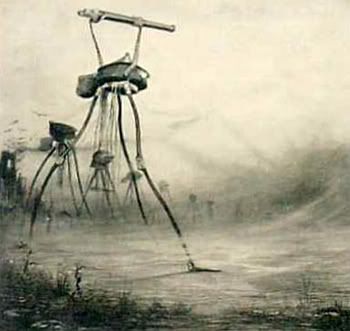
The Army is moving ahead with plans to mount a laser cannon on a massive, 35-ton-plus truck.
The service just handed Boeing a $36 million contract to "continue developing a truck-mounted, high-energy laser weapon system that will destroy rockets, artillery shells and mortar rounds," according to a company statement.
Low power demonstrations are scheduled for 2010, with battlefield-strength laser tests to follow in 2013.
About a year ago, the Army asked Boeing and Northrop Grumman to work up preliminary designs for the HEL beam control system -- and promised to choose a winning model by 2009. So the program appears to be on track. And it's one of a number of energy weapon projects that have been picking up steam, after decades of unfulfilled promise. Relatively easy-to-deploy electric lasers have just about worked their way up to weapons-grade. Boeing recently test-fired the real-life ray gun on its Advanced Tactical Laser -- a blaster-equipped gunship. Raytheon has worked up a prototype of its Phalanx mortar-shooter that uses fiber lasers, instead of traditional ammo, to knock down targets. Even the eternally-delayed Airborne Laser -- a modified 747, designed to zap ballistic missiles -- may finally get a long-awaited flight test.


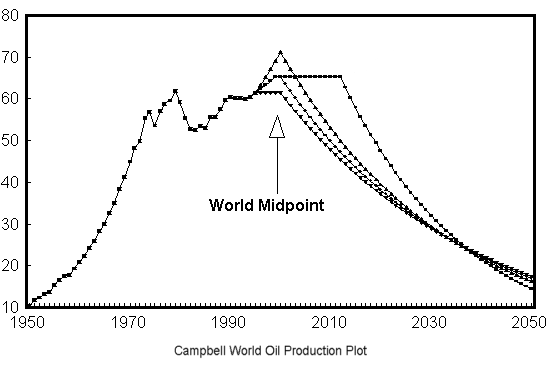
As Oil Giants Lose Influence, Supply Drops
...“This is an industry in crisis,” said Amy Myers Jaffe, the associate director of Rice University’s energy program in Houston. “It’s a crisis of leadership, a crisis of strategy and a crisis of what the future looks like for the supermajors,” a term often applied to the biggest oil companies. “They are like a deer caught in headlights. They know they have to move, but they can’t decide where to go...”
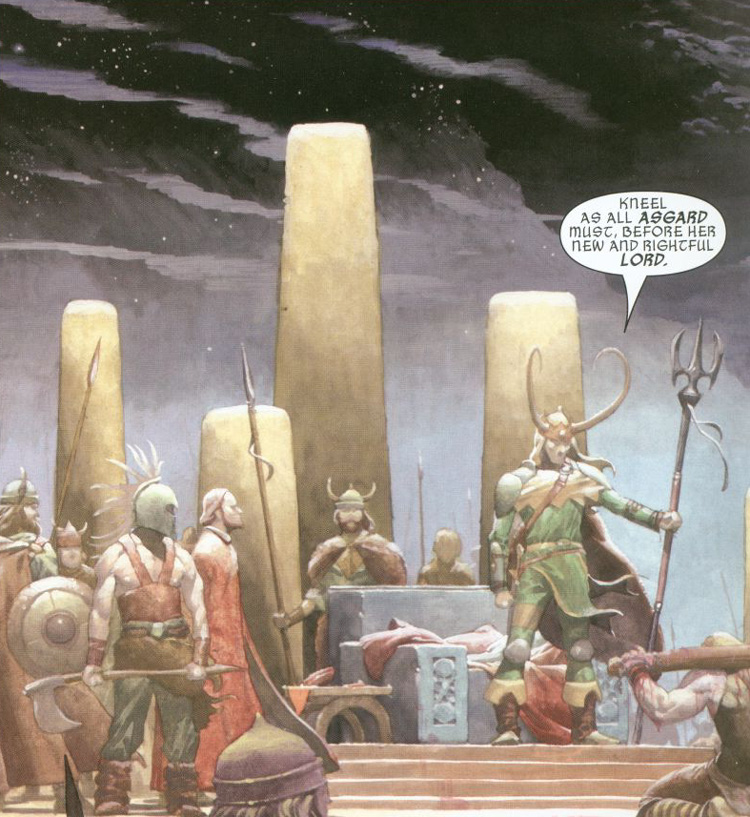

Mikheil Saakashvili’s decision to use the opening of the Olympic Games to cover Georgia’s invasion of its breakaway province of South Ossetia must rank in stupidity with Gamal Abdel-Nasser’s decision to close the Straits of Tiran to Israeli ships.
Nasser’s blunder cost him the Sinai in the Six-Day War. Saakashvili’s blunder probably means permanent loss of South Ossetia and Abkhazia.
After shelling and attacking what he claims is his own country, killing scores of his own Ossetian citizens and sending tens of thousands fleeing into Russia, Saakashvili’s army was whipped back into Georgia in 48 hours.
Vladimir Putin took the opportunity to kick the Georgian army out of Abkhazia, as well, to bomb Tbilisi, and to seize Gori, birthplace of Stalin.
Reveling in his status as an intimate of George Bush, Dick Cheney and John McCain, and as America’s lone democratic ally in the Caucasus, Saakashvili thought he could get away with a lightning coup and present the world with a fait accompli.
Mikheil did not reckon on the rage or resolve of the Bear.
American charges of Russian aggression ring hollow. Georgia started this fight—Russia finished it. People who start wars don’t get to decide how and when they end.
Russia’s response was “disproportionate” and “brutal,” wailed Bush.
True. But did we not authorize Israel to bomb Lebanon for 35 days in response to a border skirmish where several Israel soldiers were killed and two captured? Was that not many times more “disproportionate”?
Russia has invaded a sovereign country, railed Bush. But did not the United States bomb Serbia for 78 days and invade to force it to surrender a province, Kosovo, to which Serbia had a far greater historical claim than Georgia had to Abkhazia or South Ossetia, both of which prefer Moscow to Tbilisi?
Is not Western hypocrisy astonishing?
When the Soviet Union broke into 15 nations, we celebrated. When Slovenia, Croatia, Macedonia, Bosnia, Montenegro and Kosovo broke from Serbia, we rejoiced. Why, then, the indignation when two provinces, whose peoples are ethnically separate from Georgians and who fought for their independence, should succeed in breaking away?
Are secessions and the dissolution of nations laudable only when they advance the agenda of the neocons, many of whom viscerally detest Russia?
That Putin took the occasion of Saakashvili’s provocative and stupid stunt to administer an extra dose of punishment is undeniable. But is not Russian anger understandable? For years the West has rubbed Russia’s nose in her Cold War defeat and treated her like Weimar Germany.
When Moscow pulled the Red Army out of Europe, closed its bases in Cuba, dissolved the evil empire, let the Soviet Union break up into 15 states, and sought friendship and alliance with the United States, what did we do?
American carpetbaggers colluded with Muscovite scalawags to loot the Russian nation. Breaking a pledge to Mikhail Gorbachev, we moved our military alliance into Eastern Europe, then onto Russia’s doorstep. Six Warsaw Pact nations and three former republics of the Soviet Union are now NATO members.
Bush, Cheney and McCain have pushed to bring Ukraine and Georgia into NATO. This would require the United States to go to war with Russia over Stalin’s birthplace and who has sovereignty over the Crimean peninsula and Sebastopol, traditional home of Russia’s Black Sea fleet.
When did these become U.S. vital interests, justifying war with Russia?
The United States unilaterally abrogated the Anti-Ballistic Missile Treaty because our technology was superior, then planned to site anti-missile defenses in Poland and the Czech Republic to defend against Iranian missiles, though Iran has no ICBMs and no atomic bombs. A Russian counteroffer to have us together put an anti-missile system in Azerbaijan was rejected out of hand.
We built a Baku-Tbilisi-Ceyhan pipeline from Azerbaijan through Georgia to Turkey to cut Russia out. Then we helped dump over regimes friendly to Moscow with democratic “revolutions” in Ukraine and Georgia, and tried to repeat it in Belarus.
Americans have many fine qualities. A capacity to see ourselves as others see us is not high among them.
Imagine a world that never knew Ronald Reagan, where Europe had opted out of the Cold War after Moscow installed those SS-20 missiles east of the Elbe. And Europe had abandoned NATO, told us to go home and become subservient to Moscow.
How would we have reacted if Moscow had brought Western Europe into the Warsaw Pact, established bases in Mexico and Panama, put missile defense radars and rockets in Cuba, and joined with China to build pipelines to transfer Mexican and Venezuelan oil to Pacific ports for shipment to Asia? And cut us out? If there were Russian and Chinese advisers training Latin American armies, the way we are in the former Soviet republics, how would we react? Would we look with bemusement on such Russian behavior?
For a decade, some of us have warned about the folly of getting into Russia’s space and getting into Russia’s face. The chickens of democratic imperialism have now come home to roost—in Tbilisi.
NEW YORK — Long before Aafia Siddiqui allegedly tried to kill U.S. agents and military officers in Afghanistan, the MIT-educated neuroscientist once plotted to assassinate former presidents George H.W. Bush, Jimmy Carter and Bill Clinton, government sources told FOXNews.com.
According to sources, Siddiqui was concocting a plan to use biological agents to contaminate former president Carter’s water.
“This was very serious, the investigations will go on for some time,” a government source told FOXNews.com...
WASHINGTON — Dropping her opposition to a vote on coastal oil exploration, Speaker Nancy Pelosi said Saturday that the House would consider expanded offshore drilling as part of broad energy legislation when Congress returns next month...
...The Justice Department has proposed a new domestic spying measure that would make it easier for state and local police to collect intelligence about Americans, share the sensitive data with federal agencies and retain it for at least 10 years.
The proposed changes would revise the federal government's rules for police intelligence-gathering for the first time since 1993 and would apply to any of the nation's 18,000 state and local police agencies that receive roughly $1.6 billion each year in federal grants.
Quietly unveiled late last month, the proposal is part of a flurry of domestic intelligence changes issued and planned by the Bush administration in its waning months. They include a recent executive order that guides the reorganization of federal spy agencies and a pending Justice Department overhaul of FBI procedures for gathering intelligence and investigating terrorism cases within U.S. borders.
Taken together, critics in Congress and elsewhere say, the moves are intended to lock in policies for Bush's successor and to enshrine controversial post-Sept. 11 approaches that some say have fed the greatest expansion of executive authority since the Watergate era...
...Michael German, policy counsel for the American Civil Liberties Union, said the proposed rule may be misunderstood as permitting police to collect intelligence even when no underlying crime is suspected, such as when a person gives money to a charity that independently gives money to a group later designated a terrorist organization...
...The rule also would allow criminal intelligence assessments to be shared outside designated channels whenever doing so may avoid danger to life or property -- not only when such danger is "imminent," as is now required, German said.
On the day the police proposal was put forward, the White House announced it had updated Reagan-era operating guidelines for the U.S. intelligence community. The revised Executive Order 12333 established guidelines for overseas spying and called for better sharing of information with local law enforcement. It directed the CIA and other spy agencies to "provide specialized equipment, technical knowledge or assistance of expert personnel" to support state and local authorities.
And last week, Attorney General Michael B. Mukasey said that the Justice Department will release new guidelines within weeks to streamline and unify FBI investigations of criminal law enforcement matters and national security threats. The changes will clarify what tools agents can employ and whose approval they must obtain.
The recent moves continue a steady expansion of the intelligence role of U.S. law enforcement, breaking down a wall erected after congressional hearings in 1976 to rein in such activity...
...Former Justice Department official Jamie S. Gorelick said the new FBI guidelines on their own do not raise alarms. But she cited the recent disclosure that undercover Maryland State Police agents spied on death penalty opponents and antiwar groups in 2005 and 2006 to emphasize that the policies would require close oversight...
...German, an FBI agent for 16 years, said easing established limits on intelligence-gathering would lead to abuses against peaceful political dissenters. In addition to the Maryland case, he pointed to reports in the past six years that undercover New York police officers infiltrated protest groups before the 2004 Republican National Convention; that California state agents eavesdropped on peace, animal rights and labor activists; and that Denver police spied on Amnesty International and others before being discovered.
"If police officers no longer see themselves as engaged in protecting their communities from criminals and instead as domestic intelligence agents working on behalf of the CIA, they will be encouraged to collect more information," German said. "It turns police officers into spies on behalf of the federal government."
Civil liberties groups also have warned that forthcoming Justice Department rules for the FBI may permit the use of terrorist profiles that could single out religious or ethnic groups such as Muslims or Arabs for investigation...

WASHINGTON — An American-trained Pakistani neuroscientist with ties to operatives of Al Qaeda has been charged with trying to kill American soldiers and F.B.I. agents in a police station in Afghanistan last month, the Justice Department said Monday night.
The scientist, Aafia Siddiqui, who studied at Brandeis University and the Massachusetts Institute of Technology, was transferred to New York on Monday, and is to be arraigned Tuesday in the United States District Court for the Southern District of New York, the department said in a statement.
Ms. Siddiqui, 36, disappeared with her three children while visiting her parents’ home in Karachi, Pakistan, in March 2003, leading human rights groups and her family to believe she had been secretly detained. But in interviews Monday and in a criminal complaint made public later Monday, American officials said they had no knowledge of Ms. Siddiqui’s location for the past five years until July 17, when Ms. Siddiqui and a teenage boy were detained in Ghazni, Afghanistan, after local authorities became suspicious of their loitering outside the provincial governor’s compound.
When they searched Ms. Siddiqui’s handbag, the Afghan police found documents describing the creation of explosives as well as excerpts from the “Anarchist’s Arsenal.” She also carried sealed bottles and glass jars filled with liquids and gels.
The day after she was detained, an American team, including two F.B.I. agents, two American soldiers and interpreters, went to the police station to talk to her. The F.B.I. has wanted her for questioning since May 2004, a Justice Department spokesman said.
The complaint gave the following account of what happened next. Americans entered a room in the police station, unaware that Ms. Siddiqui was being held there, unsecured, behind a curtain. One of the soldiers, a warrant officer, sat down and placed his M-4 rifle on the floor next to the curtain.
Shortly after the meeting began, the other soldier, a captain, heard a woman yelling from the curtain. He turned to see Ms. Siddiqui pointing the warrant officer’s rifle at him.
The interpreter sitting closest to Ms. Siddiqui lunged at her and pushed the rifle away as she pulled the trigger and shouted, “God is Great.” She fired at least two shots, but no one was hit. The warrant officer returned fire with his 9mm pistol, hitting Ms. Siddiqui at least once in the torso.
Ms. Siddiqui struggled when officers tried to subdue her, shouting in English that she wanted to kill Americans. After she was subdued, the complaint said, she “temporarily lost consciousness.”
Ms. Siddiqui was charged Monday with one count of trying to kill American officers and employees and one count of assaulting them, the Justice Department said. If convicted, she faces a maximum sentence of 20 years in prison for each count.
The wild scene in the police station is the latest chapter in one of the strangest episodes in the American campaign against terrorism.
Human rights groups and a lawyer for Ms. Siddiqui, Elaine Whitfield Sharp, said they believed that Ms. Siddiqui had been secretly detained since 2003, much of the time at Bagram Air Base in Afghanistan.
“We believe Aafia has been in custody ever since she disappeared,” Ms. Sharp said in an interview on Monday before the complaint was made public, “and we’re not willing to believe that the discovery of Aafia in Afghanistan is coincidence...”
The lawyer, Elizabeth M. Fink, told the judge that the allegation that her client, who the lawyer said weighed 90 pounds, had picked up the rifle and attacked the Americans, was “patently absurd.”
JUST when you think Uncle Sam's war has no more surprises to spring on an unsuspecting world, he comes up with yet another gem.
Take the case of Dr Aafia Siddiqui, a Pakistani neuroscientist who grew up in the US and went to top universities including the prestigious Massachusetts Institute of Technology. The woman who had been a star student and a topper throughout a remarkable career had to leave the US when the authorities began harassing her and her husband for their charity activities in the wake of September 11 upheavals.
The family settled down in Karachi and was never involved in any illegal activities. One day in March 2003, this talented young woman went missing with her three children when she was on her way to Karachi airport.
Dr Siddiqui resurfaced this week after five years in a New York court as a 'top Al Qaeda terrorist'. She was barely able to walk and speak, which was not surprising given the fact she had been recently involved in a "gun fight with FBI agents" in Afghanistan. The US authorities claim Dr Siddiqui was captured near the governor's offices in Ghazni, Afghanistan last month with a bag full of "suspicious liquids in tubes."
If you think this is an incredible yarn, here's some more food for thought. We are told Siddiqui assaulted a team of US troops and FBI officials with a highly sophisticated weapon when they went to quiz her in Afghanistan.
And where did she get the weapon? Somebody had of course placed it near her rather conveniently. She is said to have fired several rounds with the hi-tech weapon.
Interestingly, while all those alleged rounds of firing with the alleged weapon failed to wound or injure America's brave soldiers, Siddiqui herself has ended up with a bullet wound in her chest.
Even though one has never been enamoured of the Bushies' extraordinary intellectual powers, this cock and bull tale is an insult to the intelligence of American people as well as the rest of the world.
I mean they could have at least employed more ingenuity of thought and imagination in cooking up this incredibly bizarre case against a lone, defenceless, half-dead woman who seems to have no clue where she is or what she is accused of.
There are some basic questions that an ordinary mind like mine just can't seem to figure out.
First, where was Aafia Siddiqui hiding or hidden all these years - since she went missing in Karachi in March 2003? How did she turn up in the remote Ghazni province in Afghanistan, of all the God-forsaken places? And what happened to her three children?
Second, if the MIT-educated neuroscientist was indeed an Al Qaeda mastermind, why wasn't she presented in a court of law all this while? Even today when she is facing the US law, she is not being tried on terrorism charges but for allegedly assaulting the US officials. So what's her original crime, if she has indeed committed a crime?
Third, why wasn't the Pakistani government informed about her detention in Afghanistan and her subsequent deportation to the US? Or are Pakistan's Enlightened and Moderate leaders also involved in this international enterprise against a 31-year old mom of three?
There are so many gaping holes in this "case" that the US constitution, Magna Carta and the UN human rights charter can all go through them at the same time.
You abduct a completely innocent, married woman with a family and put her away for five years to conveniently discover her now as a terrorist in the lawless Afghanistan.
Elaine Whitfield Sharp, Siddiqui's lawyer, believes she has been put on trial now because she has "become a terrible embarrassment" to the US and Afghan authorities.
The question is why has she been reinvented now? It is quite possible that Siddiqui has been FOUND now because of a relentless campaign by British journalist Yvonne Ridley. Ridley herself had been a prisoner of the Taleban regime for 11 days just before the US invasion in 2001 and converted to Islam after her strange experience in Afghanistan.
Ridley has been running a campaign called Cage Prisoner for the release of a mysterious female prisoner who has been held at the Bagram airbase in Afghanistan in total isolation and regularly tortured for five years.
The unknown female prisoner, known as the Prisoner No. 650 or the Grey Lady of Bagram, was brought to the world attention after Ridley read about the woman in a book by fellow Briton Moazzam Begg, a former Gitmo and Bagram prisoner. In his book, Enemy Combatant, Beg talks of a woman's endless screams for help as she was tortured. Beg first thought he was imagining his wife's screams.
"We now know the screams came from a woman who has been held in Bagram for some years. And she is Prisoner No. 650," Ridley disclosed at a recent Press conference in Pakistan.
And I strongly suspect that Prisoner No. 650 is none other than Dr Aafia Siddiqui. It is quite possible that her captors decided to end her isolation after the Pakistani Press and activists like Yvonne Ridley began increasingly talking about the Prisoner No. 650 and how she was tortured and abused physically, mentally and sexually for the past four years.
I find it hard to believe all this can happen in this age and time. When one read Russian author Alexander Solzhenitsyn, the Nobel laureate who died last week, years ago and his first person account of the Soviet gulag and how they turned living human beings into humanity's refuse, one thought it could never happen in our age and time. But one is not so sure now.
If they could do this to a gifted, US-educated and trained scientist, I shudder to think of the fate of illiterate and impoverished men and women summarily picked up in Pakistan, Afghanistan and elsewhere.
The Aafia Siddiqui case may have come to the world's attention because of some conscientious activists. But what about all those innocent individuals, who have just vanished down the black hole called the Guantanamo Bay, without a trial and without anyone looking for them? And who knows how many such gulags are out there and how many innocents they have sucked into their belly?
This war has turned the whole world into a big gulag where there are no borders, no rule of law, no courts, no justice and no rights whatsoever. But, the neocons reassure us, all this is necessary to promote Democracy and Human Freedom of course.
Whatever happened to the America of Jefferson and Lincoln, the country that we all loved once and turned to for inspiration?
The traitors and war criminals who have taken over our government are dancing with joy this evening, and rightly so. Earlier today, a Federal Court of Appeals in Washington granted them legal immunity for every criminal action they have taken while in office.
The ruling, made by a panel of three judges in dismissing an appeal in the case of Valerie Plame [photo], absolves government officials of individual accountability for any actions taken in an official capacity, regardless of whether those actions violated federal law or jeopardized national security. In effect, it legalizes treason, war crimes, and crimes against humanity...
The court ruled Cheney and the others were acting within their official capacity when they revealed Plame's identity to reporters.
Government employees who engage in questionable acts, such as abusing prisoners at the Guantanamo Bay facility or engaging in defamatory speech, cannot be held individually liable if they are carrying out official duties, the court said.
"The conduct, then, was in the defendants' scope of employment regardless of whether it was unlawful or contrary to the national security of the United States," Appeals Court Chief Judge David Sentelle wrote in the opinion.
It is interesting -- and horrifying! -- to note that this decision ventures well beyond the "just following orders" defense which was used by the Nazi war criminals and found wanting at Nuremberg.
It even goes beyond the "divine right of government officials" long desired by the Dominionists of the allegedly "Christian" so-called "Right". At least under the proposed "Constitution Restoration Act", government officials would have to claim they believed they were carrying out the will of God in order to be absolved of their crimes.
And -- let's be clear -- there is no question about whether crimes have been committed in this case. The Vice President's right-hand-man, Lewis "Scooter" Libby [photo], has already been convicted, and although his sentence was commuted, that doesn't make him any less guilty.
The crime in this case involved much more than outing Valerie Plame, an undercover national security professional, ruining her career and jeopardizing the lives of everyone who had ever worked with her. It was done at least in part to discredit her husband, Joe Wilson, who had publicly challenged one of the administration's most useful lies.
The lie was useful because it propelled the country along the road to war against Iraq -- a war waged on false pretenses that has already cost our country trillions of dollars and thousands of lives, not to mention all the other damages that are not so easily counted.
The falsely "justified" war has cost Iraq even more, of course; we've wrecked the infrastructure of a country that used to be home to 28 million people, and along the way we've killed more than a million of them and turned millions more into refugees...
A Federal court has ruled that some of the highest officials in our government are not accountable for their acts of treason, mass murder, war crimes, and crimes against humanity -- not because they were following orders (for surely some of them, especially Karl Rove and Dick Cheney, were giving the orders); not because they thought they were doing something righteous or Blessed by God; but simply because they held positions in the United States government -- regardless of the fact that these actions violated the most serious federal and international laws, regardless of the fact that they all knew their actions were deeply illegal, and regardless of the fact that they were never legitimately elected to those government positions in the first place -- or legitimately re-elected in the second place.
Furthermore, the court decrees, this immunity applies not only to the principals in this case but to all manner of American government officials committing all manner of horrific crimes -- including torturing prisoners at Guantanamo Bay.
Did you get that? Do you finally get it now?
The terrorists have won. The federal courts are now ruling that they are all beyond the law.
No doubt the perpetrators of 9/11 will be afforded the same immunity [* UPDATE: This prediction came true two days later].
Yesterday, according to Reuters, a federal court ruled thatThe Kingdom of Saudi Arabia, four princes and other Saudi entities are immune from a lawsuit filed by victims of the September 11 attacks and their families alleging they gave material support to al Qaeda...
Why? Because foreigners are protected by the Foreign Sovereign Immunities Act unless their country is "designated a state sponsor of terrorism by the U.S. State Department", and Saudi Arabia is not so designated.
...GENERAL WESLEY CLARK: Well, I think we should be very concerned and it's not just the U.S. and Russia. This is really about NATO. It's about the U.S. leadership role in Europe and how European countries respond to the United States. So, we need to be focusing on not just a U.S. - Russia bilateral relationship, but we need to be focusing on Transatlantic unity in- and using that Transatlantic unity to shape the behavior of Russia. That's one of the areas in which I think the administration has frankly not been as effective in the last seven years as it could've been, because there's been a lot of emphasis on U.S. unilateral relations with Russia and elsewhere and not enough emphasis on Transatlantic unity...
Tom Foreman: President Saakasvili in Georgia is blaming the West for making this breakout right now because, he said, the West entertained the idea of bringing Georgia into NATO, in which case NATO would've been bound to defend them against the Russians, but didn't bring them in. And that sort of poked Russia in the chest and made this happen. Do you buy his complaint that the West is to blame?
GENERAL WESLEY CLARK: Not exactly. I think that, first of all, I've been, I've been very pleased to see NATO enlarge as it has over the last few years, but every, every step has to be carefully looked at. It has to have the, the backing of all NATO members, and there is some membership criteria that have to be met. One of those membership criteria incidentally is that all the territorial issues have to be resolved. they weren't resolved in the case of Georgia. The United States proposed Georgia for membership. The European allies asked some tough questions. It was decided that to give it a little bit more time. So, I don't think that the United States or NATO's responsible for this. But I do think that we could've seen this crisis coming. I think we should've worked for years to diffuse this and protect Georgia's claims on South Ossetia and Abkhazia from Russian encroachment.
Tom Foreman: H-how would you have done that?
GENERAL WESLEY CLARK: I would've insisted a neutral peacekeeping force, not Russian peacekeepers in the area and a real process of addressing the, the, the alleged grievances between Abkhazia, South Ossetia and Georgia...
...Tome Foreman: Obviously, the, the Georgians are very concerned about the idea that the Russians are still there despite this agreement. If the Russians, Russians will not leave and will not leave quickly, what should be done?
GENERAL WESLEY CLARK: Well, what has to be done regardless is we've got to get the neutral observers in there. France first proposed this in the cease-fire agreement. I, I think it's absolutely essential. Barack Obama has called for it. We've got to have people on the ground. With all due respect to CNN (chuckles) and, and BBC, we got to have real observers in there who can tell us where the Russian forces are, what they're doing and help us serve as the link to say, to go right back to Moscow and say, say, 'Mr. President or Prime Minster, you said the forces were pulling out, but they've just moved to this village and that village. Get it stopped.' And you've got to have that kind of instant communication from the bottom to the top. That can't be done only through the news media. We've got to have observers in there. And then we've got to use our leverage - economic leverage, political leverage, legal leverage. Russia's done one heck of a lot of financial damage to Georgia. I think they should be held accountable. Take them tr-, to court. I mean, this is a, a world that has law. And we don't know what the economic consequences of this are, but they're profound. And I think Russia needs to leave the Georgian military equipment and bases - some of which were payed by the United States - leave them alone. They're no threat to Russia. Pull out and and pull out now.
Tom Foreman: Are we anywhere near talking about a military option in that country, or is that something way off in the future?
GENERAL WESLEY CLARK: I don't think we're talking about a military option there. I'm glad to see a humanitarian airlift in there. I think that's great. But putting-
Tom Foreman: But we have a lot of talking to do between now and that sort of position.
GENERAL WESLEY CLARK: Put, putting U.S. troops in there, i-it just doesn't make sense. It's not what- it's not necessary, and we just shouldn't be talking about this. What we really have to talk about is Transatlantic resolve. Russia has to behave as a responsible member of the international community. It's not behaving, and we need to call it on this bad behavior. And to call it, it takes the united resolve of all the nations of the West, not just the United States.


MOSCOW — A day after the American secretary of state Condoleezza Rice went to Georgia, not far from the front lines, to press for immediate withdrawal of Russian forces there, the Kremlin announced on Saturday that it had approved a framework for a cease-fire.
The Russian president, Dmitri A. Medvedev, signed the six-point settlement after meeting with Russian security officials, the Kremlin press office said. But it did not specify whether Russia had specifically assented to revisions in one of the provisions, which the Georgians had considered a loophole that Russia could use to justify its advance deep into Georgia...
Is it possible that this time the October surprise was tried in August, and that the garbage issue of brave little Georgia struggling for its survival from the grasp of the Russian bear was stoked to influence the U.S. presidential election?
Before you dismiss that possibility, consider the role of one Randy Scheunemann, for four years a paid lobbyist for the Georgian government who ended his official lobbying connection only in March, months after he became Republican presidential candidate John McCain’s senior foreign policy adviser.
Previously, Scheunemann was best known as one of the neoconservatives who engineered the war in Iraq when he was a director of the Project for a New American Century. It was Scheunemann who, after working on the McCain 2000 presidential campaign, headed the Committee for the Liberation of Iraq, which championed the U.S. invasion of Iraq.
There are telltale signs that he played a similar role in the recent Georgia flare-up. How else to explain the folly of his close friend and former employer, Georgian President Mikheil Saakashvili, in ordering an invasion of the breakaway region of South Ossetia, an invasion that clearly was expected to produce a Russian counterreaction? It is inconceivable that Saakashvili would have triggered this dangerous escalation without some assurance from influential Americans he trusted, like Scheunemann, that the United States would have his back. Scheunemann long guided McCain in these matters, even before he was officially running foreign policy for McCain’s presidential campaign.
In 2005, while registered as a paid lobbyist for Georgia, Scheunemann worked with McCain to draft a congressional resolution pushing for Georgia’s membership in NATO. A year later, while still on the Georgian payroll, Scheunemann accompanied McCain on a trip to that country, where they met with Saakashvili and supported his bellicose views toward Russia’s Vladimir Putin.
Scheunemann is at the center of the neoconservative cabal that has come to dominate the Republican candidate’s foreign policy stance in a replay of the run-up to the war against Iraq. These folks are always looking for a foreign enemy on which to base a new Cold War, and with the collapse of Saddam Hussein’s regime, it was Putin’s Russia that came increasingly to fit the bill.
Yes, it sounds diabolical, but that may be the most accurate way to assess the designs of the McCain campaign in matters of war and peace. There is every indication that the candidate’s demonization of Russian leader Putin is an even grander plan than the previous use of Saddam to fuel American militarism with the fearsome enemy that it desperately needs...
...a little while ago when Karl Rove declined to appear for Congressional hearings on the grounds that he would be out of the country on a "long-planned trip", that trip was to the Crimea. Gosh, I wonder what he was up to, there...
...Who did Karl Rove meet on his sweet vacation in Crimea?
Hmm, it turns out he wasn't on vacation. Karl Rove never takes vacations!
FIFTH ANNUAL YALTA MEETING
10-13 July, 2008
LIST OF PARTICIPANTS
Richard Haass, Karl Rove, Bob Shrum, Mikhаil Saakashvili, William Taylor...
Richard Haass is the President of the Council on Foreign Relations...
Bob Shrum was Al Gore's consultant in 2000, part of John Kerry's U.S. presidential election 2004 campaign team. Interesting that he showed up at this meeting.
Randy Scheunemann is part of John McCain's campaign staff. Also:The issue this time is advisor Randy Scheunemann and his business partner, who apparently lobbied McCain or his staff dozens of times on behalf of -- and getting paid by -- Georgia. As the Associated Press summed it up: "On April 17, a month and a half after Scheunemann stopped working for Georgia, his partner signed a $200,000 agreement with the Georgian government. The deal added to an arrangement that brought in more than $800,000 to the two-man firm from 2004 to mid-2007. For the duration of the campaign, Scheunemann is taking a leave of absence from the firm."
McCain, of course, has warned Russia that its actions in Georgia could cost it "the benefits they enjoy from being part of the civilized world," and has called for the deployment of international peacekeepers in the region. His staunch defense of Georgia -- regardless of how the showdown came about -- raises questions about the possible conflict of interest of Scheunemann, one of McCain's top foreign policy advisors.
... The missile defense deal was announced by Polish officials and confirmed by the White House. Under it, Poland would host an American base with 10 interceptors designed to shoot down a limited number of ballistic missiles, in theory launched by a future adversary such as Iran. A tracking radar system would be based in the Czech Republic. The system is expected to be in place by 2012.
In exchange for providing the base, Poland would get what the two sides called “enhanced security cooperation,” notably a top-of-the-line Patriot air defense system that can shoot down shorter-range missiles or attacking fighters or bombers.
A senior Pentagon official described an unusual part of this quid pro quo: an American Patriot battery would be moved from Germany to Poland, where it would be operated by a crew of about 100 American military personnel members. The expenses would be shared by both nations. American troops would join the Polish military, at least temporarily, at the front lines — facing east toward Russia...
...I remember reading some stuff recently about how it was unseemly for Barack Obama to go on an overseas trip. Why, he was acting like he'd already won! Now, we have McCain making statements on television that are having an actual impact on an international crisis, and which might even be illegal, and I'm hearing gasbags say he looks very presidential. It looks more like presumptuousness to me.
But then a grizzled old veteran's presumptuousness isn't the same as a young, African American upstart's, is it?
Update: Even Jonathan Martin at the Politico sees something amiss with this one:
I think Greg Sargent is on to something regarding McCain's announcement at his press conference today that Sens. Lindsey Graham and Joe Lieberman — his two closest friends in the Senate — will be heading to Georgia soon.
Yes, they're both members of the Armed Services Committee. But McCain's declaration has something of a shadow government feel to it, as though he's sending his own emissaries into the war zone.
Try to imagine if Obama had announced that he was sending Biden and Levin to the war zone...
...I found myself wondering whether this war is an omen — a sign that the second great age of globalization may share the fate of the first.
If you’re wondering what I’m talking about, here’s what you need to know: our grandfathers lived in a world of largely self-sufficient, inward-looking national economies — but our great-great grandfathers lived, as we do, in a world of large-scale international trade and investment, a world destroyed by nationalism.
Writing in 1919, the great British economist John Maynard Keynes described the world economy as it was on the eve of World War I. “The inhabitant of London could order by telephone, sipping his morning tea in bed, the various products of the whole earth ... he could at the same moment and by the same means adventure his wealth in the natural resources and new enterprises of any quarter of the world.”
And Keynes’s Londoner “regarded this state of affairs as normal, certain, and permanent, except in the direction of further improvement ... The projects and politics of militarism and imperialism, of racial and cultural rivalries, of monopolies, restrictions, and exclusion ... appeared to exercise almost no influence at all on the ordinary course of social and economic life, the internationalization of which was nearly complete in practice.”
But then came three decades of war, revolution, political instability, depression and more war. By the end of World War II, the world was fragmented economically as well as politically. And it took a couple of generations to put it back together.
So, can things fall apart again? Yes, they can...