Just another Reality-based bubble in the foam of the multiverse.

Thursday, January 18, 2007

Pot, Meet Kettle

China successfully carried out its first test of an anti-satellite weapon last week, signaling its resolve to play a major role in military space activities and bringing expressions of concern from Washington and other capitals, the Bush administration said Thursday.

Only two nations — Russia and the United States — have previously destroyed spacecraft in anti-satellite tests, most recently the United States in the mid 1980s.

Arms control experts called the test, in which a Chinese missile destroyed an aging Chinese weather satellite, a troubling development that could foreshadow either an anti-satellite arms race or, alternatively, a diplomatic push by China to force the Bush administration into negotiations on a weapons ban.

“This is the first real escalation in the weaponization of space that we’ve seen in 20 years,” said Jonathan McDowell, a Harvard astronomer who tracks rocket launchings and space activity. “It ends a long period of restraint...”


In which bubble of the multiverse has Dr. McDowell been living?

The Air Force, saying it must secure space to protect the nation from attack, is seeking President Bush's approval of a national-security directive that could move the United States closer to fielding offensive and defensive space weapons, according to White House and Air Force officials.

The proposed change would be a substantial shift in American policy. It would almost certainly be opposed by many American allies and potential enemies, who have said it may create an arms race in space.

A senior administration official said that a new presidential directive would replace a 1996 Clinton administration policy that emphasized a more pacific use of space, including spy satellites' support for military operations, arms control and nonproliferation pacts...


A new Air Force strategy, Global Strike, calls for a military space plane carrying precision-guided weapons armed with a half-ton of munitions. General Lord told Congress last month that Global Strike would be "an incredible capability" to destroy command centers or missile bases "anywhere in the world."

Pentagon documents say the weapon, called the common aero vehicle, could strike from halfway around the world in 45 minutes. "This is the type of prompt Global Strike I have identified as a top priority for our space and missile force," General Lord said...


45 minutes! Team Xinhua got theirs up in 20!

Obviously, something needs to be done about this!

But as Lambert has noted, Cheney's PNAC said it awhile back:

To ensure America's control of space in the near term, the minimum requirements are to develop a robust capability to transport systems to space, carry on operations once there, and service and recover space systems as needed. As outlined by Space Command, carrying out this program would include a mix of re- useable and expendable launch vehicles and vehicles that can operate within space, including "space tugs to deploy, reconstitute, replenish, refurbish, augment, and sustain" space systems. But, over the longer term, maintaining control of space will inevitably require the application of force both in space and from space, including but not limited to anti- missile defenses and defensive systems capable of protecting U.S. and allied satellites; space control cannot be sustained in any other fashion, with conventional land, sea, or airforce, or by electronic warfare. This eventuality is already recognized by official U.S. national space policy, which states that the "Department of Defense shall maintain a capability to execute the mission areas of space support, force enhancement, space control and force application."


Not that anyone reads in American cable media, anyway.

Again, you can't have a blank check without an endless war, and you can't have an enemy in space unless you make one there.

Yet , anyway.

It's part of the strategery.

You can not have endless war without someone to fight.

WASHINGTON (AP) - Fighter jet parts and other sensitive U.S. military gear seized from front companies for Iran and brokers for China have been traced in criminal cases to a surprising source: the Pentagon.

In one case, federal investigators said, contraband purchased in Defense Department surplus auctions was delivered to Iran, a country President Bush has branded part of an ``axis of evil.''

In that instance, a Pakistani arms broker convicted of exporting U.S. missile parts to Iran resumed business after his release from prison. He purchased Chinook helicopter engine parts for Iran from a U.S. company that had bought them in a Pentagon surplus sale. Immigration and Customs Enforcement agents say those parts did make it to Iran.

Sensitive military surplus items are supposed to be demilitarized or ``de-milled'' - rendered useless for military purposes - or, if auctioned, sold only to buyers who promise to obey U.S. arms embargoes, export controls and other laws.

Yet the surplus sales can operate like a supermarket for arms dealers.

``Right Item, Right Time, Right Place, Right Price, Every Time. Best Value Solutions for America's Warfighters,'' the Defense Reutilization and Marketing Service says on its Web site, calling itself ``the place to obtain original U.S. Government surplus property.''

Federal investigators are increasingly anxious that Iran is within easy reach of a top priority on its shopping list: parts for the precious fleet of F-14 ``Tomcat'' fighter jets the United States let Iran buy in the 1970s when it was an ally.

In one case, convicted middlemen for Iran bought Tomcat parts from the Defense Department's surplus division. Customs agents confiscated them and returned them to the Pentagon, which sold them again - customs evidence tags still attached - to another buyer, a suspected broker for Iran.

``That would be evidence of a significant breakdown, in my view, in controls and processes,'' said Greg Kutz, the Government Accountability Office's head of special investigations. ``It shouldn't happen the first time, let alone the second time.''

A Defense Department official, Fred Baillie, said his agency followed procedures...


This is also why we help dictators build nuclear reactors and subcontract the development of our Star Wars and Future Combat weapons systems to the Russians and Chinese. It is why we guarded the oil but let the locals in Iraq walk away with Saddam's military cache and supplies. Otherwise, peace would break out all over as people simply tried to live their lives normally.

Chaos is the plan.

Revisionism by Chimps

Smarter monkeys, please.

Remember Amendment IV:

The right of the people to be secure in their persons, houses, papers, and effects, against unreasonable searches and seizures, shall not be violated, and no warrants shall issue, but upon probable cause, supported by oath or affirmation, and particularly describing the place to be searched, and the persons or things to be seized.


Unless, of course, Der Decider decides otherwise.

Abu Gonzales was on a roll today. Since he wouldn't accuse his Congressional budgetary overlords of treason to their face, he accused bloggers of wanting to stop eavesdropping against terrorists. Not true; we simply want the judciary oversight Bu$hCo loathes.

But it's not like we see you eavesdropping on TheoCons who want to blow up Planned Parenthood clinics. You prefer antiwar Quakers who are intrinsically nonviolent. Or maybe you'd prefer Al Gore's non campaign offices.


The Constitution is in crisis as long as these people would rule us all.


Elsewhere we find hearsay can lead to execution, without ever being able to look at the evidence against you.

Only ashes remain...

"If you attack the establishment long enough and hard enough, they will make you a member of it."

Dead, alas.

Tuesday, January 16, 2007

They Couldn't Screw It Up More If They Tried

Of course, some people think they've been trying to.

Tonight, for your consideration, a lucid moment from the Twilight Zone, Jeff Wells:

...Early in his you ain't seen nothin' yet speech of last week, George Bush sited the bombing of Samarra's Golden Mosque as the principal trigger event for Iraq's sectarian violence: "Al Qaeda terrorists and Sunni insurgents recognized the mortal danger that Iraq's elections posed for their cause, and they responded with outrageous acts of murder aimed at innocent Iraqis. They blew up one of the holiest shrines in Shia Islam — the Golden Mosque of Samarra — in a calculated effort to provoke Iraq's Shia population to retaliate. Their strategy worked." Yet even though they never made America's front page, there were always compelling reasons to suspect a different calculus, and other hands on the trigger. For instance, Kurt Nimmo noted that "at least two witnesses saw 'unusual activities by the Iraqi National Guard in the area around the mosque.' Two mosque guards reported four men in ING uniforms had blindfolded them and planted explosives. A second witness, Muhammad al-Samarrai, the owner of an internet cafe in the area, was told to stay in his store and not leave the area. From 11 pm until 6:30 am, ten minutes before two bombs were detonated, the area surrounding the mosque was patrolled by 'joint forces of Iraqi ING and Americans,' according to al-Samarrai."

In April 2004 Michael Karem, then special adviser to Paul Bremer, voiced concern over the exceptional corruption and thuggish sectarianism of Bayan Jabr, the Shia Minister for Housing and Construction in Iraq's Coalition Provisional Authority pajama parliament. A few days after composing a memo detailing his concern, Karem and senior aide Robert Clay were called to a meeting with the CPA's deputy administrator, Vice Admiral Scott Redd. "We were thrilled at the end of the meeting," said Karem. "Everybody was shaking their head about the corruption. They said that they were going to get rid of the minister."

But something else happened, because some else - somebody very high up, to borrow Guillory's words - had other plans:

Days later, he and Clay were asked to return to Redd's office. They walked in expecting to hear that Jabr had been fired. Instead they were told that their services with the CPA were as of that moment terminated; the minister would stay on. “We were told that we had lost effectiveness because we couldn't work with the minister,” Karem recalled. “We were in shock.”

Jabr was promoted to Minister of the Interior and, according to Harper's Ken Silverstein, his appointment "corresponds almost precisely" to the rise of Iraq's death squads. (A coincidence doubled-up soon after by the arrival of the Death Squad's own Goodwill Ambassador, John Negroponte, as the next Green Zone bully boy.)

Of course the Golden Mosque and Bayan Jabr are already old stories by the measures of Iraq's dissolution and our own time's seeming acceleration, but almost daily new filigrees of outrage are added to them. In Baghdad's latest "pacification" campaign, government-backed militias are withholding food and preventing the evacuation of wounded, while US troops make no effort to intervene. "This military siege is killing us," said Sunni Abu Sady. "The Americans are doing nothing, as if they are backing the militias."

It was evident even before the invasion that the war's intention included making a failed state of Iraq. That that's not yet conventional wisdom shows just how much too many still want to believe bad policy is made in good faith. As Keith Gottschalk gingerly asked Canada's mainstream left last week:

"...isn't it even barely possible, although it seems mad, that everything that has happened in Iraq, this “progressive destructive chaos,” has been the plan from the get-go and that civil war was not only expected but hoped for? If you must rule a people or a nation for the benefit of their natural resources and geopolitical value, would it not be a possible tactic to allow them to destroy themselves first without committing too many of your own people to the effort?"

Was Bush's speech, as Xymphora speculated, code to enact a Sunni genocide? Will the atrocity about to fall upon Iran become a Shia holocaust? I think the vision from the White House is grander than either proposition. There's a Mansonic logic at play here, and it's been playing since Bush's first stolen election.

Despite multiple offenses and parole violations, Spahn Ranch wasn't raided before Tate-LaBianca because the police were expressly told they should not arrest Manson or his followers. Despite the grievous injuries they've inflicted upon the nation and the constitution, George Bush and Dick Cheney will not be impeached because Democrats have elected, for some reason, to take impeachment "off the table." Like an unmolested Manson sending his family on "creepy crawly" burglaries of canyon homes Bush will not be stopped by the law, because behind the law are the gods of Helter Skelter who are not yet finished with him. As Guillory said of Manson, so Bush is "a very ready tool" who currently enjoys the unprecedented and seemingly unaccountable permission to do the unthinkable. And because he can, something big is coming down...


Accidents will happen, especially if you believe official explanations.

BAGHDAD, Jan. 15 — Iraq’s turbulent effort to reckon with the violence of its past took another macabre turn on Monday when the execution of Saddam Hussein’s half brother ended with the hangman’s noose decapitating him after he dropped through the gallows trapdoor...


On the one hand, King Abdullah supports his Little Boots.

...earlier on Tuesday, Prince Saud al-Faisal, the foreign minister of Saudi Arabia, issued a more guarded and carefully worded endorsement of the new Bush strategy.

“We agree fully with the goals set by the new strategy, which in our view are the goals that — if implemented — would solve the problems that face Iraq,” he said.

Prince Saud said he could not comment on specifics of the plan, which Bush administration officials acknowledge relies heavily on the actions of Prime Minister Nuri Kamal al-Maliki of Iraq, a Shiite political leader who has shown a reluctance to crack down on violent Shiite militias. Yet he also declined to be drawn into a discussion of possible Saudi action to protect Sunni Arabs in Iraq in the event of a full-blown sectarian civil war...


On the other hand, his minions supports their own interests.

WASHINGTON - Sheik Saleh Al Luhaidan, seen in video seated to the right of the crown prince, is chief justice of Saudi Arabia's Supreme Judicial Council. His sermons and words carry great significance.

In an audiotape secretly recorded at a government mosque last October and obtained by NBC News, Luhaidan encourages young Saudis to go to Iraq to wage war against Americans.

"If someone knows that he is capable of entering Iraq in order to join the fight, and if his intention is to raise up the word of God, then he is free to do so," says Luhaidan in Arabic on the tape...


Ah, but who is this god of which you speak?

Monday, January 15, 2007

Protection Racket

Michael T. Klare is doing a series at TomDispatch on the financial service of the future- if you're a multinational oil corporation. It's link-rich, with a substantial introduction, not reproduced here.


The Pentagon: A Global Oil-Protection Service

The most significant expression of this trend has been the transformation of the U.S. military into a global oil-protection service whose primary function is the guarding of overseas energy supplies as well as their global delivery systems (pipelines, tanker ships, and supply routes). This overarching mission was first articulated by President Jimmy Carter in January 1980, when he described the oil flow from the Persian Gulf as a "vital interest" of the United States, and affirmed that this country would employ "any means necessary, including military force" to overcome an attempt by a hostile power to block that flow.

When President Carter issued this edict, quickly dubbed the Carter Doctrine, the United States did not actually possess any forces capable of performing this role in the Gulf. To fill this gap, Carter created a new entity, the Rapid Deployment Joint Task Force (RDJTF), an ad hoc assortment of U.S-based forces designated for possible employment in the Middle East. In 1983, President Reagan transformed the RDJTF into the Central Command (Centcom), the name it bears today. Centcom exercises command authority over all U.S. combat forces deployed in the greater Persian Gulf area including Afghanistan and the Horn of Africa. At present, Centcom is largely preoccupied with the wars in Iraq and Afghanistan, but it has never given up its original role of guarding the oil flow from the Persian Gulf in accordance with the Carter Doctrine.

The greatest danger to the Persian Gulf oil flow is now said to emanate from Iran, which has threatened to choke off all oil shipments through the vital Strait of Hormuz (the narrow passageway at the mouth of the Gulf) in the event of an American air assault on its nuclear facilities. In possible anticipation of such a move, the Pentagon recently ordered additional air and naval forces into the Gulf and replaced General John Abizaid, the Centcom Commander, who favored diplomatic engagement with Iran and Syria, with Admiral William Fallon, the Commander of the Pacific Command (Pacom) and an expert in combined air and naval operations. Fallon arrived at Centcom just as President Bush, in a nationally televised speech on January 10, announced the deployment of an additional carrier battle group to the Gulf and warned of harsh military action against Iran if it failed to halt its support for insurgents in Iraq and its pursuit of uranium-enrichment technology.

When first promulgated in 1980, the Carter Doctrine was aimed principally at the Persian Gulf and surrounding waters. In recent years, however, American policymakers have concluded that the United States must extend this kind of protection to every major oil-producing region in the developing world. The logic for a Carter Doctrine on a global scale was first spelled out in a bipartisan task force report, "The Geopolitics of Energy," published by the Washington-based Center for Strategic and International Studies (CSIS) in November 2000. Because the United States and its allies are becoming increasingly dependent on energy supplies from unstable overseas suppliers, the report concluded, "[T]he geopolitical risks attendant to energy availability are not likely to abate." Under these circumstances, "the United States, as the world's only superpower, must accept its special responsibilities for preserving access to worldwide energy supply."

This sort of thinking -- embraced by senior Democrats and Republicans alike -- appears to have governed American strategic thinking since the late 1990s. It was President Clinton who first put this policy into effect, by extending the Carter Doctrine to the Caspian Sea basin. It was Clinton who originally declared that the flow of oil and gas from the Caspian Sea to the West was an American security priority, and who, on this basis, established military ties with the governments of Azerbaijan, Georgia, Kazakhstan, Kyrgyzstan, and Uzbekistan. President Bush has substantially upgraded these ties -- thereby laying the groundwork for a permanent U.S. military presence in the region -- but it is important to view this as a bipartisan effort in accordance with a shared belief that protection of the global oil flow is increasingly not just a vital function, but the vital function of the American military.

More recently, President Bush has extended the reach of the Carter Doctrine to West Africa, now one of America's major sources of oil. Particular emphasis is being placed on Nigeria, where unrest in the Delta (which holds most of the country's onshore petroleum fields) has produced a substantial decline in oil output. "Nigeria is the fifth largest source of U.S. oil imports," the State Department's Fiscal Year 2007 Congressional Budget Justification for Foreign Operations declares, "and disruption of supply from Nigeria would represent a major blow to U.S. oil security strategy." To prevent such a disruption, the Department of Defense is providing Nigerian military and internal security forces with substantial arms and equipment intended to quell unrest in the Delta region; the Pentagon is also collaborating with Nigerian forces in a number of regional patrol and surveillance efforts aimed at improving security in the Gulf of Guinea, where most of West Africa's offshore oil and gas fields are located.

Of course, senior officials and foreign policy elites are generally loath to acknowledge such crass motivations for the utilization of military force -- they much prefer to talk about spreading democracy and fighting terrorism. Every once in a while, however, a hint of this deep energy-based conviction rises to the surface. Especially revealing is a November 2006 task force report from the Council on Foreign Relations on "National Security Consequences of U.S. Oil Dependency." Co-chaired by former Secretary of Defense James R. Schlesinger and former CIA Director John Deutsch, and endorsed by a slew of elite policy wonks from both parties, the report trumpeted the usual to-be-ignored calls for energy efficiency and conservation at home, but then struck just the militaristic note first voiced in the 2000 CSIS report (which Schlesinger also co-chaired): "Several standard operations of U.S. regionally deployed forces [presumably Centcom and Pacom] have made important contributions to improving energy security, and the continuation of such efforts will be necessary in the future. U.S. naval protection of the sea-lanes that transport oil is of paramount importance." The report also called for stepped up U.S. naval engagement in the Gulf of Guinea off the coast of Nigeria.

When expressing such views, U.S. policymakers often adopt an altruistic stance, claiming that the United States is performing a "social good" by protecting the global oil flow on behalf of the world community. But this haughty, altruistic posture ignores crucial aspects of the situation:

* First, the United States is the world's leading gas guzzler, accounting for one out of every four barrels of oil consumed daily around the world.

* Second, the pipelines and sea lanes being protected by American soldiers and sailors at risk of life and limb are largely those oriented toward the United States and close allies like Japan and the NATO countries.

* Third, it is often specifically American-based corporations whose overseas operations are being protected by U.S. forces in turbulent areas abroad, again at significant risk to the military personnel involved.

* Fourth, the Pentagon is itself one of the world's great oil guzzlers, consuming 134 million barrels of oil in 2005, as much as the entire nation of Sweden.

So while it is true that other countries may obtain some benefits from the activities of the American military, the primary beneficiaries are the American economy and giant U.S. corporations; the primary losers are the American soldiers who risk their lives every day to protect the pipelines and refineries, the poor of these countries who see little or no benefit from the extraction of their natural resources, and the global environment as a whole.


He forgot somebody.

What about the millions of Americans, participants in the Dream Machine, living a reality they've sold themselves on, losing what they never realize they had in the first place?

Sunday, January 14, 2007

Video Game Atrocity


Frida Berrigan:

...Even though today the Armed Forces can't recruit enough soldiers or adequately equip those already in uniform, the Pentagon is committing itself to massive corporate contracts for new high-tech weapons systems slated to come on-line years, even decades, from now, guaranteed only to enrich their makers.

The typical soldier in Iraq carries about half his or her body weight in gear and suffers the resulting back pain. Body armor, weapon(s), ammunition, water, first aid kit -- it adds up in the 120 degree heat of Basra or Baghdad.

Ask soldiers in Iraq what they need most and answers may include: well-armored Humvees (many soldiers are jerry-rigging their own homemade Humvee armor); more body armor (an unofficial 2004 Army study found that one in four casualties in Iraq was the result of inadequate protective gear), or even silly string (Marcelle Shriver found out that her son was squirting the goo into a room as he and his squad searched buildings to detect trip wires around bombs).

The same Army that can't provide such basics of modern war is now promising the Future Combat Systems network (FCS), a "family of systems" that will enable soldiers to "perceive, comprehend, shape, and dominate the future battlefield at unprecedented levels." The FCS network will consist of a "family" of 18 manned and unmanned ground vehicles, air vehicles, sensors, and munitions, including:

* eight new, super-armored, super-strong ground vehicles to replace current tanks, infantry carriers, and self-propelled howitzers;

* four different planes and drones that soldiers can fly by remote control;

* several "unmanned" ground vehicles.

Put together these are supposed to plunge soldiers into a video-game-like version of warfighting.


The FCS will theoretically allow them to act as though they are in the midst of enemy territory -- taking out "high value" targets, blowing up "insurgent safe houses," monitoring the movements of "un-friendlies"-- all the while remaining at a safe distance from the bloody action...


Who knows? If Jenna and Not-Jenna can do it in their party room with some friends, maybe they'll be able to make some kills of their own in the War on Terra.

With Friends Like These...

Yglesias:

Brookings Institution scholar Michael O'Hanlon, who I'm given to understand would have received a high-level appointment in a Kerry administration, and co-author of a recent book on "what the Democrats need to do" about national security policy, feels the urge to surge. As we've seen previously, O'Hanlon's Brookings colleague Ken Pollack feels much the same way.

My advice to Democrats in congress and hoping to run for president would be to stop listening to these guys.

UPDATE: Elsewhere in the liberal hawk multiverse, Jeffrey Herf explains that the Bush administration's long record of incompetence is a good reason to support the surge.


Assuming, of course, the Democrats and the Republicans have different objectives.

Elsewhere, administration spokesmen ask how can people be so sure the urge to surge won't succeed in Iraq?

Because, perhaps, all your best generals and officers think it won't work, maybe? Because the people you're putting in charge of things are the ones who've bolluxed it up tremendously "training" police and death squada already? Perhaps because a Navy man who knows carriers and aircraft isn't the one who should oversee combat resembling Stalingrad more than anything else? Because, maybe, the Iraqi "government" doesn't want it? Because, maybe, all the people who were wrong about the war in the first place think it's a good idea, and all the people who were right have hundreds of good reasons not to do this?

You know, there are other plans out there. The progressive Democrats have one. The Iraq Study Group has another; in fact, some of your old friends even liked it better.

But I forget. You and your bases' definition of $uccess is a little different from the vulgar masses.

The Sacrifice


TomDispatch:

They
...grew up in places with vanishingly small populations but even those who didn't came from places you're likely to have heard of only if you grew up there yourself. As Lizette Alvarez and Andrew Lehren put it, in examining the last thousand American deaths in Iraq for the New York Times:

"The service members who died during this latest period fit an unchanging profile. They were mostly white men from rural areas, soldiers so young they still held fresh memories of high school football heroics and teenage escapades. Many men and women were in Iraq for the second or third time. Some were going on their fourth, fifth or sixth deployment."

All you have to do is look through the most recent of these Pentagon announcements of deaths in Iraq to find more evidence of that parade of places you just haven't heard of: Vassar, Michigan (pop. 2,823), Paris, Tennessee (pop. 9,763), Wasilla, Alaska (pop. 5,470), Tamarac, Florida (pop. 55,588), New Castle, Delaware (pop. 4,836), and Vancouver, Washington (pop. 157,493).

This isn't new. You could say, in fact, that here, as elsewhere in the American experience of war in Iraq, the Vietnam analogy seems to apply, at least to a degree. Historian Chris Appy in his book Working-Class War comments:

"Rural and small-town America may have lost more men in Vietnam, proportionately, than did even central cities and working-class suburbs… It is not hard to find small towns that lost more than one man in Vietnam. Empire, Alabama, for example, had four men out of a population of only 400 die in Vietnam -- four men from a town in which only a few dozen boys came of draft age during the entire war."

But in the present all-volunteer military at the height of an increasingly catastrophic, ever less popular war, this trend toward sacrificing the overlooked young from overlooked American communities seems especially pronounced.


It's expecially striking if you travel there. Small town America, not the suburbs and exurbs, but the infrastructure in little towns tucked away in the hills and plains that 50 years ago served a strong agricultural base look and feel as ramshackle as slums in an industrial seting. The lifestyle is marginally better because of the lack of crowding, but the poverty and ignorance of the world is largely the same. Such youth are loaded guns themselves, full of energy and hostility to a world they misunderstand.

Digby posts on the nature of the conservative mindset that produces and depends on a lifestyle that victimizes the unwitting to do the unthinkable:

There are always a smattering of Republicans who don't follow the party line on a particular issue like stem cell research or mental health coverage. When you look beneath the surface it's always because they personally know someone, usually a family member, who would benefit from the program. (You can often see this in national emergencies where they suddenly clamor for federal help after disdaining the same requests by people in other parts of the country and constantly voting against such measures on a programmatic level.)

I think this is one of the defining aspects of conservatism. They have a stunted sense of empathy and an undeveloped ability to understand abstract concepts. It makes them unable to fashion any solutions to common problems, which they blame on "poor character" because they cannot visualize themselves ever being in a vulnerable or unlucky position through no fault of their own. Until it happens to them or someone they know, in which case they never question their philosophy as a whole but merely apply a special exemption to whichever particular problem or risk to which they have personally been exposed.

Empathy is not some altruistic concept. In fact, it's quite selfish and designed to make humans better able to survive. It allows a person to walk in another's shoes so that they might have an inkling of what it would be like if that person's experience became their own. It is necessary to understand how to head off problems that you might someday have to confront and it is certainly necessary to fully understand other necessary concepts such as justice, fairness and love.

I'm not drawing any conclusions from this, but it's interesting. It seems that when they test psychopaths, they find that they can't understand abstract concepts. I'm just saying.


This is why fundamentalism draws so heavily on the uneducated and depends on so much disinformation. It produces a pool of cheap inexpensive labor motivated to follow the Word. It is a vicious cycle the oligarchs depend on to make Empire.

Saturday, January 13, 2007

If You Build It, They Will Come

Build first, ask questions later . Like how to aim it, for example.

...the Airborne Laser isn't mean to win beauty contests. It's being to blast ballistic missiles -- using a chemically-powered, megawatt-class laser -- as they're first climbing into the sky. That's when missiles are slowest and most vulnerable.

This is called boost-phase intercept. Mid-course intercept is up to the Navy's SM-3 missile and the Ground-Based Interceptors based in California and Alaska. Terminal interception -- right before the suckers hit -- is left to Army Patriot missiles, Navy SM-2s and the Army's forthcoming Terminal High-Altitude Air Defense missile, or THAAD. It takes defenses in all three phases to make a fully-functioning missile shield.

The boost-phase intercept is the hardest. There's just a short window before a missile accelerates, noses over, deploys decoys and gets a lot harder to kill. Some folks in the military think the job is so difficult, we shouldn't even bother, going with "pre-boost phase" defense instead -- blowing up the missiles before they ever get off the launching pad, with lightning-quick attacks. But with three Airborne Laser jets, you could maintain a 24-hour orbit near a launch area and zap the missiles mere seconds after launch. Theoretically.

Problem is, the 747's chemical laser and delicate sensors don't quite work yet, despite about a zillion tests, and planning going back the Reagan Administration. The first was supposed to enter service in 2002, then 2005. Now, the target date has been pushed back at least until 2009, and further production is on hold. Obering says he hasn't lost hope -- yet. "Airborne Laser, if it pans out, is very capable," he said at the Surface Navy Symposium, held yesterday in Crystal City near Washington, D.C. "[It is] our primary boost-phase program -- but it's a high-risk program. If it doesn't pan out, we [still] need a boost-phase capability."


It'll knock down a missile and punch through steel plating, but you have to have a 747 full of hardware and powerplant to fire it.

There might be better ways to do this. Just a suggestion. I'm sure the Chinese- and the British- have already figured it out.

Many of the links to the 2005 story have been removed, but a news release at the time is here.

The Federation of American Scientists has more links on this story here.

Friday, January 12, 2007

Dominion Death Cult

Jeff Sharlet at Harpers' via xan

... In the pantheon of fundamentalist history, the man revered above all others is General Stonewall Jackson of the Confederacy, perhaps the most brilliant military commander in American history and certainly the most pious. United States History for Christian Schools devotes more space to Jackson, “Soldier of the Cross,” and the revivals he led among his troops in the midst of the Civil War, than to either Robert E. Lee or Ulysses S. Grant; Practical Homeschooling magazine offers instructions for making Stonewall costumes out of gray sweatsuits with which one can celebrate his birthday, a homeschooling “fun day.” The Vision Forum catalogue offers for men a military biography and for the ladies a collection of Jackson’s letters to his wife; both books extol his strategic and romantic achievements as corollaries to his unparalleled love of God.

Fundamentalists even celebrate the Confederate hero as an early civil rights visionary, dedicated to teaching slaves to read so that they could learn their Bible lessons. For fundamentalist admirers, that is enough; this fall saw the publication of Stonewall Jackson: The Black Man’s Friend, by Richard G. Williams, a regular contributor to the conservative Washington Times. Jackson fought not to defend slavery, argues another biographer, but for religious freedom; he believed the North had usurped the moral jurisdiction of God. “The North seemed to be striving to alter basic American structures,” writes James I. Robertson Jr. “Such activity flew in the face of God’s preordained notion of what America should be.”

Jackson’s popularity with fundamentalists represents the triumph of the Christian history that Rousas John Rushdoony dreamed of when he discovered, during the early 1960s, the forgotten works of the theologian Robert Lewis Dabney, including Life and Campaigns of Lieut.- Gen. Thomas J. Jackson (Stonewall Jackson). Dabney had served under Jackson, but, more important, he was a theologian in the tradition of John Calvin—that is, he believed deeply in a God who worked through chosen individuals—and he wrote the general’s life in biblical terms. Rushdoony imagined the story as transcending its Confederate origins, and so helped make it a founding text of the nascent homeschooling movement. [5]

In 2003, Vision Forum sponsored a national essay contest and awarded first prize to a pretty, freckle-faced young woman named Amanda Freeborn for her essay, “How Stonewall Jackson Demonstrated a Biblical Vision of Manhood.” “There is a name,” writes Freeborn,

"that casts upon the screen of our imaginations the image of the personification of godly manhood. That name is Stonewall Jackson. . . . His life was a testimony to the world of what God can do through a man consecrated to his purposes."

Freeborn goes on to admire Jackson’s reverence for authority and his commitment to prayer—in battle, wrote a fighting pastor who knew him, Jackson would give up the reins of his horse “to lift up his hands towards heaven.” And she admires his Job-like acceptance of suffering—in civilian life he was shy, inept, and so physically fragile that he spent much his time investigating ascetic diets and taking the waters at miracle spas around the country. With his wife, Anna, he loved to dance secret polkas when no one else was watching, but he felt so out of place in “society” that he was deathly afraid of public speaking. Absent enemy fire, he did not know how to take a stand. He watched John Brown hang with his own eyes and marveled at the strength of the man’s Christian conviction. And yet when his own time to fight came, he proved just as devoted. “Draw the sword,” he told his students at the Virginia Military Institute, “and throw away the scabbard.” In All Things for Good: The Steadfast Fidelity of Stonewall Jackson, fundamentalist historian J. Steven Wilkins opens a chapter on Jackson’s belief in the “black flag” of no quarter for the enemy with a quotation: “Shoot them all, I do not wish them to be brave.” The only path to peace, he believed, was total war.

“Today,” writes Freeborn,

"Mr. Jackson’s life stands as a witness to a new generation of what God can and desires to do in each of His children. Let us rise up and follow the shining example of this stern soldier, loving husband, devoted church officer, and Christ-like man."

Civil War buffs study his military maneuvers and wonder whether, had he not been mistaken for a Yankee and shot by his own men in 1863, he might have outflanked the Union Army and fought the North to a standstill. But Freeborn chooses as case study not a Civil War battle but his first victory as a lowly lieutenant out of West Point. Sent to the Mexican War, he defied an order to retreat, fought the Mexican cavalry alone with one artillery piece, won, and was promoted, later commended by General Winfield Scott, commander of the U.S. forces, for “the way in which [he] slaughtered those poor Mexicans.”

Many of the poor Mexicans Jackson slaughtered were civilians. After his small victory had helped clear the way for the American advance, Jackson received orders to turn his guns on Mexico City residents attempting to flee the oncoming U.S. army. He did so without hesitation—mowing them down as they sought to surrender.

What are we to make of this murder? Secular historians attribute this atrocity to Jackson’s military discipline—he simply obeyed orders. But fundamentalists see in that discipline, that willingness to kill innocents, confirmation of Romans 13:1: “For there is no power but of God: the powers that be are ordained of God.” Obeying one’s superiors, according to this logic, is an act of devotion to the God above them.

But wait—fundamentalists also praise the heroism that resulted from his defiance of orders to retreat, his rout of the Mexican cavalry so miraculous—it’s said that a cannonball bounced between his legs as he stood fast—that it seems to fundamentalist biographers proof that he was anointed by God. Is this hypocrisy on the part of his fans? Not exactly.

Key men always obey orders, but they follow the command of the highest authority. Jackson’s amazing victory is taken as evidence that God was with him—that God overrode the orders of his earthly commanders. And yet the civilian dead that resulted from Jackson’s subsequent obedience of those very same earthly commanders are also signs of God’s guiding hand. The providential God sees everything; that such a tragedy was allowed to occur must be evidence of a greater plan. One of fundamentalist history’s favorite proofs comes not from Scripture itself but from Ben Franklin’s paraphrase at the Constitutional Convention: “And if a sparrow cannot fall to the ground without His notice, is it probable that an empire can rise without His aid?”

To put it in political terms, the contradictory legend of Stonewall Jackson—rebellion and reverence, rage and order—results in the synthesis of self-destructive patriotism embraced by contemporary fundamentalism. The most striking example is a short video on faith and diplomacy made in the aftermath of September 11, 2001, by Christian Embassy, a behind-the-scenes ministry for government and military elites. It almost seems to endorse deliberate negligence of duty. Dan Cooper, an undersecretary of veterans’ affairs, announces that his weekly prayer sessions are “more important than doing the job.” Major General Jack Catton says that he sees his position as an adviser to the Joint Chiefs of Staff as a “wonderful opportunity” to evangelize men and women setting defense policy. “My first priority is my faith,” he says. “I think it’s a huge impact. . . . You have many men and women who are seeking God’s counsel and wisdom as they advise the Chairman [of the Joint Chiefs] and the Secretary of Defense.” Brigadier General Bob Caslen puts it in sensual terms: “We’re the aroma of Jesus Christ.” There’s a joyous disregard for democracy in these sentiments, for its demands and its compromises, that in its darkest manifestation becomes the overlooked piety at the heart of the old logic of Vietnam, lately applied to Iraq: In order to save the village, we must destroy it...


"...had he not been mistaken for a Yankee and shot by his own men in 1863"- a likely euphemistic excuse for the first fragging of a barking madman officer by an enlisted man.

The Preznit Who Cried "Wolf"

Bush's Legacy: The President Who Cried Wolf
By Keith Olbermann
MSNBC "Countdown"
(with You Tube Video feed)
Thursday 11 January 2007

Olbermann: Bush's strategy fails because it depends on his credibility.

Only this president, only in this time, only with this dangerous, even messianic certitude, could answer a country demanding an exit strategy from Iraq, by offering an entrance strategy for Iran.

Only this president could look out over a vista of 3,008 dead and 22,834 wounded in Iraq, and finally say, "Where mistakes have been made, the responsibility rests with me" - only to follow that by proposing to repeat the identical mistake ... in Iran.

Only this president could extol the "thoughtful recommendations of the Iraq Study Group," and then take its most far-sighted recommendation - "engage Syria and Iran" - and transform it into "threaten Syria and Iran" - when al-Qaida would like nothing better than for us to threaten Syria, and when Iranian President Mahmoud Ahmadinejad would like nothing better than to be threatened by us.

This is diplomacy by skimming; it is internationalism by drawing pictures of Superman in the margins of the text books; it is a presidency of Cliff Notes.

And to Iran and Syria - and, yes, also to the insurgents in Iraq - we must look like a country run by the equivalent of the drunken pest who gets battered to the floor of the saloon by one punch, then staggers to his feet, and shouts at the other guy's friends, "Ok, which one of you is next?"

Mr. Bush, the question is no longer "What are you thinking?" but rather "Are you thinking at all?"

"I have made it clear to the prime minister and Iraq's other leaders that America's commitment is not open-ended," you said last night.

And yet - without any authorization from the public, which spoke so loudly and clearly to you in November's elections - without any consultation with Congress (in which key members of your own party, including Senators Sam Brownback, Norm Coleman and Chuck Hagel, are fleeing for higher ground) - without any awareness that you are doing exactly the opposite of what Baker-Hamilton urged you to do - you seem to be ready to make an open-ended commitment (on America's behalf) to do whatever you want, in Iran.

Our military, Mr. Bush, is already stretched so thin by this bogus adventure in Iraq that even a majority of serving personnel are willing to tell pollsters that they are dissatisfied with your prosecution of the war.

It is so weary that many of the troops you have just consigned to Iraq will be on their second tours or their third tours or their fourth tours - and now you're going to make them take on Iran and Syria as well?

Who is left to go and fight, sir?

Who are you going to send to "interrupt the flow of support from Iran and Syria?"

Laura and Barney?

The line is from the movie "Chinatown" and I quote it often: "Middle of a drought," the mortician chuckles, "and the water commissioner drowns. Only in L.A.!"

Middle of a debate over the lives and deaths of another 21,500 of our citizens in Iraq, and the president wants to saddle up against Iran and Syria.

Maybe that's the point - to shift the attention away from just how absurd and childish this latest war strategy is (strategy, that is, for the war already under way, and not the one on deck).

We are going to put 17,500 more troops into Baghdad and 4,000 more into Anbar Province to give the Iraqi government "breathing space."

In and of itself that is an awful and insulting term.

The lives of 21,500 more Americans endangered, to give "breathing space" to a government that just turned the first and perhaps the most sober act of any democracy - the capital punishment of an ousted dictator - into a vengeance lynching so barbaric and so lacking in the solemnities necessary for credible authority, that it might have offended the Ku Klux Klan of the 19th century.

And what will our men and women in Iraq do?

The ones who will truly live - and die - during what Mr. Bush said last night will be a "year ahead" that "will demand more patience, sacrifice, and resolve?"

They will try to seal Sadr City and other parts of Baghdad where the civil war is worst.

Mr. Bush did not mention that while our people are trying to do that, the factions in the civil war will no longer have to focus on killing each other, but rather they can focus anew on killing our people.

Because last night the president foolishly all but announced that we will be sending these 21,500 poor souls, but no more after that, and if the whole thing fizzles out, we're going home.

The plan fails militarily.

The plan fails symbolically.

The plan fails politically.

Most importantly, perhaps, Mr. Bush, the plan fails because it still depends on your credibility.

You speak of mistakes and of the responsibility "resting" with you.

But you do not admit to making those mistakes.

And you offer us nothing to justify this clenched fist toward Iran and Syria.

In fact, when you briefed news correspondents off-the-record before the speech, they were told, once again, "if you knew what we knew … if you saw what we saw … "

"If you knew what we knew" was how we got into this morass in Iraq in the first place.

The problem arose when it turned out that the question wasn't whether we knew what you knew, but whether you knew what you knew.

You, sir, have become the president who cried wolf.

All that you say about Iraq now could be gospel.

All that you say about Iran and Syria now could be prescient and essential.

We no longer have a clue, sir.

We have heard too many stories.

Many of us are as inclined to believe you just shuffled the director of national intelligence over to the State Department because he thought you were wrong about Iran.

Many of us are as inclined to believe you just put a pilot in charge of ground wars in Iraq and Afghanistan because he would be truly useful in an air war next door in Iran.

Your assurances, sir, and your demands that we trust you, have lost all shape and texture.

They are now merely fertilizer for conspiracy theories.

They are now fertilizer, indeed.

The pile has been built slowly and with seeming care.

I read this list last night, before the president's speech, and it bears repeating because its shape and texture are perceptible only in such a context.

Before Mr. Bush was elected, he said nation-building was wrong for America.

Now he says it is vital.

He said he would never put U.S. troops under foreign control.

Last night he promised to embed them in Iraqi units.

He told us about WMD.

Mobile labs.

Secret sources.

Aluminum tubes.

Yellow-cake.

He has told us the war is necessary:

Because Saddam was a material threat.

Because of 9/11.

Because of Osama bin Laden. Al-Qaida. Terrorism in general.

To liberate Iraq. To spread freedom. To spread Democracy. To prevent terrorism by gas price increases.

Because this was a guy who tried to kill his dad.

Because - 439 words in to the speech last night, he trotted out 9/11 again.

In advocating and prosecuting this war he passed on a chance to get Abu Musab al-Zarqawi.

To get Muqtada al-Sadr. To get Bin Laden.

He sent in fewer troops than the generals told him to. He ordered the Iraqi army disbanded and the Iraqi government "de-Baathified."

He short-changed Iraqi training. He neglected to plan for widespread looting. He did not anticipate sectarian violence.

He sent in troops without life-saving equipment. He gave jobs to foreign contractors, and not Iraqis. He staffed U.S. positions there, based on partisanship, not professionalism.

He and his government told us: America had prevailed, mission accomplished, the resistance was in its last throes.

He has insisted more troops were not necessary. He has now insisted more troops are necessary.

He has insisted it's up to the generals, and then removed some of the generals who said more troops would not be necessary.

He has trumpeted the turning points:

The fall of Baghdad, the death of Uday and Qusay, the capture of Saddam. A provisional government, a charter, a constitution, the trial of Saddam. Elections, purple fingers, another government, the death of Saddam.

He has assured us: We would be greeted as liberators - with flowers;

As they stood up, we would stand down. We would stay the course; we were never about "stay the course."

We would never have to go door-to-door in Baghdad. And, last night, that to gain Iraqis' trust, we would go door-to-door in Baghdad.

He told us the enemy was al-Qaida, foreign fighters, terrorists, Baathists, and now Iran and Syria.

He told us the war would pay for itself. It would cost $1.7 billion. $100 billion. $400 billion. Half a trillion. Last night's speech alone cost another $6 billion.

And after all of that, now it is his credibility versus that of generals, diplomats, allies, Democrats, Republicans, the Iraq Study Group, past presidents, voters last November and the majority of the American people.

Oh, and one more to add, tonight: Oceania has always been at war with East Asia.

Mr. Bush, this is madness.

You have lost the military. You have lost the Congress to the Democrats. You have lost most of the Iraqis. You have lost many of the Republicans. You have lost our allies.

You are losing the credibility, not just of your presidency, but more importantly of the office itself.

And most imperatively, you are guaranteeing that more American troops will be losing their lives, and more families their loved ones. You are guaranteeing it!

This becomes your legacy, sir: How many of those you addressed last night as your "fellow citizens" you just sent to their deaths.

And for what, Mr. Bush?

So the next president has to pull the survivors out of Iraq instead of you?

Thursday, January 11, 2007

About the Shell Game, Again...

One can't help but wonder who's playing whom.

...If I had my foil firmly on, I’d remember the nuclear submarine that collided with the tanker in the Straits of Hormuz. And I’d remember that the submarine carried cruise missiiles. And I might think that attacking Teheran with cruise missiles right before, or even during, his Iraq speech would be exactly the kind of bellicose gesture that would excite Bush’s manly firmness. Unfortunately, the collision prevented all that. Reminds me of Jimmy Carter’s problems with helicopters in the desert. With immeasurably larger stakes, of course.

This theory would account for the delay of many weeks to make the speech. The delay wasn’t to consult at all; everybody knows Bush doesn’t do that. The delay was to get the forces positioned. And the massive screwup in the Straits would account for Bush’s bizarre demeanor during the speech as well.

UPDATE Interestingly, Bush did attack an Iranian embassy during the speech.


What if the sub wreck was absolutely intentional? It’s not like sub drivers are blind or stupid. It might not have been Dear Leader's intent.

Remember, it's not in the Company interest to have World War III. Not with nukes, anyway. It's good to have a market to sell to instead of radioactive embers.

Poppy knows it, but Junior keeps forgetting, because he likes bright fireworks and noise.

Do the Name "Custer" Mean Anything to You?


The Crusader strikes back! Arkin:

If there's anything in the President Bush's remarks tonight that we didn't already know or didn't anticipate him saying militarily about Iraq, it is his evident willingness to go to war with Syria and Iran to seek peace.

Speaking about the two countries tonight, the president said that the United States wiill "seek out and destroy" those who are providing material support to our enemies.

It is only a threat. But it is a far cry from the diplomatic proposals floated just last month for making Syria and Iran part of the solution. Can the president really be saying that we are willing to risk war with the two countries, and even attack elements inside them, to achieve peace in Iraq?


Yes, indeedy do, and they're gonna blame it on you, DINOs.

SEN. BIDEN: Secretary Rice, do you believe the president has the constitutional authority to pursue across the border into Iraq (sic/Iran) or Syria, the networks in those countries?

SEC. RICE: Well, Mr. Chairman, I think I would not like to speculate on the president's constitutional authority or to try and say anything that certainly would abridge his constitutional authority, which is broad as commander in chief.

I do think that everyone will understand that -- the American people and I assume the Congress expect the president to do what is necessary to protect our forces...


Love that riding crop, honey.

Meanwhile, Black Spot's doing his part to re-focus the War on Terra on Al Qaeda SyrIran before Secretary Supertanker goes down:

WASHINGTON - Al-Qaida poses the gravest terrorist threat to the United States, and an emboldened Hezbollah is a growing danger, the U.S. intelligence chief said Thursday.

In his annual review of global threats, National Intelligence Director John Negroponte highlighted an increasingly worrisome assessment of Hezbollah — backed by Iran and Syria — since its 34-day war with Israel last year.

“As a result of last summer’s hostilities, Hezbollah’s self-confidence and hostility toward the United States as a supporter of Israel could cause the group to increase its contingency planning against United States interests,” Negroponte told the Senate Intelligence Committee...

He depicted a more multifaceted terrorist threat than in years past. Since the attacks of Sept. 11, 2001, U.S. spy agencies have stressed the threat from al-Qaida and associated Sunni extremist groups, rather than from Hezbollah and other Shiite Muslim groups.

Hezbollah has a global fundraising network but has not directly attacked U.S. interests in years. It was responsible for the 1983 bombings of the U.S. Embassy and the Marine barracks in Beirut, Lebanon, that killed hundreds of American servicemen. The group’s Saudi wing, in coordination with the larger Lebanese Hezbollah, is blamed for the Khobar Towers bombing in Saudi Arabia in 1996.

A separate report by a government task force predicted that attacks against America and its allies probably would increase in the next few years because terrorists’ intentions have not diminished and their methods are “very nimble and very complex.”

The panel said al-Qaida is a diminished organization overall...


Hold on boys (girls, too)! The Calvary's comin'!

Washington intelligence, military and foreign policy circles are abuzz today with speculation that the President, yesterday or in recent days, sent a secret Executive Order to the Secretary of Defense and to the Director of the CIA to launch military operations against Syria and Iran.

The President may have started a new secret, informal war against Syria and Iran without the consent of Congress or any broad discussion with the country.

The bare outlines of that order may have appeared in President Bush's Address to the Nation last night outlining his new course on Iraq:

Succeeding in Iraq also requires defending its territorial integrity and stabilizing the region in the face of extremist challenges. This begins with addressing Iran and Syria. These two regimes are allowing terrorists and insurgents to use their territory to move in and out of Iraq. Iran is providing material support for attacks on American troops. We will disrupt the attacks on our forces. We'll interrupt the flow of support from Iran and Syria. And we will seek out and destroy the networks providing advanced weaponry and training to our enemies in Iraq.

We're also taking other steps to bolster the security of Iraq and protect American interests in the Middle East. I recently ordered the deployment of an additional carrier strike group to the region. We will expand intelligence-sharing and deploy Patriot air defense systems to reassure our friends and allies. We will work with the governments of Turkey and Iraq to help them resolve problems along their border. And we will work with others to prevent Iran from gaining nuclear weapons and dominating the region.


Adding fuel to the speculation is that U.S. forces today raided an Iranian Consulate in Arbil, Iraq and detained five Iranian staff members. Given that Iran showed little deference to the political sanctity of the US Embassy in Tehran 29 years ago, it would be ironic for Iran to hyperventilate much about the raid.

But what is disconcerting is that some are speculating that Bush has decided to heat up military engagement with Iran and Syria -- taking possible action within their borders, not just within Iraq.

Some are suggesting that the Consulate raid may have been designed to try and prompt a military response from Iran -- to generate a casus belli for further American action...


Of course, Iran doesn't have to hyperventilate, the Kurds (our best friends in Iraq and no friends of Iran) are doing that quite nicely for them.

A U.S. raid on an Iranian government office in the Iraqi city of Irbil is a violation of the region's sovereignty and of international immunity laws, says the Kurdish regional government.
Kurdish officials expressed "concern and condemnation" over the pre-dawn operation, urging the U.S. military to release Iranian staff arrested during the raid, which came hours after President Bush's speech Wednesday night.

The Kurds have been one of the United States' top allies in Iraq...


[thanks Syntallic- whereever you are]

Lambert's right. Greenwald's right.

There's no last stand in Iraq, the Little Big Horn is in Iran.

Wednesday, January 10, 2007

Even the Sock Puppets have Sock Puppets


It's just some are better puppeteers than others.

But first, a diversion into the latest in puppet technology, but you have to be very smart to use it correctly.

The United States Navy has 51 nuclear powered Los Angeles Class submarines, 16 in the Pacific Fleet and 32 in the Atlantic Fleet. The first was commissioned in 1976 and the latest of the class, the USS Cheyenne, was commissioned in 1996. The ships have been built by Northrop Grumman Ship Systems (formerly Newport News Shipbuilding) and General Dynamics Electric Boat Division.

Nine of the Los Angeles class submarines were deployed in the Gulf War in 1991, during which Tomahawk missiles were launched from two of the submarines. 12 Los Angeles submarines were deployed in support of Operation Iraqi Freedom in March/April 2003. All 12 launched Tomahawk TLAM missiles.

The Los Angeles class submarine is an attack submarine equipped for anti-submarine warfare, intelligence gathering, show-of-force missions, insertion of special forces, strike missions, mining and search and rescue.

Los Angeles Class submarines built since 1982 are equipped with a vertical launch missile system with twelve launch tubes. The submarine is fitted with a Raytheon CCS Mark 2 combat data system. This is to be replaced with a further development, the Raytheon AN/BYG-1 Combat Control System, also to be fitted on USN Virginia and Seawolf classes and Australian Collins Class submarines. The first system will be fitted on SSN68 Los Angeles in late 2005.

The submarine is armed with both the land-attack and anti-ship version of the Tomahawk missile from Raytheon. The land-attack Tomahawk has a range of 2,500km. A TAINS (Tercom Aided Inertial Navigation System) guides the missile towards the target flying at subsonic speed at an altitude of 20m to 100m. Block III improvements include an improved propulsion system and Navstar Global Positioning System (GPS) guidance capability. Tomahawk can be fitted with a nuclear warhead which is not normally carried on the Los Angeles class. The anti-ship Tomahawk missile is equipped with an inertial guidance and an active radar and anti-radiation homing head. The range is up to 450km.
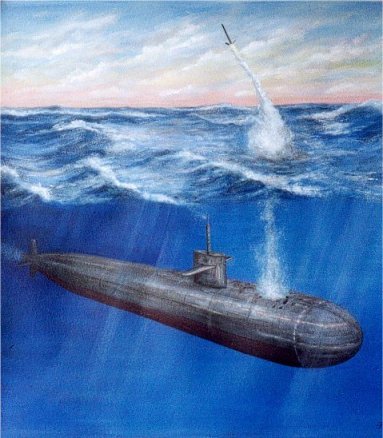
First underwater launch of the new Raytheon Tactical Tomahawk Block IV missile with a live warhead took place from USS Tucson (SSN 770) in July 2003. Block IV includes a two-way satellite link that allows reprogramming of the missile in flight and transmission of Battle Damage Indication (BDI) imagery. The missile entered service with USN surface ships in September 2004.

The Los Angeles class also carry the Harpoon anti-ship missile from Boeing. Sub-Harpoon uses active radar homing to deliver a 225kg warhead. The range is 130km and the speed is high subsonic...


Last week one of Olmert's pet NeoCons leaked that Israel had plans to nuke Iran. It doesn't matter that most of the brass of the Israeli military think it's a really bad idea. It doesn't matter that most of the Israeli people think tossing nukes at Iran is a really bad idea. Nor does it matter that Israel does its best to convince the world it doesn't have nukes, much less that the nuke threatened was an experimental low yield bunker buster form that breaks all the nuclear ban treaties. And of course, it certainly doesn't matter that the existance of such a weapon is totally hypothetical, its existence only speculated by Donald Rumsfeld a few years ago.

As a matter of fact, the only concrete thing in this post is the Los Angeles class of nuclear submarine, a fast attack sub, that is perfectly capable of firing nuclear missiles. Among other things.

You see, one of these craft, offically operating off the African coast aiding in the Somalian action, hit a Japanese oil tanker off the coast of Iran on Monday night.


WASHINGTON, Jan. 8 — An American nuclear-powered attack submarine has collided with a Japanese commercial vessel in the Arabian Sea. Initial reports from the area said there were no injuries and only slight damage, a Pentagon spokesman said Monday night.

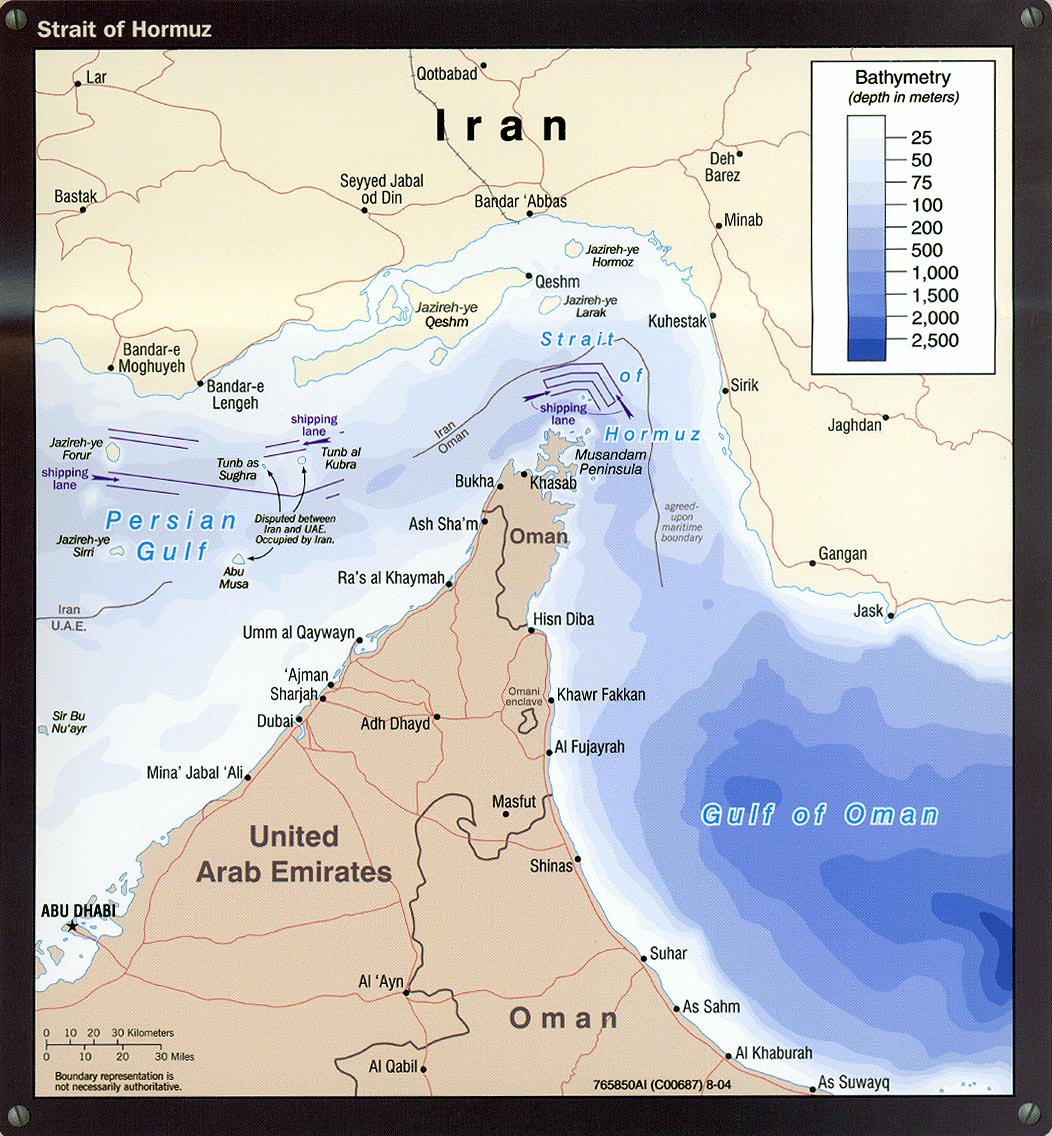
The collision, south of the Strait of Hormuz, was first reported by the Kyodo news agency in Japan, which said the Foreign Ministry in Tokyo had been officially notified of the accident by American officials.

A Pentagon spokesman identified the submarine as the U.S.S. Newport News. The Japanese vessel was thought to be a tanker. American military officials in Washington were seeking a fuller accounting.

The U.S.S. Newport News is a nuclear-powered, fast-attack submarine in the Los Angeles class of vessels, and was commissioned in 1989, according to Pentagon records.

The Japanese oil company Showa Shell Sekiyu K. K. said the ship involved is the tanker Mogamigawa, operated by Kawasaki Kisen Kaisha Ltd., The Associated Press reported, citing a report from the Kyodo news agency. It was traveling from the Persian Gulf to Singapore and was carrying a crew of eight Japanese and 16 Filipinos.


It seems the sub was not in Omani waters at the time- meaning it was in Iranian waters {nice catch xan].

One wonders if this sub had the "Israeli" missiles intended to do the dirty work on Iran.

You have to be smart to use an attack sub as a sock puppet. Unless, of course, you install windows in the bow.


[Thanks to Lambert for reminding me also the diameter of the sub is 10 meters, but the Straits are 40 meters max. Talk about trying to march a camel through the eye of a needle...]

Tuesday, January 09, 2007

It's a National Security Issue, Capisci?

Via Crooks and Liars, two posts of interest:


The White House and the Secret Service quietly signed an agreement last spring in the midst of the Jack Abramoff lobbying scandal declaring that records identifying visitors to the White House are not open to the public.

The Bush administration didn't reveal the existence of the memorandum of understanding until last fall. The White House is using it to deal with a legal problem on a separate front, a ruling by a federal judge ordering the production of Secret Service logs identifying visitors to the office of Vice President Dick Cheney...


!


Because, as Justin Rood's post suggests, if they told you, they'd have to kill you as a matter of National Security and Company policy...

The CIA is refusing to cooperate with federal prosecutors investigating the Duke Cunningham scandal, the Wall Street Journal's Scott Paltrow reports today.

Before getting caught in 2005, Cunningham was involved in a sprawling corruption ring between Congress and the national security community. The scandal allegedly enjoyed the participation of current and former CIA officials, including Kyle "Dusty" Foggo, the executive director of the agency. Foggo would be the highest-ranking CIA official to be prosecuted in the agency's history, according to Paltrow.

Prosecutors had expected to indict Foggo several months ago, but the Agency's refusal to declassify important documents has hampered their efforts, Paltrow reports.

Of course, prosecutors haven't received much help from Congress with their investigation, either. Last month they were forced to serve subpoenas to several powerful committees in an effort to force them to turn over documents.

Foggo's indictment -- and possible plea bargain -- would be a notable triumph for the Feds. For many months the case has stagnated, and observers have wondered if the investigation was hopelessly compromised. Nailing Foggo would also be important for prosecutors, as it would give them leverage to go after alleged Cunningham briber Brent Wilkes. Wilkes, who ran a government contracting business, was close with Foggo and is said to have worked closely with him. Despite being identified by Cunningham as a major briber, Wilkes has refused to plead guilty or cooperate with prosecutors.


Of course, Dear Leader is always thinking about security. In fact, he's so preoccupied with security, he wants to block the new Congressional efforts to disrupt global black markets for nuclear weapons technology and to enhance cargo inspection.

If you found out why he's against it, , he'd have to deal with you afterwards as a matter of National Security.

Monday, January 08, 2007

Whom the Gods Would Destroy...

...they motivate to escalate a land war in Asia.

Robert Parry:

On Jan. 4, Bush ousted the top two commanders in the Middle East, Generals John Abizaid and George Casey, who had opposed a military escalation in Iraq, and removed Director of National Intelligence John Negroponte, who had stood by intelligence estimates downplaying the near-term threat from Iran’s nuclear program.

Most Washington observers have treated Bush’s shake-up as either routine or part of his desire for a new team to handle his planned “surge” of U.S. troops in Iraq. But intelligence sources say the personnel changes also fit with a scenario for attacking Iran’s nuclear facilities and seeking violent regime change in Syria...

Bush’s personnel changes also come as Israel is reported stepping up preparations for air strikes, possibly including tactical nuclear bombs, to destroy Iran’s nuclear facilities, such as the reactor at Natanz, south of Tehran, where enriched uranium is produced.

The Sunday Times of London reported on Jan. 7 that two Israeli air squadrons are training for the mission and “if things go according to plan, a pilot will first launch a conventional laser-guided bomb to blow a shaft down through the layers of hardened concrete [at Natanz]. Other pilots will then be ready to drop low-yield one kiloton nuclear weapons into the hole.”

The Sunday Times wrote that Israel also would hit two other facilities – at Isfahan and Arak – with conventional bombs. But the possible use of a nuclear bomb at Natanz would represent the first nuclear attack since the United States destroyed Hiroshima and Nagasaki in Japan at the end of World War II six decades ago.

While some observers believe Israel may be leaking details of its plans as a way to frighten Iran into accepting international controls on its nuclear program, other sources indicate that Israel and the Bush administration are seriously preparing for this wider Middle Eastern war...

Whatever Iran’s intent, Negroponte has said U.S. intelligence does not believe Iran could produce a nuclear weapon until next decade.

Negroponte’s assessment in April 2006 infuriated neoconservative hardliners who wanted a worst-case scenario on Iran’s nuclear capabilities, much as they pressed for an alarmist view on Iraq’s weapons of mass destruction before the U.S. invasion in 2003.

Unlike former CIA Director George Tenet, who bent to Bush’s political needs on Iraq, Negroponte stood behind the position of intelligence analysts who cited Iran’s limited progress in refining uranium.

“Our assessment is that the prospects of an Iranian weapon are still a number of years off, and probably into the next decade,” Negroponte said in an interview with NBC News. Expressing a similarly tempered view in a speech at the National Press Club, Negroponte said, “I think it’s important that this issue be kept in perspective...”

As investigative reporter Seymour Hersh wrote in The New Yorker, a number of senior U.S. military officers were troubled by administration war planners who believed “bunker-busting” tactical nuclear weapons, known as B61-11s, were the only way to destroy Iran’s nuclear facilities buried deep underground.

A former senior intelligence official told Hersh that the White House refused to remove the nuclear option from the plans despite objections from the Joint Chiefs of Staff. “Whenever anybody tries to get it out, they’re shouted down,” the ex-official said. [New Yorker, April 17, 2006]

By late April 2006, however, the Joint Chiefs finally got the White House to agree that using nuclear weapons to destroy Iran’s uranium-enrichment plant at Natanz, less than 200 miles south of Tehran, was politically unacceptable, Hersh reported.

“Bush and [Vice President Dick] Cheney were dead serious about the nuclear planning,” one former senior intelligence official said. [New Yorker, July 10, 2006]

But one way to get around the opposition of the Joint Chiefs would be to delegate the bombing operation to the Israelis. Given Israel’s powerful lobbying operation in Washington and its strong ties to leading Democrats, an Israeli-led attack might be more politically palatable with the Congress...

One Israeli source told me that Bush’s interest in spreading the war to Syria was considered “nuts” by some senior Israeli officials, although Prime Minister Olmert generally shared Bush’s hard-line strategy against Islamic militants. [See Consortiumnews.com’s “Bush Wants Wider War.”]

... An Israeli assault on Iran could put the region’s remaining pro-American dictators in jeopardy, too. In Pakistan, for instance, Islamic militants with ties to al-Qaeda have been gaining strength and might try to overthrow Gen. Pervez Musharraf, conceivably giving Islamic terrorists control of Pakistan’s nuclear arsenal.

For some U.S. foreign policy experts, this potential for disaster from a U.S.-backed Israeli air strike on Iran is so terrifying that they ultimately don’t believe Bush and Olmert would dare implement such the plan.

But Bush’s actions in the past two months – reaffirming his determination to achieve “victory” in Iraq – suggest that he wants nothing of the “graceful exit” that might come from a de-escalation of the war...

On Nov. 6, Defense Secretary Donald Rumsfeld sent Bush a memo suggesting a “major adjustment” in Iraq War policy that would include “an accelerated drawdown of U.S. bases” from 55 to five by July 2007 with remaining U.S. forces only committed to Iraqi areas that request them.

“Unless they [the local Iraqi governments] cooperate fully, U.S. forces would leave their province,” Rumsfeld wrote.

Proposing an option similar to a plan enunciated by Democratic Rep. John Murtha, Rumsfeld suggested that the commanders “withdraw U.S. forces from vulnerable positions – cities, patrolling, etc. – and move U.S. forces to a Quick Reaction Force (QRF) status, operating from within Iraq and Kuwait, to be available when Iraqi security forces need assistance.”

And in what could be read as an implicit criticism of Bush’s lofty rhetoric about transforming Iraq and the Middle East, Rumsfeld said the administration should “recast the U.S. military mission and the U.S. goals (how we talk about them) – go minimalist.” [NYT, Dec. 3, 2006]

On Nov. 8, two days after the memo and one day after American voters elected Democratic majorities in the House and Senate, Bush fired Rumsfeld. The firing was widely interpreted as a sign that Bush was ready to moderate his position on Iraq, but the evidence now suggests that Bush got rid of Rumsfeld for going wobbly on the war.

On Dec. 6, when longtime Bush family counselor James Baker issued a report by the bipartisan Iraq Study Group urging a drawdown of U.S. troops in Iraq, Bush wasted little time in slapping it down.

Instead, Bush talked about waging a long war against Islamic “radicals and extremists,” an escalation from his original post-9/11 goal of defeating “terrorists with global reach.”

At his news conference on Dec. 20, Bush cast this wider struggle against Islamists as a test of American manhood and perseverance by demonstrating to the enemy that “they can’t run us out of the Middle East, that they can’t intimidate America.”


It's probably not surprising Black Spot has greater loyalties to his old time Chief, Poppy. He's canny enough to realize the Fixer's word is Law from the Royal House. If Parry's analysis is right, his change in hats was in no small part due to Dear Leader's contempt. Still, it would be really surprising if Negroponte's job change doesn't serve the Company's purpose, and his own, and not necessarily Dear Leader's.

As mind boggling as it may be if this analysis is correct, Darth Rumsfeld's resignation may have been forced because Dear Leader felt Rummy was simply too soft and not because everyone thought he was a maniac. On the other hand, Rumsfeld may have also felt safer on the Consigliere's suggested golden path. If this is true, one wonders how the Family and its Company will react as Dear Leader's Kool-Aid continues to sour and he continues to plan for his own glory over Company profit.

Sunday, January 07, 2007

Back on the air, to Ricky Rat's Chagrin

I'm sure Tinkerbeotch will be hell to live with.

But she can't help it, she's drawn that way.

Black Spot as the Secretary of State with Glowing Attitude...

There had to be a motivation behind his dodge behind Secretary Supertanker other than his disdain for constantly briefing the C average cheerleader from Yale.

Jeff Stein at CQ via TPM via Attaturk:

On many a workday lunchtime, the nominal boss of U.S. intelligence, John D. Negroponte, can be found at a private club in downtown Washington, getting a massage, taking a swim, and having lunch, followed by a good cigar and a perusal of the daily papers in the club’s library.

“He spends three hours there [every] Monday through Friday,” gripes a senior counterterrorism official, noting that the former ambassador has a security detail sitting outside all that time in chase cars. Others say they’ve seen the Director of National Intelligence at the University Club, a 100-year-old mansion-like redoubt of dark oak panels and high ceilings a few blocks from the White House, only “several” times a week....

...He’s figured out the job. Which is to say, he really doesn’t have much control over the 16 U.S. intelligence agencies.

So why not hang at the University Club?

Negroponte spokesman Carl Kroft takes serious issue with that portrayal.

“He’s the hardest working person in U.S. intelligence,” Kroft said. “He’s hard at work from the early hours of the morning to late every night. The job never ends.”


Attaturk figures Condi may be changing hats herself soon. Black Spot will fill her shoes with no Congressional friction whatsoever. Regardless of what he's involved in he's the smoothest operator in town.

Wherever Black Spot operates, chaos, confusion, and catastrophe follow. So his elevation sideways back into the international arm of government means one thing. The road is about to get appreciably rockier.

Defense Tech:

"The Bush administration is expected to announce next week a major step forward in the building of the country’s first new nuclear warhead in nearly two decades," the Times is reporting.

The $100 billion effort is called the Reliable Replacement Warhead. Back in August, our own Haninah Levine took a four-part look at the program. Go read up: part 1, part 2, part 3, part 4.


Reliable Replacement Warhead. Bu$hCo names go like this: Clean Air Act, the law that lets industries toss whatever they like out of their smokestacks. And as you might expect, according to Haninah Levine, the Reliable Replacement Warhead will be none of those things, but will serve as an excuse for Bu$hCo to junk all of the nuclear test ban treaties.

Oh, and one more thing, incidently. Israel has plans to nuke Iran. Just an itty bitty one, really, from a country that officially has none. And oh, yes, it's an experimental "bunker buster" one designed to penetrate underground that nobody's used before, or even by international law should have developed, but Rumsfeld suggested a few years back. No big deal, really.

Now, seeing as the bovine fecal material is about to hit the fan in a really big radioactive way, what options does Congress really have, if it's promised to be a good bipartisan Congress and not cut off money for the party time in the Middle East or impeach Dear Leader?

Well, none whatsoever apparently. But that's what bipartisanship is all about. Date rape.

Saturday, January 06, 2007

doubleplusungood thoughtcrime

Xenophon notes:

The “lower –upper-class” and the Billionaire upper class are heating up for a global war for feudal territory and serfs. The geography of networks of dominion are subtly shifting away from the perceptible skirmishes of nation states and are inscribing themselves in the ubiquitous, pervasive infrastructure of global commerce.


He points to an older post where he references this CNN note last October that has a strange through-the-looking-glass feel about it:

...Not long ago an investment banker worth millions told me that he wasn't in his line of work for the money. "If I was doing this for the money," he said, with no trace of irony, "I'd be at a hedge fund." What to say? Only on a small plot of real estate in lower Manhattan at the dawn of the 21st century could such a statement be remotely fathomable. That it is suggests how debauched our ruling class has become.

The widening chasm between rich and poor may well threaten our democracy. Yet if that banker's lament staggers your brain as it did mine, you're on your way to seeing why America's income gap is arguably less likely to spark a retro fight between proletarians and capitalists than a war between what I call the "lower upper class" and the ultrarich.

Here's my outlandish theory: that economic resentment at the bottom of the top 1 percent of America's income distribution is the new wild card in public life. Ordinary workers won't rise up against ultras because they take it as given that "the rich get richer."

But the hopes and dreams of today's educated class are based on the idea that market capitalism is a meritocracy. The unreachable success of the superrich shreds those dreams...

Lower uppers are doctors, accountants, engineers, lawyers. At companies they're mostly executives above the rank of VP but below the CEO. Their comrades include well-fed members of the media (and even Fortune columnists who earn their living as consultants).

Lower uppers are professionals who by dint of schooling, hard work and luck are living better than 99 percent of the humans who have ever walked the planet. They're also people who can't help but notice how many folks with credentials like theirs are living in Gatsby-esque splendor they'll never enjoy.

This stings. If people no smarter or better than you are making ten or 50 or 100 million dollars in a single year while you're working yourself ragged to earn a million or two - or, God forbid, $400,000 - then something must be wrong...

There's only so much of this a smart, vocal elite can take before the seams burst - and a bilious reaction against unmerited privilege starts oozing from every pore. Especially when it's clear to lower uppers that many ultras are reaping the rewards of rigged systems: CEOs who preside over tumbling stock prices, hedge fund managers who barely beat the market.

It may seem far-fetched to think a revolt against extreme inequality will be led by posh professionals. But the conversations above suggest there's a potent political opening for a "comeuppance agenda."

Eliot Spitzer, an ultra by birth (like F.D.R.), has shown the power of turning against the sleazy self-dealing of his class. Once Spitzer's crusades against greed sweep him into the New York governor's mansion next month, imitators may follow. Shame as a strategy to constrain avarice may come back into fashion.

Like I said, it's just a theory. It could be sour grapes. But if I were in this for the money, I'd bet there was something to it.


Shame as a strategy to constrain avarice. How Democratic of them. Spitzer did win, incidently. But in an age where the chief opponent of the Rethuglicans in the Senate has the MGM Grand Casinos as a major legal donor, one wonders about the effectiveness of such a strategy. It feels much more like a strategery to me.

Which brings me around to my thinking about 9-11-01. What is the connection?


On 9-11 one group of lesser billionaire Saudi Royals made war on the economic base of King Fahd, a greater billionaire.

There was a lot of smoke and mirrors about the motivations behind the loss of the Twin Towers (+1, WTC7). You've read them before on this site maybe. But the biggest motivation was as always taking the money and running. You will notice a few American billionaires profited quite nicely from the result.

Taking the money and running is the best explanation for the war in Iraq. The reluctance to stop it certainly is best explained by this motivation. They might write letters, those earnest Democrats in Congress, but the cash must flow regardless.

Just try to tell people the War on Terra is a diversion to separate the rubes from their money. It will get you in trouble in polite company every time.


[thanks to scarshapedstar for the title!]