Wednesday, January 31, 2007


Tuesday, January 30, 2007
Funeral for a Friend?

The Hubble Space Telescope is flying partly blind across the heavens, a result of a short circuit on Saturday morning in its most popular instrument, the Advanced Camera for Surveys.
NASA engineers reported yesterday that most of the camera’s capabilities, including the ability to take the sort of deep cosmic postcards that have inspired the public and to track the mysterious dark energy splitting the universe to the ends of time, had probably been lost for good.
In a telephone news conference, Hubble engineers and scientists said the telescope itself was in fine shape and would continue operating with its remaining instruments, which include another camera, the wide-field planetary camera 2, or wfpc2, and an infrared camera and spectrograph named Nicmos.
“Obviously, we are very disappointed,” Preston Burch, program manager for the telescope, said at the Goddard Space Flight Center in Greenbelt, Md., noting that the camera had basically met its five-year design lifetime. The Hubble telescope, Mr. Burch said, still has significant science capability.
Mr. Burch and his colleagues said it was unlikely that they would be able to repair the camera during the next Hubble servicing mission, which is scheduled for September 2008. On that mission, astronauts will replace the wide-field camera with a powerful new version, wfpc3, which will extend the telescope’s vision to ultraviolet and infrared wavelengths and restore the lost capabilities. They will also install a new ultraviolet spectrograph and make many other pressing repairs.
Noting that the five days of spacewalks for that mission were already full, and that changing things to fix the camera would cost time and money, Dr. Burch said, “At first blush, this doesn’t look attractive…”


Billions if not trillions on wars for oil. Not a penny more to service the most used instrument on a very useful machine. Useful, that is, if you have natural human curiosity, think it's worthwhile knowing how the universe works, and want to accelerate human knowledge. Not so useful if you are TheoConservative, weapons maker, or In-Q-Tel/ CSC/ DynCorp head of NASA looking to please your cronies.
But of course, the onslaught of the ignorant against the 21st century continues on many fronts.
Monday, January 29, 2007
The NeoConservative
Pot meets kettle and calls it black.
...South Tehran is Ahmadinejad’s heartland. It is here, in the less affluent neighborhoods of the city of 14 million where he was once mayor, that he rose from the obscure end of the seven-candidate roster in 2005, only to become one of the most popular figures in the Muslim world. Because liberal-minded Iranians boycotted the 2005 presidential election, and because Ahmadinejad so adeptly played the populist card, the militants, the unemployed and the cultural conservatives of neighborhoods like this one were in the driver’s seat, steering the politics of this crucial nation while their opponents warned of their presumed doctrinaire views and political naïveté.
Early on, Ahmadinejad’s faction was expected to win last month’s elections handily. But the results contradicted the conventional wisdom about the Iranian electorate. The president put forward his own slate of candidates for the city councils. It was trounced. By some reckonings, reformists won two-fifths of the council seats and even dominated in some cities, including Kerman and Arak. Some conservative city-council candidates did well, particularly in Tehran, but they were not the conservatives associated with Ahmadinejad: rather, they belonged to the rival conservative faction of the current Tehran mayor, Mohammad Baqer Qalibaf. And most significant, the vote for Rafsanjani for the Assembly of Experts dwarfed that of Mesbah-Yazdi by nearly two to one. By mid-January, Ahmadinejad’s isolation even within his own faction was complete: 150 of 290 members of parliament, including many of Ahmadinejad’s onetime allies, signed a letter criticizing the president’s economic policies for failing to stanch unemployment and inflation. A smaller group also blamed Ahmadinejad’s inflammatory foreign-policy rhetoric for the United Nations Security Council resolution imposing sanctions on Iran. As if that were not enough, an editorial in Jomhouri Eslami, a newspaper that reflects the views of the supreme leader, accused the president of using the nuclear issue to distract the public from his failed policies. Ahmadinejad’s behavior was diminishing popular support for the nuclear program, the editorial warned. The Iranian political system seems to be restoring its equilibrium by showing an extremist president the limits of his power. But is it an equilibrium that can hold?
In part, last month’s election results reflected the complexity of Ahmadinejad’s skeptical, conditional and diverse constituency. They also demonstrated his isolation within the powerful conservative establishment, whose politics, however opaque, are determinative. At its center, Khamenei commands a faction known as the traditional conservatives. No elected leader can serve, let alone execute a policy agenda, without the acquiescence of the supreme leader and his associates. But was Ahmadinejad one of the leader’s associates? Or was he, like his predecessor, Khatami, something of a political rival? The answer to this question should determine the extent to which Ahmadinejad’s foreign-policy extremism and authoritarian tendencies are taken seriously as a political program. But it is a puzzle that has vexed political analysts since the president took office in August 2005, bringing with him a faction that was largely new to the post-revolutionary political scene. Composed partly of military and paramilitary elements, partly of extremist clerics like Mesbah-Yazdi and partly of inexperienced new conservative politicians, those in Ahmadinejad’s faction are often called “neoconservatives.” But to the extent that they have an ideology, it is less new than old, harking back to the early days of the Islamic republic. Since that time, the same elite has largely run Iranian politics, though it has divided itself into competing factions, and the act of wielding power has mellowed many hard-liners into pragmatists. Ahmadinejad’s faction, on the other hand, came into power speaking the language of the past but with the zeal of the untried...
Born in 1934, Mesbah-Yazdi is an éminence grise among the ayatollahs of Qom, but age has not mellowed him. In the last decade he has become famous less for his learned philosophical exegeses (he posts his entry in the Routledge Encyclopedia of Philosophy on his Web site) than for his jeremiads at Friday prayers against popular sovereignty, free speech, women’s rights and Islamic reform. Public execution and flogging are “a basic principle of Islam,” Mesbah-Yazdi has said, and the government should regulate the content of speech “just as it checks the distribution of adulterated or contaminated foodstuffs.” Because “Mesbah” sounds like the Farsi word for crocodile, he is known by his critics as Ayatollah Crocodile. (A cartoonist was once imprisoned for depicting him as a reptile, shedding crocodile tears as he strangled a dissident writer with his tail.)
At Ahmadinejad’s invitation, members of Mesbah-Yazdi’s Haqqani circle occupy several key government posts. But before Ahmadinejad came to power, they had been pushed mostly to the margins of Iranian politics, where they complained bitterly about the efforts of the reformist Khatami and his colleagues to advance their agenda through the elected branches of government. To the Haqqani scholars, it seemed that the reformists were challenging the doctrine of velayat-i-faqih, which is based on the sovereign power of the chief jurist, the supreme leader. “We shall wait to see what place these foxes who claim to be the supporters of reform will occupy in hell,” Mesbah-Yazdi proclaimed. If Iranians believed in their supreme leader as the agent of God, second-guessing his judgment through elections was tantamount to holding a referendum on whether or not Damavand was the highest peak in Iran. What if 51 percent of the public said that it was not? “It doesn’t matter what the people think,” Mesbah-Yazdi was quoted as saying. “The people are ignorant sheep.” He has also said, “Islam was the government of God, not the government of the people.”
...Young Ahmadinejad led a politically and religiously conservative Islamist student group during the Islamic Revolution, the writers claim. When the leftist Islamist students proposed seizing the American Embassy in 1979, Ahmadinejad opposed the action as imprudent, but he suggested that if they went ahead with it, they should seize the Soviet Embassy as well. His plan rejected, Ahmadinejad found himself excluded from historic events and spurned by the Islamic left, which was at that time a powerful faction within the regime. His opposition to that faction ossified into a vendetta.
Soon after Khomeini’s death, the Islamic left lost the factional battle for dominance. Its members wandered eight years in the political wilderness before returning as the reform movement. That, too, Ahmadinejad was anxious to crush. In that aspiration he would have found ample common ground with the Haqqani circle.
As president, Ahmadinejad looked to the extreme right rather than seeking allies among the traditional conservatives, and in so doing, he exposed himself politically. “They were very arrogant,” Hadian said of Ahmadinejad and his camp. “They didn’t want to make any compromises. He has stood against the entire political structure in Iran, not inviting any of them, even the conservatives, to be partners. You don’t see them in the cabinet; you don’t see them in political positions.”
And for that there was a price to be paid. This fall, Rafsanjani, who had suffered a humiliating defeat at Ahmadinejad’s hands in the presidential election of 2005, was reportedly persuaded to run again for the Assembly of Experts by the supreme leader or people close to him. Rafsanjani is a divisive figure in Iranian politics. He is widely perceived as a kingmaker, the power behind the rise of Khamenei to the position of supreme leader and that of Khatami to the presidency. But though he remains highly respected among clerics, Rafsanjani is not a beloved figure in Iranian public life. During his presidency, he adopted an economic liberalization program that involved extremely unpopular austerity measures; meanwhile, through pistachio exports, he had himself become one of the richest men in Iran. Political and social repression did not ease until Khatami, his successor, came into office.
Nonetheless, in the Assembly of Experts elections in December, Rafsanjani emerged as the compromise candidate of the reformists and traditional conservatives. One reformist activist described him to me as the very last line of defense against the extreme right. And Rafsanjani delivered a staggering blow, winning nearly twice as many votes as Mesbah-Yazdi. The neoconservatives, it seemed, had been slapped down much the same way the reformists had: the traditional conservatives had decided that the threat they posed was intolerable, and the voters had decided that the president associated with them could not deliver on his promises...
The Iranian economy has been mismanaged at least since the revolution, and to fix it would require measures no populist would be willing to take. Under Ahmadinejad, inflation has risen; foreign investors have scorned Iranian markets, fearing political upheaval or foreign invasion; the Iranian stock market has plummeted; Iranian capital has fled to Dubai. Voters I talked to pointed to the prices of ordinary foodstuffs when they wanted to explain their negative feelings about the government. According to Iranian news sources, from January to late August 2006 the prices of fruits and vegetables in urban areas rose by 20 percent. A month later, during Ramadan, the price of fruit reportedly doubled while that of chicken rose 10 percent in mere days. Housing prices in Tehran have reached a record high. Unemployment is still widespread. And Ahmadinejad’s approval rating, as calculated by the official state television station, had dipped to 35 percent in October.
Iran is not a poor country. It is highly urbanized and modern, with a sizable middle class. Oil revenues, which Iran has in abundance, should be channeling plenty of hard currency into the state’s coffers, and in fact the economy’s overall rate of growth is healthy and rising. But as Parvin Alizadeh, an economist at London Metropolitan University, explained to me, what ultimately matters is how the state spends its influx of wealth. The Iranian government has tried to create jobs swiftly and pacify the people by spending the oil money on new government-run projects. But these projects are not only overmanned and inefficient, like much of the country’s bloated and technologically backward public sector; they also increase the demand for consumer goods and services, driving up inflation.
Ahmadinejad has continued this trend. He has generated considerable personal good will in poorer communities, but hardly anyone I asked could honestly say that their lives had gotten better during his presidency. He fought to lower interest rates, which drove up lending, leading to inflation and capital flight. The government cannot risk infuriating the public with the austerity measures that would be required in order to solve its deep-rooted economic problems. But as long as its short-term fixes continue to fail, the government will go on being unpopular. The last two presidents have lost their constituencies over this issue. And so officials seek to distract people from their economic woes with ideological posturing and anti-Western rhetoric. Not only has this lost its cachet with much of the Iranian public, it also serves to compound Iran’s economic problems by blackening its image abroad. “Iran has not sorted out its basic problem, which is to be accepted in the international community as a respectable government,” Alizadeh said. “Investors do not take it seriously. This is a political crisis, not an economic crisis.”
For a Western traveler in Iran these days, it is hard to avoid a feeling of cognitive dissonance. From a distance, the Islamic republic appears to be at its zenith. But from the street level, Iran’s grand revolutionary experiment is beset with fragility. The state is in a sense defined by its contradictions, both constitutional and economic. It cannot be truly stable until it resolves them, and yet if it tries to do so, it may not survive.
Sunday, January 28, 2007
Nemesis by Misdirection
There is a striking likeness in the expressions of George W Bush and Mahmoud Ahmadinejad of Iran as they confront each other over the issues of uranium enrichment and dominance in the Middle East. It falls somewhere between the chastened and defiant playground bully.
This is unsurprising: though not political equivalents, the two are really quite similar. Both had little experience of government or international affairs before being carried to power on a tide of populist, religious conservatism. Neither travelled abroad much, but they both had certain views about the world and the destiny of their nations. They had all the answers, yet there was also a dangerous lack of seriousness in them which has now earned them both the scorn of their people and rebuffs from their elders.
There is a striking likeness in the expressions of George W Bush and Mahmoud Ahmadinejad of Iran as they confront each other over the issues of uranium enrichment and dominance in the Middle East. It falls somewhere between the chastened and defiant playground bully.
This is unsurprising: though not political equivalents, the two are really quite similar. Both had little experience of government or international affairs before being carried to power on a tide of populist, religious conservatism. Neither travelled abroad much, but they both had certain views about the world and the destiny of their nations. They had all the answers, yet there was also a dangerous lack of seriousness in them which has now earned them both the scorn of their people and rebuffs from their elders.
We think of Bush as being the more unpopular of the two. His approval ratings are at the level of Nixon's just before he left the White House. After an unconvincing performance in the State of the Union Address, his plans for the troop surge in Iraq were rejected by the Senate Foreign Relations Committee and may now be voted down by the entire Senate. Senior Republican senators such as Chuck Hagel and John Warner are furious that sensible suggestions contained in the Iraq Study Group Report have been ignored. Although the President looked receptive when the report was delivered to him by James Baker, there has been no progress in policy, no evidence of any kind of deeper thinking in the White House. Nothing except that familiar foggy, narrow-eyed truculence of Bush Junior in a tight spot.
This would be a depressing but for similar difficulties experienced by Ahmadinejad over the last few weeks. Just as the senior Republican elders have turned on Bush, so Iran's religious leaders are moving to restrain their President. They criticise his bellicose foreign policy and the exceptionally poor record on promised reforms at home. There is a sense of embarrassment among sophisticated Iranians about their President's pronouncements, which surely rings a bell with Americans.
The most important sign-off disenchantment came in Jomhouri Islami, the newspaper owned by Iran's supreme religious leader Ayatollah Ali Khamenei, which said in an editorial: 'Turning the nuclear issue into a propaganda issue gives the impression that to cover up the flaws in government you are exaggerating its importance.'
The paper also suggested that the President should speak about the nuclear issue less, stop provoking aggressive powers like the United States and concentrate on the daily needs of the people - 'those who voted for you on your promises'. Two weeks ago, 150 legislators sent a letter to Ahmadinejad openly attacking him for missing his budget deadline and blaming him for inflation and rising unemployment.
A loss of confidence in both men at home is important because it offers us a brief opportunity to assert diplomacy over the habits of rhetoric and escalation. Although UN nuclear experts suggest the Iranians are at least five years from developing a bomb and delivery system, the Iranians are due to open a large uranium enrichment plant within a matter of weeks. If this goes ahead, a peaceful solution will be much harder to find; to decommission this new facility will require a loss of face for Ahmadinejad...
And this comment, the first of many good ones:
Does anyone seriously believe that Iran would launch a nuclear missile at Israel? And kill not only Jews but hundreds of thousands of Palestinian Muslims at the same time? Israel's neighbours would hardly rejoice in such an attack either as they would be affected by radioactive fallout on their territory. The idea is preposterous - why does anyone believe it?
About the only people who believe it also believe this
 sorry excuse for a human being.
Or this one:

In his State of the Union address last night, President Bush presented an arguably misleading and often flawed description of "the enemy" that the United States faces overseas, lumping together disparate groups with opposing ideologies to suggest that they have a single-minded focus in attacking the United States.
Under Bush's rubric, a country such as Iran -- which enjoys diplomatic representation and billions of dollars in trade with major European countries -- is lumped together with al-Qaeda, the terrorist group responsible for the Sept. 11, 2001, attacks. "The Shia and Sunni extremists are different faces of the same totalitarian threat," Bush said, referring to the different branches of the Muslim religion.
Similarly, Bush asserted that Shia Hezbollah, which has won seats in the Lebanese government, is a terrorist group "second only to al-Qaeda in the American lives it has taken." Bush is referring to attacks nearly a quarter-century ago on a U.S. embassy and a Marine barracks when the United States intervened in Lebanon's civil war by shelling Hezbollah strongholds. Hezbollah has evolved into primarily an anti-Israeli militant organization -- it fought a war with Israel last summer -- but the European Union does not list it as a terrorist organization.
At one point, Bush catalogued what he described as advances in the quest for freedom in the Middle East during 2005 -- such as the departure of Syrian troops from Lebanon and elections in Iraq. Then, Bush asserted, "a thinking enemy watched all of these scenes, adjusted their tactics and in 2006 they struck back." But his description of the actions of "the enemy" tried to tie together a series of diplomatic and military setbacks that had virtually no connection to one another, from an attack on a Sunni mosque in Iraq to the assassination of Maronite Lebanese political figure...
In the two of the most liberal and diverse societies in the Middle East -- Lebanon and the Palestinian territories -- events have undercut Bush's argument in the past year. Hezbollah has gained power and strength in Lebanon, partly at the ballot box. Meanwhile, Palestinians ousted the Fatah party -- which wants to pursue peace with Israel -- from the legislature in favor of Hamas, which is committed to Israel's destruction and is considered a terrorist organization by the State Department.
In fact, many of the countries that Bush considers "moderate" -- such as Egypt and Saudi Arabia -- are autocratic dictatorships rated among the worst of the "not free" nations by the nonpartisan Freedom House. Their Freedom House ratings are virtually indistinguishable from Cuba, Belarus and Burma, which Bush last night listed as nations in desperate need of freedom...
The problem is, of course, there is an issue even more likely to defuse the World War than the disconcerting tendency towards democracy in the Axis of Evil and totalitarianism among the Faithful:
Iran's efforts to produce highly enriched uranium, the material used to make nuclear bombs, are in chaos and the country is still years from mastering the required technology.
Iran's uranium enrichment programme has been plagued by constant technical problems, lack of access to outside technology and knowhow, and a failure to master the complex production-engineering processes involved...
Saturday, January 27, 2007
Afraid of the Sky
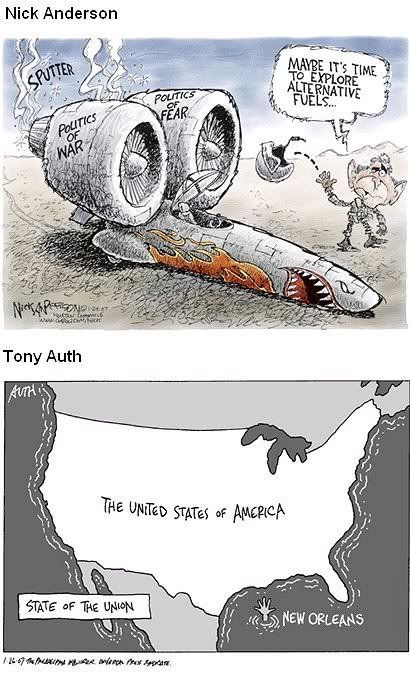
Dear Leader just can't get any respect these days. Even Pootie-Pute is telling him the truth:
NEW DELHI (AP) – Russian President Vladimir Putin on Thursday criticized U.S. plans for space-based weapons, saying it was the reason behind a recent Chinese anti-satellite weapons test.
Asked about the Chinese test at a news conference in New Delhi after a meeting with Indian Prime Minister Manmohan Singh, Putin avoided directly criticizing the Chinese, saying only that Russia was against putting any weapons in space.
Instead Putin chose to issue a warning to the U.S. on the dangers of the militarization of space.
“At the same time, I would like to note that China was not the first country to conduct such a test,'' Putin said.
The Jan. 11 test, first reported last week by the magazine Aviation Week, destroyed a defunct Chinese weather satellite by hitting it with a warhead launched on board a ballistic missile.
“The first such test was conducted back in the late 1980s and we also hear it today about the U.S. military circles considering plans of militarization of space. We must not let the genie out of the bottle,'' Putin said.
U.S. President George W. Bush signed an order in October tacitly asserting the U.S. right to space weapons and opposing the development of treaties or other measures restricting them.
Bush has also pushed an ambitious program of space-based missile defense and the Pentagon is working on missiles, ground lasers and other technology to shoot down satellites...
Of course, Dear Leader has his own Battlestar Galactica of space weapons planned. A good recent official lowdown can be found, as usual, at Defense Tech. But these are communications systems, important for intelligence and integration. The real space weapons, UAVs, the space fighters, the rods from god, the anti satellites, the lasers, and the microwave weapons that can be used optimally in space, aren't discussed. You can find out more about them by searching Defense Tech, or this site, if you're interested.
But more on the Chinese situation: basically, Beijing says, it was none of our business.
PARIS — The Chinese government confirmed Jan. 23 that it had sent a missile to destroy one of its own satellites but insisted the test should not be viewed as a hostile act.
In a press briefing in Beijing, Liu Jianchao, spokesman for the Chinese Foreign Ministry, reiterated that China "has never participated and will never participate in any arms race in outer space," Liu said, according to excerpts of his remarks provided by China's Xinhua News Agency. "This test was not directed at any country and does not pose a threat to any country."
Liu also said China had informed the United States and Japan of the anti-satellite test after the fact.
U.S. State Department spokesman Sean McCormack said Jan 22 that the Chinese Foreign Ministry had discussed the anti-satellite test in Beijing with Christopher R. Hill, assistant State Department secretary for East Asian and Pacific affairs, who is on a previously scheduled trip in East Asia...
...The U.S. Air Force has conducted similar anti-satellite tests in the past, but deputy U.S. State Department spokesman Tom Casey on Jan. 19 said U.S. policy has changed since the last U.S. anti-satellite demonstration in 1985...
Pefectly clear to me. The Pentagon's clutching its pearls because China can do what it could 20 years ago. Somewhere Dick Cheney huddles in his bunker afraid of the sky, because he knows despite his treasure trove of horror weapons America can't save its own cities like it could 20 years ago much less intimidate China.
The Denial of History
Perhaps the worst thing about Obama is that he acts as if the divide in this country is a new phenomenon he can blame on his parent's generation alone.
He's made comments to this effect in The New York Pravda and elsewhere.
Aside from the issue of asking, "What's the fraking matter with Kansas?", let me reiterate that those that forget history are doomed to repeat it.
The cultural divide in this country goes as far back as Patriots and Tories. The issue of exploitation and manipulation go to the very embryonic conception of this country: most of the first immigrants were brought here as indentured servants, and when that didn't work out so well, slavery became the economic base of the most habitable part of the country.
The Guilded Age was a product of the same robber barons, who basically wanted all the perks of the Old South without having to bother with the overhead of really holding slaves.
Even Roosevelt's own family had some fault in this. His realization that he had to see beyond the traditions of his own class came from the understanding that their class warfare was destroying the base of their prosperity: the American worker.
Obama's tendency to ignore the reality of the long-term corporatism of the Bush crime family makes him a most unsuitable Presidential candidate, and ensures the Rovian promotion of Clinton/ Obama DINOcratic ticket in 2008.
[Thanks to Lambert for the tip.]
He's made comments to this effect in The New York Pravda and elsewhere.
In his second book, “The Audacity of Hope,” Mr. Obama is critical of the style and the politics of the 60s, when the psyches of most of his potential rivals for the White House were formed. He writes that the politics of that era were highly personal, burrowing into every interaction between youth and authority and among peers. The battles moved to Washington in the 1990s and endure today, he says.
“In the back and forth between Clinton and Gingrich, and in the elections of 2000 and 2004,” he writes, “I sometimes felt as if I were watching the psychodrama of the baby boom generation — a tale rooted in old grudges and revenge plots hatched on a handful of college campuses long ago — played out on the national stage.”
Mr. Obama says he recognizes that the flashpoints of the 60s — war, racism, inequality, the relations between the sexes — still animate American politics and society and remain largely unresolved. And he acknowledges, as a child of a white Kansan mother and black Kenyan father, that his own prominence and prospects would have been impossible without the struggles of those who marched in Selma and Washington. But he argues that America faces new challenges that require a new political paradigm.
Aside from the issue of asking, "What's the fraking matter with Kansas?", let me reiterate that those that forget history are doomed to repeat it.
The cultural divide in this country goes as far back as Patriots and Tories. The issue of exploitation and manipulation go to the very embryonic conception of this country: most of the first immigrants were brought here as indentured servants, and when that didn't work out so well, slavery became the economic base of the most habitable part of the country.
The Guilded Age was a product of the same robber barons, who basically wanted all the perks of the Old South without having to bother with the overhead of really holding slaves.
Even Roosevelt's own family had some fault in this. His realization that he had to see beyond the traditions of his own class came from the understanding that their class warfare was destroying the base of their prosperity: the American worker.
Obama's tendency to ignore the reality of the long-term corporatism of the Bush crime family makes him a most unsuitable Presidential candidate, and ensures the Rovian promotion of Clinton/ Obama DINOcratic ticket in 2008.
[Thanks to Lambert for the tip.]
Friday, January 26, 2007
Cheney's Solution to Global Warming
It's been covered here before. It's Big Science about to go awry in a very big way, fitting for Big Time himself. Since they don't want to stop the profitable process causing global warming, they figure, why not quench the only source of warmth in the world?
This idea is so bad I don't know where to begin:
Why does every solution these guys come up with involve more destruction of the natural world?
Why is it this seems likely to lower the possibility of ever using the Sun as an alternate energy source?
And finally, why does this seem just the kind of answer a Dark Lord would choose?
This idea is so bad I don't know where to begin:
The US government wants the world's scientists to develop technology to block sunlight as a last-ditch way to halt global warming, the Guardian has learned. It says research into techniques such as giant mirrors in space or reflective dust pumped into the atmosphere would be "important insurance" against rising emissions, and has lobbied for such a strategy to be recommended by a major UN report on climate change, the first part of which will be published on Friday.
The US has also attempted to steer the UN report, prepared by the Intergovernmental Panel on Climate Change (IPCC), away from conclusions that would support a new worldwide climate treaty based on binding targets to reduce emissions - as sought by Tony Blair. It has demanded a draft of the report be changed to emphasise the benefits of voluntary agreements and to include criticisms of the Kyoto Protocol, the existing treaty which the US administration opposes.
The final IPCC report, written by experts from across the world, will underpin international negotiations to devise a new emissions treaty to succeed Kyoto, the first phase of which expires in 2012. World governments were given a draft of the report last year and invited to comment.
The US response, a copy of which has been obtained by the Guardian, says the idea of interfering with sunlight should be included in the summary for policymakers, the prominent chapter at the front of each IPCC report. It says: "Modifying solar radiance may be an important strategy if mitigation of emissions fails. Doing the R&D to estimate the consequences of applying such a strategy is important insurance that should be taken out. This is a very important possibility that should be considered."
Why does every solution these guys come up with involve more destruction of the natural world?
Why is it this seems likely to lower the possibility of ever using the Sun as an alternate energy source?
And finally, why does this seem just the kind of answer a Dark Lord would choose?
Thursday, January 25, 2007
Pfired Pfree Pfalling
Just ask the Pfizer people- the ex-Pfizer people- in Ann Arbor about how that Pfree market globalization thing is working to improve life for everyone.
Their ex-CEO walked off legally with $180M severance package. It's good to recall Peter Rost's warning about them after he got fired for wanting to do honest business with the government:
Pfizer bought out the Ann arbor operation because they'd developed drugs like Lipitor and Troglitizone. But Lipitor's patent is run out, and troglitizone isn't the wonder drug against diabetes they'd hoped for. Now the whole Ann Arbor operation's shutting down, thrown away like a used tissue.
Of course, the VP in charge of soothing the fevered masses while kissing up to the latest CEO sez it's a Wonderful Move to Increase "Our" Entrepreneurial Competitiveness.
Don't get me wrong. The VP's been a good Joe, giving money to the community here and trying to be decent. But, you know, he's kept his job, and it's a choppy sea.
Pfizer's made its billions not by doing basic research, but by buying smaller companies that have invented new drugs. And cleaning them out and closing them down.
If it cuts like a cutlass, it's piracy to me.
Their ex-CEO walked off legally with $180M severance package. It's good to recall Peter Rost's warning about them after he got fired for wanting to do honest business with the government:
...I’m also uninsured for the first time in my life and I have to pay full price for drugs I used to get for free, just like over 40 million other
uninsured Americans. I have to admit that when I started fighting for cheaper drugs for the uninsured I never expected to become part of that group myself.
Contrary to many others, however, I do have a choice. In accordance with federal COBRA law, Pfizer has offered me the opportunity to continue my health care coverage for 18 months. The cost of doing that, straight out of my own pocket would be $15,269 per year.
That’s a shocking amount of money for simple insurance. You know, there used to be a time when insurance meant paying a small amount of money to avoid a big cost later on. But $15,269—how many people can afford to pay that? And even if they can—who’d want to pay that amount?
Ladies and gentlemen. The system we have today isn’t just broke. The system is utterly and completely sick and our weakest citizens are paying the price, every day. And here I get to the important point. I can’t talk about what’s wrong with the drug companies without also talking about what’s wrong with our current system. It’s a system that quite frankly is built on greed.
You know the definition of greed? Greed is an excessive desire to acquire or possess more than someone needs or deserves. Greed is not a corporate executive who builds an organization such as Microsoft and happens to get rich. Greed is coal miners killed because of safety violations. Greed is unaffordable drugs. Greed is underperforming CEO’s with big pay packages.
Let me give you a real-life example of greed. There’s a company where the CEO has secured about a $100 million retirement package, he’s fired 16,385 employees, he also got a 72% pay increase to $16.6 million. And of course this would be great if he had actually increased shareholder value. That’s his job. The only problem is that the company’s stock price has drastically underperformed its peers and dropped 40% over the last five year—twice as much as the AMEX Pharmaceutical Index. So he didn’t do a great job, and still got all that money for himself. The company’s name is Pfizer.
Greed. It’s pretty easy to recognize. And our society is built on it. We
have removed all sense of decency; we have pulled out all the stops.
According to the New York Times average worker pay has remained flat since 1990—sixteen long years—at around $27,000, after adjusting for inflation, while CEO compensation has QUADRUPLED, from $2.82 million to $11.8 million.
So the CEO’s made sure their million dollar compensation increased by 400% while the workers saw virtually no increase. What’s wrong with this? What is wrong is that the CEO’s have been put in a position in which they can basically use our American companies as their personal piggy banks. They have unlimited power, they put in their own board of directors and pay consultants. And then they start robbing our corporations. And this is perfectly legal as long as they get someone else to sign their check. Meanwhile, the federal minimum wage has remained at $5.15 an hour since September 1, 1997. In fact, after adjusting for inflation, the value of the minimum wage is at its second lowest level since 1955.
And don’t think congress isn’t helping these very rich men. Imagine you get an award from your employer, taking a trip on an airplane to a vacation spot in Cancun. Of course you’ll have to pay tax on the full value of your airfare. But if the CEO flies to the same spot on the corporate jet, at fifty times your cost, he doesn’t have to pay more tax than you did. This is a law courtesy of U.S. Congress, elected by our people. In short, our country, our corporations, our future, is being stolen away by rich men in handmade suits and our elected representatives are helping them.
Anyone heard of the Abramoff affair? Mr. Abramoff's actions have prompted Assistant Attorney General Alice Fisher to state, “Government officials and government action are not for sale.” According to the Baltimore Sun, “This was an outrageous lie. Just because the excessive chutzpah and greed of Jack-the-Corrupter Abramoff and his gang got them nabbed does not negate the political reality that government officials and government action have been, still are, and in all likelihood will remain for sale.”
There is nothing cheaper to buy than a congressman or two; or a President. Let me explain; every year we see these tallies of millions spent on lobbying. The pharmaceutical industry in 2003 spent $143 million on lobbying activities according to the Center for Public Integrity. At that time, there were 1,274 registered pharmaceutical lobbyists in Washington, D.C. During the 2004 election cycle, the drug industry contributed $1 million to President Bush.
Did you hear that? One Million!! Is that all it takes to buy a President? You’re asking what’s wrong with the drug industry, when you can buy a president for a million bucks? What industry wouldn’t buy him for that fire sale price? My point is that for an industry that makes $500 billion on a global basis, spending just one million on a President is pocket change. It’s nothing. And hey, just to hedge their bet the drug industry also spent half a million on Kerry. Clearly the drug industry wanted Bush to win, but if Kerry won, they wanted him to be indebted to them too. There is no free lunch, no money without strings, not even for a President.
And what did the drug industry get for this money? Well, they certainly were able to stop cheaper drugs. This money was well spent. It stopped legalized import of cheaper drugs and instead we got a new Medicare drug program. This $720 billion law includes $139 billion in profits to drug manufactures and $46 billion in subsidies to HMOs and private insurance plans. The program has been such a disaster for our poor that at least twenty-four states have enacted emergency measures to ensure access to medications in the last couple of weeks.
That’s what a million dollars buys in Washington. It is probably not surprising that Democratic Leader Pelosi, yesterday asked for a congressional investigation into the role played by the Alexander Strategy Group, a lobbying firm closely linked to Tom DeLay and Jack Abramoff, in the passage of the Medicare Prescription Drug Act.
They wrote, “The Medicare Prescription Drug Act, which has caused so much confusion and havoc since January 1, was a product of a corrupt legislative process.”
What a world. And of course the drug industry plays along in this corrupt
reality. They’re corporations; they’re only here to make money. Lot’s of
money. That’s what a corporation does. Just like a lion eats other animals.
But we have a government to makes sure there is a balance in the nature of economics. That the lions don’t eat all the sheep. Only as many as they need for survival. I’m not saying we shouldn’t have lions; we should have lots of healthy lions. I’m simply saying that in the nature of economics there needs to be balance. Reality, however, is that the lions have bribed the caretakers in the Zoo called American politics, and get to feast on however many sheep and lamb they want. And the sheep; our poor, are paying for this with their lives, every day.
The American democracy has been stolen by the lions; our new class of Robber Barons—the CEO’s of our big corporations. A political system dependent on charity from corporations managed by rich men isolated from the masses in chauffeur driven limousines and private jets, with $100 million retirement packages is not a true democracy. It is a kleptocracy...
Pfizer bought out the Ann arbor operation because they'd developed drugs like Lipitor and Troglitizone. But Lipitor's patent is run out, and troglitizone isn't the wonder drug against diabetes they'd hoped for. Now the whole Ann Arbor operation's shutting down, thrown away like a used tissue.
Of course, the VP in charge of soothing the fevered masses while kissing up to the latest CEO sez it's a Wonderful Move to Increase "Our" Entrepreneurial Competitiveness.
Don't get me wrong. The VP's been a good Joe, giving money to the community here and trying to be decent. But, you know, he's kept his job, and it's a choppy sea.
Pfizer's made its billions not by doing basic research, but by buying smaller companies that have invented new drugs. And cleaning them out and closing them down.
If it cuts like a cutlass,
it's piracy to me.
Mouthpieces of the Masters of the Universe
Who's behind our annointed frontrunners?
Umm, you don't either, Lisa. But you certainly think you do.
...Hedge fund money, which now exceeds $1 trillion, has emerged in the last several years as a potentially powerful force in politics, as underscored by the significant role it is playing in the presidential aspirations of Mrs. Clinton and Mr. Giuliani. During the 2006 election cycle, executives who work at the 30 biggest hedge funds made $2.8 million in contributions to political candidates or party committees, almost double the amount in 2000.
Yet it is not just the money they donate directly that makes people in hedge funds attractive to campaigns. They also offer access to other potential donors in the financial world, which in recent election cycles has become one of the biggest sources of political contributions. That pipeline has made it easy for well-connected candidates like Mrs. Clinton, Mr. Giuliani and Senator John McCain to consider forgoing public funding. (Mrs. Clinton has done so; Mr. McCain is expected to opt out; and Mr. Giuliani has not yet addressed the topic.)
And top candidates for the 2008 campaign are expected to raise a lot of money quickly — at least $100 million each by the end of this year by some estimates.
“Are hedge fund guys going to be happy with their art collections and their houses in Greenwich or are they going to take the next step?” said Byron R. Wien, the investment strategist at Pequot Capital. “As Hollywood once invaded politics, you will see the same with hedge funds.”
Money from Wall Street has long been a factor in Washington and has tended to flow, with a policy agenda, to the ascendant political party. Giving by people in hedge funds, on the other hand, tends to be more personal and ideological. Some of the most aggressive donors have been Democratic supporters like George Soros, David E. Shaw of D. E. Shaw and James H. Simons at Renaissance Technologies, as well as younger executives like Thomas F. Steyer at Farallon and Marc Lasry at Avenue Capital, all of whom gave generously during the 2006 election cycle.
While hedge fund money appears to be tilting toward Democrats of late, Republican donors like Julian H. Robertson Jr., the founder of Tiger Management, who has given more than $700,000 over the last three cycles, and Bruce Kovner at Caxton Associates have backed their party’s candidates and causes.
Still, compared with the billions of dollars that hedge fund magnates have spent on art, mansions and other extravagances, these political donations are a pittance, held in check by federal finance laws that limit personal contributions to $2,100 and by a general reluctance to step into the public limelight.
But with the rapid growth of their money and stature, an increasing number of the hedge fund wealthy are not just putting their money to work, they are forging personal and professional ties with a generation of politicians who have come to spend as much time raising money as they do drafting legislation...
The connections can take different shapes and forms. For John Edwards, the Democratic presidential candidate, the 14 months he spent as a paid senior adviser at Fortress Investment, a $29.7 billion hedge fund and private equity firm, helped him to bond with the fund’s liberal-leaning executives, several of whom have given money to Mr. Edwards.
As to what Mr. Edwards, a trial lawyer with no previous financial markets experience, did at Fortress, an adviser to the candidate said that Mr. Edwards “advised on where there might be investment opportunities and where he saw the global economy going.” Mr. Edwards resigned from Fortress last month before declaring his candidacy.
And Avenue Capital, a $12 billion fund run by Mr. Lasry, a prominent financial supporter of the Clintons, hired their daughter, Chelsea, last year.
Mr. Singer and Ms. Perry represent different sides of the same coin. Mr. Singer, 62, is the founding partner of Elliott Associates, a $7 billion hedge fund with a conservative, risk-averse bias that has been in business since 1977, making it one of the oldest funds around. A reserved, private man who would answer questions only via e-mail, Mr. Singer is a self-described conservative libertarian who has given millions of dollars to Republican organizations that emphasize a strong military and support Israel.
They include Progress for America ($1.5 million in contributions), a political advocacy group set up to advance the policies of the Bush administration; Swift Vets and P.O.W.’s for Truth; and the Jewish Institute for National Security Affairs, which includes Vice President Dick Cheney and Richard N. Perle, an adviser to the former Defense Secretary Donald H. Rumsfeld, among its past and current advisory directors.
Mr. Singer said that his support for Mr. Giuliani sprang from an appreciation of Mr. Giuliani’s work as mayor. “Rudy’s stewardship is primarily responsible for making New York one of the greatest cities of the world,” he said.
A trustee at the Manhattan Institute, the conservative policy group that has been a source of many of Mr. Giuliani’s core policies, like welfare reform and a focus on quality-of-life issues, Mr. Singer sees Mr. Giuliani as the “strongest, most conservative candidate in the race.”
While Kenneth G. Langone, a co-founder of Home Depot, held Mr. Giuliani’s first public fund-raiser last month, a campaign strategy notebook that was leaked to The Daily News of New York this month pointed to Mr. Singer as the locus of Mr. Giuliani’s fund-raising network. “I will be raising money for Rudy in professional and personal circles,” he said.
Asked to describe his political philosophy, Mr. Singer says his conservatism dates back to Barry Goldwater and is founded on free enterprise and a belief that the government should “not be taking from one person and giving to another.” He abhors what he calls social engineering and he has financially supported state propositions that advocate preventing state agencies from collecting racial information.
He believes in the doctrine of American exceptionalism and is wary about United States involvement in “international organizations and alliances.” As for the war in Iraq, he said, “America finds itself at an early stage of a drawn-out existential struggle with radical strains of pan-national Islamists.”
In an industry known for its secrecy, Mr. Singer keeps a particularly low profile. He does all that he can to keep his picture from appearing in the media and does virtually no marketing for his fund, which had a return of 17 percent last year...
A graduate of the University of Rochester and Harvard Law School, Mr. Singer practiced law before he began to dabble in what was then an obscure investment strategy called convertible arbitrage. By buying convertible bonds and selling the attached stock short — or betting that its price would fall — he realized that he could achieve a decent investment return in up and down markets.
Steeled by the bear markets of the 1970s, he worries that managers may have become punch-drunk from a surfeit of happy investment times. “I am struck by the size of the hedge fund community and the amount of money being managed by people who have little experience in risk management and adverse market environments,” he said.
In contrast to Mr. Singer’s quiet approach, Ms. Perry’s embrace of Mrs. Clinton has taken on a more celebratory cast. She has tapped New York’s art world for fund-raising parties and opened up her Long Island house, in Sag Harbor, for gatherings for the senator.
Over the last three election cycles, Ms. Perry, 48, has given more than $1 million to Democrats, putting her in the most elite tier of Democratic donors. Given that she wrote her first check in 1998, when she was a stay-at-home mother, it has been a rapid evolution and one that has been fueled by her belief that there are not enough women senators in Washington...
While her husband, Richard, is also a Democrat, Ms. Perry points out that her giving and fund-raising are driven by her own politics, not his. Still, he, too, is a supporter of Mrs. Clinton.
“He thinks she is one of the smartest people he has ever met,” Ms. Perry said.
But it is her own largess that gives her a sense of pride. “Not a lot of women write their own checks,” she said.
Umm, you don't either, Lisa. But you certainly think you do.
Wednesday, January 24, 2007
Komodo Kristmas

MANCHESTER, England - A British zoo announced Wednesday the virgin birth of five Komodo dragons, giving scientists new hope for the captive breeding of the endangered species.
In an evolutionary twist, the newborns’ eight-year-old mother Flora shocked staff at Chester Zoo in northern England when she became pregnant without ever having a male partner or even being exposed to the opposite sex.
“Florais oblivious to the excitement she has caused but we are delighted to say she is now a mum and dad,” said a delighted Kevin Buley, the zoo’s curator of lower vertebrates and invertebrates.
The shells began cracking last week, after an eight-month gestation period, which culminated with the arrival on Tuesday of the fifth black and yellow colored dragon.
The dragons are between 15.5 and 17.5 inches and weigh between 3.5 and 5.3 ounces, said Buley, who leads the zoo’s expert care team.
He said the reptiles are in good health and enjoying a diet of crickets and locusts.
Other reptile species reproduce asexually in a process known as parthenogenesis. But Flora’s virginal conception, and that of another Komodo dragon earlier this year at the London Zoo, are the first time it has been documented in a Komodo dragon.
The evolutionary breakthrough could have far-reaching consequences for endangered species.
Captive breeding could ensure the survival of the world’s largest lizards, with fewer than 4,000 Komodos left in the wild.
Scientists hope the discovery will pave the way to finding other species capable of self fertilization.
While it wasn’t unusual for female dragons to lay eggs without mating, scientists understood they were witnessing something important when they realized Flora’s eggs had been fertilized.
DNA paternity tests confirmed the lack of male input, although the brood are not exact clones of their mother.
Strategery of War
In No Country Larger Than Virginia – No Nation At Peace With Its Neighbors, Evening Pilgrim has captured the essence of the corporate NeoCon plan in the Middle East.
The one they never talk about.
Chaos is their plan, and it likely to be their reward, too.
The one they never talk about.
Chaos is their plan, and it likely to be their reward, too.
Tuesday, January 23, 2007
Fronted Runners
Let's screw up the Presidential $election process altogether, she says:
So to the devil with the public system designed to end campaign corruption; after all, the corrupt have figured out how to win the last few presidential $elections in spite of it. The Clintons, the self-proclaimed bastions of the progressive liberals in America, once again have shown that they do an awfully good job of progressing the neoconservative agenda.
Jeff Cohen notices something odd here:
Meanwhile, chicago dyke notices that the Congressional leaders are having a little trouble with this "Leadership" concept.
Yes, but look at those campaign contributions!
WASHINGTON, Jan. 22 — The public financing system for presidential campaigns, a post-Watergate initiative hailed for decades as the best way to rid politics of the corrupting influence of money, may have quietly died over the weekend.
Senator Hillary Rodham Clinton of New York became the first candidate since the program began in 1976 to forgo public financing for both the primary and the general election because of the spending limits that come with the federal money. By declaring her confidence that she could raise far more than the roughly $150 million the system would provide for the 2008 presidential primaries and general election, Mrs. Clinton makes it difficult for other serious candidates to participate in the system without putting themselves at a significant disadvantage.
Officials of the Federal Election Commission and advisers to several campaigns say they expect the two candidates who reach Election Day 2008 will raise more than $500 million apiece. Including money raised by other primary candidates, the total spent on the presidential election could easily exceed $1 billion.
People involved in the Republican primary campaign of Senator John McCain of Arizona say he, too, is beginning to seek private donations for the primary and general elections, albeit with the option of returning them. A longtime proponent of campaign finance change, Mr. McCain has recently removed his name as a co-sponsor of a bill to expand the presidential public financing program.
Former Gov. Mitt Romney of Massachusetts, another Republican primary contender, has already decided to forgo public financing for the primaries. Senator Barack Obama of Illinois, a rival to Mrs. Clinton for the Democratic nomination, declined to comment, as did spokesmen for several other candidates.
In a sense, Mrs. Clinton was merely confirming what many in Washington already knew: that the public financing system has failed to keep pace with the torrents of money flowing toward the presidential elections. In 2004, President Bush and Senator John Kerry, the Democratic candidate, each opted out of the system for the primaries but not the general election. By accepting the public financing, they had to agree not to raise or spend any private money for the period after their nominating conventions.
But when Mr. Bush raised some $270 million, and Mr. Kerry about $235 million, it became clear that major-party candidates could raise far more from private donors than from the public system...
So to the devil with the public system designed to end campaign corruption; after all, the corrupt have figured out how to win the last few presidential $elections in spite of it. The Clintons, the self-proclaimed bastions of the progressive liberals in America, once again have shown that they do an awfully good job of progressing the neoconservative agenda.
Jeff Cohen notices something odd here:
Prominent pundits seem ecstatic over Hillary Clinton's entry into the presidential race just days after Barack Obama's media-created candidacy became official. Media talking heads are having so much fun lately they don't seem to notice that our political system is failing to address ever-worsening problems: social, environmental, fiscal and imperial.
Indeed, our country's political decline in recent decades has been abetted by the decline in mainstream media. The same media outlets that were complicit in the disastrous Iraq War are bent on turning politics into an insular celebrity club in which only they get to anoint front-runners.
If the torch of leadership passes from Bush I to Clinton I to Bush II to Clinton II, it will be a loss for our country - but a victory for a corrupt Beltway press corps that abhors fresh ideas, especially those that challenge its power and privilege. It was a frightened national press corps that vilified the netroots supporters of Democratic outsider Ned Lamont in defense of warhorse Joe Lieberman.
For the coming election season to be fact-based and reality-based instead of just power-based, independent media (online and off) will have to play a bigger role in shaping the debate and correcting the record. For example, a recent San Francisco Chronicle news report (headlined "Obama Emerges as Clinton's Rival for Dems' Left") asserted that Hillary Clinton was "widely regarded as the left's most influential voice inside the now-revered Clinton White House."
Widely regarded? Actually, progressives see Hillary Clinton as having been consistently wrong on the war and a host of other issues, especially trade. Her absurdly bureaucratic health-care proposal in 1993 - shaped by and for big insurance companies - was a slap in the face of unions, Congress members and grassroots forces who'd built a movement for simple, nonprofit national health insurance: In effect, enhanced Medicare for all. She helped set back the cause of universal coverage for years.
And far from being "revered," many Democratic activists see the Clinton era as one of decline in which Democrats lost their strong majorities in the US Senate, US House, governorships and state legislatures. It's simple math.
The 2008 presidential election is shaping up as a test of the power and capacity of new independent media vs. old conglomerate-dominated media. And a test of grassroots/netroots politics vs. corporatized Democratic politics...
Meanwhile, chicago dyke notices that the Congressional leaders are having a little trouble with this "Leadership" concept.
...In the year since top Democrats started demanding their own party leadership not work to stop the war, 907 U.S. soldiers have been killed. Of course, that’s never reported by the Washington press corps when they hear the same Democrats preach a “go slow” approach. But that doesn’t mean those troops didn’t die, and that the people still telling us to “go slow” should be regarded as even mildly credible when it comes to national security. The fact that the people who get things wrong over and over and over again are granted financial and political rewards on the Beltway cocktail party circuit doesn’t mean these people are doing anything other than running the country into the ground...
Yes, but look at those campaign contributions!
Monday, January 22, 2007
Children of the Human Mind

They have seen strange sunsets for us

in places no human could walk.
Their eyes see deeper

into their world to find things our eyes can appreciate but our minds only begin to understand.

The first tools of humans on Mars continue to exceed expectations, making their parents proud of them. They learn. They function independently.
It may be some time before we see their like again, given the current priorities of the people running NASA. But the kind of people who designed them in the first place are still working out there, even if they no longer have the blessing of the space program.

In Science
Science 19 January 2007:
Vol. 315. no. 5810, pp. 322 - 324
DOI: 10.1126/science.315.5810.322:
Thirteen years ago on a sunny spring morning, two divers prepared to descend into what could be the world's deepest water-filled pit: northeastern Mexico's El Zacatón, a 180-meterwide limestone sinkhole filled by hydrothermal springs. The water is 30°C, teeming with strange microbes, and pitch-black below the first 30 meters. One diver was Sheck Exley, then holder of the world's scuba depth record; the other was his friend Jim Bowden, a top underwater caver. They wished each other luck, adjusted their masks, and began free-falling down separate safety lines. Ten hours later, Bowden surfaced with a new world record--925 feet (282 meters)--without ever finding the bottom. Exley did not surface. Three days later, his body was pulled out, tangled in the line. No one knows what killed him.
The sinkhole's depth remains unknown; sonars work poorly in narrow spaces, so readings peter out at about 330 meters. But this week another team is preparing to replumb the mysteries of Zacatón--this time, with an audacious new robot made to probe both its geology and biology. The NASA-funded Deep Phreatic Thermal Explorer (DEPTHX) is designed to navigate and map deep underwater tunnels, spot living things, grab them, and bring them back--all without direction from the surface. If it survives its first voyage in March, DEPTHX will be a major advance in robotics and exploration of extreme environments. If it survives NASA budget cuts, it could be a model for probing Jupiter's moon Europa, where Zacatón-like cracks or holes in the icy surface may offer the best chance of finding extraterrestrial life.
Compared to other autonomous underwater vehicles (AUVs), DEPTHX is "well ahead," says Gwyn Griffiths, head of the National Oceanography Centre underwater lab in Southampton, U.K. But like other NASA-funded astrobiology projects, the robot's future is uncertain. Its funding is about to run out, and a follow-up project may be a long shot as NASA cuts back support for such efforts. "Robotic exploration of our planet and the universe has been wildly successful and cheap," says Dana Yoerger, an AUV guru and cheerleader for DEPTHX at Woods Hole Oceanographic Institution in Massachusetts. "To cut back on stuff like that for manned exploration is going to give the taxpayers very poor value."
The ringleader of DEPTHX is extreme engineer and cave explorer Bill Stone, who in 1989 made it to NASA's semifinal astronaut-selection round but was nixed as being too independent. During the past 3 decades, he has worked on space and military projects for the National Institute of Standards and Technology and on the side explored some of Earth's most dangerous caverns. Traveling a kilometer or more under the surface, he has stayed down for weeks at a time in air-filled caves. Underwater, he has often dived through twisty, silt-choked passages, re-emerging alive to appear in National Geographic. Finding standard scuba tanks too bulky, he invented a compact rebreather that recycles gases, now used by divers worldwide. In 1998, he made the first high-resolution maps of an underwater cavern, Florida's Wakulla Spring, by inventing a torpedo-like personal propulsion vehicle studded with sonars--the precursor to DEPTHX. He and colleagues drove the devices through 6.4 kilometers of inky-black passages to create three-dimensional (3D) images of the invisible walls. "Deep cave systems are the last terrestrial frontier; they push the limits of human endeavor, technology, and psychology," says Stone.
They are also dangerous. Stone has lost 16 friends to exploration accidents and has dragged out the bodies of seven himself. Exley was his cave-diving mentor. "I've come to the conclusion that there are places where humans cannot travel safely," says Stone, now 54. "We need a surrogate."
At Zacatón, Stone is working with Marcus Gary, a University of Texas, Austin, Ph.D. student who assisted at the fatal 1994 dive and became obsessed with the sinkhole. In a Geological Society of America paper last year, Gary reported that the system owes its vastness to volcanism that adds heat and gases to water running into the limestone. This hastens chemical dissolution of the rock as well as making things cozy for unusual bacteria. In 2003, Stone and Gary joined with a cast of luminaries in space, robotics, and microbiology to win a $5 million, 3-year grant from NASA's Astrobiology Science and Technology for Exploring Planets (ASTEP) program to use Zacatón as a proving ground for a prototype robot that could explore Europa. A side benefit would be exploring Zacatón itself.
Another team member is Richard Greenberg, a planetary scientist at the University of Arizona in Tucson who helped show that Europa, about the size of Earth's moon, has a hidden ocean covered with an icy crust. Tides crack and puncture the ice from below, creating sinkholelike features on the surface. Like Zacatón, Europa's ocean is also probably heated by volcanism--ideal for the development of life. Many scientists think a robot might have to melt through some 10 kilometers of ice to reach liquid and thus life, but Greenberg says organisms--probably strictly microbes--may also lie in the surficial slushy cracks and holes. "The beauty of this robot is that it would have the smarts to get in there and look itself," he says. (A separate craft would probably melt its way to the bottom of the ice and release one or more DEPTHX-like robots to search the liquid ocean.)

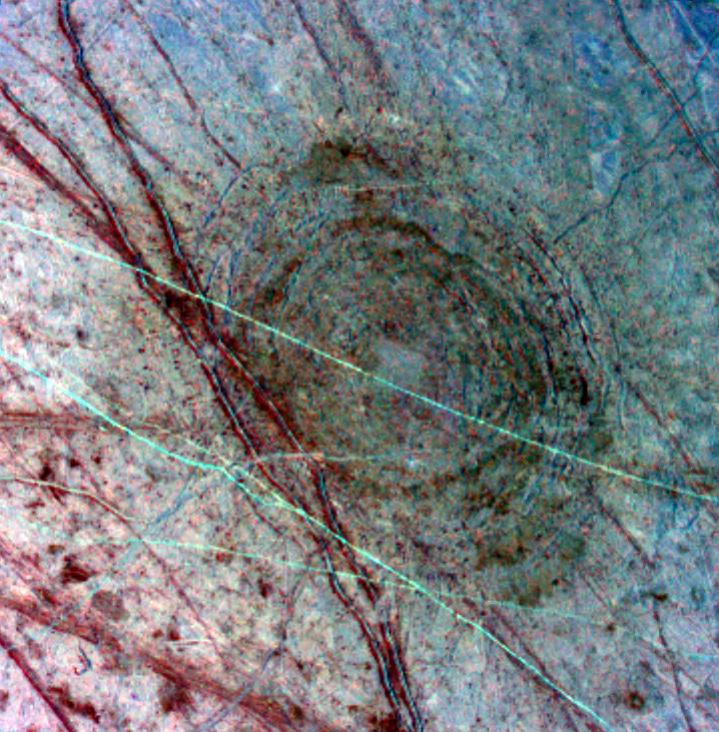
People who NASA find "too independent" to be astronauts will be the ones who find the horizon, and sail over the edge of the Earth, with the children of their minds and hands, finding it round, not flat, and greater than the empires of men.
Nothing succeeds like success. Or cake.
So by all means, let's avoid funding that at all costs.
It's almost week old news now, but
Of course, Dear Leader rushes in at the NIH to take immediate credit, but they know better, and as Think Progess notes from ABC News (watch the video clip):
Nothing succeeds like success, and Dear Leader is definitely the one to end the nightmare of peace, prosperity, and success.
Paul Krugman examines how Dear Leader will bring his Midas touch to the national health care affordability crisis, penalizing those people who commit the free market crime of having good health insurance from their employers:
Incredible, but Dear Leader has this way with words.
It's almost week old news now, but
Cancer deaths in the United States have dropped for a second straight year, confirming that a corner has been turned in the war on cancer. After a decline of 369 deaths from 2002 to 2003, the decrease from 2003 to 2004 was 3,014 - or more than eight times greater, according to a review of U.S. death certificates by the American Cancer Society.
The drop from 2002 to 2003 was the first annual decrease in total cancer deaths since 1930. But the decline was slight, and experts were hesitant to say whether it was a cause for celebration or just a statistical fluke.
The trend seems to be real, Cancer Society officials said.
"It's not only continuing. The decrease in the second year is much larger," said Ahmedin Jemal, a researcher at the organization...
Of course, Dear Leader rushes in at the NIH to take immediate credit, but they know better, and as Think Progess notes from ABC News (watch the video clip):
The total budget for the National Cancer Institute has increased $1.2 billion since 2001. But as ABC News’s Medical Editor(Timothy Johnson) pointed out last night, “most of that occurred in those early years under a Clinton initiative. The budget was actually cut last year and the projected budget for this year is to be cut even further. So, I think it’s a real tragedy that we are cutting the budget for the National Cancer Institute at a time we’re on the verge of many exciting discoveries.”
Nothing succeeds like success, and Dear Leader is definitely the one to end the nightmare of peace, prosperity, and success.
Paul Krugman examines how Dear Leader will bring his Midas touch to the national health care affordability crisis, penalizing those people who commit the free market crime of having good health insurance from their employers:
President Bush's Saturday radio address was devoted to health care, and officials have put out the word that the subject will be a major theme in tomorrow's State of the Union address. Mr. Bush's proposal won't go anywhere. But it's still worth looking at his remarks, because of what they say about him and his advisers.
On the radio, Mr. Bush suggested that we should "treat health insurance more like home ownership." He went on to say that "the current tax code encourages home ownership by allowing you to deduct the interest on your mortgage from your taxes. We can reform the tax code, so that it provides a similar incentive for you to buy health insurance."
Wow. Those are the words of someone with no sense of what it's like to be uninsured.
Going without health insurance isn't like deciding to rent an apartment instead of buying a house. It's a terrifying experience, which most people endure only if they have no alternative. The uninsured don't need an "incentive" to buy insurance; they need something that makes getting insurance possible.
Most people without health insurance have low incomes, and just can't afford the premiums. And making premiums tax-deductible is almost worthless to workers whose income puts them in a low tax bracket.
Of those uninsured who aren't low-income, many can't get coverage because of pre-existing conditions - everything from diabetes to a long-ago case of jock itch. Again, tax deductions won't solve their problem.
The only people the Bush plan might move out of the ranks of the uninsured are the people we're least concerned about - affluent, healthy Americans who choose voluntarily not to be insured. At most, the Bush plan might induce some of those people to buy insurance, while in the process - whaddya know - giving many other high-income individuals yet another tax break.
While proposing this high-end tax break, Mr. Bush is also proposing a tax increase - not on the wealthy, but on workers who, he thinks, have too much health insurance. The tax code, he said, "unwisely encourages workers to choose overly expensive, gold-plated plans. The result is that insurance premiums rise, and many Americans cannot afford the coverage they need."
Again, wow. No economic analysis I'm aware of says that when Peter chooses a good health plan, he raises Paul's premiums. And look at the condescension. Will all those who think they have "gold plated" health coverage please raise their hands?
According to press reports, the actual plan is to penalize workers with relatively generous insurance coverage. Just to be clear, we're not talking about the wealthy; we're talking about ordinary workers who have managed to negotiate better-than-average health plans...
Incredible, but Dear Leader has this way
with words.
Sunday, January 21, 2007
Because it's good for business?
Why did the Chinese knock down their old satellite?
Because of the mystique? Because inscrutability works better than bravado?
If Dear Leader's mouthpieces are spreading that, you can bet Hu Jintao knew exactly what they're doing.
Defense Tech has an interesting perspective to extend the Pravda:
You don't suppose the old Cold Warriors at the Pentagon (and Big Time Dick) asked 'em to try again?
Or maybe, since the Chinese own such a big piece of our own defense industries, they're just trying to keep up the price of their stock.
Because of the mystique? Because inscrutability works better than bravado?
WASHINGTON, Jan. 21 — Bush administration officials said that they had been unable to get even the most basic diplomatic response from China after their detection of a successful test to destroy a satellite 10 days ago, and that they were uncertain whether China’s top leaders, including President Hu Jintao, were fully aware of the test or the reaction it would engender.
...It was more than a week before the intelligence leaked out: a Chinese missile had been launched and an aging weather satellite in its path, more than 500 miles above the earth, had been reduced to rubble. But protests filed by the United States, Japan, Canada and Australia, among others, were met with silence — and quizzical looks from officials in The Chinese Foreign Ministry, who seemed to be caught unaware.
The mysteries surrounding China’s silence are reminiscent of the cold war, when every case of muscle-flexing by competing powers was examined for evidence of a deeper agenda.
The American officials presume that Mr. Hu was generally aware of the missile testing program, but speculate that he may not have known the timing of the test. China’s continuing silence would appear to suggest, at a minimum, that Mr. Hu did not anticipate a strong international reaction, either because he had not fully prepared for the possibility that the test would succeed, or because he did not foresee that American intelligence on it would be shared with allies, or leaked.
In an interview late Friday, Stephen J. Hadley, President Bush’s national security adviser, raised the possibility that China’s leaders might not have fully known what their military was doing...
If Dear Leader's mouthpieces are spreading that, you can bet Hu Jintao knew exactly what they're doing.
Defense Tech has an interesting perspective to extend the Pravda:
This was actually the fourth time the Chinese tried to destroy a satellite, GlobalSecurity.org notes. And as "reckless, self-defeating and stupid" as the test was, adds Arms Control Wonk Jeffrey Lewis, the test was legal, because there's "currently no prohibition on destructive ASAT [anti-satellite] testing. There should be."
...Last week's test has given a "shiver of hope" to the "nation’s star warriors, frustrated that their plans to arm the heavens went nowhere for two decades despite more than $100 billion in blue-sky research," Bill Broad says in a tart opinion piece.
You don't suppose the old Cold Warriors at the Pentagon (and Big Time Dick) asked 'em to try again?
Or maybe, since the Chinese own such a big piece of our own defense industries, they're just trying to keep up the price of their stock.
Mass Murderer
Leftiblog via George at skippy's place:

...Most people who pay attention to things like this probably know that the second person hanged was Saddam's half-brother and former intelligence chief, Barzam al-Tikriti, sometimes described as "one of the most feared men in Iraq." But what about the third victim of U.S. "justice"? That was a man named Awad Hamad al-Bandar, who was the judge in the two-year trial which resulted in the conviction and eventual hanging of 148 men for the attempted assassination of Saddam Hussein. His "crime" was signing the death warrants of 148 people, 4 fewer than signed by George Bush while he was governor of Texas.
Our Allies in the War on Terra
QUETTA, Pakistan — The most explosive question about the Taliban resurgence here along the border between Afghanistan and Pakistan is this: Have Pakistani intelligence agencies been promoting the Islamic insurgency?
Does a bear defecate in the arbor?
The government of Pakistan vehemently rejects the allegation and insists that it is fully committed to help American and NATO forces prevail against the Taliban militants who were driven from power in Afghanistan in 2001.
Western diplomats in both countries and Pakistani opposition figures say that Pakistani intelligence agencies — in particular the powerful Inter-Services Intelligence and Military Intelligence — have been supporting a Taliban restoration, motivated not only by Islamic fervor but also by a longstanding view that the jihadist movement allows them to assert greater influence on Pakistan’s vulnerable western flank...
So next time you hear all the breathless panic about Iran getting nukes, and what they'll do with them, remember these guys not only financially support Al Qaeda, they airlifted Osama out of Tora Bora and likely smuggled him back to Riyadh, where he hides in the family palace with all the comforts of home.
Magical Thinking
Dear Leader's Faithful base is still in deep denial that we imported Negroponte into Iraq to organize the death squads- on both Shia and Sunni sides. As well as the sides of mercenaries posing as Shia and Sunni. It doesn't matter that the likes of Rumsfeld called for that just before the installation of Negroponte and the acceleration of the insurgency. It doesn't matter the likes of Sy Hersch extensively documented it. It doesn't matter kidnappers wear police unifroms.
It doesn't matter how much it gets documented.
They, and their cohorts, call reality-based conclusions like that deep paranoia.
I call their assertations at best magical thinking, at all times disinformation, and at worst downright lies.
No Hell below us
Above us, only sky
It doesn't matter how much it gets documented.
They, and their cohorts, call reality-based conclusions like that deep paranoia.
I call their assertations at best magical thinking, at all times disinformation, and at worst downright lies.
No Hell below us
Above us, only sky
Saturday, January 20, 2007
Keeping only the best prosecutors money can buy.

How unfair. That hardly begins to touch what these crooks have accomplished.

Krugman:
There's something happening here, and what it is seems completely clear: the Bush administration is trying to protect itself by purging independent-minded prosecutors.
Last month, Bud Cummins, the U.S. attorney (federal prosecutor) for the Eastern District of Arkansas, received a call on his cellphone while hiking in the woods with his son. He was informed that he had just been replaced by J. Timothy Griffin, a Republican political operative who has spent the last few years working as an opposition researcher for Karl Rove.
Mr. Cummins's case isn't unique. Since the middle of last month, the Bush administration has pushed out at least four U.S. attorneys, and possibly as many as seven, without explanation. The list includes Carol Lam, the U.S. attorney for San Diego, who successfully prosecuted Duke Cunningham, a Republican congressman, on major corruption charges. The top F.B.I. official in San Diego told The San Diego Union-Tribune that Ms. Lam's dismissal would undermine multiple continuing investigations.
In Senate testimony yesterday, Attorney General Alberto Gonzales refused to say how many other attorneys have been asked to resign, calling it a "personnel matter."
In case you're wondering, such a wholesale firing of prosecutors midway through an administration isn't normal. U.S. attorneys, The Wall Street Journal recently pointed out, "typically are appointed at the beginning of a new president's term, and serve throughout that term." Why, then, are prosecutors that the Bush administration itself appointed suddenly being pushed out?
The likely answer is that for the first time the administration is really worried about where corruption investigations might lead...

Move along, move along... while we're raiding Pravda, Frank Rich on the subject:
...The DeLay and Abramoff investigations are not to be confused with the many others percolating in the capital, including, most famously of late, the Justice Department and S.E.C. inquiries into the pious Bill Frist's divine stock-sale windfall and the homeland security inspector general's promised inquiry into possible fraud in the no-bid contracts doled out by FEMA for Hurricane Katrina. The mother of all investigations, of course, remains the prosecutor Patrick Fitzgerald's pursuit of whoever outed the C.I.A. agent Valerie Wilson to Robert Novak and whoever may have lied to cover it up. The denouement is on its way.
But whatever the resolution of any of these individual dramas, they will not be the end of the story. Like the continuing revelations of detainee abuse emerging from Afghanistan, Iraq and Guantánamo, this is a crisis in the governing culture, not the tale of a few bad apples. Every time you turn over a rock, you find more vermin. We've only just learned from The Los Angeles Times that Joseph Schmitz, until last month the inspector general in charge of policing waste, fraud and abuse at the Pentagon, is himself the focus of a Congressional inquiry. He is accused of blocking the investigation of another Bush appointee who is suspected of siphoning Iraq reconstruction contracts to business cronies. At the Justice Department, the F.B.I. is looking into why a career prosecutor was demoted after he started probing alleged Abramoff illegality in Guam. According to The Los Angeles Times, the demoted prosecutor was then replaced by a Rove-approved Republican pol who just happened to be a cousin of a major target of another corruption investigation in Guam.
We have to hope that the law will get to the bottom of these cases and start to connect the recurring dots. But while everyone is innocent until proved guilty, the overall pattern stinks and has for a long time. It's so filthy that the Republican caucus couldn't even find someone clean to name as Mr. DeLay's "temporary" stand-in as House majority leader last week. As The Washington Post reported in 2003, Roy Blunt, the Missouri congressman who got the job, was found trying to alter a homeland security bill with a last-minute provision that would have benefited Philip Morris-brand cigarettes. Not only had the tobacco giant contributed royally to Mr. Blunt's various campaign coffers, but both the congressman's girlfriend (now wife) and his son were Philip Morris lobbyists at the time.
This is the culture that has given us the government we have. It's a government that has spent more of the taxpayers' money than any since L.B.J.'s (as calculated by the Cato Institute, a libertarian research institution), even as it rewards its benefactors with tax breaks and corporate pork. It's a government so used to lying that Mr. DeLay could say with a straight face that the cost of Katrina relief could not be offset by budget cuts because there was no governmental fat left to cut. It's the government that fostered the wholesale loss of American lives in both Iraq and on the Gulf Coast by putting cronyism above patriotism.
The courts can punish crooks, but they can't reform democracy from the ground up, and the voters can't get into the game until 2006. Meanwhile, on the Republican side, the key players both in the White House and in the leadership of both houses of Congress are either under investigation or joined at the hip to Messrs Rove, DeLay, Abramoff, Reed or Norquist. They seem to be hoping that some magical event - a sudden outbreak of peace and democracy in Iraq, the capture of Osama bin Laden, a hurricane affording better presidential photo ops than Rita - will turn things around. Dream on...
Let's sing along together (to the tune of "The Aadams Family"):
They're shady and they're naughty,
Imperious and haughty.
Pretending that they're doughty.
The Bush crime family.
Their crime spans generations.
They've preyed upon our nation,
Through two administrations.
The Bush crime family.
Pop's Iran-Contra pardons,
To bombing Saddam's gardens;
Their lust for war just hardens
The Bush crime family.

Conspiracy Fact
Weapons grade anthrax was delivered to Democrats and major news outlets critical of Bu$hCo- not to Rethuglicans or Faux News.
But nothing to see here, move along, move along, these aren't the droids you're looking for.
But nothing to see here, move along, move along,
these aren't the droids you're looking for.
Friday, January 19, 2007
Dis Information
Urban Terra Legend category:
There's another legend that needs debunking out there [via Lambert, who does a great job deconstructing it too]. He has the ears of the Bu$h crime family, just like he served as Sith Lord under Tricky Dicky. He's reluctant about saying too much in public here at home, but he's quite willing to talk to the Royals in the United Arab Emirates. Read his words with care, because he should be treated with some sympathy, and some taste. Use all your well-learned polities or he'll lay your soul to waste:
The Baker-Hamilton commission has powerfully described the impasse on the ground. It is the result of cumulative choices — some of them enumerated by the president — in which worthy (Lie- no, wait, worth about a trillion dollars so far) objectives and fundamental (as fundamental as the dollar) American values clashed with regional and cultural realities.
The important goal of modernising US armed forces led to inadequate troop levels for the military occupation of Iraq. The reliance on early rigged elections as the key to political evolutionof a puppet government, in a country lacking a sense of national identity that Junior and Poppy approved of, caused the newly enfranchised to vote almost exclusively for sectarian parties, deepening historic divisions into chasms. The understandable if you're doing 300 µgs of LSD-25 — but, in retrospect, premature i.e., dumb as a rock — strategery of replacing American with indigenous forces deflected US forces from a military mission; nor could it deal with the most flagrant shortcoming of Iraqi forces, which is to define what the Iraqi forces are supposed to fight for and under what banner. Whopper. So they didn't want to fight so Cheneyburton could run their oil wells. Encouraging Faith-based government is bound to cause problems when every city block has its own private hot line to God.
These circumstances have merged into an almost perfect storm of mutually reinforcing crises: Within Iraq, the sectarian militias are engaged in civil war or so close to it as to make little practical difference. The conflict between Shias and Sunnis goes back 1,400 years. In most Middle Eastern countries, Shia minorities coexist precariously with Sunni majorities. The civil war in Iraq threatens to usher in a cycle of domestic upheavals and a war between Shia and Sunni states, with a high potential of drawing in countries from outside the region. In addition, the Kurds of Iraq seek full autonomy from both Sunnis and Shias; their independence would raise the prospect of intervention from Turkey and possibly Iran. Perfect, that is, if you make money selling munitions and running private security concerns.
The war in Iraq is part of another war that cuts across the Shia-Sunni issue: the assault on the international order conducted by radical groups in both Islamic sects. Functioning as states within the states and by brutal demonstrations of the inability of established governments to protect their populations, such organisations as Hezbollah in Lebanon, the Mahdi army in Iraq and the Al Qaeda groups all over the Middle East seek to reassert an Islamic identity submerged, in their view, by Western secular institutions and values. But mostly they really seek that huge pile of cash King Abdullah sits on top of. Any enhancement of radical Islamist self-confidence therefore threatens all the traditional states of the region, as well as others with significant Islamic populations, from Indonesia through India to Western Europe. Of course, we've done an excellent job of that by listening to the PNAC, the AEI, and pompous asses like you, Henry. The most important target is the United States, as the most powerful country of the West and the indispensable component of any attempt to build a new world order, owned largely by major lienholders like King Abdullah of Saudi Arabia..
The disenchantment of the American public with the burdens it has borne alone for nearly four years has generated growing demands for some form of unilateral withdrawal, usually expressed in the form of benchmarks to be put to the Baghdad government which, if not fulfilled in specific time periods, would trigger American disengagement.
But under present conditions, withdrawal is not an option. Or so I, Henry Kissinger, apologist for the Mighty, hope. Without this lovely bloodshed I'd be staring at the walls of a retirement or maybe even a prison cell, thinking about the millions of deaths my bloated self-promotion has caused over the last 50 years. American forces are indispensable. They are in Iraq not as a favour to its government or as a reward for its conduct. They are there as an expression of the American national interest to prevent the Iranian combination of imperialism and fundamentalist ideology from dominating a region on which the energy supplies of the industrial democracies depend. Jackpot. Money quote. We didn't go in to topple Saddam. We went in to take the oil for our very own. Remember, he's talking to Sunni fundamentalists in the Emirates, and he wants to scare their robes off- and raid their Treasuries, too.
Now, for the Dominos, just like Southeast Asia in the '70s:
An abrupt American departure will greatly complicate efforts to help stem the terrorist tide far beyond Iraq; fragile governments from Lebanon to the Gulf will be tempted into pre-emptive concessions. It might drive the sectarian conflict within Iraq to genocidal dimensions beyond levels that impelled American intervention in the Balkans. Graduated withdrawal would not ease these dangers until a different strategy is in place and shows some progress. For now, it would be treated both within Iraq and in the region as the forerunner of a total withdrawal, and all parties would make their dispositions on that basis. See? I told you he was da Best
President Bush’s decision should therefore not be debated in terms of the “stay the course” strategy he has repeatedly disavowed in recent days. Rather it should be seen as the first step towards a new grand strategy relating power to diplomacy for the entire region, ideally on a nonpartisan basis. Every strategery Henry the K. ever dreamed up was Grand. It was inevitable and natural he would team up with Karl Rove and Big Time Dick. It would have happened sooner, but he and Darth Rumsfeld always got along like sodium metal and water.
The purpose of the new strategy should be to demonstrate that the US is determined to remain relevant to the outcome in the region; to adjust American military deployments and numbers to emerging realities; and to provide the maneuvering room for a major diplomatic effort to stabilise the region. Relevant. Henry, your '70s jargon is showing. But that's a fine fluff paragraph, isn't it?
Of the current security threats in Iraq — the intervention of outside countries, the presence of Al Qaeda fighters, an extraordinarily large criminal element, the sectarian conflict — the United States has a national interest in defeating the first two (in other words, we're going to dream up as many AlQaedaIranofascists as we possibly can, whether they're really there or not. And ignore any evidence that says all the civilians we're murdering are affiliated with neither Al Qaeda or the Iranian government); it must not involve itself in the sectarian conflict for any extended period, much less let itself be used by one side for its own sectarian goals. On the other hand, our Special Forces/mercenaries death squads private security forces will be doing their best to divide and conquer along these lines.
The sectarian conflict confines the Iraqi government’s unchallenged writ to the sector of Baghdad defined as the Green Zone protected by American forces. In many areas the militias exceed the strength of the Iraqi national army. Appeals to the Iraqi government to undertake reconciliation and economic reforms are not implemented, partly because the will to do so is absent but essentially because it lacks the power to put such policies in place, even if the will to do so could suddenly be mobilised. If the influence of the militias can be eliminated — or greatly reduced — the Baghdad government would have a better opportunity to pursue a national policy. So let's avoid that, and instead use the militias for our own purposes, shall we?
The new strategy has begun with attempts toethnically cleanse clear the insurrectional Sunni parts of Baghdad. But it must not appear to turn into ethnic cleansing or the emergence of another tyrannical state, only with a different sectarian allegiance. Side by side with disarming the Sunni militias and death squads, the Baghdad government must show comparable willingness to disarm Shia militias and death squads that we don't control, anyway. American policy should not deviate from the goal of a civil state, whose political process is available to all citizens.
As the comprehensive strategy evolves, a repositioning of American forces from the cities into enclaves should be undertaken so that they can separate themselves from the civil war and concentrate on the threats described above. Rock da Casbah, baby. The principal mission would be to protect the borders against infiltration, to prevent the establishment of terrorist training areas or Taleban-type control over significant regions. At that point, too, significant reductions of American forces should be possible. Such a strategy would make withdrawals depend on conditions on the ground instead of the other way around. It could also provide the time to elaborate a cooperative diplomacy for rebuilding the region, including progress towards a settlement of the Palestine issue.
For such a strategy, it is not possible to jettison the military instrument and rely, as some argue, on purely political means. A free-standing diplomacy is an ancient American illusion. History offers few examples of it. The attempt to separate diplomacy and power results in power lacking direction and diplomacy being deprived of incentives. Or like my old buddy Mao used to kid, Power issues from the barrel of a gun.
Diplomacy is the attempt to persuade another party to pursue a course compatible with a society’s strategic interests. Obviously this involves the ability to create a calculus that impels or rewards the desired direction. The outcome, by definition, is rarely the ability to impose one’s will but a compromise that gives each party a stake in maintaining it.
Few diplomatic challenges are as complex as that surrounding Iraq. Diplomacy must mediate between Iraqi sects which, though in many respects mortal enemies, are assembled in a common governmental structure. It needs to relate that process to an international concept involving both Iraq’s neighbours and countries further away that have a significant interest in the outcome.
Two levels of diplomatic effort are necessary:
(1) The creation of a contact group, assembling neighbouring countries whose interests are directly affected and which rely on American support. This group should include Turkey, Saudi Arabia, Egypt and Jordan. Its function should be to advise on ending the internal conflict and to create a united front against outside domination. You suckahs gotta sit down and lissen to me, ya hear?
(2) Parallel negotiations should be conducted with Syria and Iran, which now appear as adversaries, to give them an opportunity to participate in a peaceful regional order. Both categories of consultations should lead to an international conference including all countries that will have to play a stabilising role in the eventual outcome, specifically the permanent members of the UN Security Council as well as such countries as Indonesia, India and Pakistan. Recall his buddy Mao's statement again. He favors negotiation a la Bruce Willis.
Too much of the current discussion focuses on the procedural aspect of starting a dialogue with adversaries. The frakin' table will be round, beotches. In fact, a balance of risks and opportunities needs to be created so that Iran is obliged to choose between a significant but not dominant role (bottoms only!) or riding the crest of Shia fundamentalism. In the latter case, it must pay a serious, not a rhetorical, price for choosing the militant option. An outcome in which Iran is approaching nuclear status, because of hesitant and timid non-proliferation policies in the UN Security Council, coupled with a political vacuum in front of it in the region must lead to catastrophic consequences. And by all means, make 'em choose quick before they get rid of their pro-nuclear figure head.
Similar principles apply to the prospects for settlement in Palestine. Moderates in both the Arab countries neighbouring Israel and in Israel are evolving compromises unimaginable a decade ago. But if the necessary outcomes are perceived as the result of panic by moderates and an exit from the region by the United States, radicals could raise unfulfillable demands and turn the peace process against the moderates. He do love his Dominoes.
In all this, the United States cannot indefinitely bear alone the burden for both the military outcome and the political structure. At some point, Iraq has to be restored to the international community, and other countries must be prepared to share responsibilities for regional peace. Some of America’s allies and other affected countries seek to escape the upheavals all around them by disassociating from the United States. But just as it is impossible for America to deal with these trends unilaterally, sooner or later a common effort to rebuild the international order (i.e., the New World Order, beotches) will be imposed on all the potential targets. The time has come for an effort to define the shoals within which diplomacy is obliged to navigate and to anchor any outcome in some broader understanding that accommodates the interests of the affected parties. And believe it, this chump will navigate dragging his anchor to keep the war at sea.
[Henry A Kissinger, a former US secretary of state, is considered the architect of US foreign policy during the Cold War] That is, in keeping the Cold War bucks rolling on in.
WASHINGTON: Reversing itself, the Defense Department now acknowledges that a U.S. government espionage report it produced warning about Canadian coins with tiny radio frequency transmitters hidden inside was not true.
The Defense Security Service said it never could substantiate its own published claims about the mysterious coins. It has launched an internal review to determine how the false information was included in a 29-page report about espionage concerns.
The service originally had warned such coins were found planted on U.S. contractors with classified security clearances on at least three separate occasions between October 2005 and January 2006 as the contractors traveled through Canada.
"The allegations, however, were found later to be unsubstantiated following an investigation into the matter," the agency said in a statement published on its Web site.
Intelligence and technology experts were flabbergasted over the initial report, which suggested such transmitters could be used to surreptitiously track the movements of people carrying the coins...
The now-disavowed U.S. report never suggested who might be tracking American defense contractors or why. It also never described how the Pentagon discovered the purported ruse, how the transmitters functioned or even which Canadian currency allegedly contained them.
The service initially maintained that its report on the spy coins was accurate but said further details about the spy coins were classified.
The government's report was filled with other espionage warnings. It described unrelated hacker attacks, eavesdropping with miniature pen recorders and the case of a female foreign spy who seduced her American boyfriend to steal his computer passwords.
There's another legend that needs debunking out there [via Lambert, who does a great job deconstructing it too]. He has the ears of the Bu$h crime family, just like he served as Sith Lord under Tricky Dicky. He's reluctant about saying too much in public here at home, but he's quite willing to talk to the Royals in the United Arab Emirates. Read his words with care, because he should be treated with some sympathy, and some taste. Use all your well-learned polities or he'll lay your soul to waste:
PRESIDENT George W Bush’s bold decision to order a “surge” of some 20,000 American troops for Iraq has brought the debate over the war to a defining stage. There will not be opportunity for another reassessment.Lie. Every moment we're there we can and should reassess.
The Baker-Hamilton commission has powerfully described the impasse on the ground. It is the result of cumulative choices — some of them enumerated by the president — in which worthy (Lie- no, wait, worth about a trillion dollars so far) objectives and fundamental (as fundamental as the dollar) American values clashed with regional and cultural realities.
The important goal of modernising US armed forces led to inadequate troop levels for the military occupation of Iraq. The reliance on early rigged elections as the key to political evolutionof a puppet government, in a country lacking a sense of national identity that Junior and Poppy approved of, caused the newly enfranchised to vote almost exclusively for sectarian parties, deepening historic divisions into chasms. The understandable if you're doing 300 µgs of LSD-25 — but, in retrospect, premature i.e., dumb as a rock — strategery of replacing American with indigenous forces deflected US forces from a military mission; nor could it deal with the most flagrant shortcoming of Iraqi forces, which is to define what the Iraqi forces are supposed to fight for and under what banner. Whopper. So they didn't want to fight so Cheneyburton could run their oil wells. Encouraging Faith-based government is bound to cause problems when every city block has its own private hot line to God.
These circumstances have merged into an almost perfect storm of mutually reinforcing crises: Within Iraq, the sectarian militias are engaged in civil war or so close to it as to make little practical difference. The conflict between Shias and Sunnis goes back 1,400 years. In most Middle Eastern countries, Shia minorities coexist precariously with Sunni majorities. The civil war in Iraq threatens to usher in a cycle of domestic upheavals and a war between Shia and Sunni states, with a high potential of drawing in countries from outside the region. In addition, the Kurds of Iraq seek full autonomy from both Sunnis and Shias; their independence would raise the prospect of intervention from Turkey and possibly Iran. Perfect, that is, if you make money selling munitions and running private security concerns.
The war in Iraq is part of another war that cuts across the Shia-Sunni issue: the assault on the international order conducted by radical groups in both Islamic sects. Functioning as states within the states and by brutal demonstrations of the inability of established governments to protect their populations, such organisations as Hezbollah in Lebanon, the Mahdi army in Iraq and the Al Qaeda groups all over the Middle East seek to reassert an Islamic identity submerged, in their view, by Western secular institutions and values. But mostly they really seek that huge pile of cash King Abdullah sits on top of. Any enhancement of radical Islamist self-confidence therefore threatens all the traditional states of the region, as well as others with significant Islamic populations, from Indonesia through India to Western Europe. Of course, we've done an excellent job of that by listening to the PNAC, the AEI, and pompous asses like you, Henry. The most important target is the United States, as the most powerful country of the West and the indispensable component of any attempt to build a new world order, owned largely by major lienholders like King Abdullah of Saudi Arabia..
The disenchantment of the American public with the burdens it has borne alone for nearly four years has generated growing demands for some form of unilateral withdrawal, usually expressed in the form of benchmarks to be put to the Baghdad government which, if not fulfilled in specific time periods, would trigger American disengagement.
But under present conditions, withdrawal is not an option. Or so I, Henry Kissinger, apologist for the Mighty, hope. Without this lovely bloodshed I'd be staring at the walls of a retirement or maybe even a prison cell, thinking about the millions of deaths my bloated self-promotion has caused over the last 50 years. American forces are indispensable. They are in Iraq not as a favour to its government or as a reward for its conduct. They are there as an expression of the American national interest to prevent the Iranian combination of imperialism and fundamentalist ideology from dominating a region on which the energy supplies of the industrial democracies depend. Jackpot. Money quote. We didn't go in to topple Saddam. We went in to take the oil for our very own. Remember, he's talking to Sunni fundamentalists in the Emirates, and he wants to scare their robes off- and raid their Treasuries, too.
Now, for the Dominos, just like Southeast Asia in the '70s:
An abrupt American departure will greatly complicate efforts to help stem the terrorist tide far beyond Iraq; fragile governments from Lebanon to the Gulf will be tempted into pre-emptive concessions. It might drive the sectarian conflict within Iraq to genocidal dimensions beyond levels that impelled American intervention in the Balkans. Graduated withdrawal would not ease these dangers until a different strategy is in place and shows some progress. For now, it would be treated both within Iraq and in the region as the forerunner of a total withdrawal, and all parties would make their dispositions on that basis. See? I told you he was da Best
President Bush’s decision should therefore not be debated in terms of the “stay the course” strategy he has repeatedly disavowed in recent days. Rather it should be seen as the first step towards a new grand strategy relating power to diplomacy for the entire region, ideally on a nonpartisan basis. Every strategery Henry the K. ever dreamed up was Grand. It was inevitable and natural he would team up with Karl Rove and Big Time Dick. It would have happened sooner, but he and Darth Rumsfeld always got along like sodium metal and water.
The purpose of the new strategy should be to demonstrate that the US is determined to remain relevant to the outcome in the region; to adjust American military deployments and numbers to emerging realities; and to provide the maneuvering room for a major diplomatic effort to stabilise the region. Relevant. Henry, your '70s jargon is showing. But that's a fine fluff paragraph, isn't it?
Of the current security threats in Iraq — the intervention of outside countries, the presence of Al Qaeda fighters, an extraordinarily large criminal element, the sectarian conflict — the United States has a national interest in defeating the first two (in other words, we're going to dream up as many AlQaedaIranofascists as we possibly can, whether they're really there or not. And ignore any evidence that says all the civilians we're murdering are affiliated with neither Al Qaeda or the Iranian government); it must not involve itself in the sectarian conflict for any extended period, much less let itself be used by one side for its own sectarian goals. On the other hand, our Special Forces/
The sectarian conflict confines the Iraqi government’s unchallenged writ to the sector of Baghdad defined as the Green Zone protected by American forces. In many areas the militias exceed the strength of the Iraqi national army. Appeals to the Iraqi government to undertake reconciliation and economic reforms are not implemented, partly because the will to do so is absent but essentially because it lacks the power to put such policies in place, even if the will to do so could suddenly be mobilised. If the influence of the militias can be eliminated — or greatly reduced — the Baghdad government would have a better opportunity to pursue a national policy. So let's avoid that, and instead use the militias for our own purposes, shall we?
The new strategy has begun with attempts to
As the comprehensive strategy evolves, a repositioning of American forces from the cities into enclaves should be undertaken so that they can separate themselves from the civil war and concentrate on the threats described above. Rock da Casbah, baby. The principal mission would be to protect the borders against infiltration, to prevent the establishment of terrorist training areas or Taleban-type control over significant regions. At that point, too, significant reductions of American forces should be possible. Such a strategy would make withdrawals depend on conditions on the ground instead of the other way around. It could also provide the time to elaborate a cooperative diplomacy for rebuilding the region, including progress towards a settlement of the Palestine issue.
For such a strategy, it is not possible to jettison the military instrument and rely, as some argue, on purely political means. A free-standing diplomacy is an ancient American illusion. History offers few examples of it. The attempt to separate diplomacy and power results in power lacking direction and diplomacy being deprived of incentives. Or like my old buddy Mao used to kid, Power issues from the barrel of a gun.
Diplomacy is the attempt to persuade another party to pursue a course compatible with a society’s strategic interests. Obviously this involves the ability to create a calculus that impels or rewards the desired direction. The outcome, by definition, is rarely the ability to impose one’s will but a compromise that gives each party a stake in maintaining it.
Few diplomatic challenges are as complex as that surrounding Iraq. Diplomacy must mediate between Iraqi sects which, though in many respects mortal enemies, are assembled in a common governmental structure. It needs to relate that process to an international concept involving both Iraq’s neighbours and countries further away that have a significant interest in the outcome.
Two levels of diplomatic effort are necessary:
(1) The creation of a contact group, assembling neighbouring countries whose interests are directly affected and which rely on American support. This group should include Turkey, Saudi Arabia, Egypt and Jordan. Its function should be to advise on ending the internal conflict and to create a united front against outside domination. You suckahs gotta sit down and lissen to me, ya hear?
(2) Parallel negotiations should be conducted with Syria and Iran, which now appear as adversaries, to give them an opportunity to participate in a peaceful regional order. Both categories of consultations should lead to an international conference including all countries that will have to play a stabilising role in the eventual outcome, specifically the permanent members of the UN Security Council as well as such countries as Indonesia, India and Pakistan. Recall his buddy Mao's statement again. He favors negotiation a la Bruce Willis.
Too much of the current discussion focuses on the procedural aspect of starting a dialogue with adversaries. The frakin' table will be round, beotches. In fact, a balance of risks and opportunities needs to be created so that Iran is obliged to choose between a significant but not dominant role (bottoms only!) or riding the crest of Shia fundamentalism. In the latter case, it must pay a serious, not a rhetorical, price for choosing the militant option. An outcome in which Iran is approaching nuclear status, because of hesitant and timid non-proliferation policies in the UN Security Council, coupled with a political vacuum in front of it in the region must lead to catastrophic consequences. And by all means, make 'em choose quick before they get rid of their pro-nuclear figure head.
Similar principles apply to the prospects for settlement in Palestine. Moderates in both the Arab countries neighbouring Israel and in Israel are evolving compromises unimaginable a decade ago. But if the necessary outcomes are perceived as the result of panic by moderates and an exit from the region by the United States, radicals could raise unfulfillable demands and turn the peace process against the moderates. He do love his Dominoes.
In all this, the United States cannot indefinitely bear alone the burden for both the military outcome and the political structure. At some point, Iraq has to be restored to the international community, and other countries must be prepared to share responsibilities for regional peace. Some of America’s allies and other affected countries seek to escape the upheavals all around them by disassociating from the United States. But just as it is impossible for America to deal with these trends unilaterally, sooner or later a common effort to rebuild the international order (i.e., the New World Order, beotches) will be imposed on all the potential targets. The time has come for an effort to define the shoals within which diplomacy is obliged to navigate and to anchor any outcome in some broader understanding that accommodates the interests of the affected parties. And believe it, this chump will navigate dragging his anchor to keep the war at sea.
[Henry A Kissinger, a former US secretary of state, is considered the architect of US foreign policy during the Cold War] That is, in keeping the Cold War bucks rolling on in.
Subscribe to:
Posts (Atom)