The reconstructions used, in order from oldest to most recent publication are:
1. (dark blue 1000-1991): P.D. Jones, K.R. Briffa, T.P. Barnett, and S.F.B. Tett (1998). "High-resolution Palaeoclimatic Records for the last Millennium: Interpretation, Integration and Comparison with General Circulation Model Control-run Temperatures". The Holocene 8: 455-471. DOI:10.1191/095968398667194956
2. (blue 1000-1980): M.E. Mann, R.S. Bradley, and M.K. Hughes (1999). "Northern Hemisphere Temperatures During the Past Millennium: Inferences, Uncertainties, and Limitations". Geophysical Research Letters 26 (6): 759-762. DOI:10.1029/1999GL900070 (pre-print)
3. (light blue 1000-1965): Crowley and Lowery (2000). "Northern Hemisphere Temperature Reconstruction". Ambio 29: 51-54. Modified as published in Crowley (2000). "Causes of Climate Change Over the Past 1000 Years". Science 289: 270-277. DOI:10.1126/science.289.5477.270 (data available from NCDC : [2])
4. (lightest blue 1402-1960): K.R. Briffa, T.J. Osborn, F.H. Schweingruber, I.C. Harris, P.D. Jones, S.G. Shiyatov, S.G. and E.A. Vaganov (2001). "Low-frequency temperature variations from a northern tree-ring density network". J. Geophys. Res. 106: 2929-2941. DOI:10.1029/2000JD900617
5. (light green 831-1992): J. Esper, E.R. Cook, and F.H. Schweingruber (2002). "Low-Frequency Signals in Long Tree-Ring Chronologies for Reconstructing Past Temperature Variability". Science 295 (5563): 2250-2253. DOI:10.1126/science.1066208
6. (yellow 200-1980): M.E. Mann and P.D. Jones (2003). "Global Surface Temperatures over the Past Two Millennia". Geophysical Research Letters 30 (15): 1820. DOI:10.1029/2003GL017814.
7. (orange 200-1995): P.D. Jones and M.E. Mann (2004). "Climate Over Past Millennia". Reviews of Geophysics 42: RG2002. DOI:10.1029/2003RG000143
8. (red-orange 1500-1980): S. Huang (2004). "Merging Information from Different Resources for New Insights into Climate Change in the Past and Future". Geophys. Res Lett. 31: L13205. DOI:10.1029/2004GL019781
9. (red 1-1979): A. Moberg, D.M. Sonechkin, K. Holmgren, N.M. Datsenko and W. Karlén (2005). "Highly variable Northern Hemisphere temperatures reconstructed from low- and high-resolution proxy data". Nature 443: 613-617. DOI:10.1038/nature03265
10. (dark red 1600-1990): J.H. Oerlemans (2005). "Extracting a Climate Signal from 169 Glacier Records". Science 308: 675-677. DOI:10.1126/science.1107046
11. (black 1856-2004): Instrumental data was jointly compiled by the Climatic Research Unit and the UK Meteorological Office Hadley Centre. Global Annual Average data set TaveGL2v [3] was used.
Documentation for the most recent update of the CRU/Hadley instrumental data set appears in: P.D. Jones and A. Moberg (2003). "Hemispheric and large-scale surface air temperature variations: An extensive revision and an update to 2001". Journal of Climate 16: 206-223. DOI:10.1175/1520-0442(2003)016<0206:HALSSA>2.0.CO;2
Velociraptors or their reasonable facsimilies may end up stalking the swamps of Montana again
.

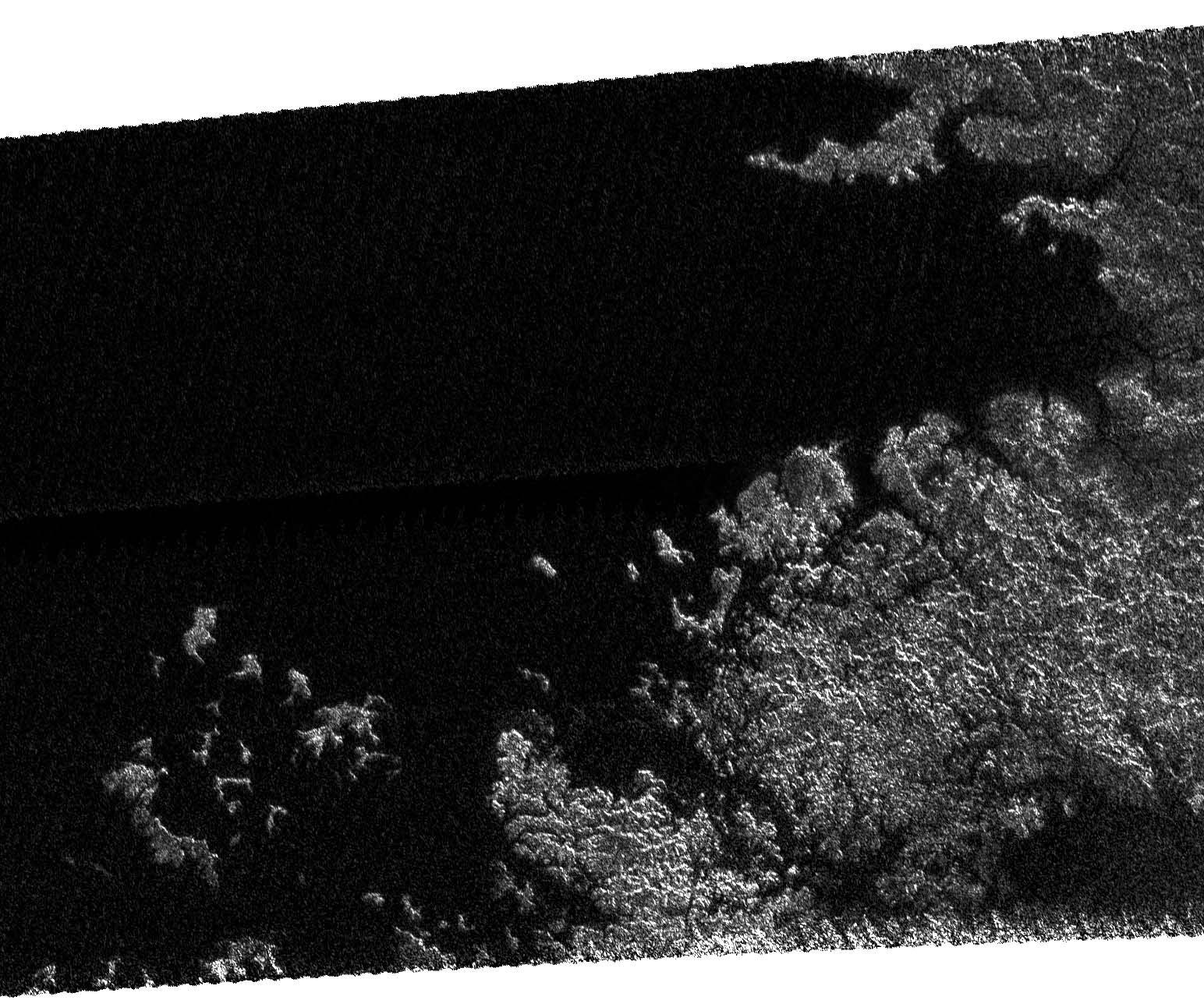
What is this vast dark region on Titan? Quite possible a sea of liquid hydrocarbons. The region was imaged earlier this month when the robotic Cassini spacecraft swooped past Saturn's cloudy moon and illuminated part of it with radar. The dark region in the above image reflected little radar, an effect expected were the dark surface relatively flat, as expected for a liquid. Other indications that the vast dark area is liquid include the coastline-like topology of the brighter regions, which appear to include islands, inlets, and tributary channels. The uninterrupted smoothness of much of the dark sea may indicate that the sea runs deep, with speculation holding a depth estimate of tens of meters. A hydrocarbon sea on Titan holds particular interest for exobiologists as it might be a place where life could develop. In 2005 the Huygens probe landed on Titan and returned the first surface images. Cassini will continue to explore Titan, as 13 more flybys are planned.

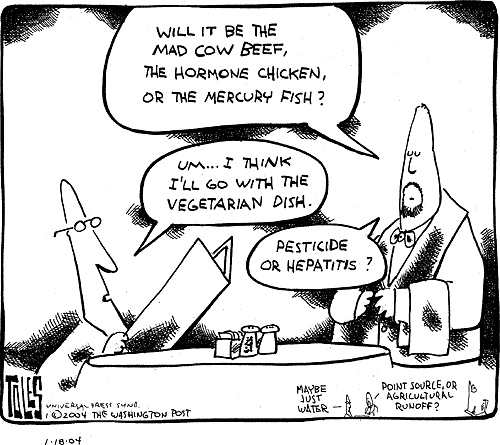
"The Bush administration said Tuesday it will fight to keep meatpackers from testing all their animals for mad cow disease...
"A beef producer in the western state of Kansas, Creekstone Farms Premium Beef, wants to test all of its cows...
"Larger meat companies feared that move because, if Creekstone should test its meat and advertised it as safe, they might have to perform the expensive tests on their larger herds as well.
"The Agriculture Department regulates the test and argued that widespread testing could lead to a false positive that would harm the meat industry."
...When E. coli conservatives say self-regulation is preferable to government, they're even lying about that. Second, observe the contempt for small business. When a small company want to - voluntarily! - hold its product to a higher standard, the government blocks it, in part because bigger companies have to be protected from the competition, in part because a theoretical threat to the bottom line (false positives) trumps protection against a deadly disease.
There's your conservatism, America: not extremism in defense of liberty. State socialism in defense of Mad Cow.
...Bush's push to the Chinese to accept US beef was the latest stab at so-called "cheeseburger diplomacy" to try to get major trading partners like China, Japan and South Korea to remove curbs on US beef imports.
The barriers were erected over fears that US beef is tainted with bovine spongiform encephalopathy, the brain-wasting condition commonly known as mad-cow disease...
, do you?
The Coal Trap
Published: May 30, 2007
There is a rule for judging solutions to the twin problems of energy dependence and global warming: A policy designed to solve one problem should not make the other worse. But that is a likely outcome of the many “energy independence” bills circulating in Congress that aim to build a whole new generation of coal-to-liquid plants to convert coal into automotive fuel.
These bills have already acquired an enthusiastic constituency and will be offered as amendments to what is now a relatively simple and sound energy bill designed to increase the fuel efficiency of cars and light trucks, encourage the production of biofuels and provide research and development money for the capture and storage of carbon dioxide emissions from power plants.
There are, of course, ways to make this bill better. Senator Jeff Bingaman will offer a useful amendment to require utilities to generate a percentage of their electricity from renewable sources like wind. But there are also ways to make the bill a lot worse. One of them is to require the expenditure of billions of dollars in loans, tax incentives and price guarantees to lock in a technology that could end up doing more harm than good.
Coal is far and away America’s most abundant fuel. It provides more than half the country’s electricity. And there is no doubt that it could substitute for foreign oil, although how much and at what price is not clear. In addition, the technology to convert coal into liquid fuels is well established. But it is also true that between the production process and burning it in cars, coal-to-liquid fuel produces more than twice the greenhouse gas emissions as gasoline and nearly twice the emissions of ordinary diesel. These are terrible ratios...
Researchers at M.I.T. estimate that it will cost $70 billion to build enough coal-to-liquid plants to replace 10 percent of American gasoline consumption. A similar investment in biofuels like cellulosic or sugar-based ethanol — which could yield substantial reductions in greenhouse gases — would seem a lot smarter.
Given the dimensions of our energy problems, new ideas must be explored. But it makes little sense to shackle the country now to a coal-based technology of such uncertain promise.

Cindy Sheehan was a mother who lost her son and wanted to know why. Her initial trip to Crawford inspired a flashmob of thousands to join her in the ditches outside Bush's ranch and gave, as they say, a "face" to the anti-war movement. Unlike the other faces we see on our TVs, hers wasn't all pretty and polished like the professional pundits - the ones that are paid to tell us what to think. Her features showed quite plainly the sadness of her lot. Nevertheless, Cindy looked better on camera than the real faces of the antiwar movement - the ones that had been shot away or melted off inside a burning Humvee.
To be perfectly honest with you, I've felt like writing a letter like Cindy's damn near every day...
...When I started doing this, I didn't think it'd take more than a couple hundred signs, at most, for people to "get it": the simple, obvious and irrefutable fact that when you put a sign on a freeway, a HELL of a lot of people read it. With 200,000 people seeing the same sign, day after day for weeks, it seemed reasonable that at least one of them would say to themselves, "Hey! I could do that!" and that the ball would just start rolling from there. Didn't Happen. Which is kind of amazing when you think about it, and frankly still confounds me.
Before I became the Freewayblogger I used to bring clothing to villages in the Sierra Madre mountains in Mexico. I did this because it seemed that the most useful thing I could do with the resources I had was to collect warm clothes, put them in my truck, and then go find the coldest, poorest people I could. Like freewayblogging, it was a simple idea, easily executed, that practically anyone could do, provided they were willing to break a few small rules in defense of a greater one. (Bringing used clothing into Mexico is illegal, even for charity, if you don't have a bunch of impossible-to-get permits. I'd usually get through customs by explaining who the clothes were for and hoping they'd let me through. If that didn't work, leaving a couple of twenties on the drivers seat usually did the trick. On the rare occasions they sent me back, I just went to a different crossing, or waited a bit and tried again at the same one. I always got through.) It took about three years and a hundred thousand miles of driving, but I managed to clothe damn near everybody living in the northwest Sierra Madres. And believe me, compared to that sticking signs up on freeways is a piece of cake.
The reason I’m bringing this up is to emphasize the power that one person can have when they decide on a plan of action and then just Do It. Don’t get together with friends, don’t form a group and for God’s sakes, don’t hold another meeting. Figure out the most useful thing you can do with the resources you have and then Just Do It...
Fix the broken ducts, whereever you find them. It's the only way to fly.
President Bush, U.S. Sen. John McCain and other supporters of the war on Iraq continue to deceive the American people by mischaracterizing the situation there. War supporters argue that the war in Iraq is the central front in a war against ``terrorism'' and that if we don't fight the terrorists there we will have to fight them here later. This is a ludicrous assertion.
This falsehood goes back to the lies advanced by the Bush administration in the propaganda campaign to market the war that Iraq was involved in the Sept. 11 attacks and had operational ties to al-Qaida. There was no evidence of such ties or involvement.
We must understand the violence in Iraq is not caused by ``terrorists'' but by the American military occupation. Our presence there does not prevent violence -- it causes it. The ``enemy'' we are fighting in Iraq is the Iraqi people who are resisting the belligerent occupation of their country, as many of us would do. The ``insurgents'' are various Sunni and some Shiite militias who are resisting the American occupation and the puppet government that the United States is attempting to impose.
There are a small number of foreign jihadists, including some members of al-Qaida, who have come into Iraq since the U.S. invasion. But they are a very small presence, only 1,000 to 2,000 strong according to the Iraq Study Group. A February report of the U.S. Defense Intelligence Agency noted that ``attacks by terrorist groups account for only a fraction of insurgent violence.''
According to most experts on the Middle East, this small group of foreign terrorists has no ability to come to the U.S., no ability to take over the Iraqi government and will be driven from Iraq as soon as the U.S. leaves. As University of Michigan Middle Eastern history professor Juan Cole points out, ``Turkey, Jordan and Iran are not going to put up with an al-Qaida stronghold on their borders; nor would Shiite and Kurdish Iraqis.''
Rather than fighting terrorism, the invasion of Iraq has caused more terrorism. In a recent report, the Oxford Research Group noted that ``treating Iraq as part of the war on terror only spawned new terror in the region and created a combat training zone for jihadists.'' Thus, continuing this war makes us less safe from future terrorism, not more.
Again, it is critical to understand that the central source of the violence in Iraq is the illegal United States invasion and occupation. The invasion and occupation has caused the deaths of an estimated 650,000 Iraqis according to the best scientific study published in The Lancet. It has resulted in more than 3,000 American deaths.
Sunni insurgents resisting the brutal actions of the occupation and its administration attack U.S. forces and Shiite collaborators. Shiite militias take revenge on Sunnis. Many of these Shiite militias are a significant part of the Iraqi army and police force. In fact, as Tom Hayden points out, the new de facto U.S. policy in Iraq is ``to support, fund, arm and train a sectarian Shi'a-Kurdish state, one engaged in ethnic cleansing, mass detention and murder of Sunni Arabs.'' U.S. support of this Shi'a-Kurdish state allows the current Iraqi government to avoid compromise.
The violence will continue until the American occupation ends. As Cole argues, ``The key to preventing an intensified civil war is U.S. withdrawal from the equation so as to force the parties to an accommodation. Therefore, the United States should announce its intention to withdraw its military forces from Iraq, which will bring Sunnis to the negotiating table and put pressure on Kurds and Shiites to seek a compromise with them.''
Furthermore, as it withdraws its military forces, the U.S. should work cooperatively with the United Nations to convene a regional conference, that must include Iran, Syria, Egypt, Saudi Arabia and Jordan, for the purpose of developing a security, stabilization and reconstruction plan for Iraq along the lines suggested by George McGovern and William Polk in their book, ``Out of Iraq.''
Some commentators think nothing can be done to salvage Iraq at this point. That may be true, but ending the occupation offers the best chance to stop the violence and give Iraqis a chance to determine their own fate.
...Our political process, not just the Federal bureaucracy, but our political process is broken. And somehow, we as Americans have allowed that to happen. And I don't know what you think about it, but I'm damned mad about it, and I'm doing everything I can, across the country, to tell people that I believe this; to tell them how I think the Federal bureaucracy needs to be repaired—including the Congress of the United States; its committee relationship with the Executive branch is absurd, it's an anachronism. The Congress needs to be reformed, the Executive branch needs to be reformed.
But the big problem we're confronted with is going to come to bear again, very shortly: it's this insane process where you have less than 50% of Americans electing our President. And if you think about that, that means one in four, actually elect him or her. And this insane process of primaries, and factions, as Washington called it—not parties; he called it "factions"—who go out there and appeal to their extremes, and are successful in doing so! We have to do something about that, and the only people who can do something about that, are us.
WASHINGTON (Reuters) - The United States plans to let a landmark nuclear arms reduction treaty with Russia expire in 2009 and replace it with a less formal agreement that eliminates strict verification requirements and weapons limits, a senior U.S. official says.
This would continue President George W. Bush's practice of repudiating arms control as a means of curbing nuclear weapons while relying more on countermeasures like export controls, interdiction and sanctions.
This approach makes many arms control experts uneasy, but the Democratic-led U.S. Congress has shown little interest in the START treaty's fate...


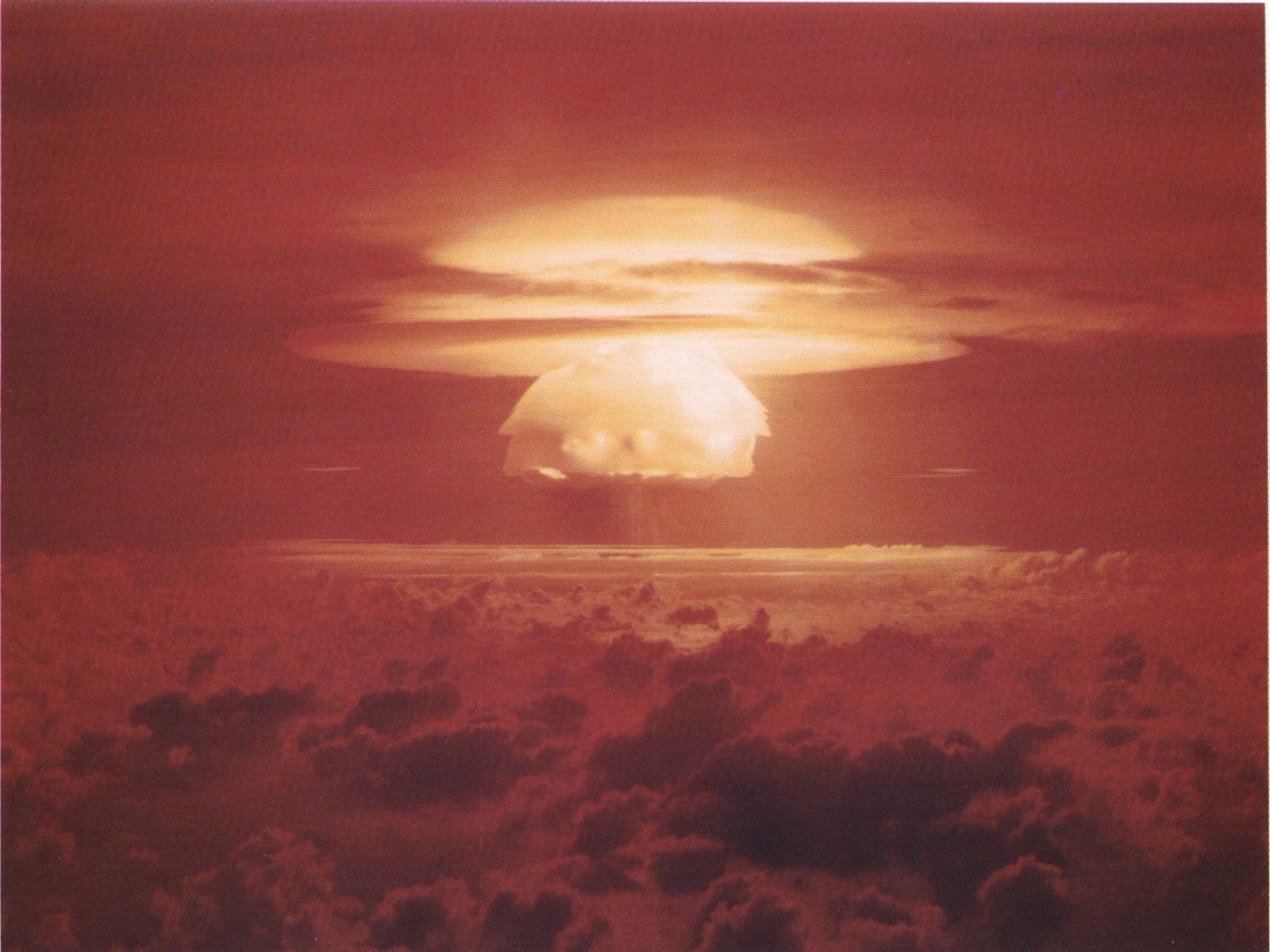
The fireball touched the ground, reached nearly as high as the altitude of the release plane, and was seen and felt 1,000 km away. The heat from the explosion could have caused third degree burns 100 km away from ground zero. The subsequent mushroom cloud was about 60 km high (nearly seven times higher than Mount Everest)and 30–40 km wide. The explosion could be seen and felt in Finland, even breaking windows there[citation needed]. Atmospheric focusing caused blast damage up to 1,000 km away. The seismic shock created by the detonation was measurable even on its third passage around the Earth. Its Richter magnitude was about 5 to 5.25.
Since 50 Mt is 2.1×10¹⁷ joules, the average power produced during the entire fission-fusion process, lasting around 39 nanoseconds, was a power of about 5.4×1024 watts or 5.4 yottawatts. This is equivalent to approximately 1% of the power output of the Sun. The detonation of Tsar Bomba therefore qualifies as being the single most powerful device ever utilized throughout the history of humanity...
...What is at issue here today is whether recent reports of Iranian breakthroughs in enrichment are true. Before today's report it was pretty clear the media's claims were not correct. The claims had been completely debunked by experts before the IAEA report came out. And yet the claims still managed to form the dominant media narrative, as this ABC Report reiterates :
"The International Atomic Energy Agency (IAEA) is expected to confirm Iran's rapid progress in advancing its uranium enrichment program in a report due tomorrow."
The only problem is that the report confirms no such thing. What the report details and conversations with arms control experts confirm is that the Iranians have made no major breakthroughs like that claimed by David E. Sanger of the New York Times. Furthermore, his story of May 15 was, as one expert put it, "misleading and sensationalized."
The relevant portions of the IAEA Report, released today, conclude:
"Since the Director General's last report, Iran has fed approximately 260 kg of UF6 into the cascades at FEP. Iran has declared that it has reached enrichment levels up to 4.8% U-235 at FEP, which the Agency is in the process of verifying. On 13 May 2007, eight 164-machine cascades were operating simultaneously and were being fed with UF6; two other similar cascades had been vacuum tested and three more were under construction."
Dr. Jeffrey Lewis of the Belfer Center wrote "[that] Iran does seem to be making steady progress toward continuous operation of their centrifuges." But this is hardly indicative of a nuclear program about to start spitting out bomb grade material next week.
This evidence, presented in the IAEA report, says Paul Kerr of Arms Control Today "does not support [the] rapid progress" described by Sanger in his article and portrayed by the media as a whole. Kerr added, "it doesn't seem like [the Iranians] have crossed a major threshold."
The claims filtering in and out of the media that Iran is one to two years away from producing bomb grade material are, to put it mildly, wildly inaccurate, as the report notes the Iranians are only reprocessing moderate amounts of UF6 to 4.8% U-235, and bomb grade material must be at least 80%.
Will the media correct its inflamed and sensationalized claims in light of this latest of IAEA reports?
Vice President Dick Cheney on Saturday urged the 978 new graduates of the U.S. Military Academy to provide leadership to troops fighting terrorists in Iraq and Afghanistan.
Noting that West Point is about 50 miles north of where terrorists struck lower Manhattan on Sept. 11, 2001, the vice president said, “Nobody can promise us we won’t be hit again.”
He received standing ovations before and after he spoke to a crowd of about 20,000. To the emerging Army second lieutenants, Cheney appealed for them to defend freedom against those who would destroy it and carry forward the academy’s values of duty, honor and country...
Iran is secretly forging ties with al-Qaida elements and Sunni Arab militias in Iraq in preparation for a summer showdown with coalition forces intended to tip a wavering US Congress into voting for full military withdrawal, US officials say.
"...Iran is fighting a proxy war in Iraq and it's a very dangerous course for them to be following. They are already committing daily acts of war against US and British forces," a senior US official in Baghdad warned. "They [Iran] are behind a lot of high-profile attacks meant to undermine US will and British will, such as the rocket attacks on Basra palace and the Green Zone [in Baghdad]. The attacks are directed by the Revolutionary Guard who are connected right to the top [of the Iranian government]."
...Iran's Supreme Leader Ayatollah Ali Khamenei, while addressing a gathering of religious figures in the holy city of Mashhad on May 16, posed the question, "How is it possible to hold talks with the US's arrogant, bullying, expansionist administration and its impolite, reckless and demanding officials?"
There are no easy answers. As the countdown began for the Baghdad talks, in a series of moves, Washington rebuffed Iran's search for "logical, principled and fair ties" (to quote Foreign Minister Manouchehr Mottaki) with the US.
First, Washington has adopted an inexplicably obdurate stance over the detention of five Iranian diplomats who were kidnapped by US forces in the northern Iraqi town of Irbil in January. Their continued detention is illogical insofar as their kidnapping itself has turned out to be a fiasco, a case of mistaken identity. The US has turned down the Iranian request for consular access to the detainees, sought through the International Committee of the Red Cross.
Arguably, the US is provoking a "hostage crisis" with Iran. Tehran understands Washington's game plan. So far it has reacted with prudence. However, patience is wearing thin. Mottaki said on May 18, "In meetings with the Iraqi president, prime minister, foreign minister and other senior officials, I have told them clearly that the Iraqi government is responsible for releasing the kidnapped Iranian diplomats, and no excuse is acceptable." A crisis is no doubt brewing unless Washington releases the diplomats during the next couple of weeks.
Within two days of Mottaki's warning, Tehran charged a noted American scholar at the Smithsonian Institution's Woodrow Wilson International Center for Scholars, Haleh Esfandiari (who was visiting Iran), with subversive activities against the Iranian regime. The Iranian authorities have detained four Iranian-American nationals in recent weeks...

...The Pentagon and the intelligence establishment are providing support to add muscle and nuance to the diplomatic effort led by Condi Rice, her deputy John Negroponte, Under Secretary of State R. Nicholas Burns, and Legal Adviser John Bellinger. The support that Director of National Intelligence Mike McConnell, Secretary of Defense Robert Gates, and CIA Director Michael Hayden are providing Rice's efforts are a complete, 180 degree contrast to the dysfunction that characterized relations between these institutions before the recent reshuffle of top personnel.
However, the Department of Defense and national intelligence sector are also preparing for hot conflict. They believe that they need to in order to convince Iran's various power centers that the military option does exist.
But this is worrisome. The person in the Bush administration who most wants a hot conflict with Iran is Vice President Cheney. The person in Iran who most wants a conflict is Iranian President Mahmoud Ahmadinejad. Iran's Revolutionary Guard Quds Force would be big winners in a conflict as well -- as the political support that both have inside Iran has been flagging.
Multiple sources have reported that a senior aide on Vice President Cheney's national security team has been meeting with policy hands of the American Enterprise Institute, one other think tank, and more than one national security consulting house and explicitly stating that Vice President Cheney does not support President Bush's tack towards Condoleezza Rice's diplomatic efforts and fears that the President is taking diplomacy with Iran too seriously.
This White House official has stated to several Washington insiders that Cheney is planning to deploy an "end run strategy" around the President if he and his team lose the policy argument.
The thinking on Cheney's team is to collude with Israel, nudging Israel at some key moment in the ongoing standoff between Iran's nuclear activities and international frustration over this to mount a small-scale conventional strike against Natanz using cruise missiles (i.e., not ballistic missiles).
This strategy would sidestep controversies over bomber aircraft and overflight rights over other Middle East nations and could be expected to trigger a sufficient Iranian counter-strike against US forces in the Gulf -- which just became significantly larger -- as to compel Bush to forgo the diplomatic track that the administration realists are advocating and engage in another war.
There are many other components of the complex game plan that this Cheney official has been kicking around Washington. The official has offered this commentary to senior staff at AEI and in lunch and dinner gatherings which were to be considered strictly off-the-record, but there can be little doubt that the official actually hopes that hawkish conservatives and neoconservatives share this information and then rally to this point of view. This official is beating the brush and doing what Joshua Muravchik has previously suggested -- which is to help establish the policy and political pathway to bombing Iran.
The zinger of this information is the admission by this Cheney aide that Cheney himself is frustrated with President Bush and believes, much like Richard Perle, that Bush is making a disastrous mistake by aligning himself with the policy course that Condoleezza Rice, Bob Gates, Michael Hayden and McConnell have sculpted.
According to this official, Cheney believes that Bush can not be counted on to make the "right decision" when it comes to dealing with Iran and thus Cheney believes that he must tie the President's hands...
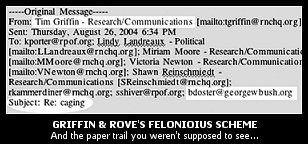
...Goodling testified that Gonzales' Chief of Staff, Kyle Sampson, perjured himself, lying to the committee in earlier testimony. The lie: Sampson denied Monica had told him about Tim Griffin's "involvement in 'caging' voters" in 2004.
Huh?? Tim Griffin? "Caging"???
The perplexed committee members hadn't a clue --- and asked no substantive questions about it thereafter. Karl Rove is still smiling. If the members had gotten the clue, and asked the right questions, they would have found "the keys to the kingdom," they thought they were looking for. They dangled right in front of their perplexed faces.
The keys: the missing emails --- and missing link --- that could send Griffin and his boss, Rove, to the slammer for a long, long time.
Kingdom enough for ya?
But what's 'caging' and why is it such a dreadful secret that lawyer Sampson put his license to practice and his freedom on the line to cover Tim Griffin's involvement in it? Because it's a felony. And a big one.
Here's how caging worked, and along with Griffin's thoughtful emails themselves you'll understand it all in no time.
The Bush-Cheney operatives sent hundreds of thousands of letters marked "Do not forward" to voters' homes. Letters returned ("caged") were used as evidence to block these voters' right to cast a ballot on grounds they were registered at phony addresses. Who were the evil fakers? Homeless men, students on vacation and --- you got to love this --- American soldiers. Oh yeah: most of them are Black voters...
not destroy the Ring of Power, just win it for their own use.
This is, in fact, a comment about… betrayal.
Few men or women elected in our history—whether executive or legislative, state or national—have been sent into office with a mandate more obvious, nor instructions more clear:
Get us out of Iraq.
Yet after six months of preparation and execution—half a year gathering the strands of public support; translating into action, the collective will of the nearly 70 percent of Americans who reject this War of Lies, the Democrats have managed only this:
* The Democratic leadership has surrendered to a president—if not the worst president, then easily the most selfish, in our history—who happily blackmails his own people, and uses his own military personnel as hostages to his asinine demand, that the Democrats “give the troops their money”;
* The Democratic leadership has agreed to finance the deaths of Americans in a war that has only reduced the security of Americans;
* The Democratic leadership has given Mr. Bush all that he wanted, with the only caveat being, not merely meaningless symbolism about benchmarks for the Iraqi government, but optional meaningless symbolism about benchmarks for the Iraqi government.
* The Democratic leadership has, in sum, claimed a compromise with the Administration, in which the only things truly compromised, are the trust of the voters, the ethics of the Democrats, and the lives of our brave, and doomed, friends, and family, in Iraq.
You, the men and women elected with the simplest of directions—Stop The War—have traded your strength, your bargaining position, and the uniform support of those who elected you… for a handful of magic beans.
You may trot out every political cliché from the soft-soap, inside-the-beltway dictionary of boilerplate sound bites, about how this is the “beginning of the end” of Mr. Bush’s “carte blanche” in Iraq, about how this is a “first step.”
Well, Senator Reid, the only end at its beginning... is our collective hope that you and your colleagues would do what is right, what is essential, what you were each elected and re-elected to do.
Because this “first step”… is a step right off a cliff.
And this President!
How shameful it would be to watch an adult... hold his breath, and threaten to continue to do so, until he turned blue.
But how horrifying it is… to watch a President hold his breath and threaten to continue to do so, until innocent and patriotic Americans in harm’s way, are bled white.
You lead this country, sir?
You claim to defend it?
And yet when faced with the prospect of someone calling you on your stubbornness—your stubbornness which has cost 3,431 Americans their lives and thousands more their limbs—you, Mr. Bush, imply that if the Democrats don’t give you the money and give it to you entirely on your terms, the troops in Iraq will be stranded, or forced to serve longer, or have to throw bullets at the enemy with their bare hands.
How transcendentally, how historically, pathetic.
Any other president from any other moment in the panorama of our history would have, at the outset of this tawdry game of political chicken, declared that no matter what the other political side did, he would insure personally—first, last and always—that the troops would not suffer.
A President, Mr. Bush, uses the carte blanche he has already, not to manipulate an overlap of arriving and departing Brigades into a ‘second surge,’ but to say in unequivocal terms that if it takes every last dime of the monies already allocated, if it takes reneging on government contracts with Halliburton, he will make sure the troops are safe—even if the only safety to be found, is in getting them the hell out of there.
Well, any true President would have done that, Sir.
You instead, used our troops as political pawns, then blamed the Democrats when you did so.
Not that these Democrats, who had this country’s support and sympathy up until 48 hours ago, have not since earned all the blame they can carry home.
“We seem to be very near the bleak choice between war and shame,” Winston Churchill wrote to Lord Moyne in the days after the British signed the Munich accords with Germany in 1938. “My feeling is that we shall choose shame, and then have war thrown in, a little later…”
That’s what this is for the Democrats, isn’t it?
Their “Neville Chamberlain moment” before the Second World War.
All that’s missing is the landing at the airport, with the blinkered leader waving a piece of paper which he naively thought would guarantee “peace in our time,” but which his opponent would ignore with deceit.
The Democrats have merely streamlined the process.
Their piece of paper already says Mr. Bush can ignore it, with impugnity.
And where are the Democratic presidential hopefuls this evening?
See they not, that to which the Senate and House leadership has blinded itself?
Judging these candidates based on how they voted on the original Iraq authorization, or waiting for apologies for those votes, is ancient history now.
The Democratic nomination is likely to be decided... tomorrow.
The talk of practical politics, the buying into of the President’s dishonest construction “fund-the-troops-or-they-will-be-in-jeopardy,” the promise of tougher action in September, is falling not on deaf ears, but rather falling on Americans who already told you what to do, and now perceive your ears as closed to practical politics.
Those who seek the Democratic nomination need to—for their own political futures and, with a thousand times more solemnity and importance, for the individual futures of our troops—denounce this betrayal, vote against it, and, if need be, unseat Majority Leader Reid and Speaker Pelosi if they continue down this path of guilty, fatal acquiescence to the tragically misguided will of a monomaniacal president.
For, ultimately, at this hour, the entire government has failed us.
* Mr. Reid, Mr. Hoyer, and the other Democrats... have failed us.
They negotiated away that which they did not own, but had only been entrusted by us to protect: our collective will as the citizens of this country, that this brazen War of Lies be ended as rapidly and safely as possible.
* Mr. Bush and his government... have failed us.
They have behaved venomously and without dignity—of course.
That is all at which Mr. Bush is gifted.
We are the ones providing any element of surprise or shock here.
With the exception of Senator Dodd and Senator Edwards, the Democratic presidential candidates have (so far at least) failed us.
They must now speak, and make plain how they view what has been given away to Mr. Bush, and what is yet to be given away tomorrow, and in the thousand tomorrows to come.
Because for the next fourteen months, the Democratic nominating process—indeed the whole of our political discourse until further notice—has, with the stroke of a cursed pen, become about one thing, and one thing alone.
The electorate figured this out, six months ago.
The President and the Republicans have not—doubtless will not.
The Democrats will figure it out, during the Memorial Day recess, when they go home and many of those who elected them will politely suggest they stay there—and permanently.
Because, on the subject of Iraq...
The people have been ahead of the media....
Ahead of the government...
Ahead of the politicians...
For the last year, or two years, or maybe three.
Our politics... is now about the answer to one briefly-worded question.
Mr. Bush has failed.
Mr. Warner has failed.
Mr. Reid has failed.
So.
Who among us will stop this war—this War of Lies?
To he or she, fall the figurative keys to the nation.
To all the others—presidents and majority leaders and candidates and rank-and-file Congressmen and Senators of either party—there is only blame… for this shameful, and bi-partisan, betrayal.
...A public high school teacher in Brooklyn told me recently about a student who didn’t believe that a restaurant tab for four people could come to more than $500. The student shook his head, as if resisting the very idea. He just couldn’t fathom it.
“How much can you eat?” the student asked.
When I asked a teacher in a second school to mention the same issue, one of the responses was, “Is this a true story?”
A lot of New Yorkers are doing awfully well. There are 8 million residents of New York City, and roughly 700,000 are worth a million dollars or more. The average price of a Manhattan apartment is $1.3 million. The annual earnings of the average hedge fund manager is $363 million.
The estimated worth of the mayor, Michael Bloomberg, ranges from $5.5 billion to upwards of $20 billion.
You want a gilded age? This is it. The elite of the Roaring Twenties would be stunned by the wealth of the current era.
Now the flip side, which is the side those public school students are on. One of the city’s five counties, the Bronx, is the poorest urban county in the nation. The number of families in the city’s homeless shelters is the highest it has been in a quarter of a century. Twenty-five percent of all families with children in New York City — that’s 1.5 million New Yorkers — are trying to make it on incomes that are below the poverty threshold established by the federal government.
The streets that are paved with gold for some are covered with ash for many others. There are few better illustrations of the increasingly disturbing divide between rich and poor than New York City.
“I get to walk in both worlds,” said Larry Mandell, the president of the United Way of New York City. “In a given day I might be in a soup kitchen and also in the halls of Fortune 500 companies dealing with the senior executives. I’ve become acutely aware that the lives of those who are well off are not touched at all by contact with the poor. It’s not that people don’t care or don’t want to help. It’s that they have very little awareness of poverty.”
I’d always thought of the United Way as a charitable outfit. But Mr. Mandell has committed his organization to the important task of raising the awareness of Americans and their political leaders to the pressing needs of America’s cities, and especially the long-neglected, poverty-stricken neighborhoods of the inner cities.
It’s a measure of how low the bar has been set for success in America’s cities that New York is thought to be doing well, even though 185,000 of its children ages 5 or younger are poor, and 18,000 are consigned to homeless shelters each night. More than a million New Yorkers get food stamps, and another 700,000 are eligible but not receiving them. That’s a long, long way from a $500 restaurant tab.
Only 50 percent of the city’s high school students graduate in four years. And if you talk to the kids in the poorer neighborhoods, they will tell you that they don’t feel safe. They are worried about violence and gang activity, which in their view is getting worse, not better.
This is what’s going on in the nation’s most successful big city...
The term “triangulation” in politics means a set of leaders trying joining with their opponents to pass measures that run counter to those leaders’ own supporters. Typically, triangulation is practiced by presidents against their own parties in Congress, with the master of triangulation being President Bill Clinton who, among other things, rammed welfare reform and NAFTA “over the dead bodies” of rank-and-file Democratic lawmakers and the progressive movement. Can congressional leaders can pull the same move? Unfortunately, we’re going to find out very soon, as congressional Democratic leaders are very clearly attempting to triangulate against their own party on the three issues the party ran on to win Election 2006.
TRADE - TRIANGULATING WITH A SECRET DEAL IN PURSUIT OF WALL STREET CASH
On trade, Public Citizen has shown [.pdf] that the Democratic Party relied on candidates who ran against lobbyist-written trade deals in order to win many of the crucial conservative-leaning districts that were necessary to win the congressional majority. Yet, as we’ve seen over the last week, a handful of senior Democratic leaders are joining with the Bush White House in an attempt to ram an ultra-secret free trade deal through Congress, acknowledging that in order to be successful, they will rely on all Republicans and just 25 percent of Democratic lawmakers. As rank-and-file Democratic lawmakers and organizations representing millions of workers, farmers and small businesses have raised objections to the deal, Reuters reports today that Ways and Means Committee Chairman Charlie Rangel (D-NY) is digging in, saying that if he knew what he knew now about how serious rank-and-file Democratic opposition to lobbyist-written trade policy was, he would have tried to negotiate the deal in even more secrecy than it was negotiated in in the first place.
On Bill Moyers’ terrific PBS report on Friday about the secret deal, author John R. MacArthur says the motivations for the triangulation on trade are obvious. “This is like the NAFTA campaign of the ’90s, an attempt by the Democratic leadership - in those days it was the Clintons - to raise money from Wall Street.” You can watch Bill Moyers’ entire piece on the secret deal here.
This drive to triangulate on trade has now reached a point where the handful of Democrats who made the deal are publicly attacking those rank-and-file Democratic lawmakers, labor, environmental, health, human rights, religious, consumer protection and agricultural groups raising questions about the deal. On Friday, Reuters reported that Ways and Means Committee Chairman Charlie Rangel (D-NY) “offered no apology” for negotiating the deal in secret or for continuing to conceal the legislative text of the deal. Instead, he went on the attack, saying the only thing he would do differently would be to “ignore a lot of people that really were just wasting my time.” He claimed innocently that “I cannot see how anybody would be upset” by the deal, even though as Public Citizen shows today, the list of reforms to current trade policies [.pdf] that fair trade groups forwarded to Democratic leaders many months ago was almost entirely brushed aside by Rangel, as were proposals for a whole new framework for global trade deals.
TRIANGULATION STRATEGY: The dynamics set up a situation whereby the Democratic congressional leadership and less than half of all Democratic lawmakers (as during NAFTA) join with all Republicans to ram a free trade package through Congress over the objections of the progressive movement and rank-and-file Democrats who ran against lobbyist-written trade policies in 2006.
LOBBYING - TRIANGULATING TO PERPETUATE THE CULTURE OF CORRUPTION
Most observers agree that outrage at the Republican’s corruption scandals and Democrats promise to clean up the “culture of corruption” helped Democrats win in 2006. Yet, late last week, The Politico reported that Democrats on the House Judiciary committee yesterday “scrapped a beefed-up provision of the Lobbying Reform Bill that would have prohibited former lawmakers and senior staff from lobbying their former colleagues during their first two years out of office.” The original bill would have extended the revolving door ban from one to two years, but the amendment eliminating that provision passed by a unanimous voice vote. AP reports that “several days of backroom deal-making where some of the toughest proposed reforms were left on the cutting-room floor.” The shenanigans come just as freshman Democrats announced their demands for a much stronger anti-corruption bill.
TRIANGULATION STRATEGY: The dynamics set up a situation whereby the Democratic congressional leadership would join with all Republicans to ram a sham lobbying “reform” bill through Congress potentially over the objections of many of rank-and-file Democrats and the progressive movement.
IRAQ -POTENTIALTRIANGULATION TO KEEP THE WAR GOING
Finally, Iraq - the big issue that helped Democrats win in 2006. The Associated Press reports that congressional Democratic leaders may be backing away from using their power to oppose the war, floating the possibility of an Iraq War supplemental bill that “would allow the president to waive compliance with a deadline for troop withdrawals.” The New York Times says that the “likelihood that any final agreement will specify no withdrawal date for American troops from Iraq raised the possibility that antiwar Democrats will not support it, particularly in the House, and that the measure will need substantial Republican support to pass.”
TRIANGULATION STRATEGY: The dynamics set up a situation whereby the Democratic congressional leadership would join with all Republicans to ram a blank check Iraq spending bill through Congress potentially over the objections of many of rank-and-file Democrats and the progressive movement.
***
Where is the motivation for triangulation coming from? As MacArthur says, at least some of it comes from money - especially the issues like trade and corruption that deal directly with Wall Street’s power over the Democratic Party. But I’d also say it comes from the psychology of those who the Democratic Party elders in Washington have grown used to listening to...
That has more than a little something to do with the kinds of people who have dominated the Democratic Party: Washington insiders, many of whom are former Clinton officials...
We see this with, for instance, Rep. Rahm Emanuel (D-IL)... He is running around bragging about working to pass the secret trade deal over the objections of 75 percent of congressional Democrats, and he has been using his position as chairman of the House Democratic Caucus to try to prevent an open debate on the still-secret deal.
Then there is Leon Panetta, a former chief of staff to Clinton...
Panetta doesn’t care about what’s being talked about, or the substance of whatever deals are made on issues - all he seems to care about is making a deal. This same kind of attitude is spewed by the Beltway press, as evidenced by its trumpeting of the secret trade deal without ever having seen the actual legislative language of the deal. It is a psychology that prioritizes any deal on any issue - even one that sells out the Democratic Party’s agenda and the interests of the vast majority of the American people - is good...

NEW YORK - Although it has already taken nearly four decades to get this far in building the Internet, some university researchers with the federal government's blessing want to scrap all that and start over...
The National Science Foundation wants to build an experimental research network known as the Global Environment for Network Innovations, or GENI, and is funding several projects at universities and elsewhere through Future Internet Network Design, or FIND.
Rutgers, Stanford, Princeton, Carnegie Mellon and the Massachusetts Institute of Technology are among the universities pursuing individual projects. Other government agencies, including the Defense Department, have also been exploring the concept...
Clean-slate advocates say the cozy world of researchers in the 1970s and 1980s doesn't necessarily mesh with the realities and needs of the commercial Internet...
...one scenario being considered within the Pentagon would maintain a strong U.S. military presence in Iraq for several decades into the future.
This so-called “lily pad” strategy entails keeping a “series of military installations around Iraq,” with tens of thousands of U.S. troops remaining in the country for as long as a few decades:
"[W]hat it essentially envisions is a series of military installations around Iraq, maybe five or six of them, a total of maybe 30-40 thousand U.S. troops in Iraq for a long period of time, lasting, maybe a few decades. And the idea is that these bases will be somewhat hermetically sealed, that U.S. military forces won’t be leaving them, they won’t be conducting presence patrols and the patrols they conduct now. Ground convoys won’t be driving into them.
"Airplanes will be essentially landing in to deliver supplies and these sort of lily pads will be in various strategic areas in Iraq … And that will enable the U.S. military to maintain a presence in the country, perhaps…for a few decades."
The Pentagon’s goal with the lily pads is to preserve U.S. interests in Iraq for years to come “in the event that Congress or the administration pushes this [withdrawal plan] forward.” As NPR details, those interests are at least three-fold: 1) Training Iraq forces, 2) Preserving economic interests, as “Iraq obviously [sits] on the second largest reserve of oil in the world,” and 3) Providing a U.S. military “presence” to deter Iran and Turkey from “getting involved” after withdrawal.
While 60 percent of Americans are calling for a withdrawal of the U.S. from Iraq, the Pentagon is instead making preparations for an unending occupying presence.
Diethylene glycol, a poisonous ingredient in some antifreeze, has been found in 6,000 tubes of toothpaste in Panama, and customs officials there said yesterday that the product appeared to have originated in China.
“Our preliminary information is that it came from China, but we don’t know that with certainty yet,” said Daniel Delgado Diamante, Panama’s director of customs. “We are still checking all the possible imports to see if there could be other shipments.”
Some of the toothpaste, which arrived several months ago in the free trade zone next to the Panama Canal, was re-exported to the Dominican Republic in seven shipments, customs officials said. A newspaper in Australia reported yesterday that one brand of the toothpaste had been found on supermarket shelves there and had been recalled.
Diethylene glycol is the same poison that the Panamanian government inadvertently mixed into cold medicine last year, killing at least 100 people. Records show that in that episode the poison, falsely labeled as glycerin, a harmless syrup, also originated in China.
There is no evidence that the tainted toothpaste is in the United States, according to American government officials.
Panamanian health officials said diethylene glycol had been found in two brands of toothpaste, labeled in English as Excel and Mr. Cool. The tubes contained diethylene glycol concentrations of between 1.7 percent and 4.6 percent, said Luis Martínez, a prosecutor who is looking into the shipments.
Health officials say they do not believe the toothpaste is harmful, because users spit it out after brushing, but they nonetheless took it out of circulation...
...Last year, government officials there unwittingly mixed diethylene glycol into 260,000 bottles of cold medicine — with devastating results. Families have reported 365 deaths from the poison, 100 of which have been confirmed so far. With the onset of the rainy season, investigators are racing to exhume as many potential victims as possible before bodies decompose even more.
Panama’s death toll leads directly to Chinese companies that made and exported the poison as 99.5 percent pure glycerin...
...
Democratic National Committee
Darfur Rehabilitiation
Coalition of Fire and Police Unions
MSNBC
...
The National Association of State Boards of Education will elect officers in July, and for one office, president-elect, there is only one candidate: a member of the Kansas school board who supported its efforts against the teaching of evolution.
Scientists who have been active in the nation’s evolution debate say they want to thwart his candidacy, but it is not clear that they can.
The candidate is Kenneth R. Willard, a Kansas Republican who voted with the conservative majority in 2005 when the school board changed the state’s science standards to allow inclusion of intelligent design, an ideological cousin of creationism. Voters later replaced that majority, but Mr. Willard, an insurance executive from Hutchinson, retained his seat. If he becomes president-elect of the national group, he will take office in January 2009.
The group, based in Washington, is a nonprofit organization of state school boards whose Web site (www.nasbe.org) says it “works to strengthen state leadership in educational policymaking.”
Brenda L. Welburn, its executive director, said Mr. Willard’s only opponent in the race withdrew for personal reasons after the period for nominations had closed. Each state has one vote in the election...


The Reverend Jerry Falwell is dead. His Thomas Road Baptist Church, founded in 1956 in Lynchburg, Virginia, was one of the principal well-springs of politicized evangelicalism that waged war against those who worked for a liberal, open, progressive, tolerant society.
Dr. Falwell will be missed by millions of devout Christians who believed his message to have been authentic and in keeping with a strict, literal interpretation of the Holy Bible. Millions of others, however, firmly held that Falwell was a charlatan who preyed on the lonely, the disaffected, the ignorant, and the lost to advance his personal fortune and power using a hateful interpretation of Christianity that imposed suffering on many while doing nothing to alleviate misery, end poverty, and provide earthly hope.
...Not long before our nation launched the invasion of Iraq, our longest-serving Senator, Robert Byrd of West Virginia, stood on the Senate floor and said: "This chamber is, for the most part, silent—ominously, dreadfully silent. There is no debate, no discussion, no attempt to lay out for the nation the pros and cons of this particular war. There is nothing. We stand passively mute in the United States Senate."
Why was the Senate silent?
In describing the empty chamber the way he did, Byrd invited a specific version of the same general question millions of us have been asking: "Why do reason, logic and truth seem to play a sharply diminished role in the way America now makes important decisions?" The persistent and sustained reliance on falsehoods as the basis of policy, even in the face of massive and well-understood evidence to the contrary, seems to many Americans to have reached levels that were previously unimaginable.
A large and growing number of Americans are asking out loud: "What has happened to our country?" People are trying to figure out what has gone wrong in our democracy, and how we can fix it.
To take another example, for the first time in American history, the Executive Branch of our government has not only condoned but actively promoted the treatment of captives in wartime that clearly involves torture, thus overturning a prohibition established by General George Washington during the Revolutionary War.
It is too easy—and too partisan—to simply place the blame on the policies of President George W. Bush. We are all responsible for the decisions our country makes. We have a Congress. We have an independent judiciary. We have checks and balances. We are a nation of laws. We have free speech. We have a free press. Have they all failed us? Why has America's public discourse become less focused and clear, less reasoned? Faith in the power of reason—the belief that free citizens can govern themselves wisely and fairly by resorting to logical debate on the basis of the best evidence available, instead of raw power—remains the central premise of American democracy. This premise is now under assault.
American democracy is now in danger—not from any one set of ideas, but from unprecedented changes in the environment within which ideas either live and spread, or wither and die. I do not mean the physical environment; I mean what is called the public sphere, or the marketplace of ideas.
It is simply no longer possible to ignore the strangeness of our public discourse. I know I am not alone in feeling that something has gone fundamentally wrong...
As a young lawyer giving his first significant public speech at the age of 28, Abraham Lincoln warned that a persistent period of dysfunction and unresponsiveness by government could alienate the American people and that "the strongest bulwark of any government, and particularly of those constituted like ours, may effectively be broken down and destroyed—I mean the attachment of the people."
Many Americans now feel that our government is unresponsive and that no one in power listens to or cares what they think. They feel disconnected from democracy. They feel that one vote makes no difference, and that they, as individuals, have no practical means of participating in America's self-government. Unfortunately, they are not entirely wrong.
Voters are often viewed mainly as targets for easy manipulation by those seeking their "consent" to exercise power. By using focus groups and elaborate polling techniques, those who design these messages are able to derive the only information they're interested in receiving from citizens—feedback useful in fine-tuning their efforts at manipulation....
Many young Americans now seem to feel that the jury is out on whether American democracy actually works or not. We have created a wealthy society with tens of millions of talented, resourceful individuals who play virtually no role whatsoever as citizens. Bringing these people in—with their networks of influence, their knowledge, and their resources—is the key to creating the capacity for shared intelligence that we need to solve our problems.
Unfortunately, the legacy of the 20th century's ideologically driven bloodbaths has included a new cynicism about reason itself—because reason was so easily used by propagandists to disguise their impulse to power by cloaking it in clever and seductive intellectual formulations. When people don't have an opportunity to interact on equal terms and test the validity of what they're being "taught" in the light of their own experience and robust, shared dialogue, they naturally begin to resist the assumption that the experts know best.
So the remedy for what ails our democracy is not simply better education (as important as that is) or civic education (as important as that can be), but the re-establishment of a genuine democratic discourse in which individuals can participate in a meaningful way—a conversation of democracy in which meritorious ideas and opinions from individuals do, in fact, evoke a meaningful response.
Fortunately, the Internet has the potential to revitalize the role played by the people in our constitutional framework. It has extremely low entry barriers for individuals. It is the most interactive medium in history and the one with the greatest potential for connecting individuals to one another and to a universe of knowledge. It's a platform for pursuing the truth, and the decentralized creation and distribution of ideas, in the same way that markets are a decentralized mechanism for the creation and distribution of goods and services. It's a platform, in other words, for reason.
But the Internet must be developed and protected, in the same way we develop and protect markets—through the establishment of fair rules of engagement and the exercise of the rule of law. The same ferocity that our Founders devoted to protect the freedom and independence of the press is now appropriate for our defense of the freedom of the Internet. The stakes are the same: the survival of our Republic.
We must ensure that the Internet remains open and accessible to all citizens without any limitation on the ability of individuals to choose the content they wish regardless of the Internet service provider they use to connect to the Web. We cannot take this future for granted. We must be prepared to fight for it, because of the threat of corporate consolidation and control over the Internet marketplace of ideas...
...The big Web portals like Yahoo, AOL and Microsoft are working on it, trying to tease out which display ads should be shown and to whom. Last month, when Google paid $3.1 billion for DoubleClick, which specializes in software for display ads and has close relationships with Web publishers and advertisers, it declared that display ads would be crucial to its future strategy.
But besides the giant portals, there are scores of small, innovative companies — typically venture-backed start-ups — that are behind the revolution on Madison Avenue.
Industry analysts estimate that there are about 200 such companies. Many call themselves ad networks, while others are referred to as ad exchanges or optimization services. The roster includes Revenue Science, Tacoda, Tribal Fusion, Rapt, AdECN and x+1. In one way or another, they are all trying to bring more effectiveness to the online display ad market.
...The process of delivering relevant search-based ads is comparatively easy — a typed search term sets off related text ads, which appear next to the results, exposing consumers to sundry, generally relevant, advertisers.
Brand advertising, however, starts higher up on the marketing food chain; it is meant to foster brand and product awareness as well as purchases. The goal is to deliver select audiences — of thousands, even millions — to mass marketers.
The new science of online display advertising involves a potent mix of behavioral targeting, social networking algorithms, predictive economics, pricing optimization and other mathematical strategies.
These geeky tools are used to address the marketer’s quandary, well articulated by John Wanamaker, the 19th-century Philadelphia merchant who said that half the money he spent on advertising was wasted, but he didn’t know which half.
“We’re trying to not only tell which half of ads don’t work, but we’re not going to buy that half,” said Toby Gabriner, chief executive of x + 1, an ad optimization service in New York.
The ideal, Mr. Gabriner said, is to advertise only to prime customers. “Imagine an environment where the company that makes dentures and denture products only advertises to people who don’t have teeth,” he said.
The most common technique for identifying an audience is called behavioral targeting, which tracks, analyzes and predicts online behavior based on where you (actually your browser software) have gone before on the Internet. The ad targeters cull vast quantities of Web-viewing behavior and other data, like the speed of your Internet connection, the time of day you visited a site, whether it was done from work or home and even associated ZIP codes.
These defined audience clusters consist of people who share characteristics based on their behavior on the Internet, not personal information like names, ages, home addresses or telephone numbers. So, for example, a person who recently visited sports and auto Web sites and read global warming articles on news sites would most likely turn out to be an 18- to 45-year-old male. An algorithm would then determine that he would be a good candidate for an ad about Toyota’s hybrid-electric Prius. Advertisers are willing to pay much higher rates to reach such screened audiences.
“The technology finds the best virtual person for an advertiser and that person’s behavioral friends — in the thousands or millions,” said Bill Gossman, chief executive of Revenue Science, a behavioral targeting company in New York whose payroll has doubled to 70 employees in the last year.
The ads are not personalized electronic marketing, however, a prospect that was popularized in the movie “Minority Report,” in which virtual advertisements on the street addressed potential customers by name. But targeting companies do place small software programs, called cookies, on people’s personal computers to monitor their movements on the Web, making privacy advocates uneasy.
Tacoda is an ad network that specializes in behavioral targeting. Its network has 125 million individuals (PCs with the Tacoda cookie). Its software tags are also on 4,000 Web sites; and it collects nine billion data items a day. For every dollar it collects from an advertiser, Tacoda keeps 40 cents, gives 40 cents, as a broker, to the Web publisher displaying the ad and distributes 20 cents to the sites providing targeted data.
Tacoda, which is based in New York, works closely with Web sites at several large media companies, including ABC, NBC, The Wall Street Journal and The New York Times, as well as consumer-product companies and ad agencies. Computing and esoteric mathematics play a role in advertising on the Internet, but so do brand managers, publishing salespeople and ad strategists, said Curt Viebranz, chief executive of Tacoda and a former Time Warner executive. “There’s a lot here that transcends algorithms,” he said.
But automated efficiency is the online advantage. Right Media, for example, wanted to bring the supereffectiveness of the stock market to online display advertising.
The company was founded in 2003 by Mike Walrath, a former fitness manager at a New York Sports Club in Stamford, Conn., who went to work for DoubleClick in 1999. He experienced the dot-com boom and bust of the Internet ad business at DoubleClick, which he called his business school. He started Right Media with many contacts, as well as the belief that the online ad business was riddled with inefficiency.
The company’s first office was a reconverted supply closet at x+1, the optimization service. Right Media provided services for Web advertisers, like AOL, by poring through their data to determine where their ads were most effective. Working on Excel spreadsheets, Mr. Walrath and a few employees performed endless calculations, manual labor by today’s standards.
“It was me and a couple of quants in a windowless room and a willingness to stay up all night,” he said.
In 2005, Mr. Walrath opened the Right Media Exchange, in which advertisers and publishers buy and sell online ad placements in real time through auctions, with Right Media’s optimization technology predicting where the ads will work best. The exchange built gradually but really took off in the last year, handling tens of thousands of auctions in fractions of a second.
Its employment has more than doubled in the last year to 220, to include computer scientists and ad veterans. Last year, its customers transacted $150 million in deals on the exchange, and the company collected an average fee of 7.5 percent, or about $11 million for the year. Mr. Walrath predicted that the volume would more than triple this year.
Right Media’s rapid growth attracted Yahoo, which paid $40 million for a 20 percent stake last fall. Two weeks ago, Yahoo agreed to pay $680 million for the other 80 percent. An industry consultant put Mr. Walrath’s share at about $200 million. (Mr. Walrath, 32, would not confirm this.)
In an interview recently, he said: “Are we pleased? Absolutely. But we haven’t accomplished what we set out to do, which is to bring more efficiency and rationality to these markets. I’ll be here for a long time.”


of Big Science, two things stand out: 1) it ain't being done here no more (one wonders, why-
for about a half second); and, 2) what they might find. What will the new Large Hadron Collider at Cern have to say about string theory, the alleged theory of everything that describes nature as composed of tiny wriggling strings?

String theorists hope that it will confirm supersymmetry, a notion that doubles the kinds of particles in the universe. and was originally invented as part of string theory. String theorists would be gratified by its discovery, but that would not prove their case.
In most cases, to test string theory directly, experimenters would have to build an accelerator to boost particles to the so-called Planck energy, at which “stringy” effects are expected to show up, roughly 10 quadrillion trillion electron volts. That is a quadrillion times the energy of the new hadron collider, which will accelerate protons to energies of seven trillion electron volts before smashing them together.
String theory’s hope for the new collider — and it is a slim one — rests on a long-shot variant of the theory in which gravity is not weaker than the other forces but has just been diluted by extra dimensions of space. In that case, the new collider could produce black holes or bounce particles into other dimensions.
John Ellis, a Cern theorist, said that possibility, which would give physicists a chance to study string theory and quantum gravity in the lab, was “almost too exciting to think about.”
Admiral William Fallon, then President George W. Bush’s nominee to head the Central Command (CENTCOM), expressed strong opposition in February to an administration plan to increase the number of carrier strike groups in the Persian Gulf from two to three and vowed privately there would be no war against Iran as long as he was chief of CENTCOM, according to sources with access to his thinking. Fallon’s resistance to the proposed deployment of a third aircraft carrier was followed by a shift in the Bush administration’s Iran policy in February and March away from increased military threats and toward diplomatic engagement with Iran. That shift, for which no credible explanation has been offered by administration officials, suggests that Fallon’s resistance to a crucial deployment was a major factor in the intra-administration struggle over policy toward Iran.
The plan to add a third carrier strike group in the Gulf had been a key element in a broader strategy discussed at high levels to intimidate Iran by a series of military moves suggesting preparations for a military strike.
Admiral Fallon’s resistance to a further buildup of naval striking power in the Gulf apparently took the Bush administration by surprise. Fallon, then Commander of the U.S. Pacific Command, had been associated with naval aviation throughout his career, and last January, Secretary of Defence Robert Gates publicly encouraged the idea that the appointment presaged greater emphasis on the military option in regard to the U.S. conflict with Iran...
Leave it to Dick Cheney to dash hopes for any cooler heads to prevail between Washington and Tehran.
Remember, it was Cheney who did everything in his power to hype the Iraq War and scuttle any possibility of a diplomatic solution prior to that conflict.
Now he’s doing the same with Iran.
Even as the State Department and the National Security Council are at least exploring the possibility of talking with Tehran, the Vice President of the United States, in typical fashion, is sabotaging that effort.
On Friday, aboard an aircraft carrier in the Persian Gulf, Cheney rattled a saber at Ahmedinejad.
Cheney said: “With two carrier strike groups in the Gulf, we’re sending clear messages to friends and adversaries alike.”
In case anyone missed what he was referring to, Cheney spelled it out: “We’ll stand with others to prevent Iran from gaining nuclear weapons and dominating the region.”
By “with others,” Cheney was referring to Israel, which has already threatened to take out Iran’s nuclear facilities. Back in January 2005, Cheney sympathized with Israel’s desire to attack Iran first:
“One of the concerns people have is that Israel might do it without being asked, that if in fact the Israelis became convinced the Iranians had a significant nuclear capability, given the fact that Iran has a stated policy that their objective is the destruction of the state of Israel, that the Israelis might well decide to act first.”
Cheney also may have been referring to Saudi Arabia, which doesn’t want to see an ascendant Shiite Iran across the gulf.
In any event, Cheney’s message got through.
Ahmedinejad, who thrives on rhetorical clashes with Washington, warned that Iran would retaliate if the United States attacked it.
And that’s no idle threat, either.
If Bush and Cheney are crazy enough to bomb Iran, and there’s no reason to suspect they’re not, Iran would make life even more miserable for the United States in Iraq, and it could also destabilize the world oil markets, with devastating consequences for our economy.
But Bush and Cheney have shown us already that they don’t consider the consequences.
Prior to the Iraq War, Hosni Mubarak of Egypt warned that toppling Saddam would create “100 bin Ladens.”
Mubarak just warned Cheney again, this time saying that a war with Iran would have “grave repercussions on the region.”
This warning may have as little impact as the last.

The news I have for "netroots" types and Huffington Post liberals who see the Democratic Party as the major if not only hope for the antiwar movement can be summed up in two words: forget it. Majority leader Sen. Harry Reid recently let the cat out of the bag when he said, "There is new reason this week to believe that a bipartisan consensus on Iraq is emerging."
Translation: the sellout is coming, if it isn't already here.
American voters sent a clear message to Washington last November when they voted to put an ostensibly antiwar Democratic Congress in power: they told pollsters the war was the big issue, and, furthermore, they wanted out of Iraq. They voted Democratic not because they suddenly believed that party would end "the culture of corruption" – which is a very bipartisan phenomenon, and voters aren't dumb enough to believe otherwise – but because they took seriously Democratic promises to get us out of Iraq. Before the election, leading Democrats called for a timetable aiming at complete "redeployment" of U.S. troops out of Iraq: immediately after the election, however, the Dems capitulated to the "surge" (even as their "antiwar" rhetoric waxed louder). Last week the House voted down a measure that would have withdrawn the troops in nine months. If you follow the link you'll see that Madam Speaker allowed the withdrawal vote "in the hope that her rank-and-file would then unite behind the funding bill" – a two-part bill that would release some $48 billion initially and then schedule a summertime vote to appropriate $52.8 billion more to cover expenses until the end of September.
The White House has threatened to veto the two-part funding ploy but coupled this with an offer to negotiate on the Benchmark Question. All eyes are now on the Senate, reports the Christian Science Monitor, "where majority leader Harry Reid and White House officials have been hunkered down in secret negotiations. Last week, Bush said he had empowered White House negotiators 'to find common ground on benchmarks.'"
Caught between the Democratic Party's antiwar base and the War Party's control of the reins of power in Washington, Pelosi and Reid have been walking a tightrope between the two, but their balancing act is increasingly untenable. Pressure from the ranks of groups such as MoveOn.org – whose leadership initially colluded with the Democratic sellout – has forced a turnaround, and the MoveOners have now issued an ultimatum of sorts to the Dems in the form of an open letter: they're threatening to move "into opposition"!


LONDON (Reuters) - Former U.S. Central Intelligence Agency Director George Tenet has joined the British research firm thought to have provided the inspiration for 'Q', the character who creates spy gadgets for James Bond.
Tenet has been appointed an independent non-executive director of QinetiQ, the company said on Tuesday.
"I am especially interested in the capacity of the company's technologies to meet a number of the challenges faced by our nations' military and intelligence personnel," Tenet said.
One of the longest serving U.S. spymasters in history, Tenet was CIA director from 1997 to 2004.
He served under presidents Bill Clinton and George W. Bush before quitting in June 2004, citing personal reasons.
Critics blamed the CIA during his reign for shortcomings in intelligence gathered in the run-up to war in Iraq and questioned whether more could have been done to predict the September 11 hijackings.
QinetiQ is partly owned by U.S. private equity firm Carlyle Group, whose advisers have included former U.S. President George Bush and former British Prime Minister John Major.
Once a secretive part of Britain's Ministry of Defense, the firm was listed on the London Stock Exchange in February.
QinetiQ (LSE: QQ.) is a British defence technology company, made out of the greater part of the government agency DERA when it was split up in June 2001 (with the smaller part forming Dstl). The Chief Executive at inception was the present day Chairman Sir John Chisholm. The CEO is Graham Love.
QinetiQ solves defence and security problems at the leading edge of both the development and application of science and technology. For example, it made the semi-intelligent ultrasound scuba diver detector called Cerberus.
When Defence Minister Lewis Moonie announced that QinetiQ was created, he said that the company would remain a British company, based in the UK. The Ministry of Defence would keep a 'Special Share' in the company, and safeguards would be in place to prevent conflicts of interest. In February 2003, the U.S. private equity firm the Carlyle Group acquired a 33.8% share in the company for £42m. Current ownership is split between the MOD (56%), Carlyle Group (31%) and staff (13%). The Carlyle Group was expected to invest for three to five years, after which a stock exchange float would take place.
As a privatised company, QinetiQ is now one of the largest defence research organisations in the world. While part of DERA, the defence research sites that now form QinetiQ carried out testing, research and development, including the invention of liquid crystal displays, the technology for flat panel speakers, microwave radar, Chobham armour, and thermal imagers. In recent years QinetiQ has also developed software products, especially those for the defence and security industries.
QinetiQ has a long term agreement (25 years) with the Ministry of Defence to manage military ranges. It is a major stakeholder in the UK Defence Technology Centre which place military research contracts on behalf of the UK Ministry of Defence.
What can QinetiQ do for your semi-legit organization, government, conglomerate, racket, faction, and secret service, society, or bloodline keen to obscure massive conflicts of interest and synergize forces in the noble culling of the masses? A few of their chivalric strengths:
Weaponeering for life
Electromagnetic research
Communications, analysis and data fusion
...According to the most recent government figures, 37 million Americans are living below the official poverty threshold, which is $19,971 a year for a family of four. That’s one out of every eight Americans, and many of them are children.
More than 90 million Americans, close to a third of the entire population, are struggling to make ends meet on incomes that are less than twice the official poverty line. In my book, they’re poor.
We don’t see poor people on television or in the advertising that surrounds us like a second atmosphere. We don’t pay much attention to the millions of men and women who are changing bedpans, or flipping burgers for the minimum wage, or vacuuming the halls of office buildings at all hours of the night. But they’re there, working hard and getting very little in return.
The number of poor people in America has increased by five million over the past six years, and the gap between rich and poor has grown to historic proportions. The richest one percent of Americans got nearly 20 percent of the nation’s income in 2005, while the poorest 20 percent could collectively garner only a measly 3.4 percent.
A new report from a highly respected task force on poverty put together by the Center for American Progress tells us, “It does not have to be this way.” The task force has made several policy recommendations, and said that if all were adopted poverty in the U.S. could be cut in half over the next decade.
The tremendous number of people in poverty is an enormous drag on the U.S. economy. And one of the biggest problems is the simple fact that so many jobs pay so little that even fulltime, year-round employment is not enough to raise a family out of poverty. One-fifth of the working men in America and 29 percent of working women are in such jobs.
Peter Edelman, a Georgetown law professor who was a co-chairman of the task force, said, “An astonishing number of people are working as hard as they possibly can but are still in poverty or have incomes that are not much above the poverty line.”
So the starting point for lifting people out of poverty should be to see that men and women who are working are adequately compensated for their labor. The task force recommended that the federal minimum wage, now $5.15 an hour, be raised to half the average hourly wage in the U.S., which would bring it to $8.40.
The earned-income tax credit, which has proved very successful in supplementing the earnings of low-wage working families, should be expanded to cover more workers, the task force said. It also recommended expanded coverage of the federal child care tax credit, which is currently $1,000 per child for up to three children.
A crucial component to raising workers out of poverty would be an all-out effort to ensure that workers are allowed to form unions and bargain collectively. As the task force noted, “Among workers in similar jobs, unionized workers have higher pay, higher rates of health coverage, and better benefits than do nonunionized workers.”
In a recent interview about poverty, former Senator John Edwards told me: “Organizing is so important. We have 50 million service economy jobs and we’ll probably have 10 or 15 million more over the next decade. If those jobs are union jobs, they’ll be middle-class families. If not, they’re more likely to live in poverty. It’s that strong.”
The task force made several other recommendations, including proposals to ease access to higher education for poor youngsters, to help former prisoners find employment, to develop a more equitable unemployment compensation system, and to establish housing policies that would make it easier for poor people to move from neighborhoods of concentrated poverty to areas with better employment opportunities and higher-quality public services...
Summary: By rushing into Iraq instead of finishing off the hunt for Osama bin Laden, Washington has unwittingly helped its enemies: al Qaeda has more bases, more partners, and more followers today than it did on the eve of 9/11. Now the group is working to set up networks in the Middle East and Africa -- and may even try to lure the United States into a war with Iran. Washington must focus on attacking al Qaeda's leaders and ideas and altering the local conditions in which they thrive.
Al Qaeda is a more dangerous enemy today than it has ever been before. It has suffered some setbacks since September 11, 2001: losing its state within a state in Afghanistan, having several of its top operatives killed, failing in its attempts to overthrow the governments of Egypt, Jordan, and Saudi Arabia. But thanks largely to Washington's eagerness to go into Iraq rather than concentrate on hunting down al Qaeda's leaders, the organization now has a solid base of operations in the badlands of Pakistan and an effective franchise in western Iraq. Its reach has spread throughout the Muslim world, where it has developed a large cadre of operatives, and in Europe, where it can claim the support of some disenfranchised Muslim locals and members of the Arab and Asian diasporas. Osama bin Laden has mounted a successful propaganda campaign to make himself and his movement the primary symbols of Islamic resistance worldwide. His ideas now attract more followers than ever.
Bin Laden's goals remain the same, as does his basic strategy. He seeks to, as he puts it, "provoke and bait" the United States into "bleeding wars" throughout the Islamic world; he wants to bankrupt the country much as he helped bankrupt, he claims, the Soviet Union in Afghanistan in the 1980s. The demoralized "far enemy" would then go home, allowing al Qaeda to focus on destroying its "near enemies," Israel and the "corrupt" regimes of Egypt, Jordan, Pakistan, and Saudi Arabia. The U.S. occupation of Iraq helped move his plan along, and bin Laden has worked hard to turn it into a trap for Washington. Now he may be scheming to extend his strategy by exploiting or even triggering a war between the United States and Iran.
Decisively defeating al Qaeda will be more difficult now than it would have been a few years ago. But it can still be done, if Washington and its partners implement a comprehensive strategy over several years, one focused on both attacking al Qaeda's leaders and ideas and altering the local conditions that allow them to thrive. Otherwise, it will only be a matter of time before al Qaeda strikes the U.S. homeland again...
The U.S. invasion of Iraq took the pressure off al Qaeda in the Pakistani badlands and opened new doors for the group in the Middle East. It also played directly into the hands of al Qaeda leaders by seemingly confirming their claim that the United States was an imperialist force, which helped them reinforce various local alliances. In Iraq, Zarqawi adopted a two-pronged strategy to alienate U.S. allies and destabilize the country. He sought to isolate U.S. forces by driving out all other foreign forces with systematic terrorist attacks, most notably the bombings of the United Nations headquarters and the Jordanian embassy in Baghdad in the summer of 2003. More important, he focused on the fault line in Iraqi society -- the divide between Sunnis and Shiites -- with the goal of precipitating a civil war. He launched a series of attacks on the Shiite leadership, holy Shiite sites, and Shiite men and women on the street. He organized the assassination of the senior leader of the Supreme Council for the Islamic Revolution in Iraq, Ayatollah Muhammad Baqir al-Hakim, in the summer of 2003, and the bombings of Shiite shrines in Najaf and Baghdad in March 2004 and in Najaf and Karbala in December 2004. Even by the ruthless standards of al Qaeda, Zarqawi excelled.
Zarqawi's strategy did prompt criticism from other jihadi groups and some second-guessing within al Qaeda, but it nevertheless succeeded brilliantly. In a letter to Zarqawi dated July 9, 2005, Zawahiri questioned the wisdom of igniting Sunni-Shiite hatred in the Muslim world, and Zarqawi became known within the movement as al Gharib (the Stranger) because of his extreme views. Still, he pressed ahead, and the al Qaeda leadership in Pakistan never challenged him publicly. Although he led only a small percentage of the Sunni militants in Iraq, Zarqawi was at the cutting edge of the insurgency, the engine of the civil war. By late 2004, he had formally proclaimed his allegiance to bin Laden, and bin Laden had anointed him "the prince of al Qaeda in Iraq..."
With two new bases secured and local alliances reinforced, al Qaeda has worked to expand its reach beyond Afghanistan, Pakistan, and Iraq. To vividly showcase its strength, al Qaeda records most of its operations and transmits the gruesome coverage to jihadi Web sites all over the world. The U.S invasion of Iraq and the chaos that followed were a boon to al Qaeda's propaganda efforts, as they offered tangible evidence, al Qaeda's leaders could argue, both that Washington had imperialist plans and that the jihad against U.S. forces was working.
Bin Laden made a landmark video recording in October 2004, in time for the presidential election in the United States, promising to bankrupt Washington in Afghanistan and Iraq. Largely silent in 2005, he made several announcements in 2006. On the fifth anniversary of 9/11, al Qaeda released a major statement entitled "The Manhattan Raid," featuring previously unseen videos of two of the 9/11 pilots and the most extensive discussion yet on the background and purpose of the operation. Zawahiri, al Qaeda's propaganda point man -- whose role is to reassure the faithful that the movement is alive and well -- has also become more prolific; he issued at least 15 messages in 2006. Overall, al Qaeda quadrupled its output of videos between 2005 and 2006 -- all propaganda instruments, of course, but also a means for the organization's leaders to rally its followers and send them instructions. According to one expert, there are also some 4,500 overtly jihadi Web sites that disseminate the al Qaeda leadership's messages.
...Bin Laden might also be nurturing bolder plans, such as exploiting or even triggering an all-out war between the United States and Iran. Indeed, there is evidence that al Qaeda in Iraq -- and elements of the Iraqi Sunni community -- increasingly consider Iran's influence in Iraq to be an even greater problem than the U.S. occupation. Al Qaeda worries about the Sunni minority's future in a Shiite-dominated Iraq after the Americans leave. Propaganda material of Sunni jihadists in Iraq and elsewhere openly discusses their fear that Iran will dominate a postoccupation Iraq and seek to restore the type of regional control that the Persian Empire had in the sixteenth century. In a remarkable statement last November, Zarqawi's successor, Abu Hamza al-Masri, thanked President George W. Bush for sending the U.S. Army to Iraq and thus giving al Qaeda the "great historic opportunity" to engage Americans in direct fighting on Arab ground. (He also said that Bush was "the most stupid and ominous president" in U.S. history.) But he warned that the invasion had "revived the glory of the old Persian Safavid Empire in a very short period of time." Similarly, the self-proclaimed emir of the Islamic State of Iraq, Abu Omar al-Baghdadi, issued a statement in February 2007 welcoming news that the U.S. government was considering sending more troops to Iraq and saying that he was eagerly looking forward to an American nuclear attack on Iran.
...Al Qaeda would especially like a full-scale U.S. invasion and occupation of Iran, which would presumably oust the Shiite regime in Tehran, further antagonize Muslims worldwide, and expand al Qaeda's battlefield against the United States so that it extends from Anbar Province in the west to the Khyber Pass in the east. It understands that the U.S. military is already too overstretched to invade Iran, but it expects Washington to use nuclear weapons. Baghdadi has told Sunnis in Iran to evacuate towns close to nuclear installations.
The biggest danger is that al Qaeda will deliberately provoke a war with a "false-flag" operation, say, a terrorist attack carried out in a way that would make it appear as though it were Iran's doing...
No doubt al Qaeda will claim a victory when the United States leaves Iraq. (It already does so at the sheer mention of withdrawal.) But it is unlikely that the Islamic State of Iraq will fare well after the occupation ends. Anbar and adjacent Sunni provinces have little water, few other natural resources, and no access to the outside world except through hostile territory. The Shiites and the Kurdish militias will have no compunction about attacking the Islamic State of Iraq. (Al Qaeda's own propaganda indicates that it fears the Shiites' wrath after the United States' departure more than it fears what would happen if the Americans stayed.)
Another essential aspect of the United States' war against al Qaeda is the war of ideas. Washington must learn to develop more compelling narratives for its actions. Its calls for bringing democracy to Iraq have not resonated, partly because its actions have not matched its rhetoric. Human rights abuses at Abu Ghraib and Guantanamo Bay have even further sullied the United States' reputation and honor. Washington should emphasize the concrete steps the United States is taking to heal differences between Islam and the West and to bring peace to Palestine and Kashmir, among other areas. Creating a new narrative will probably also require bringing to Washington (and London) new leaders who are untarnished by the events of the last few years.
The repackaging effort will also have to involve concrete actions to address the issues that al Qaeda invokes to win recruits, particularly the Arab-Israeli conflict but also the conflict in Kashmir...
t is now fashionable to call the struggle against al Qaeda the long war. It need not be so, even though helping to rebuild Afghanistan will require a long-term commitment. Decisive actions in key arenas could bring significant results in short order, and a focused strategy could eventually destroy the al Qaeda movement. On the other hand, a failure to adjust U.S. strategy would increase the risk that al Qaeda will launch another "raid" on the United States, this time perhaps with a weapon of mass destruction. For the last several years, al Qaeda's priority has been to bleed the United States in Afghanistan and Iraq. Striking on U.S. soil has been a lesser goal. If al Qaeda survives, however, sooner or later it will attack the U.S. homeland again...
...The lesson is clear: al Qaeda is still too weak to overthrow established governments equipped with effective security services; it needs failed states to thrive.

The stellar explosion cataloged as supernova SN 2006gy shines in this wide-field image (left) of its host galaxy, NGC 1260, and expanded view (upper right panel) of the region surrounding the galaxy's core. In fact, given its estimated distance of 240 million light-years, SN 2006gy was brighter than, and has stayed brighter longer than, any previously seen supernova. The Chandra observations in the lower right panel establish the supernova's x-ray brightness and lend strong evidence to the theory that SN 2006gy was the death explosion of a star well over 100 times as massive as the Sun. In such an exceptionally massive star, astronomers suspect an instability producing matter-antimatter pairs led to the cosmic blast and obliterated the stellar core. Thus, unlike in other massive star supernovae, neither neutron star, or even black hole, would remain. Intriguingly, analogs in our own galaxy for SN 2006gy's progenitor may include the well-known, extremely massive star Eta Carinae.

...So what about gold? A revived gold standard is out of the question. In the nineteenth century, governments spent less than ten percent of national income in a given year. Today, they routinely spend half or more, and so they would never subordinate spending to the stringent requirements of sustaining a commodity-based monetary system. But private gold banks already exist, allowing account holders to make international payments in the form of shares in actual gold bars. Although clearly a niche business at present, gold banking has grown dramatically in recent years, in tandem with the dollar’s decline. A new gold-based international monetary system surely sounds far-fetched. But so, in 1900, did a monetary system without gold. Modern technology makes a revival of gold money, through private gold banks, possible even without government support.
Rice and her colleagues in the administration decided to embark on a daring and risky third course: a coordinated campaign, directed with the help of the intelligence services of Saudi Arabia, Egypt, Jordan, Israel, and the United Arab Emirates. While the “get tough” crew favored direct military action against Iran, the administration chose a more subtle mix of diplomatic and economic pressure, large-scale military exercises, psychological warfare, and covert operations. The bill for the covert part of this activity, which has involved funding sectarian political movements and paramilitary groups in Iraq, Iran, Lebanon, and the Palestinian territories, is said to amount to more than $300 million. It is being paid by Saudi Arabia and other concerned Gulf states, for whom the combination of a hasty American withdrawal from Iraq and a nuclear-armed Iran means trouble...
Sources in the United States and the Middle East familiar with the covert side of the American-led effort to “push back” Iran...pointed to an upsurge in antigovernment guerrilla activity inside Iran, including a bomb in Zahedan, the economic center of the province of Baluchistan, that killed 11 soldiers in the elite Islamic Revolutionary Guard Corps on February 14; the mysterious death of the Iranian scientist Ardashir Hosseinpour, who worked on uranium enrichment at the Isfahan nuclear facility; and the defection of a high-ranking Iranian general named Ali Asgari, a former deputy minister of defense who was also the Revolutionary Guard officer responsible for training and supplying Hezbollah during its war against the Israelis in southern Lebanon in the 1980s. Iran’s oil infrastructure may be another likely target..."
...Al Qaeda cannot defeat America, but it can trick America into defeating itself. The “historic trap” is not military; it’s psychological. All al Qaeda has to do is issue another video, mocking the U.S., and the entire American Right jumps up and dances to al Qaeda’s tune...

...James H. Ottaway Jr., a trustee for most of the family shares and formerly a longtime Dow Jones executive and board member, said, “Dow Jones has no good reason to be sold to anyone.” And the reputation of The Journal and Dow Jones for serious, accurate and objective work, he said, “would be damaged if Rupert Murdoch and his News Corporation take over Dow Jones,” he said.
“He has for a long time expressed his personal, political and business biases through his newspapers and television channels,” Mr. Ottaway said. The Post “regularly runs biased news stories and headlines supporting his friends, political candidates and public policies, and attacks people he personally opposes,” while at Fox News, “one man’s political opinions have become the editorial and news policy.”
He accused Mr. Murdoch of caving in to political pressure to advance his business interests, contrasting the actions of a News Corporation property, Star TV, in bowing to Chinese government censorship, with The Journal’s editorial page censure of Chinese human rights abuses. “I doubt its freedom to criticize the Chinese government would continue under Murdoch ownership,” he said.
The right answer to the News Corporation bid, Mr. Ottaway added, is that “Dow Jones is not for sale, at any price, to Rupert Murdoch.”


SAUDI ARABIA, home of Islam’s holiest sites, flush with oil revenue, and increasingly the most influential player among Arab countries, has long resisted changing its ultratraditional ways. Now the intrusions of global economics and technology have begun to challenge some traditions in ways that the country’s idealists could not. And the strain that this is causing is showing in the form of surprisingly open debate about how much Saudis really want to modernize...
...The leadership, for example, has not pushed to change a public school curriculum loaded with teachings that promote intolerance — even hostility — toward other faiths. But the curriculum often has been criticized as failing to prepare Saudi graduates for the modern world. So, after an international ranking put three Saudi universities among the world’s worst, the king announced that $32 billion would go to new education-related projects, including a plan to bring in foreign consultants.
In other words, the signals remain mixed. Ms. Abou Khalid, the sociology professor, said that for 14 years she and a few other women gathered in their homes to debate and discuss issues. A few months ago, the government announced that sites for such gatherings must first get permission, effectively shutting them down.
Muhammad Al Zulfa, a historian and member of the Shoura Council, an advisory body to the king that resembles a parliament but with no legislative authority, said: “The conservatives are not happy to see any change.” “The conservatives say they are protecting the values of society,” he said. “They are protecting their privileges...”


ROHRABACHER: After 9/11, we established different operations because we needed to do it, because we knew at that time there were people who were willing to kill tens of thousands of other human beings because they hate our way of life. Now, we’re only talking about the question at hand — we’ve looked at your report — we’re talking about a minuscule number of people here as compared to the number of people who are being protected. And does that mean — and of the minuscule number of people, 100, 200 people who are being held in this way, how many of those have been mistreated? How many of those have actually suffered the type of unfair treatment because they themselves really aren’t members of al Qaeda and they were just, their name was mistaken. For example, I know in one or two cases you have a man whose name was exactly the same name as a Muslim that was involved in al Qaeda. To the degree there are a few of those cases, we should do our best to make sure those cases don’t exist, try to find a system to root them out.
But, here’s the other shoe dropping, we are at war, and we’ve got to make sure that we do not let go 50 terrorists who will go out and plant a bomb in London and kill 20,000 people in order to protect that one person who we arrested accidentally because his name was the same. That’s the type of unfortunate consequence.
[Audience groans.]
Well, I hope it’s your families, I hope it’s your families that suffer the consequences. Mr. Chairman, I will be very happy to talk to everybody afterwards if you want to talk to me, but in terms of the hearing, I’d like to make my points without having it animated. One person — if we let, if in order to protect the rights of one or two people, or five people or ten people, who are mistakenly abducted because their names were the same or because they went to a mosque that they didn’t know this thing was going on in the back room, if 10 of those people suffer those consequences, but in order for us to take 90 other people off the street who are intent and involved in plans that would slaughter tens of thousands of our citizens, I’m afraid that’s the price we pay in a real world. And the United States, we’re not ghouls. We’re not, we don’t, we’re not, we don’t want to torture somebody because he has a bad name. We want to get information from somebody that we think might want to kill our children and kill your children. And if you doubt our motives, you’re welcome to, I know there’s a lot of people who hate America, but when the pressure’s on, quite frankly, we have known all along that at times America has to go it alone, and people will try to find fault with us rather than trying to at least understand our morality...


I was scanning the FDA website for information regarding the ever expanding pet food recall and food safety crisis, when I noticed a press release advising manufacturers “to be especially vigilant in assuring that glycerin, a sweetener commonly used worldwide in liquid over-the-counter and prescription drug products, is not contaminated with diethylene glycol.” The press release states no reason why they would issue such a warning at this time.
Hmm. Glycerin is an ingredient sometimes used in pet food. Diethylene glycol is a poison used in antifreeze, that is known to cause renal failure. Thousands of dogs and cats have died from renal failure, supposedly due to melamine, an industrial chemical not previously known to be highly toxic.
Can’t help but wonder.
...Bill Clinton used to say that, once he became president, he finally earned more money than his wife. That was a carefully crafted bit of modesty to show Bill as an aw-shucks regular guy versus Richie Rich-kid George Bush.
But Bill’s cute remark raised a question in my mind: How did Hillary get that big ol’ salary? And another question arises: how has she stayed out of prison?
The story’s a little complicated, involving a New Orleans power company, Indonesian billionaires, a New York nuclear plant and plain old influence peddling. But if we follow the money, we’ll get the picture. And it ain’t pretty.
But first, let’s stop at Wal-Mart. Read an official biography of the Senator and you’ll find her six-month stint on a child-protection task force. Yet you won’t find her SIX YEARS on the board of directors of Wal-Mart Corporation. She may have earned a Grammy for “It Takes a Village to Raise a Child.” But it takes a Governor’s wife to provide cover for Wal-Mart’s profiteering off systematic wage-enslavement of children in its factories in South America.
Sam Walton called Hillary, “My little lady.” Sam paid her an eyebrow raising sum for a director - equal to 60% of her entire not-insubstantial salary as a lawyer. By contrast, Wendy Diaz (her real name), a 13-year-old in Honduras, was paid 25 cents an hour to make shirts for the “little lady’s” label.
Hillary’s rake-in was made possible by Wal-Mart’s 100% union-free operation and out-sourcing of 100% of its manufacturing, some to prison factories in China. Now, you could say that Hillary couldn’t hear the screams of the kiddies in Kamp Wal-Mart in Honduras. After all, she relied on the intelligence provided her by the President (of Wal-Mart).
Fast forward to 1994 and the Brown ‘mother-f’ing tour guide’ business. According to Nolanda Hill, the Commerce Secretary’s long-time business partner and love interest, Brown, who died in 1996, endorsed a Hillary cash-for-access scheme ($10,000 for coffee with the President, $100,000 for a night in the Lincoln bedroom). However, Brown resented the discount rate the First Lady put on US executives joining Brown’s lucrative trade missions. ‘I’m worth more than $50,000 a pop!’ he said.
One company more than happy to pony up for a cash joy-ride with Brown was Entergy International. This electric company, based in Little Rock, became one of the world’s biggest power system operators on the planet under the Clinton regime. Interestingly, Bill Clinton began his political climb by running for Arkansas Attorney General campaigning on a pledge to fight Entergy’s electric price hikes. His pro-consumer plan was defeated in court by Entergy’s law firm - which included one Hillary Rodham.
There were more favors for Entergy. In 1998, I discovered, while working under cover for the Guardian and Observer, that Tony Blair was personally fixing the system to let Entergy to violate British policy on coal plants. Why? I picked up in my secret recordings of Blair’s cronies that calls to take care of Entergy, rules be damned, had come in from the office of ‘the Flotus’ - the First Lady of the United States.
It gets creepier. In June of 1994, Entergy’s partner in Asia, the Riady family of Indonesia paid recently-resigned Associate Attorney General Webster Hubbell a $100,000 consulting fee. Odd that: Hubbell was on his way to prison for the felony crime of inflating his legal bills. Why would Asians pay a lawyer for advice on Asia who was on his way to the pokey?
Maybe it had to do with his partner in crime. I’ve conducted investigations of lawyer over-billing. It is nearly impossible for a senior lawyer to pad billing records unless the junior partner also fraudulently monkeys with time logs to make sure the records don’t give away the game. Who was Hubbell’s “little lady” junior partner? Today we call her Madame Senator.
Hillary’s logs were worth close inspection by authorities, no? But the funny thing about Hillary’s billing records: when requested for disclosure in another suit, they disappeared. First, her law firm’s computers went ka-blooey. Then the paper printouts vanished, but not before, during the 1992 Presidential campaign, they were secretly combed over, line by line, by … Web Hubbell.
Hubbell knew his own logs were phonied, and he understood the consequences of exposure. Ultimately, bloated hours on those records caused him to lose his law license, his Associate Attorney General post and his freedom. He got 21 months in the slammer.
What did Hubbell see and know about Hillary’s logs? Hubbell won’t say, except for a cryptic remark, after seeing her bills, that ‘every lawyer’ fabricates records. Hubbell pleaded guilty, but refused to answer investigators’ questions, a requirement in any plea bargain - so the judge had to sentence him to prison.
Why would Hubbell choose to do time on the chain gang over testifying about the First Lady? His prosecutors did not know at the time of the $100,000 Riady payment, the first of over half a million dollars Hubbell would receive from Clinton friends in the weeks up to his entering jail.
And those Hillary billing records? Hubbell lost them - how convenient. Then they reappeared two years later, just outside Hillary’s office, right after Hubbell announced he would refuse to testify against her.
Maybe the Clintons knew nothing about the big money flowing to prison-bound Hubbell. Knowledge of the payments would suggest they were buying Hubbell’s silence. In 1996, when the LA Times uncovered the payments, Mrs. Clinton’s First Man Bill stone-cold denied he knew anything about it.
Then, in 2000, in a deposition by the Justice Department, the President changed his tune. Investigators confronted the President with this: on June 20, 1994, Hubbell met with Hillary. Two days later, James Riady, the Asian billionaire Entergy partner, met with Hubbell for breakfast. Just a few hours later, Riady returned to the White House, then met again with Hubbell, then made two more treks to the White House. Two days later, a videotape shows the beginning of another meeting in the Oval Office between Clinton and Riady — but oddly, before they talk, the tape goes blank. Two days after that, Hubbell gets his $100,000 through a Riady bank.
Lying to journalists is a venal sin, but lying to the Feds is perjury. In his deposition, the President’s denial transformed into amnesia. He couldn’t remember if Riady mentioned the payment. Then, the President slyly opened the door to the truth. “I wouldn’t be surprised if James told me,” Clinton said. Neither would I.
What did Riady get? The Flotus herself, says Nolanda Hill, forced Brown to accept the appointment of Riady’s bag man, John Huang, as a Commerce Department deputy. According to records of calls the Guardian obtained via the Freedom of Information Act, Huang’s first order of business was to wheedle his way into confidential CIA briefings on Indonesia and China, then call Riady and his Entergy partners.
The same day Riady met the President, documents show he called on a Clinton crony at the top of the department’s Export-Import Bank. “We just came over from the Oval Office,” is a nice way to provide assurance of the ‘political connection’ required for help. These and other Riady team meetings at Commerce are marked ’social’. Yet, shortly thereafter, the department agreed to promote and fund the Riady-Entergy China venture.
Influence is not a victimless crime. Riady and his minions’ visits to the White House (94 times!) included successful requests for the President to meet Indonesian dictator Suharto and to kill negative reports on East Timor and working conditions in Indonesia. Timorese and Indonesians paid for these policy flips with blood.
Has Entergy’s investment in Hillary’s jail-bird partner continued to pay dividends?


The new crew spacecraft will have more volume than the Apollo capsules, reducing development time, boosting stability, and permitting safe travel for up to six crewmembers.

Future astronauts will ride to orbit on Ares I, which uses a single five-segment solid rocket booster, a derivative of the space shuttle's solid rocket booster, for the first stage. A liquid oxygen/liquid hydrogen J-2X engine derived from the J-2 engine used on Apollo's second stage will power the crew exploration vehicle's second stage. The Ares I can lift more than 55,000 pounds to low Earth orbit.
Ares V, a heavy lift launch vehicle, will use five RS-68 liquid oxygen/liquid hydrogen engines mounted below a larger version of the space shuttle's external tank, and two five-segment solid propellant rocket boosters for the first stage. The upper stage will use the same J-2X engine as the Ares I. The Ares V can lift more than 286,000 pounds to low Earth orbit and stands approximately 360 feet tall. This versatile system will be used to carry cargo and the components into orbit needed to go to the moon and later to Mars...
...The Ares I first stage is a single, five-segment reusable solid rocket booster derived from the Space Shuttle Program's reusable solid rocket motor, which burns a specially formulated and shaped solid propellant.
...The Ares I second, or upper, stage is propelled by a J-2X main engine fueled with liquid oxygen and liquid hydrogen.

According to ABC News:
"...Lucinda Roy, a co-director of the creative writing program at Virginia Tech, taught Cho in a poetry class in fall of 2005 and later worked with him one-on-one after she became concerned about his behavior and themes in his writings..."
In a different ABC News article, Brad Garrett, a former FBI agent / ABC News consultant, provided some interesting commentary:
'The date of the first gun purchase will likely serve as the time of “some triggering mechanism that was very important” to Cho said Garrett, an expert on profiling murderers.'
That made me want to read through the first ABC News article again, and I noticed something that I had skipped the first time.
Let’s look at Sun-Kyung, Cho’s sister:
"Cho’s parents live in a townhouse development in Centreville, a suburb of Washington. They own a dry-cleaning shop nearby.
"His older sister, Sun-Kyung, graduated from Princeton University in 2004. A source, who asked to be identified as a senior Administration official, said she works for McNeil Technologies, a firm contracted by the State Department to manage reconstruction efforts in Iraq."
Woh. Ok. Stop right there.
What does McNeil Technologies do?
Oh, the usual black bag intelligence agency cut out kind of stuff… Actually, there’s more here than you can shake a stick at.
The McNeil Technologies Services page lists the following categories: Language Services, Information Management Services, Program Support Services, Security Services, Intelligence Services.
I clicked on Intelligence Services first.
Intelligence Services -> Overview
"McNeil’’s Intelligence and Language Center (ILC) provides unmatched expertise in the areas of Intelligence and Language Services. The combination of Intelligence and Language guarantees our clients mission success.
"Our services and capabilities include:
* Intelligence Architecture Operations in support of the US Army Training and Doctrine Command (TRADOC).
* Open Source Intelligence (OSINT) which supports the Defense Intelligence Agency (DIA) and other government agencies, and
* HUMINT (Human Intel) operations in support of DIA, or with federal counter Intel outsourcing effort. Our
* Linguist operations, with linguists deployed in various theaters of operations,
* Translation operations which include document and website translation,
* Testing, Training and Research of language and cultural awareness."
Under Intelligence Services -> Key Solutions, we see:
"HUMINT Operations:
Classified CONUS and OCONUS support by seasoned Intel professionals."
That means support for intelligence operations inside and outside of the continental United States.
...Cui bono? Who benefits? At some point in the future, would a company that provides physical security for large organizations benefit from what just happened at Virginia Tech? It’s obviously just a coincidence that the sister of the shooter works for a large provider of these services. Right? A company with more publicly stated connections to U.S. Intelligence than you can shake a stick at… A company that is providing ongoing support to current U.S. Intelligence operations…
...Who/what owns McNeil Technologies?
According to the McNeil Technologies About page:
In July 2004 Veritas Capital acquired McNeil Technologies and its subsidiaries.
Veritas Capital is a private equity investment firm headquartered in New York. Founded in 1992, Veritas’ primary objective is to partner with experienced and entrepreneurial management teams to develop leading companies in their respective markets. As a long-term investor in the defense, aerospace, and government services sectors, Veritas has established a Defense & Aerospace Advisory Council consisting primarily of former high-ranking government and military officials. The Council provides Veritas with insight into industry trends from both a business and policy perspective. Veritas’ principals bring over six decades of collective investing experience through a variety of economic conditions.
With over a $ 1 billion in investments, Veritas is able to offer unprecedented resources to its portfolio companies to help them satisfy their clients’ requirements...

A widespread contamination of pet food has been linked to the deaths of several dogs and cats and thousands of reports of sick animals throughout the country.
...Officials said the FDA has received 17,000 reports of pets that owners believe were sickened or killed by contaminated food. About 8,000 reports, roughly half of them involving animals that died, have been formally entered into the FDA's tracking system for further analysis.


Consider what Japan has decided to do with an estimated $76.3 billion: make the legendary shinkansen obsolete.
Magnetic trains zooming at a landscape-blurring 500 kilometers (310 miles) an hour will connect Tokyo and Nagoya by 2025, one of Japan’s biggest railway operators said Friday.
The new magnetically levitated, or “maglev,” trains would slash the 100-minute travel time down the country’s busiest transportation corridor and are envisioned as a successor for Japan’s iconic bullet trains, or shinkansen, first introduced to the world in 1964.
Right off, damn, that’s embarrassing. We haven’t even got bullet trains yet. Here in the Bay Area, CalTrain runs what it calls Baby Bullets, which are normal trains in express mode. They probably top out in practice around 50 mph, and since they don’t stop every mile or so and have no lights or traffic to deal with, they make far better time than the standard trains. But they’re not bullet trains, not like Japan and France have.
But noooo, we prefer the glory, honor, and sacrifice of war. One commenter calculated that for the $420 billion we’ve spent so far in Iraq we could build a maglev train system approximately equivalent to half the existing interstate system, perhaps five east-west and seven north-south routes...
For more than five years, President Bush authorized government spying on phone calls and e-mail to and from the United States without warrants. He rejected offers from Congress to update the electronic eavesdropping law, and stonewalled every attempt to investigate his spying program.
Suddenly, Mr. Bush is in a hurry. He has submitted a bill that would enact enormous, and enormously dangerous, changes to the 1978 law on eavesdropping. It would undermine the fundamental constitutional principle — over which there can be no negotiation or compromise — that the government must seek an individual warrant before spying on an American or someone living here legally.
To heighten the false urgency, the Bush administration will present this issue, as it has before, as a choice between catching terrorists before they act or blinding the intelligence agencies. But the administration has never offered evidence that the 1978 law, the Foreign Intelligence Surveillance Act, hampered intelligence gathering after the 9/11 attacks. Mr. Bush simply said the law did not apply to him.
The director of national intelligence, Michael McConnell, said yesterday that the evidence of what is wrong with FISA was too secret to share with all Americans. That’s an all-too-familiar dodge. Senator Dianne Feinstein, Democrat of California, who is familiar with the president’s spying program, has said that it could have been conducted legally. She even offered some sensible changes for FISA, but the administration and the Republican majority in the last Congress buried her bill.
Mr. Bush’s motivations for submitting this bill now seem obvious. The courts have rejected his claim that 9/11 gave him virtually unchecked powers, and he faces a Democratic majority in Congress that is willing to exercise its oversight responsibilities. That, presumably, is why his bill grants immunity to telecommunications companies that cooperated in five years of illegal eavesdropping. It also strips the power to hear claims against the spying program from all courts except the Foreign Intelligence Surveillance Court, which meets in secret.
According to the administration, the bill contains “long overdue” FISA modifications to account for changes in technology. The only example it offered was that an e-mail sent from one foreign country to another that happened to go through a computer in the United States might otherwise be missed. But Senator Feinstein had already included this fix in the bill Mr. Bush rejected.
Moreover, FISA has been updated dozens of times in the last 29 years. In 2000, Lt. Gen. Michael Hayden, who ran the National Security Agency then, said it “does not require amendment to accommodate new communications technologies.” And since 9/11, FISA has had six major amendments.
The measure would not update FISA; it would gut it. It would allow the government to collect vast amounts of data at will from American citizens’ e-mail and phone calls. The Center for National Security Studies said it might even be read to permit video surveillance without a warrant.
This is a dishonest measure, dishonestly presented, and Congress should reject it. Before making any new laws, Congress has to get to the truth about Mr. Bush’s spying program. (When asked at a Senate hearing yesterday if Mr. Bush still claims to have the power to ignore FISA when he thinks it is necessary, Mr. McConnell refused to answer.)
With clear answers — rather than fearmongering and stonewalling — there can finally be a real debate about amending FISA. It’s not clear whether that can happen under this president. Mr. Bush long ago lost all credibility in the area where this law lies: at the fulcrum of the balance between national security and civil liberties.
Ironically, the same military he now prays will declare war on its own people is the same military that conservative president George Bush has broken with his failed war in Iraq.
I love these conservatives who keep thinking the military should run the country. Do they not understand that America was founded on precisely the OPPOSITE principle? George Washington turning in his sword to the Congress? The disbanding of the army after the war? The military serves the nation, it does not rule it.
Furthermore, it's so profoundly disrespectful of the amazing honor and integrity that's been shown by our military throughout its history, in which every soldier shelves his own political opinion and follow orders while in uniform.
I mean, there are soldiers who choose not to vote because they believe it's improper for the military to be political. Personally, I think that's taking it a bit far, but that's a measure of the self-sacrifice that our soldiers willingly endure. They're prepared to fight and die to defend decisions, regardless of whether or not they agree with them. They serve the nation.
Conservatives like this are disgusting. They've got a fetish for uniforms & pageantry, so they want to put the guys in the nice suits in charge. They don't understand that the uniform is the trappings of service, not its essence. They're as shallow as the fashion industry.
to the fashionista.
In a conference call with media this afternoon, USDA Assistant Administrator Kenneth Petersen revealed that as many as 3 million chickens, contaminated with melamine from a single Indiana feed mill, have already been slaughtered, distributed and eaten. An additional 100,000 breeder chickens are currently being voluntarily quarantined by farmers.
These 3.1 million chickens represent only those that fed on a single batch of feed made from melamine-tainted pet food “salvaged” in February. Petersen told reporters that the “investigation will lead to additional farms.”
"There is only one thing for it then--to learn. Learn why the world wags and what wags it. That is the only thing which the mind can never exhaust, never alienate, never be tortured by, never fear or distrust, and never dream of regretting..."
-T.H. White, The Once and Future King
No Hell below us,
above us only sky...
-John Lennon, Imagine