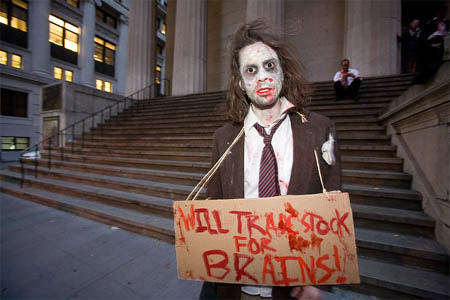
The Ninth Circuit Court has rejected the Obama Administration's request for an emergency stay to block a lawsuit against the government's warrantless wiretapping program. Attorney General Eric "Paramilitary Law" Holder has been trying to use the so-called "state secrets privilege" in several cases, even though the Administration claims it is engaged in a comprehensive review of this legal fiat.
So here we have yet another example of how odd the polical theatre is becoming as we approach the end of the first decade of the 21st Century: the federal judiciary — which had been rubber-stamping anything and everything an openly authoritarian, previous President wanted to do to degrade constitutional rights — is now getting a serious case of intestinal fortitude, while the Executive Branch — which is now under the control of a supposedly "liberal" President — is digging a trench to cabin itself in the very same legalistic wrecking ball of "state secrets privilege" that the miserably Right-wing, incompetent Bush Administration used.
Weirdness abounds. Stay tuned for more. This could get interesting.
Hacking the planet: The only climate solution left?
In a room in London late last year, a group of British politicians were grilling a selection of climate scientists on geoengineering - the notion that to save the planet from climate change, we must artificially tweak its thermostat by firing fine dust into the atmosphere to deflect the sun's rays, for instance, or perhaps even by launching clouds of mirrors into space.
Surely the scientists gave such a heretical idea short shrift. After all, messing with the climate is exactly what got us into such trouble in the first place. The politicians on the committee certainly seemed to believe so. "It is not sensible, is it? It is not a serious suggestion?"
Had the question been posed a few years ago, most climate scientists would have agreed. But the mood is changing. In the face of potentially catastrophic climate change, the politicians and scientists all agreed that since cuts to carbon emissions will likely fall short we need to be exploring "Plan B". Climatologists have hit a "social tipping point" says Tim Lenton of the University of East Anglia, UK.
What's more, respected scientists, including Nobel laureate Paul Crutzen, and groups such as the UK's Royal Society, are already assessing the risks and benefits. Are we ready to try to turn down the thermostat? Who will have the authority to push the button? And what would happen if one nation or well-intentioned "green finger" individual decided to go it alone?
Geoengineering schemes range from the low-tech, such as planting trees, to sci-fi, such as placing mirrors in orbit between Earth and the sun. All would work either by diverting solar energy away from Earth or by sucking carbon dioxide out of the atmosphere to dampen the greenhouse effect...
...take a look at one of the more mature geoengineering schemes that could provide us with instant cooling today - pumping sulphate particles into the atmosphere to reflect the sun's rays back into space. If one country forged ahead, it could have detrimental effects on others. A 2007 study suggested sulphate sunshades could trigger catastrophic drought in some regions. "There would inevitably be winners and losers, as there is not a single global thermostat which will bring about universal and consistent cooling," says David Santillo, senior research scientist at Greenpeace Research Laboratories in Exeter, UK. "By its very nature, if there is to be any purpose in geoengineering, it would have to exert an impact over a vast proportion of the planet..."


...Warren Buffett, who knows a thing or two about wealth, has noted that because of the way the tax code is structured, he effectively pays taxes at a lower rate than the secretaries who work for him, concluding: "There's class warfare, all right. But it's my class, the rich class, that's making war, and we're winning."
One reason they're winning is that the news media do not use the loaded phrases "class warfare" and "redistribution of wealth" to describe things like the Bush tax cuts for the wealthy, or the home mortgage deduction (which favors those who are wealthy enough to buy homes over those who are not) or countless other policies that benefit wealthier Americans at the expense of those who are less fortunate. Instead, the media pretend this is a one-sided war -- as though the wealthy are being unfairly assaulted by an army of bullying waitresses and janitors and farmers and teachers.
Another reason is articles like today's Washington Post front-pager. The Post tells us in paragraph one that Obama plans to raise taxes on the wealthy and waits until paragraph 18 to reveal that he plans to make permanent a tax credit for low- and middle-income workers. A tax increase that applies to almost nobody -- that leads the article. A tax credit that applies to much of the nation's workforce? Buried 18 paragraphs in...
A Bold Plan Sweeps Away Reagan Ideas

...Before becoming Mr. Obama’s top economic adviser, Lawrence H. Summers liked to tell a hypothetical story to distill the trend. The increase in inequality, Mr. Summers would say, meant that each family in the bottom 80 percent of the income distribution was effectively sending a $10,000 check, every year, to the top 1 percent of earners.
Mr. Obama’s budget reflects that sensibility. Budget experts were still sorting through the details on Thursday, but it appeared that various tax cuts and credits aimed at the middle class and the poor would increase the take-home pay of the median household by roughly $800.
The tax increases on the top 1 percent, meanwhile, will most likely cost them $100,000 a year.
“The tax code will become more progressive, with relatively higher rates on the rich and relatively lower rates on the middle class and poor,” said Roberton Williams, a senior fellow at the Tax Policy Center in Washington. “This is reversing the effects of the Bush policies,” he added, and then going even further...
...As governors in nine states, mostly in the South, consider rejecting millions of dollars in federal stimulus money for increased unemployment insurance, there is growing anger among the ranks of the jobless in those states that they could be left out of a significant government benefit...
WASHINGTON — Leon E. Panetta, the new director of the Central Intelligence Agency, said Wednesday that the agency’s campaign against militants in Pakistan’s tribal areas was the “most effective weapon” the Obama administration had to combat Al Qaeda’s top leadership.
The C.I.A. in recent months has intensified its covert campaign of missile attacks in the tribal areas, carrying out more than 30 strikes against Qaeda and Taliban leaders from drone aircraft. Mr. Panetta stopped short of directly acknowledging the missile strikes, but he said that “operational efforts” focusing on Qaeda leaders had been successful.
“It is for that reason that the president and the vice president and everyone else supports continuing that effort,” he said...

BAGHDAD — Twenty-eight members of a Shiite messianic cult responsible for brutal attacks on Shiite pilgrims in Iraq were sentenced to death on Thursday, said an official from the federal court in Dhi Qar Province...

"...I want to speak plainly and candidly about this issue tonight, because every American should know that it directly affects you and your family's well-being. You should also know that the money you've deposited in banks across the country is safe, your insurance is secure. You can rely on the continued operation of our financial system; that's not the source of concern.
The concern is that, if we do not re-start lending in this country, our recovery will be choked off before it even begins. You see...You see, the flow of credit is the lifeblood of our economy. The ability to get a loan is how you finance the purchase of everything from a home to a car to a college education, how stores stock their shelves, farms buy equipment, and businesses make payroll.
But credit has stopped flowing the way it should. Too many bad loans from the housing crisis have made their way onto the books of too many banks. And with so much debt and so little confidence, these banks are now fearful of lending out any more money to households, to businesses, or even to each other.
When there's no lending, families can't afford to buy homes or cars, so businesses are forced to make layoffs. Our economy suffers even more, and credit dries up even further.
That is why this administration is moving swiftly and aggressively to break this destructive cycle, to restore confidence, and restart lending.
And we will do so in several ways. First, we are creating a new lending fund that represents the largest effort ever to help provide auto loans, college loans, and small-business loans to the consumers and entrepreneurs who keep this economy running.
Second -- second, we have launched a housing plan that will help responsible families facing the threat of foreclosure lower their monthly payments and refinance their mortgages.
It's a plan that won't help speculators or that neighbor down the street who bought a house he could never hope to afford, but it will help millions of Americans who are struggling with declining home values, Americans who will now be able to take advantage of the lower interest rates that this plan has already helped to bring about. In fact, the average family who refinances today can save nearly $2,000 per year on their mortgage.
Third, we will act with the full force of the federal government to ensure that the major banks that Americans depend on have enough confidence and enough money to lend even in more difficult times. And when we learn that a major bank has serious problems, we will hold accountable those responsible, force the necessary adjustments, provide the support to clean up their balance sheets, and assure the continuity of a strong, viable institution that can serve our people and our economy.
Now, I understand that, on any given day, Wall Street may be more comforted by an approach that gives bank bailouts with no strings attached and that holds nobody accountable for their reckless decisions, but such an approach won't solve the problem.
And our goal is to quicken the day when we restart lending to the American people and American business and end this crisis once and for all. And I intend to hold these banks fully accountable for the assistance they receive, and this time they will have to clearly demonstrate how taxpayer dollars result in more lending for the American taxpayer.
This time -- this time, CEOs won't be able to use taxpayer money to pad their paychecks, or buy fancy drapes, or disappear on a private jet. Those days are over..."
...Earlier this year, high-flying hedge fund Paulson & Co. retained [former Federal Reserve chief Alan Greenspan] for its “advisory board.” The firm is a noted “short seller” of banks and financial stocks - meaning it makes money when these companies’ shares fall.
The thing is, Greenspan is making public comments that inevitably influence public policy and the markets - and some of those comments may well have led to his clients making a nice profit.
In a recent speech to the Economic Club of New York, Greenspan said the recession would likely “be the longest and deepest” since the Great Depression and that Congress might have to allocate more money to save the beleaguered banking system on top of the billions already gone for the Troubled Asset Recovery Program.
Then he told the Financial Times: “It may be necessary to temporarily nationalize some banks in order to facilitate a swift and orderly restructuring” of their troubled balance sheets.
Such a move would wipe out stockholders, sending shares of banks even lower - thus likely benefiting Paulson. It would also protect bondholders, helping another Greenspan client, the large bond-firm Pimco...
...To be fair, Walsh does note, way down in her review, that the downturn (or, following the brilliant rhetoric of our vice president, Joe Biden, should we not say "downtick"?) in violence in occupied Iraq was due in large part to the American tactic of bribing and arming violent sectarian gangs and giving them chunks of territory to lord over, as an alternative to their previous practice of, well, killing Americans.
This tactic, of course, had nothing to do with the so-called "surge" plan hatched in the bowels of that neocon chicken coop, the American Enterprise Institute -- which Walsh reluctantly praises for its surge plans which "healed" Iraq...
...even Walsh's acknowledgement of the central role played by the "bribes and bullets for local warlords" gambit ignores other major, non-surge-related factors in the downtick.
For instance, the completion of the American-abetted Sunni-Shia civil war, which saw "ethnic cleansing" on a scale that made, say, the Serbia-Kosovo imbroglio or the conflict in Northern Ireland look like a family reunion; and the part played by Iran in backing the American-installed Iraqi government – which is, of course, now run by long-time clients and dependents of Iran.
In other words, the violence has abated to a degree – a degree that still makes Iraq one of the deadliest places on earth – because so many people had already been killed and displaced that there were fewer people to kill and displace, and because the Americans bribed one set of antagonists to quit the battlefield and the Iranians helped tamp down internal violence, especially a potentially catastrophic intra-Shiite conflict between their Green Zone clients and the Mahdi Army.
There was also the American use of death squads, hit teams and "extrajudicial assassinations," as Bob Woodward reported – and lauded – last year. All of these developments that had nothing at all to do with the deployment of 30,000 extra troops that constituted the "surge..."

...“You have enough atoms” to make a nuclear bomb, a senior United Nations official, speaking on the condition of anonymity because of the topic’s diplomatic sensitivity, told reporters on Thursday...

gave self-respecting walruses the willies.


Biotechnology companies are keeping university scientists from fully researching the effectiveness and environmental impact of the industry’s genetically modified crops, according to an unusual complaint issued by a group of those scientists.
“No truly independent research can be legally conducted on many critical questions,” the scientists wrote in a statement submitted to the Environmental Protection Agency. The E.P.A. is seeking public comments for scientific meetings it will hold next week on biotech crops.
The researchers, 26 corn-insect specialists, withheld their names because they feared being cut off from research by the companies. But several of them agreed in interviews to have their names used.
The problem, the scientists say, is that farmers and other buyers of genetically engineered seeds have to sign an agreement meant to ensure that growers honor company patent rights and environmental regulations. But the agreements also prohibit growing the crops for research purposes.
So while university scientists can freely buy pesticides or conventional seeds for their research, they cannot do that with genetically engineered seeds. Instead, they must seek permission from the seed companies. And sometimes that permission is denied or the company insists on reviewing any findings before they can be published, they say...
Dr. Shields of Cornell said financing for agricultural research had gradually shifted from the public sector to the private sector. That makes many scientists at universities dependent on financing or technical cooperation from the big seed companies.
“People are afraid of being blacklisted,” he said. “If your sole job is to work on corn insects and you need the latest corn varieties and the companies decide not to give it to you, you can’t do your job.”
...Volcker, a former chairman of the Federal Reserve famed for breaking the back of inflation in the early 1980s, mocked the argument that "financial innovation,'' a code word for risky securities, brought any great benefits to society. For most people, he said, the advent of the ATM machine was more crucial than any asset-backed bond.
"There is little correlation between sophistication of a banking system and productivity growth,'' he said.
He stressed the importance of preventing financial institutions large enough to pose a threat to the entire system from engaging in risky behavior such as running hedge funds or trading for its own accounts...

Until 2000, Robert Allen Stanford had no record of giving money to anyone in Washington. But then the Clinton administration introduced legislation to crack down on international money laundering.
Suddenly Mr. Stanford, whose company ran a bank in Antigua, made a lot of friends, spreading money to both political parties and their leaders. The legislation languished in a Senate committee until the terrorist attacks of 9/11 convinced Congress it needed to act.
Stanford, accused by the US Securities and Exchange Commission (SEC) of an $8 billion fraud, continued to give money to scores of members of Congress, as well as the Obama presidential campaign.
The contributions, along with those from accused swindler Bernard Madoff, once again raise questions about the relationship of the rich and sometimes fraudulent to America’s lawmakers...
...In Stanford’s case, since 2000 he, his company, or its employees have delivered $2.4 million to political operations, according to Ms. Krumholz. Stanford and his wife personally gave $931,000.
Although he donated to politicians of both parties, 65 percent of his donations went to Democrats, including $31,750 from Stanford, his family, and employees to the presidential campaign of Barack Obama.
“It’s a lot of money when you consider 99 percent of the public doesn’t even give $200,” the amount needed to gain the attention of the Federal Election Commission, Krumholz says. “It makes him a big player.”
In fact, politicians of both parties have been scrambling to distance themselves from the scandal. An Obama aide says the $4,600 contribution from Stanford himself has been donated to charity. Sen. Bill Nelson (D) of Florida is going one step further, shedding money that came from Stanford or his employees.
“Bill has told his campaign he wants every thin dime associated with Stanford returned to a charity or used in some way that could help folks who were deceived by this guy,” a Nelson aide says in an e-mail.
...The same thing happened after the Madoff financial scandal broke. Mr. Madoff and his wife were also contributors to the political process, giving $238,200 since 1991, according to the CRP. His own donations, plus those of his firm, total nearly $1 million.
Two of the largest recipients, Sens. Ron Wyden (D) of Oregon ($13,000) and Charles Schumer (D) of New York ($12,000), say they have donated the money to charity.
Federal authorities accuse Stanford of “massive” fraud centering on high-interest-rate certificates of deposit (CDs). According to the SEC, in recent weeks the Stanford Financial Group has quoted rates as high as 10 percent on a five-year CD, more than twice the highest current US rate, which bankrate.com says is less than 4 percent.
Stanford, who has not been charged with any crime, may have yet more pressing concerns. According to an ABC News report, federal authorities are investigating the banker regarding money laundering for a Mexican drug cartel. The network, on its website, says one of Stanford’s private planes was detained last year by Mexican officials, who found suspicious checks that might be drug related.
...Cutting down on money laundering and financial fraud became a significant interest of Rep. Mike Rogers (R) of Michigan, a former FBI agent. He introduced legislation to improve the ability of state and federal agencies to share information. With the support of the Clinton administration, it passed the House.
But when the bill reached the US Senate, it stalled.
The public-interest lobbying group Public Citizen became curious about what happened. It found Stanford had given contributions to the “soft money” accounts of then-Sen. Tom Daschle (D) of South Dakota, who was Senate minority leader, as well as other key legislators and both political parties.
“What we concluded was that it was his soft-money contribution, aimed at killing the money-laundering legislation, that got the bill killed,” says Steve Weissman, then at Public Citizen, now associate director for policy at the Campaign Finance Institute in Washington.
Representative Rogers knew from his experience at the FBI that something needed to be done, says a spokeswoman.
“If the law had been adopted, it would have surely impacted transparency and made it easier to prevent the fraud cases we’re seeing now,” she says, quoting him.
...it is now clear that this is the worst financial crisis since the Great Depression and the worst economic crisis in the last 60 years. While we are already in a severe and protracted U-shaped recession (the deluded hope of a short and shallow V-shaped contraction has evaporated), there is now a rising risk that this crisis will turn into an uglier, multiyear, L-shaped, Japanese-style stag-deflation (a deadly combination of stagnation, recession and deflation)...
To avoid this L-shaped near-depression, a strong, aggressive, coherent and credible combination of monetary easing (traditional and unorthodox), fiscal stimulus, proper cleanup of the financial system and reduction of the debt burden of insolvent private agents (households and nonfinancial companies) is necessary in the U.S. and other economies...
The process of socializing the private losses from this crisis has already moved many of the liabilities of the private sector onto the books of the sovereign. Among these liabilities are banks, other financial institutions and, soon possibly, households and some important nonfinancial corporate companies...
At some point a sovereign bank may crack, in which case the ability of governments to credibly commit to act as a backstop for the financial system, including deposit guarantees, could come unglued.
Thus the L-shaped, near-depression scenario is still quite possible (I assign it a 30% probability), unless appropriate and aggressive policy action is undertaken by the U.S. and other economies.
This severe economic and financial crisis is now also leading to a severe backlash against financial globalization, free trade and the free-market economic model.
To paraphrase Churchill, capitalist market economies open to trade and financial flows may be the worst economic regime--apart from the alternatives. However, while this crisis does not imply the end of market-economy capitalism, it has shown the failure of a particular model of capitalism. Namely, the laissez-faire, unregulated (or aggressively deregulated), Wild West model of free market capitalism with lack of prudential regulation, supervision of financial markets and proper provision of public goods by governments...

...Blackwater never was a lone bad apple. The entire mercenary industry is rotten and needs to be discarded. Consider Dyncorp and Triple Canopy, the two mercenary outfits that will be filling the hole left by Blackwater. In 1999, for example, Dyncorp employees were implicated in a sex ring in Bosnia that involved the trafficking of women and children as young as 12 years old. When whistleblowers came forward to expose these heinous crimes, they were promptly fired.
And there is no sign that the firm has cleaned up its act in Iraq and Afghanistan. The US state department has repeatedly rebuked Dyncorp for being unprofessional and "too aggressive." In one embarrassing incident, a BBC correspondent actually saw a guard from the company slap the Afghan transport minister.
By comparison, Triple Canopy is a relative newcomer to the mercenary business. With hopes of cashing in on the most privatised war in history, the company was founded immediately after the invasion of Iraq by three US special forces veterans. According to a report from the nonpartisan Congressional Research Service, Triple Canopy relies far more heavily on so-called "third-country nationals" to cushion its bottom line than either Dyncorp or Blackwater. Paid only $33 a day, these hired guns come largely from developing countries - especially those in Latin America - that have histories of human rights abuses.
Much like Blackwater, Triple Canopy was involved in one of the most infamous shooting sprees of the war in Iraq. On 8 July 2006 - after remarking "I want to kill somebody today" - a heavily armed Triple Canopy guard in Iraq reportedly shot multiple rounds into the windshield of an unthreatening pickup truck and later a taxi for amusement...
...My inexpert guess is that full nationalization still would be less expensive and messy than creating the kind of Potemkin markets the Geither plan seems to envision – even if the unintended consequences may be more difficult to control.
At the very least, it would be a more honest solution. One of the things that creeps me out about the political system’s response to the crisis so far – the insolvency of the banking system in particular – are the increasingly desperate attempts to maintain a phony façade of free markets and private enterprise, in an economy now utterly dependent on the federal safety net. I totally expected that from Hank Paulson and the Cheney Administration, but is Obama’s financial team really pressed from exactly the same Wall Street mold?


...one of the things that we need to know is that the estimates of the day at which the trust fund runs out, just keep on receding further into the future, because the program is doing so well at running surpluses. So, ten years ago, people said it was going to run out in 2029. Now the official estimate is 2042. Realistically, it’s probably going to go well into the second half of the century. Now how does this become a crisis? Well it becomes a crisis by changing the rules...
.jpg)
Autonomous military robots that will fight future wars must be programmed to live by a strict warrior code or the world risks untold atrocities at their steely hands.

...The stark warning – which includes discussion of a Terminator-style scenario in which robots turn on their human masters – is issued in a hefty report funded by and prepared for the US Navy’s high-tech and secretive Office of Naval Research .
The report, the first serious work of its kind on military robot ethics, envisages a fast-approaching era where robots are smart enough to make battlefield decisions that are at present the preserve of humans. Eventually, it notes, robots could come to display significant cognitive advantages over Homo sapiens soldiers...
...Any sense of haste among designers may have been heightened by a US congressional mandate that by 2010 a third of all operational “deep-strike” aircraft must be unmanned, and that by 2015 one third of all ground combat vehicles must be unmanned...
...A simple ethical code along the lines of the “Three Laws of Robotics” postulated in 1950 by Isaac Asimov, the science fiction writer, will not be sufficient to ensure the ethical behaviour of autonomous military machines.
“We are going to need a code,” Dr Lin said. “These things are military, and they can’t be pacifists, so we have to think in terms of battlefield ethics. We are going to need a warrior code.”

KABUL, Afghanistan — To many in the Afghan capital, there’s an obvious explanation for the dramatic re-emergence of the Taliban — a force that seemed thoroughly dust-binned after the arrival of the world’s most powerful army seven years ago.
"Now," as one 23-year-old Kabul shopkeeper, Qand Mohmadi, put it, "we think America is supporting both the Taliban and the Afghan government. That’s what everyone says."
Indeed, the rumor of U.S. support for the Taliban is virtually ubiquitous in Kabul. And absurd as it might sound after a year in which American and other Western troops suffered record casualties in fighting with insurgents, many Kabul residents say they see at least a kernel of truth in the story.
"We don’t know for sure why they are doing it," said Daoud Zadran, a middle-aged real estate broker. "Politics is bigger than our thoughts. But maybe America wants to build up the Taliban so they have an excuse to remain in Afghanistan because of the Iranian issue..."
...In recent interviews with Kabul residents, many blamed the lack of progress on Karzai, who is seen as increasingly weak and isolated ahead of this year’s planned presidential elections.
"I see no positive progress since the beginning of the Karzai government, even though we have support from all these other countries," said one resident, Habib Rahman. "We see hundreds of promises every night on the TV, but we see nothing in reality."
From a tarp-covered stall on a street corner, Mohmadi said he too saw little progress.
"There’s no jobs," he said. "I graduated from the 12th grade, and now you see I am selling candy bars by the side of the road."
Many blamed corruption, with some seeing the U.S. or at least western companies in league with pilfering Afghan officials.
"This government is so corrupt that if Osama bin Laden and Mullah Omar were crossing the street together right outside, no one would call the police because they know the police would just take a bribe to let them go," Rahman said.
But there’s also another theory about bin Laden.
"A lot of people say that Osama is really from America," said Nasrallah Wazidi, shrugging noncommittally. "They say he’s just playing a role like a movie star."

...But we're not guaranteed anything nearly so smart. Obama is famously a smart guy, one who learns from his mistakes, but he's also most famous as a guy who learns from the people around him if he doesn't go into a situation with an opinion of his own. And I'm not even vaguely happy about the people he's gathered around him, the literally hundreds of held-over Bush appointees and warmed-over right-wing Democrat Clinton-era appointees that David Sirota at the Campaign for America's Future has taken to calling "the Team of Zombies." If he listens to them, he'll reject bold action on the mortgage crisis in favor of a nice, (politically) safe plan to "attract private investment" in order to "harness the energy of the free market" to solve this problem via "a public-private partnership." Or, just as bad, he may have learned now not to trust the Team of Zombies, only to find out that after letting Pelosi and Reid (and House and Senate Republicans, to whom he gave far too many concessions) turn his stimulus bill into a legislative Christmas tree, and after giving Geithner a blank check and no deadline, there's no money left in the treasuries market for him to use to do the right thing. In either case, we're screwed. And I've been losing sleep for days now waiting to find out which it'll be.
are on the job!
President Barack Obama announced Tuesday night that as many as 17,000 additional troops are headed to Afghanistan in the coming months, administration officials said...
Obama cited a direct threat to the United States from Al Qaeda as part of the rationale for his decision.
“The situation in Afghanistan and Pakistan demands urgent attention and swift action,” Obama said, announcing the deployment in a written statement. “The Taliban is resurgent in Afghanistan, and Al Qaeda supports the insurgency and threatens America from its safe haven along the Pakistani border.”
... Digital map displays on hand-held phones can now show the nearest gas station or A.T.M., reviews of nearby restaurants posted online by diners, or the location of friends. In the latest and biggest example of the map’s power and versatility, Google started a location-aware friend-finding system called Latitude in 27 countries early this month.
On its face, Google’s new service — available on dozens of mobile systems — is simply a way for friends to keep track of one another and meet up, for families to stay in touch or for parents to find comfort in knowing where their children are.
But it will generate a gold mine of new information about where millions of people travel each day, and there is no doubt that Google and others are planning to dig in that mine. “Everyone is watching Google, and this will open a floodgate of location-oriented applications and services,” said Greg Skibiski, the chief executive of Sense Networks, a New York City firm that mines the millions of digital trails left by cellphone users for marketing purposes...
“This is a new metaphor upon which others can build,” said Michael Halbherr, Nokia’s vice president for social location services.

"...Looks more and more like Iraq, right? Everybody "serious" is totally fucked and totally in charge, and everybody who's right gets marginalized. Yay! Another victory for the discipline of free markets!"
...House Judiciary Committee Chairman John Conyers, D-Mich., has issued a subpoena requiring Rove to appear next Monday to testify about the firings and other allegations that the Bush White House let politics interfere with the operations of the Justice Department.
Michael Hertz, the acting assistant attorney general, said in a court brief released Monday that negotiations were ongoing.
"The inauguration of a new president has altered the dynamics of this case and created new opportunities for compromise rather than litigation," Hertz wrote in the brief dated Friday. "At the same time, there is now an additional interested party — the former president — whose views should be considered."
PARIS--Most Americans don't care what happens in France. But the oldest country in "Old Europe" remains the Western world's intellectual capital and one of its primary originators of political trends. (Google "May+1968+Sorbonne.")
The French are reacting to a situation almost identical to ours--economic collapse, government impotence, corporate corruption--by turning hard left. National strikes and massive demonstrations are occurring every few weeks. How far left? This far: the late president François Mitterand's Socialist Party, the rough equivalent of America's Greens, is considered too conservative to solve the economic crisis.
A new poll by the Parisian daily Libération finds 53 percent of French voters (68 percent of 18-to-24-year-olds) favoring "radical social change." Fifty-seven percent want France to insulate itself from the global economic system. Does this mean revolution? It's certainly possible. Or maybe counter-revolution: Jean-Marie Le Pen's nativist (some would say neofascist) National Front is also picking up points.
One thing is certain: French politics are even more volatile than the financial markets these days. In yet another indication of How Far Left?, the Communist-aligned CGT labor union is on the defensive for not being militant enough. "We're not going to put out the blazing fires [of the economic crisis]," the CGT's secretary general said, trying to seize the initiative by calling for another strike on February 18th. "We're going to fan them."
Two new entities, a Left Party (PG) umbrella organization trying to unify opposition to the conservative government of President Nicolas Sarkozy (who'd be to the left of Obama in the U.S.) and the New Anticapitalist Party (NPA), have seized the popular imagination. The NPA claims to have registered more than 9000 "militants" willing to use violent force to overthrow the government if given the word.
"Only combat pays," read a banner at the NPA's first convention.
Communism is dead, most pundits--the mainstream, stupid ones anyway--have been telling us since the USSR shut down in 1991. As it turns out, the libertarians were wrong. Half-right, anyway: Human nature may be inherently individualistic, as free market capitalists claim, but it's also inherently social. When economies boom, most people are sufficiently satisfied to leave well enough alone. Who cares if my boss gets paid 100 times more than I do? I'm doing OK. As resources become scarce, however, we huddle together for protection. The sight of a small rich elite hoarding all the goodies violates our primal sense of fairness.
"In Soviet times," a man in present-day Tajikistan told me, "we lived worse than we do today. But we were all the same. Now we live a bit better, but we have to watch rich assholes pass us in their Benzes." Which would he choose? No hesitation: "Soviet times."
In America, a French cliché goes, people are afraid of the government. In France, the government is afraid of the people. With good reason, too: the French have overthrown their governments dozens of times since the Revolution of 1789. The French are hard wired with class consciousness. Strikes, demonstrations and general hell-raising are festive occasions...
...contempt for American-style "harsh capitalism," where citizens pay $800 a month for healthcare and write nary a letter to their local newspaper to complain, is 100 percent mainstream. The French don't think they should have to suffer just because some greedy bankers went on a looting spree.
Even Sarkozy is getting the message. "We don't want a European May '68 in the middle of Christmas," he warned his ministers in December. He shelved proposals to loosen regulation of business. Arnaud Lagardère, CEO of the Lagardère Group, told the financial daily Les Echos: "We're seeing, in renewed form, the most debatable aspects of Anglo-Saxon capitalism called into question."
The French and Americans face similar problems. But their temperamental differences lead them to different conclusions. An average working-class Frenchman possesses a deeper understanding of economics, politics, history and economics than most college professors in the U.S. Go to a bar or café, and sports will be on the television--but not on people's lips. They're talking politics and how to force their leaders to protect their quality of life.
Americans, on the other hand, don't expect direct help from their government. They're giving Barack Obama time to see whether his economic recovery program will work. It won't, of course; economists say so. But indolent hopefulness is less work than chucking Molotov cocktails.
Back in France, the NPA sets off rhetorical bombs Americans wouldn't dream of. "We're not a boutique party out to get votes, or an institutional mainstream party, but a party of militants," says the NPA's leader to the Le Monde newspaper. "We're real leftists, not official leftists." The NPA is currently negotiating a temporary alliance of convenience with the Communists.
A communist revolution in western Europe would be greeted by curiosity and derision in the U.S. state-controlled media. But if such a social upheaval were to protect French living standards from a global Depression spinning out of control, it might also prove inspiring to increasingly desperate Americans.
...Selling bullets may be the most secure job in Florida as long as supplies last.
After months of heavy buying, gun dealers across the state are experiencing shortages.
Some say it began with the election of President Barack Obama. Others say it’s about the economic downturn or fear of crime. Whatever the reasons, ammunition has been selling like plywood and bottled water in the days before a hurricane...
H.R. 45: Blair Holt’s Firearm Licensing and Record of Sale Act of 2009: The U.S. Is Establishing National Firearms Licensing Requirements and a National Firearms Registration Database
February 15th, 2009
Americans, by the tens of millions, are not going to go along with this. No way. How do we know? Look at California in the 1990s. Millions of gun owners simply refused to register their “assault weapons” when the state required it. Now, if Californians refused to do it, what do you think is going to happen in other states? HAHA California is probably the most anti-gun state in the U.S., but many people there had a “This is it—I refuse—Let them come,” attitude about it.
Places like Alaska, Idaho, Montana, The South, Michigan, New Hampshire…
* chuckling *
Good luck with that, Fedtards!
...I’m not going to link directly to this. Who knows what the surveillance on these Federal systems is going to be used for… If you want to read it for yourself, copy and paste this into your browser:
http://www.govtrack.us/congress/billtext.xpd?bill=h111-45
...there is a growing belief among engineers and security experts that Internet security and privacy have become so maddeningly elusive that the only way to fix the problem is to start over.
What a new Internet might look like is still widely debated, but one alternative would, in effect, create a “gated community” where users would give up their anonymity and certain freedoms in return for safety. Today that is already the case for many corporate and government Internet users. As a new and more secure network becomes widely adopted, the current Internet might end up as the bad neighborhood of cyberspace. You would enter at your own risk and keep an eye over your shoulder while you were there...
...“If you’re looking for a digital Pearl Harbor, we now have the Japanese ships streaming toward us on the horizon,” Rick Wesson, the chief executive of Support Intelligence, a computer consulting firm, said recently.
The Internet’s original designers never foresaw that the academic and military research network they created would one day bear the burden of carrying all the world’s communications and commerce. There was no one central control point and its designers wanted to make it possible for every network to exchange data with every other network. Little attention was given to security. Since then, there have been immense efforts to bolt on security, to little effect...
...scientists armed with federal research dollars and working in collaboration with the industry are trying to figure out the best way to start over. At Stanford, where the software protocols for original Internet were designed, researchers are creating a system to make it possible to slide a more advanced network quietly underneath today’s Internet...
...The Stanford Clean Slate project won’t by itself solve all the main security issues of the Internet, but it will equip software and hardware designers with a toolkit to make security features a more integral part of the network and ultimately give law enforcement officials more effective ways of tracking criminals through cyberspace. That alone may provide a deterrent...
... The Internet’s current design virtually guarantees anonymity to its users. (As a New Yorker cartoon noted some years ago, “On the Internet, nobody knows that you’re a dog.”) But that anonymity is now the most vexing challenge for law enforcement. An Internet attacker can route a connection through many countries to hide his location, which may be from an account in an Internet cafe purchased with a stolen credit card.
“As soon as you start dealing with the public Internet, the whole notion of trust becomes a quagmire,” said Stefan Savage, an expert on computer security at the University of California, San Diego.
A more secure network is one that would almost certainly offer less anonymity and privacy. That is likely to be the great tradeoff for the designers of the next Internet. One idea, for example, would be to require the equivalent of drivers’ licenses to permit someone to connect to a public computer network...
...The spectacle of bankers continuing to award themselves bonuses while taking taxpayer support is feeding an extraordinary public rage and a fierce sense of injustice...
...Want a glimpse at the truly perverse moral universe of our wise and progressive leaders? Then take a gander at the testimony of Leon Panetta, nominee for CIA chief, as he assures Congress that he "would not hestitate" to ask Obama to use "harsher interrogation techniques" than those allowed in the Army Field Manual. Panetta also says he might possibly look into prosecuting a few bits of low-hanging CIA fruit if it turns out that they might have gone beyond the permission to "torture up to the limit of death or severe bodily harm" standards set by John Yoo and George W. Bush.
Then again, he may not prosecute anybody either. You may be struck by the complete absence of any reference – by Panetta or the Congressional solons – of the possibility of prosecuting those who designed, approved and supervised the torture system. That possibility does not exist in the universe of our wise and progressive leaders.
Finally, for a bit of garnish, note the story's passing reference to some objections to Panetta's nomination, specifically, "some questions from Republicans concerned over his denunciations of torture." We have come so far in our advanced 21st century civilization that United States Senators can now express doubts about an appointee's fitness because he has denounced the use of torture. (Even though said appointee is frantically signalling to the powers that be that he doesn't mind the rough stuff – just as long as you don't call it torture.)
Read it all, in slack-jawed wonder, in this Reuters story: Obama CIA Pick May Back 'Limited' Abuse Prosecution.
Word has it that President Obama intends to appoint a task force the week after next which will be charged with "reforming" Social Security. According to inside gossip, the task force will be led entirely by economists who were not able to see the $8 trillion housing bubble, the collapse of which is giving the country its sharpest downturn since the Great Depression.
This effort is bizarre for several reasons. First, the economy is sinking rapidly. While President Obama's stimulus package is a good first step towards counteracting the decline, there is probably not a single economist in the country who believes that is adequate to the task. President Obama would be advised to focus his attention on getting the economy back in order instead of attacking the country's most important social program.
The second reason why this task force is strange is that Social Security doesn't need reforming. According to the Congressional Budget Office, it can pay all scheduled benefits for the next 40 years with no changes whatsoever.
The third reason that this effort is pernicious is that this talk of reform is occurring with the baby boomers just as the cusp of retirement. Due to the reckless policies of the Rubin-Greenspan-Bush clique, this cohort has just seen their housing equity wiped out with the collapse of the housing bubble. Tens of millions of baby boomers who might have felt reasonably secure three years ago are now approaching retirement with little or no equity in their homes.
Similarly, if they had been fortunate enough to accumulate any substantial amount of savings in a 401(k) account, they just saw much of this wealth vanish with the plunge in the stock market...
...there are basic inefficiencies intrinsic to markets. In the case of financial markets, they under-price risk. They don't count in systemic risk — general social costs...
risks are under-priced, so there are more risks taken than would happen in an efficient system. And that of course leads to crashes. If you had adequate regulation, you could control and prevent market inefficiencies. If you deregulate, you're going to maximize market inefficiency.
This is pretty elementary economics. They happen to discuss it in this book; others have discussed it too. And that's what's happening. Risks were under-priced, therefore more risks were taken than should have been, and sooner or later it was going to crash. Nobody predicted exactly when, and the depth of the crash is a little surprising. That's in part because of the creation of exotic financial instruments which were deregulated, meaning that nobody really knew who owed what to whom. It was all split up in crazy ways. So the depth of the crisis is pretty severe — we're not to the bottom yet — and the architects of this are the people who are now designing Obama's economic policies.
Dean Baker, one of the few economists who saw what was coming all along, pointed out that it's almost like appointing Osama bin Laden to run the so-called war on terror. Robert Rubin and Lawrence Summers, Clinton's treasury secretaries, are among the main architects of the crisis. Summers intervened strongly to prevent any regulation of derivatives and other exotic instruments. Rubin, who preceded him, was right in the lead of undermining the Glass-Steagall act, all of which is pretty ironic. The Glass-Steagall Act protected commercial banks from risky investment firms, insurance firms, and so on, which kind of protected the core of the economy. That was broken up in 1999 largely under Rubin's influence. He immediately left the treasury department and became a director of Citigroup, which benefited from the breakdown of Glass-Steagall by expanding and becoming a "financial supermarket" as they called it. Just to increase the irony (or the tragedy if you like) Citigroup is now getting huge taxpayer subsidies to try to keep it together and just in the last few weeks announced that it's breaking up. It's going back to trying to protect its commercial banking from risky side investments. Rubin resigned in disgrace — he's largely responsible for this. But he's one of Obama's major economic advisors, Summers is another one; Summer's protégé Tim Geithner is the Treasury Secretary.
None of this is really unanticipated. There were very good economists like say David Felix, an international economist who's been writing about this for years. And the reasons are known: markets are inefficient; they under-price social costs. And financial institutions underprice systemic risk. So say you're a CEO of Goldman Sachs. If you're doing your job correctly, when you make a loan you ensure that the risk to you is low. So if it collapses, you'll be able to handle it. You do care about the risk to yourself, you price that in. But you don't price in systemic risk, the risk that the whole financial system will erode. That's not part of your calculation.
Well that's intrinsic to markets — they're inefficient... They can be controlled by some degree of regulation, but that was dismantled under religious fanaticism about efficient markets, which lacked empirical support and theoretical basis; it was just based on religious fanaticism. So now it's collapsing.
...Social Security does not need to be fixed anytime in the next 18 years. We don't need to increase retirement ages, we don't need to lift the payroll cap (and I don't care how progressive that sounds). Fundamentally it is not broken...


...The American way of life depends, in part, on a specific illusion. It's a lie that we tell ourselves, and tell our children. What we just did last Tuesday, an orderly, peaceful, even civil transition of power from one generation to the next, from one ethnic group to another, from one political party to another political party with a different political agenda? We lie to ourselves, and lie even harder to our children, that that is something we can count on, something we have always been able to count on, that any alternative is so unthinkable and unnatural for Americans that we need have no fear whatsoever of any alternative.
Historians know that that's a lie. Even if one accepts the incredible claim that every US President who has ever been assassinated was killed by a deranged lone gunman, acting out of personal motives, with no political motive, and with no encouragement or assistance by anyone else, the fact remains: historians know that it can get so bad in the United States, economically, that the American people will withdraw their consent to be governed.
We recall one particular financial industry collapse that rippled outward around the globe (among other things, ultimately bringing the Nazis to power in Germany) not just any recession or depression, but the Great Depression, because the number of people needing work in the US rose to about 3.5 million, or about 20% of all working-age heads of households. In the hardest-hit parts of the country, it reached 50%.
And it's not a coincidence that the next several years saw three credible attempts to topple the United States government: a half-million man general strike called by Soviet-influenced CIO labor unions aimed at sparking a general uprising and Communist revolution that couldn't quite hold out long enough to get their revolution before it collapsed, Huey Long's astronomically-growing Poor People's Army that aimed at overthrowing the Constitution which was only thwarted via its leader's assassination, and an attempt by the 1930s equivalent of the Democratic Leadership Council, then called the American Liberty League, to use corporate money to bribe US military generals into placing them in power via coup d'etat.
No, we know as a matter of objective fact: somewhere in the near vicinity of 20% prolonged unemployment, the USA starts running a serious risk of anarchy followed by totalitarianism...
...FDR, congressional Republicans lead by Harold Ickes, and right-wing Democrats lead by Al Smith were wrong in exactly the same way that Barack Obama, congressional Republicans, and the Democratic Leadership Council are wrong right now. The Public Works Administration did its job. It did it under budget. It wasted not a single dollar. It attracted not a single critic. And it created almost no jobs. In 1933, it turned out that there just plain weren't that many legitimate government jobs that weren't being funded already. As Ickes took his sweet time coming up with more, lest he be criticized for wasting taxpayer money, he found out that there also weren't a whole lot of companies out there begging for the chance to bid on PWA contracts. They weren't crazy about the contract stipulations, and they weren't all that interested in retooling and reorganizing their entire corporate structures to service contracts there were guaranteed to end as soon as the Great Depression ended. As an anti-poverty, anti-violent-revolution government program, the Public Works Administration was an unvarnished, absolute, indefensible disaster. Period. End of story. Nobody even tries to defend it any more; its supporters just pretend it never happened, so they can recommend the same thing the next time without anybody knowing it's been tried before, because by their politics, it's the right thing to do whether it works or not.
And along about the time that Roosevelt was about to lose his temper over this, the First Lady talked him into talking to a very successful social worker named Harry Hopkins, who only wanted a few minutes of the President's time so he could ask one question. He showed the President figures (that he later showed Congress) showing that there were about 3.5 million Americans in 1933 who were heads of households between the ages of 18 and 64 that no employer was going to hire, no way, no how, not for any amount of money, and he asked: "Can you give one legal reason why we can't just hire those people ourselves?" The thing is, he got that estimate of 3.5 million people by going through the state-by-state lists of people who were already on the dole, people who were already receiving some kind of charitable or government cash hand-out because they weren't working. And what Hopkins realized was that not only did the American people deeply resent those people for taking money and doing nothing all day, the recipients weren't any happier about it, either: they wanted to work. So FDR shoe-horned a program through Congress, first as pilot program called the Civil Works Administration, to raise about $1200 (1933 US dollars) per year per unemployed head of household: $1000 per worker per year for wages, $24 per worker per year for administrative costs, the rest for hand tools and raw materials for whatever projects he could make up. To get CWA funding, a job had to be something that no corporation was interested in providing, and that no government agency was interested in funding, and it had to be as labor-intensive as possible (see photograph above right).
Conservatives in both parties hated it. And still do. And campaigned hard against it in the 1934 congressional primaries. Al Smith's right-wing Democrats convinced FDR that if he kept the CWA, it would cost him his majority in Congress, so he shut it down after only four months. In that four months, CWA workers had already built 1,000 rural airports, built 40,000 school buildings, built or resurfaced a quarter-million miles of roads, and laid twelve million miles of sanitary sewer lines, some of the first sewer lines laid in most counties. In four months. Right-wing Democrats and anti-tax pro-corporate Republicans screamed bloody murder about all the money that the CWA was "wasting," but (and this is a point I'll come back to again) we're still using almost all of that stuff today. 75 years later, those "worthless" "make-work" projects are turning out to be some of the most valuable stuff the government had done in its first 150 years of existence. So contrary to what the right-wing Democrats in Congress were telling FDR he "needed" to do to "save" the 1934 congressional elections, terminating the CWA turned out to be the least popular thing he did as President, and as soon as the elections were over, on voter mandate, FDR brought it right back again, rammed it through Congress again as the Works Progress Administration (WPA).
Only this time it had full funding, and a Congressional and Presidential mandate to try to hire every single one of the roughly 3.5 million unemployed, non-disabled, work-aged heads of household in America. And in almost no time at all, they came as close as makes no difference, getting to 3.3 million, on one simple philosophy: you tell us whatever it is you "do," and we'll find you a job doing it. Those jobs paid very nearly jack squat; nearly all WPA workers ended up living with their whole families in roughly 8" x 10" or so rooms in improvised "boarding houses," spare rooms leased out by people who were house-rich but cash poor, trying to save their homes, tenants with no control over the menu of the meal plan it came with and shared use of a single bathroom (or maybe just an outhouse and an outdoor water pump) with 3 to 8 other families. Nobody lived well on the WPA, but nobody starved either. On the other hand, nobody worked terribly hard, either, and I know this one from a very personal source: my paternal grandfather was a WPA veteran.
Grampa Hicks was himself a right-wing anti-tax anti-communist Democrat of the American Liberty League school, and he hated the WPA with a fiery passion for the entire rest of his life. It was from him I first heard the joke: "How many people does it take to do one WPA job? Three. One on his way to the bathroom, one on his way back from the bathroom, and one leaning on the shovel pretending to work." But here's the funny thing. You know what Grampa Hicks was before the Great Depression? He was a bum. A mostly-unemployed unskilled laborer on the rare occasions he had a job, a street brawler and small-time crook, a chronic alcoholic and wife-beater who spent most of the 1920s in jail...
But you know what? There's a funny thing about that, something I'm pretty sure Grampa Hicks never thought about. First of all, if it weren't for the WPA, we Hickses would still be bums. Grampa Hicks was desperate to get out from behind that wheel barrow and that shovel, but was too drunk to do plumbing. So he took to hanging around when the electricians were running wire, and managed to get himself a totally useless job as a sort of human Vice-Grip. "Here," says the skilled electrician who was himself out of work, yelling over to my grandpa because the WPA wouldn't spring for proper tools, "you there -- hold these two wires together while I tape them together." By following that guy around and watching over that guy's shoulder, Grampa Hicks taught himself basic electrical wiring. And when the WPA was over, he was able to lie with a straight face to employers that he was a skilled electrician, and that got him his first real job, one his son learned from him, and that I learned from my dad that paid my way through college: electrical sign erector, IBEW local 1.
But never mind how much difference those "pointless" National Guard armories made to my family, there's something even bigger that Grampa Hicks didn't know. We're still using almost every single one of those buildings. I saw an article a while back (citation lost, sorry) by an architecture student who'd gotten curious about what ever happened to all those National Guard armories, so he got some grant money and went on a national tour. And what he found was that in almost every single rural town in America and even in most suburbs, those "ridiculously over-built" armories were the first truly solid building ever built there. And because they were "ridiculously over-built," they're still in use...
I don't think you can come up with a single dollar of WPA spending that actually counts as wasted, not a single WPA "make-work" project so pointless and stupid that we didn't get our money's worth out of it, especially if you count all the on-the-job job skills training it gave the 8 or 9 million people who went through the program. And that's even if you don't factor in the analysis of very serious historians who question whether or not American "G.I.s" would have fought so hard or so well to save the world from 1941 to 1945 if they had been as resentful, and as starving, as they were in 1930. But no, the blunt fact of history is that if the truth were ever told about the WPA, if the truth hadn't been being smothered in lies by the same political factions that opposed it at the time all the way up to this very day, everybody would know what the WPA proved as inescapable facts. No dollar of government spending is wasted, if it does a job that nobody else was going to do and it builds something that lasts...
...Ronald freaking Reagan himself briefly campaigned on it, calling it "Workfare:" if you can't find a job, we'll make you one, whether you like it or not. But he didn't even get sworn in before the same pro-corporate Republicans and right-wing Democrats convinced him to drop it, to instead concentrate on cutting taxes for corporations as his only unemployment-fighting measure. No, there is now, just as there was in Franklin Roosevelt's time, a bipartisan consensus of the elites in this country that the way to put Americans back to work is that taxes must be cut on investors and corporations. We are, apparently, supposed to ignore the last thirty years of history, which teaches us that every tax cut we pass and every subsidy we grant to big corporations will be used to hire robots or to move jobs overseas. No, this time we're supposed to believe it will be different and this time they really will use that money to make more jobs. Trust them on this, they say. And just as in Roosevelt's day, the exact same political coalition of big-corporation Republicans and big-corporation Democrats insist that if that won't do the job fast enough, then what we need are even more public-private partnerships. And ironically, even Barack Obama, who very nearly lost his political career early on because he was caught on the fringes of Tony Rezko's financially corrupt public-private partnership, one that Barack Obama had gotten for him, somehow hasn't learned that it's public-private partnerships and tax cuts for corporations and the wealthy, not government make-work programs or benefits for the unemployed, that are the real welfare cheats. Being a Harvard graduate who grew up under the steady drumbeat of pro-corporate propaganda about how evil the WPA was, he's still talking up the need for more public-private partnerships like Harold Ickes' old Public Works Administration.
So I figure the odds at roughly 4 to 1 that he's going to screw up the unemployment situation in America, at the very least doing nothing to help it, and quite possibly making it worse by funding the elimination of yet more American jobs, because that's exactly what the new President and his cabinet officers are talking about doing, lately. Sadly, these are even better odds than we would have had under either Clinton or McCain, neither of whom would have even considered anything but public-private partnerships. Obama will, I think, at least think about it. But I don't think he'll do anything but try to set up another PWA. Which is a damned shame. Because what we really need is another WPA.
...while ex-Sen. Daschle is a reputed expert on health systems, he has also, since leaving the Senate, made a quarter of a million dollars as speaker, consultant and adviser to private health insurance and health care companies.
Does anyone think that, as secretary of health and human services, he would have recommended a new system that cuts out the private health insurance industry? The insurance companies are the ones that killed Hillary Clinton’s health proposals eight years ago. Where do you think the money goes that makes American health care the most expensive in the world? It’s not going into nurses’ salaries.
Nor are taxes a problem if you are going to be secretary of the treasury. “Whoops,” Timothy Geithner says, “how can I have overlooked 30 grand?” (Or maybe even a little more.) Maybe you can overlook it if you are a central banker or work for Goldman Sachs; I’m not in a position to know. Anyway, Secretary Geithner already is confirmed.
This is a serious matter, jokes aside. Is there anyone prominent in Washington who is not hopelessly entangled with big—really big—corporate money, that links him or her to certain industries or partisan positions?
Maybe not. Years ago, I used to rant that the only solution would be to require fixed and equal unpaid political campaign time on national and local broadcasting, and ban other paid political advertising. It’s the money for televised political campaigns that has turned Washington into a den of legalized larceny.
But then Washington has always been Another Place, as the Obamas are finding out. They are from Chicago, which has Serious Weather (more than three feet of snow a year). On one of their first days in the White House, less than an inch of snow fell on Washington and all the schools were closed. The president had Malia and Sasha underfoot.
He suggested to reporters that Washingtonians get a grip on themselves and find a way to cope with such crises. Since then, the snippy Washington comment has been that Washington snow is different; and that if the Obamas don’t like it in Washington, they can go back to where they came from...
BAGHDAD — This is what victory in the war in Iraq was supposed to look like: Fifteen million Iraqis voting in free and fair (largely) elections, emerging from their polling stations with their purple-stained fingers in an atmosphere that was free (largely) of intimidation or violence...
...there is Brennan's December 5, 2005 appearance on The News Hour with Jim Lehrer, in which he vehemently defended the Bush administration's use of rendition -- one of the key tools to subject detainees to torture:
JOHN BRENNAN: I think over the past decade it has picked up some speed because of the nature of the terrorist threat right now but essentially it's a practice the United States and other countries have used to transport suspected terrorists from a country, usually where they're captured to another country, either their country of origin or a country where they can be questioned, detained or brought to justice. . . .
MARGARET WARNER: So was Secretary Rice correct today when she called it a vital tool in combating terrorism?
JOHN BRENNAN: I think it's an absolutely vital tool. I have been intimately familiar now over the past decade with the cases of rendition that the U.S. Government has been involved in. And I can say without a doubt that it has been very successful as far as producing intelligence that has saved lives.
MARGARET WARNER: So is it -- are you saying both in two ways -- both in getting terrorists off the streets and also in the interrogation?
JOHN BRENNAN: Yes. The rendition is the practice or the process of rendering somebody from one place to another place. It is moving them and the U.S. Government will frequently facilitate that movement from one country to another. . .

...There are simply too many major players in the Obama team who are either alumni of the financial bubble’s insiders’ club or of the somnambulant governmental establishment that presided over the catastrophe.
This includes Timothy Geithner, the Treasury secretary. Washington hands repeatedly observe how “lucky” Geithner was to be the first cabinet nominee with an I.R.S. problem, not the second, and therefore get confirmed by Congress while the getting was good. Whether or not this is “lucky” for him, it is hardly lucky for Obama. Geithner should have left ahead of Daschle.
Now more than ever, the president must inspire confidence and stave off panic. As Friday’s new unemployment figures showed, the economy kept plummeting while Congress postured. Though Obama is a genius at building public support, he is not Jesus and he can’t do it all alone. On Monday, it’s Geithner who will unveil the thorniest piece of the economic recovery plan to date — phase two of a bank rescue. The public face of this inevitably controversial package is now best known as the guy who escaped the tax reckoning that brought Daschle down.
Even before the revelation of his tax delinquency, the new Treasury secretary was a dubious choice to make this pitch. Geithner was present at the creation of the first, ineffectual and opaque bank bailout — TARP, today the most radioactive acronym in American politics. Now the double standard that allowed him to wriggle out of his tax mess is a metaphor for the double standard of the policy he must sell: Most “ordinary Americans” still don’t understand why banks got billions while nothing was done (and still isn’t being done) to bail out those who lost their homes, jobs and retirement savings.
As with Daschle, the political problems caused by Geithner’s tax infraction are secondary to the larger questions raised by his past interaction with the corporations now under his purview. To his credit, Geithner, like Obama, has devoted his career to public service, not buckraking. But he still has not satisfactorily explained why, as president of the New York Fed, he failed in his oversight of the teetering Wall Street institutions. Nor has he told us why, in his first major move in his new job, he secured a waiver from Obama to hire a Goldman Sachs lobbyist as his chief of staff. Nor, in his confirmation hearings, did he prove any more credible than the Bush Treasury secretary, the Goldman Sachs alumnus Hank Paulson, in explaining why Lehman Brothers was allowed to fail while A.I.G. and Citigroup were spared.
Citigroup had one highly visible asset that Lehman did not: Robert Rubin, the former Clinton Treasury secretary who sat passively (though lucratively) in its executive suite as Citi gorged on reckless risk. Geithner, as a Rubin protégé from the Clinton years, might have recused himself from rescuing Citi, which so far has devoured $45 billion in bailout money.
Key players in the Obama economic team beyond Geithner are also tied to Rubin or Citigroup or both, from Larry Summers, the administration’s top economic adviser, to Gary Gensler, the newly named nominee to run the Commodity Futures Trading Commission and a Treasury undersecretary in the Clinton administration. Back then, Summers and Gensler joined hands with Phil Gramm to ward off regulation of the derivative markets that have since brought the banking system to ruin. We must take it on faith that they have subsequently had judgment transplants.
Obama’s brilliant appointees, we keep being told, are irreplaceable. But as de Gaulle said, “The cemeteries of the world are full of indispensable men.” You have to wonder if this team is really a meritocracy or merely a stacked deck. Not only did Rubin himself serve on the Obama economic transition team, but two of the transition’s headhunters were Michael Froman, Rubin’s chief of staff at Treasury and later a Citigroup executive, and James S. Rubin, an investor who is Robert Rubin’s son.
A welcome outlier to this club is Paul Volcker, the former Federal Reserve chairman chosen to direct Obama’s Economic Recovery Advisory Board. But Bloomberg reported last week that Summers is already freezing Volcker out of many of his deliberations on economic policy. This sounds like the arrogant Summers who was fired as president of Harvard, not the chastened new Summers advertised at the time of his appointment. A team of rivals is not his thing.
Americans have had enough of such arrogance, whether in the public or private sectors, whether Democrat or Republican. Voters turned on Sarah Palin not just because of her manifest unfitness for office but because her claims of being a regular hockey mom were contradicted by her Evita shopping sprees. John McCain’s sanctification of Joe the Plumber (himself a tax delinquent) never could be squared with his inability to remember how many houses he owned. A graphic act of entitlement also stripped naked that faux populist John Edwards.
The public’s revulsion isn’t mindless class hatred. As Obama said on Wednesday of his fellow citizens: “We don’t disparage wealth. We don’t begrudge anybody for achieving success.” But we do know that the system has been fixed for too long. The gaping income inequality of the past decade — the top 1 percent of America’s earners received more than 20 percent of the total national income — has not been seen since the run-up to the Great Depression.
This is why “Slumdog Millionaire,” which pits a hard-working young man in Mumbai against a corrupt nexus of money and privilege, has become America’s movie of the year. As Robert Reich, the former Clinton labor secretary, wrote after Daschle’s fall, Americans “resent people who appear to be living high off a system dominated by insiders with the right connections...”

...bonuses tend to be based on how well the individual is seen to be developing. As employees progress, their compensation is based less on individual performance and more on their role as a manager or team leader. For all professional employees the annual bonus represents a very large amount of the person's take-home pay. At the middle levels, bonuses are set after firm-wide, interdepartmental negotiation sessions that attempt to allocate the firm's compensation pool based on a combination of performance and potential.
...Remarks as Delivered by Secretary of Defense Donald H. Rumsfeld, The Pentagon , Monday, September 10, 2001
..."we cannot track $2.3 trillion in transactions"...

...The reason you are such a big story is that you’ve stolen our money. Or at least that’s how most of the country sees it. First you broke just about everything you touched: mortgages, 401(k)s, the kids’ college accounts, and even the employers who provide paychecks—the chump change that middle-class America counts on while you live high. Then we had to bail you out.
You think those auto executives looked bad when they appeared shocked, shocked to find that Congress didn’t really appreciate their traveling in corporate jets to come and beg for their bailouts?
Well, no one hates Detroit as much as they hate Wall Street. At least the Big Three make something people need to get to work and take their kids to soccer and pick up the groceries. What, exactly, do they do with a derivative?
when the rest of the world sees them like this
...over the past five years, the money the military spends on winning hearts and minds at home and abroad has grown by 63 percent, to at least $4.7 billion this year, according to Department of Defense budgets and other documents. That's almost as much as it spent on body armor for troops in Iraq and Afghanistan between 2004 and 2006.
This year, the Pentagon will employ 27,000 people just for recruitment, advertising and public relations — almost as many as the total 30,000-person work force in the State Department...
...on Dec. 12, the Pentagon's inspector general released an audit finding that the public affairs office may have crossed the line into propaganda. The audit found the Department of Defense "may appear to merge inappropriately" its public affairs with operations that try to influence audiences abroad. It also found that while only 89 positions were authorized for public affairs, 126 government employees and 31 contractors worked there.
...Another audit, also in December, concluded that a public affairs program called "America Supports You" was conducted "in a questionable and unregulated manner" with funds meant for the military's Stars and Stripes newspaper.
The program was set up to keep U.S. troops informed about volunteer donations to the military. But the military awarded $11.8 million in contracts to a public relations firm to ...drum up support for the military at a time when public opinion was turning against the Iraq war.
The audit also found that the offer to place corporate logos on the Pentagon Web site in return for donations was against regulations...
"They very explicitly identify American public opinion as an important battlefield," says Marc Lynch, a professor at George Washington University...
...In 2003, for example, initial accounts from the military about the rescue of Pvt. Jessica Lynch from Iraqi forces were faked to rally public support...
The fastest-growing part of the military media is "psychological operations," where spending has doubled since 2003...
In Afghanistan, for example, a video of a soldier joining the national army shown on Afghan television is not attributed to the U.S. And in Iraq, American teams built and equipped media outlets and trained Iraqis to staff them without making public the connection to the military.
Rear Adm. Gregory Smith, director of strategic communications for the U.S. Central Command, says psychological operations must be secret to be effective. He says that in the 21st century, it is probably not possible to win the information battle with insurgents without exposing American citizens to secret U.S. propaganda...
The danger of psychological operations reaching a U.S. audience became clear when an American TV anchor asked Gen. David Petraeus about the mood in Iraq. The general held up a glossy photo of the Iraqi national soccer team to show the country united in victory... It was U.S. psychological operations that had quietly distributed tens of thousands of the soccer posters in July 2007 to encourage Iraqi nationalism...
In 2003, Rumsfeld issued a secret Information Operations Roadmap setting out a plan for public affairs and psychological operations to work together. It noted that with a global media, the military should expect and accept that psychological operations will reach the U.S. public...
In February, the Army released a new eight-chapter field manual that puts information warfare on par with traditional warfare.
The title of an entire chapter, Chapter 7: "Information Superiority."
"...I can tell you there wouldn't be a single American disappointed with anything that we've done that might be out there, that they don't know about," says Col. Curtis Boyd, commander of the 4th PSYOP Group, the largest unit of its kind. "Frankly, they probably wouldn't care because maybe they are safer as a result of it..."
...The Pentagon claim that recently popped up as Obama moved to close Guantanamo -- that 61 released detainees have "returned to the battlefield" -- has been thoroughly and repeatedly debunked. Nonetheless, CNN's Wolf Blitzer, as part of a fear-mongering segment on closing Guantanamo, just mindlessly repeated the Pentagon claim (and he even added the scary detail that 25 of those 61 "recidivists" have perpetrated an attack in the last 10 months). As Media Matters notes, establishment journalists are repeatedly reciting the Pentagon's recidivism claim without an ounce of skepticism, without even noting the ample disputes surrounding this claim.
The reason defenders of Bush policies rely on such patently fallacious "reasoning" (if X precedes Y, then it means X caused Y -- where X = torture/Guantanamo and Y = no Terrorist attack) is because they know that these media stars have neither the ability nor the inclination to devote even a molecule of critical thought to what they're being told.
A not-so-funny thing happened on the way to economic recovery. Over the last two weeks, what should have been a deadly serious debate about how to save an economy in desperate straits turned, instead, into hackneyed political theater, with Republicans spouting all the old clichés about wasteful government spending and the wonders of tax cuts.
It’s as if the dismal economic failure of the last eight years never happened — yet Democrats have, incredibly, been on the defensive. Even if a major stimulus bill does pass the Senate, there’s a real risk that important parts of the original plan, especially aid to state and local governments, will have been emasculated.
Somehow, Washington has lost any sense of what’s at stake — of the reality that we may well be falling into an economic abyss, and that if we do, it will be very hard to get out again.
It’s hard to exaggerate how much economic trouble we’re in. The crisis began with housing, but the implosion of the Bush-era housing bubble has set economic dominoes falling not just in the United States, but around the world...
Army Gen. Jack Keane is a busy man for a retired guy. At 66, most retirees, especially those with fat government pensions, would be taking it easy. Instead, "Old Blood & Treasure" is into taking the reins of power away from the lawfully elected President of the United States of America. Keane pretended to be installing democracy in the Middle East, but he seems to be looking to overthrow it here. The only question is, will it be a bloodless coup?
GET THE WORK DONE THAT NEEDS TO GET DONE, and FUCK the Republicans.
“No matter how much money we invest or how sensibly we design our policies, the change that Americans are looking for will not come from government alone,” Mr. Obama said. “There is a force for good greater than government.”

...look at a list of U.S. State Department notices on the U.S. Embassy site for Japan.
This person said to look at the notices dated 09/07/01 and 09/10/01. Obviously, those were just before The Big Day.
...a brand new Worldwide Caution was just released on 2 February.
I thought, “There aren’t too many World Wide Cautions, but maybe it’s a coincidence,” and left it at that.
But today, ...this interview with Cheney about how “the terrorists” are going to use nuclear or biological weapons against a U.S. city if the torture industrial complex was to scale itself back a bit...

...Obama's desire to begin a "post-partisan" era may have backfired. In his eagerness to accommodate Republicans and listen to their ideas over the past week, he has allowed the GOP to turn the haggling over the stimulus package into a decidedly stale, Republican-style debate over pork, waste and overspending. This makes very little economic sense when you are in a major recession that only gets worse day by day...
, in the wings.
...I wrote the other night about that Blue Dog ass Jim Cooper and how he stuck the shiv into Obama and the stimulus. And I noted this important piece by Mike Lux about Cooper's important role in the tanking of the Clinton health care plan in 1994.
Well, guess what? He's being discussed as the replacement for Daschle at HHS, which is only slightly less ludicrous than the silly idea of Newt Gingrich in the job.
Jim Cooper is an enemy of universal health care. He will, howver, work to ensure that the insurance industry and the Big Pharma gets more of your tax dollars...
...Inverted totalitarianism, unlike classical totalitarianism, does not revolve around a demagogue or charismatic leader. It finds its expression in the anonymity of the corporate state. It purports to cherish democracy, patriotism and the Constitution while cynically manipulating internal levers to subvert and thwart democratic institutions. Political candidates are elected in popular votes by citizens, but they must raise staggering amounts of corporate funds to compete. They are beholden to armies of corporate lobbyists in Washington or state capitals who write the legislation. A corporate media controls nearly everything we read, watch or hear and imposes a bland uniformity of opinion or diverts us with trivia and celebrity gossip. In classical totalitarian regimes, such as Nazi fascism or Soviet communism, economics was subordinate to politics. “Under inverted totalitarianism the reverse is true,” Wolin writes. “Economics dominates politics—and with that domination comes different forms of ruthlessness.”
...The basic systems are going to stay in place; they are too powerful to be challenged.. This is shown by the financial bailout. It does not bother with the structure at all. I don’t think Obama can take on the kind of military establishment we have developed. This is not to say that I do not admire him. He is probably the most intelligent president we have had in decades. I think he is well meaning, but he inherits a system of constraints that make it very difficult to take on these major power configurations. I do not think he has the appetite for it in any ideological sense. The corporate structure is not going to be challenged. There has not been a word from him that would suggest an attempt to rethink the American imperium...
...in inverted totalitarianism consumer goods and a comfortable standard of living, along with a vast entertainment industry that provides spectacles and diversions, keep the citizenry politically passive...
Just because the Internet has broken down geographic barriers, don't assume that Google doesn't care about geography.
The company plans to launch software called Latitude on Wednesday that lets mobile phone users share their location with close contacts. Google hopes it will help people find each other while out and about and to keep track of loved ones...

It is instructional that only one of the three tax-challenged Obama appointees has survived public scorn to retain a high position in the new administration. Oddly enough, it is Treasury Secretary Timothy Geithner, the man who will collect our taxes, whose career has not been stunted by his failure to pay them.
What makes Geithner so special? The answer, provided by everyone from the president to the media pundits, is that his services are indispensable because he has the expertise in regulating markets needed to preside over the most massive government intervention in the economy. Are they kidding?
Both in his years in the Clinton treasury and as chair of the New York Federal Reserve Bank, Geithner has been paving the way for a runaway Wall Street. Nor has he changed his ways, as was evidenced once again last week with his appointment of Mark Peterson, a Goldman Sachs vice president and lobbyist, to be his top aide. Peterson had lobbied strenuously for precisely the deregulation that the Obama administration now concedes needs reversing. It was confirmation that Goldman Sachs runs the Treasury Department—no matter which party is in power...

Wind and solar power have been growing at a blistering pace in recent years, and that growth seemed likely to accelerate under the green-minded Obama administration. But because of the credit crisis and the broader economic downturn, the opposite is happening: installation of wind and solar power is plummeting...
Sen. Max Baucus (D-MT) — citing “obstacles” such as the economy, energy legislation, Iraq and Afghanistan, and the deficit — said at a conference today that health care reform is unlikely to happen this year. As Finance Committee Chairman, Baucus plays a key role in pushing through health care legislation...
WASHINGTON — Senator Judd Gregg, named by President Obama on Tuesday as the choice for commerce secretary, once supported eliminating the department he is to lead. He differs with his boss-to-be in favoring oil drilling on the coast of an Alaska wildlife refuge. He promotes a lighter touch with China than does the president. And he disagrees with him in backing private accounts for Social Security...
WASHINGTON — The Obama administration is expected to impose a cap of $500,000 for top executives at companies that receive large amounts of bailout money, according to people familiar with the plan.
Executives would also be prohibited from receiving any bonuses above their base pay, except for normal stock dividends.
Executives at companies that have already received money from the Treasury Department would not have to make any changes...
...“That is pretty draconian — $500,000 is not a lot of money, particularly if there is no bonus,” said James F. Reda, founder and managing director of James F. Reda & Associates, a compensation consulting firm...
Mr. Reda said only a handful of big companies pay chief executives and other senior executives $500,000 or less in total compensation. He said such limits will make it hard for the companies to recruit and keep executives, most of whom could earn more money at other firms.
“It would be really tough to get people to staff” companies that are forced to impose these limits, he said. “I don’t think this will work.”

Why is Obama putting a Social Security privatizer in charge of the Commerce Department?

...Obama, in their view, could be the perfect Democratic President: spend on term cleaning up Bush's fiscal mess, his foreign policy mess, cram down Democrats on their favorite program, force people to buy health insurance at an enormous profit to insurance companies, and then be washed away by a corporate Republican who goes back to tax cuts for the wealthy.
It is a job that Barack Obama is eager to do. Having taken 4 off the table - as in "what does 2+2=, assuming that 4 is off the table?" - in every major policy area, what is left is minor fixes and minor changes to policy. He is willing to do enough about the middle class and suburbia, such as subsidies for home buying - which, you will note, the suddenly purist free traders of Washington DC are not uttering a peep about, despite the fact that we don't import subdivisions from China or Europe - so that the middle class does not rebel against being bled dry, and enough about civil liberties so that no one is in danger of having their passports revoked. He is willing to put competent people in charge, which means that Ivy and sub-Ivy league types are not behind graduates of fundamentalist degree mills for positions of authority. He is willing to do enough about global warming so that the flatheads don't feel bad. But he is not willing to sheer away the 13% or so of American GDP that is horrendously misallocated.
Thus, restrictions on executive pay are off the table, repealing the Bush cuts early is off the table, thus giving more time to profitize and smuggle the money out, comprehensive health care is out, thus keeping 5% of GDP flowing to insurance companies, really cutting the military is out, just shifting it from one war to another.
What this means for progressives is very simple: this progressive revolt is over, dead...
This, for those of you not paying attention, or self-spinning yourselves into dizziness, is Old Politics. Old Politics is top down, with information gathering and the patina of responsiveness to produce "buy in." Small groups get small things. The people who run those small groups get to continue to live the life they like, by harvesting donations from their small group of donors who have made a particular issue "their" issue. The small groups are happy, and they support the large initiative. Buying support for pennies on the dollar. Obama is merely doing this on the left.
Old Politics rapidly annoys the public, because they both have the large issues go against them, and they seem small issues decided by "the extremists on both sides." They thus blame "the extremists on both sides" for the erosion of American opportunity. It would be like a drunk switching between water and club soda to mix with their hard liquor, seeing this as change. The reality of course is that the top down system, itself, is the problem. Revolts against top down come in the form of "bottom up" generating the next group of small issue activists to be harvested in turn by the next party in power. Social conservatives are energized by social liberals, social liberals by social conservatives. Resource exploitation is energized by environmentalism, environmentalists by resource exploitation. Military people by war opponents. Back and forth it goes in a dynamic equilibrium which is, none the less, stable. The core - protecting the financial infrastructure and super-elite - remains in place. Faith by Science, Science by Faith. In each case the irrelevancies of packaging are focused on. Coke. Pepsi. Pepsi. Coke. Which has more vitamin C in it?

...the Gates-Petraeus plan was to reclassify combat troops as "support troops" to get around that little status of forces agreement mandating set withdrawals of US forces. Apparently Obama wasn't willing to risk American credibility in that shell game.
Of course, Petraeus is trying to circumvent his commander-in-chief, which I believe they call insubordination......The assertion that Obama's withdrawal policy threatens the gains allegedly won by the Bush surge and Petraeus's strategy in Iraq will apparently be the theme of the campaign that military opponents are now planning...
...“What people didn’t yet fully comprehend was that the overall disaster, the sinking of New Orleans, was a man-made debacle, resulting from poorly designed levees and floodwalls.”
And the spectacular rush-hour collapse of the Interstate 35W bridge over the Mississippi River in Minneapolis, which killed 13 people, was not enough to get us serious.
Not even the terrible economic downturn that has gripped the country — a downturn that could be eased by a truly big-time surge of infrastructure investment — has been enough to get the leaders of the country to do the right thing.
We’re rushing to bail out the banking industry for what? What kind of country will we have once the bankers are fat and happy again? The U.S. will still be a nation with a pathetic mid-20th-century infrastructure struggling to make it in a dynamic 21st-century world. It’s a blueprint for sustained national decline.
The reason to seize this particular moment to move with a laserlike focus on the infrastructure is because of the desperate need to stop the advancing rot, and because rebuilding the infrastructure is a phenomenal source of employment...
When you juxtapose this tremendous national need with the wholesale destruction of employment that has occurred over the past several months (and that is expected to continue for some time), you have to wonder why President Obama and Congressional leaders are not moving with extraordinary quickness to put together an infrastructure investment program that is both vast and visionary.
Instead, we have infrastructure spending in the Democrats’ proposed stimulus package that, while admirable, is far too meager to have much of an impact on the nation’s overall infrastructure requirements or the demand for the creation of jobs...
The big danger is that some variation of the currently proposed stimulus package will pass, another enormous bailout for the bankers will be authorized, and then the trillion-dollar-plus budget deficits will make their appearance, looming like unholy monsters over everything else, and Washington will suddenly lose its nerve.
The mantra (I can hear it now) will be that we can’t afford to spend any more money on the infrastructure, or on a big health care initiative, or any of the nation’s other crying needs. Suddenly fiscal discipline will be the order of the day and the people who are suffering now will suffer more, and the nation’s long-term prospects will be further damaged as its long-term needs continue to be neglected.
We no longer seem to learn much from history. Time and again an economic boom has followed a period of sustained infrastructure investment. Think of the building of the Erie Canal, which connected the Great Lakes to the Atlantic Ocean. Think of the rural electrification program, the interstate highway system, the creation of the Internet.
We’re suffering now from both a failure of will and of imagination...

Question: what happens if you lose vast amounts of other people’s money? Answer: you get a big gift from the federal government — but the president says some very harsh things about you before forking over the cash.
Am I being unfair? I hope so. But right now that’s what seems to be happening.
Just to be clear, I’m not talking about the Obama administration’s plan to support jobs and output with a large, temporary rise in federal spending, which is very much the right thing to do. I’m talking, instead, about the administration’s plans for a banking system rescue — plans that are shaping up as a classic exercise in “lemon socialism”: taxpayers bear the cost if things go wrong, but stockholders and executives get the benefits if things go right.
When I read recent remarks on financial policy by top Obama administration officials, I feel as if I’ve entered a time warp — as if it’s still 2005, Alan Greenspan is still the Maestro, and bankers are still heroes of capitalism.
“We have a financial system that is run by private shareholders, managed by private institutions, and we’d like to do our best to preserve that system,” says Timothy Geithner, the Treasury secretary — as he prepares to put taxpayers on the hook for that system’s immense losses.
Meanwhile, a Washington Post report based on administration sources says that Mr. Geithner and Lawrence Summers, President Obama’s top economic adviser, “think governments make poor bank managers” — as opposed, presumably, to the private-sector geniuses who managed to lose more than a trillion dollars in the space of a few years...
In normal times, banks raise capital by selling stock to private investors, who receive a share in the bank’s ownership in return. You might think, then, that if banks currently can’t or won’t raise enough capital from private investors, the government should do what a private investor would: provide capital in return for partial ownership.
But bank stocks are worth so little these days — Citigroup and Bank of America have a combined market value of only $52 billion — that the ownership wouldn’t be partial: pumping in enough taxpayer money to make the banks sound would, in effect, turn them into publicly owned enterprises.
My response to this prospect is: so? If taxpayers are footing the bill for rescuing the banks, why shouldn’t they get ownership, at least until private buyers can be found? But the Obama administration appears to be tying itself in knots to avoid this outcome...
Will there at least be limits on executive compensation, to prevent more of the rip-offs that have enraged the public? President Obama denounced Wall Street bonuses in his latest weekly address — but according to The Washington Post, “the administration is likely to refrain from imposing tougher restrictions on executive compensation at most firms receiving government aid” because “harsh limits could discourage some firms from asking for aid...”

"There is only one thing for it then--to learn. Learn why the world wags and what wags it. That is the only thing which the mind can never exhaust, never alienate, never be tortured by, never fear or distrust, and never dream of regretting..."
-T.H. White, The Once and Future King
No Hell below us,
above us only sky...
-John Lennon, Imagine