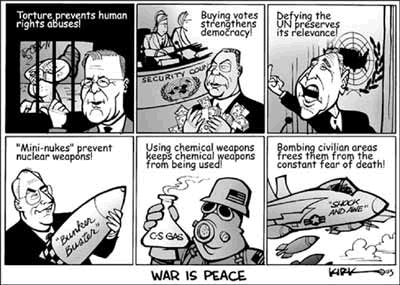
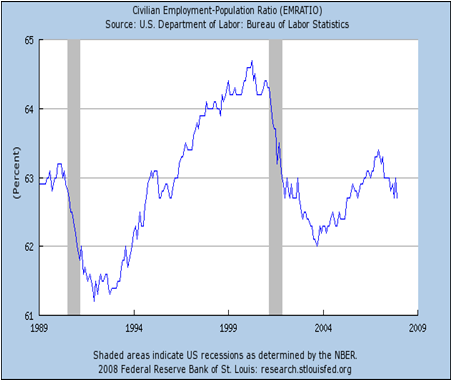
...Democrats may very well win the election. And they may have a large working majority. Hopefully they will get some good things done for the country. But if they do not run on and then act on these constitutional abuses, they will be used again the next time a Republican is in office (if not sooner) and we will have to fight this battle all over again, having lost a tremendous amount of territory in the meantime. What we will have lost in terms of morality and decency is uncountable...
...Yes, I’m sure that a new-found sense of unity, and especially a total avoidance of accountability, will be very welcome to the wealthy who stripped the country of its assets, and are now planning to retire to their mercenary-guarded gated communities...
“Confidence” is a dogwhistle to the investor class, right?

NEW ORLEANS — John Edwards, the progressive Democratic candidate who made a populist, antipoverty message the centerpiece of his campaign, announced his exit from the presidential primary race on Wednesday, saying he was stepping aside “so that history can blaze its path.”
...Just before Monday night’s State of the Union speech, in which Mr. Bush extolled bipartisanship, railed against government excesses and promised to bring the troops home as soon as it’s safe to withdraw, the White House undermined all of those sentiments with the latest of the president’s infamous signing statements...
...Over the last seven years, Mr. Bush has issued hundreds of these insidious documents declaring that he had no intention of obeying a law that he had just signed. This is not just constitutional theory. Remember the detainee treatment act, which Mr. Bush signed and then proceeded to ignore, as he told C.I.A. interrogators that they could go on mistreating detainees?
This week’s statement was attached to the military budget bill, which covers everything except the direct cost of the war. The bill included four important provisions that Mr. Bush decided he will enforce only if he wants to.
The president said they impinged on his constitutional powers. We asked the White House to explain that claim, but got no answer, so we’ll do our best to figure it out.
The first provision created a commission to determine how reliant the government is on contractors in Iraq and Afghanistan, how much waste, fraud and abuse has occurred and what has been done to hold accountable those who are responsible. Congress authorized the commission to compel government officials to testify.
Perhaps this violated Mr. Bush’s sense of his power to dole out contracts as he sees fit and to hold contractors harmless. The same theory applies to the second provision that Mr. Bush said he would not obey: a new law providing protection against reprisal to those who expose waste, fraud or abuse in wartime contracts.
The third measure Mr. Bush rejected requires intelligence officials to respond to a request for documents from the Armed Services Committees of Congress within 45 days, either by producing the documents or explaining why they are being withheld. Clearly, this violates the power that Mr. Bush has given himself to cover up an array of illegal and improper actions, like his decisions to spy on Americans without a warrant, to torture prisoners in violation of the Geneva Conventions and to fire United States attorneys apparently for political reasons.
It’s glaringly obvious why Mr. Bush rejected the fourth provision, which states that none of the money authorized for military purposes may be used to establish permanent military bases in Iraq.
It is more evidence, as if any were needed, that Mr. Bush never intended to end this war, and that he still views it as the prelude to an unceasing American military presence in Iraq.
The Senate (reportedly still under Democratic control) seems determined to help President Bush violate Americans’ civil liberties and undermine the constitutional separation of powers. Majority Leader Harry Reid is supporting White House-backed legislation that would expand the administration’s ability to spy on Americans without court supervision and ensure that the country never learns the full extent of Mr. Bush’s illegal wiretapping program.
The 1978 Foreign Intelligence Surveillance Act, or FISA — which Mr. Bush decided to ignore after 9/11 — requires a warrant to intercept telephone calls and e-mail messages between people in the United States and people abroad.
It needed updating to keep pace with technology, and the technical fixes were included in a bill that Congress passed last summer. The problem was that Mr. Bush managed to add measures that sharply undercut the court’s role in monitoring eavesdropping. Fortunately, lawmakers gave them an expiration date of Feb. 1.
The House has passed a reasonable new bill — fixing FISA without further endangering civil liberties. But Mr. Bush wants to weaken FISA as much as he can. And the Senate leadership has been only too happy to oblige.
With the help of Republican senators and the misguided chairman of the Intelligence Committee, Jay Rockefeller, the White House got a bill that, once again, reduces court supervision of wiretapping. It also adds immunity for telecommunications companies that cooperated with the illegal spying.
Mr. Bush says without amnesty, the government won’t get cooperation in the future. We don’t buy it. The real aim is to make sure the full story of the illegal wiretapping never comes out in court.
Mr. Reid — who is still falling for the White House’s soft-on-terrorism bullying — set up deliberations in a way that ensured that a better Judiciary Committee version of the bill would die a procedural death and that the Intelligence Committee bill would pass.
The Judiciary bill died this week, with the help of other bullyable Democratic senators like Mr. Rockefeller, Claire McCaskill, Mary Landrieu and Ben Nelson. The Republicans repaid them by announcing they would block any further attempts to reach a compromise.
It is now up to the House to protect Americans’ rights. Mr. Bush has already started issuing the ritual claims that if his bill is not passed instantly, Osama bin Laden will be telephoning his agents in the United States and no one will know. Let us be clear, Mr. Bush has always had the authority to order emergency wiretaps — and get court approval after the fact. That has never been the problem with FISA.
The House should vote to extend last summer’s flawed rules for at least 30 days and go on recess, forcing the Senate to do the same thing, and then bring the whole matter to a conference committee. There will then be plenty of time for a real debate.
Lawmakers and the rest of the nation should bear this in mind: Mr. Bush’s version of this law does not make intelligence-gathering more robust. Opponents like Senators Christopher Dodd and Patrick Leahy want to spy on Al Qaeda, too. They’re just not willing to do it in a way that undermines the very democracy that the spies, Congress and the president are supposed to be protecting.

Bush said: “Over the past 7 years, we have increased funding for veterans by more than 95 percent. As we increase funding, we must also reform our veterans system to meet the needs of a new war and a new generation.”
FACT — 1.8 MILLION VETERANS LACK HEALTH INSURANCE: “The new study, published in the American Journal of Public Health, estimated that in 2004 nearly 1.8 million veterans were uninsured and unable to get care in veterans’ facilities.” [New York Times, 11/9/07]
Bush said: “And our Emergency Plan for AIDS Relief is treating 1.4 million people [in Africa]. We can bring healing and hope to many more. So I ask you to maintain the principles that have changed behavior and made this program a success.”
FACT — BUSH’S AIDS POLICIES DIVERT FUNDS TO FAILED ABSTINENCE-ONLY PROGRAMS: Bush’s policy states that one-third of money allocated for HIV prevention overseas go to abstinence-only programs. “In fact, a full two-thirds of the money for the prevention of the sexual spread of HIV goes to abstinence.” [American Prospect, 7/10/07]
Bush said: “We have also changed the way we deliver aid by launching the Millennium Challenge Account. This program strengthens democracy, transparency, and the rule of law in developing nations, and I ask you to fully fund this important initiative.”
FACT — MILLENNIUM CHALLENGE PROGRAM WILL SOON BE BANKRUPT: “President Bush’s signature foreign-assistance program is likely to run out of money this year, leaving in the lurch several poor countries that have labored to meet its strict eligibility standards, according to aid officials. Mr. Bush introduced the Millennium Challenge program in 2002 as a new approach to fix the perceived failures of overseas-development assistance.” [Wall Street Journal, 1/22/07]
FACT — BUSH IGNORED DEMOCRACY DURING TRIP TO SAUDI ARABIA: During his recent visit to Saudi Arabia, Bush didn’t meet with “one Saudi dissident or political activist, much less a democrat.” [Newsweek, 1/14/08]
Bush said: ” The Congress must pass liability protection for companies believed to have assisted in the efforts to defend America. We have had ample time for debate. The time to act is now.”
FACT — IMMUNITY ABSOLVES TELECOM COMPANIES OF VIOLATING THE LAW: Immunity “would wipe out a series of pending lawsuits alleging violations of privacy rights by telecommunications companies that provided telephone records, summaries of e-mail traffic and other information to the government after Sept. 11, 2001, without receiving court warrants.” [Washington Post 10/18/07]
Bush said: “One of the most important tools we can give them is the ability to monitor terrorist communications. To protect America, we need to know who the terrorists are talking to, what they are saying, and what they are planning. Last year, the Congress passed legislation to help us do that. Unfortunately, the Congress set the legislation to expire on February 1. This means that if you do not act by Friday, our ability to track terrorist threats would be weakened and our citizens will be in greater danger. The Congress must ensure the flow of vital intelligence is not disrupted.”
FACT — TEMPORARY EXTENSION WOULD ALLOW NEW WIRETAPS TO BE IMPLEMENTED: A temporary extension would prevent the Protect America Act revisions from expiring on February 1, meaning new authorizations for surveillance would continue be governed by the Protect America Act revisions. If the extension is not passed, the Act’s “transition procedures” would cause all new authorizations to be governed by the FISA statute as it existed prior to the Protect America Act revisions. [Protect America Act]
FACT — GOVERNMENT WILL STILL BE ABLE TO WIRETAP TERRORISTS IF PROTECT AMERICA ACT EXPIRES: “Kenneth L. Wainstein, assistant attorney general for national security, said in an interview that if the August bill was allowed to expire in 10 days, intelligence officials would still be able to continue eavesdropping on already approved targets for another year under the law.” [NY Times 01/23/08]
Bush said: “American troops are shifting from leading operations, to partnering with Iraqi forces, and, eventually, to a protective overwatch mission.”
FACT — IRAQIS ANTICIPATE TAKING CONTROL OF SECURITY BY 2018:
Iraqi defense minister Abdul Qadir “that his nation would not be able to take full responsibility for its internal security until 2012, nor be able on its own to defend Iraq’s borders from external threat until at least 2018.” [New York Times, 1/15/08]
FACT — CORRUPTION AND SECTARIANISM PLAGUE SECURITY FORCES: “Rampant corruption and lingering sectarianism” within Iraqi security forces are “major hurdles that Iraqi defense and police leaders must overcome in order to take responsibility for Iraq’s security,” according to Gen. James Dubik, head of the Multi-National Security Transition Command in Iraq. “[S]hortages of key personnel, equipment, weaponry and logistical capabilities mean that Iraq’s security forces will probably require U.S. military support for as long as a decade.” [Washington Post, 1/18/08]
Bush said: “When we met last year, our troop levels in Iraq were on the rise. Today, because of the progress just described, we are implementing a policy of ‘return on success,’ and the surge forces we sent to Iraq are beginning to come home.”
FACT — SURGE HAS WEAKENED THE MILITARY: Army Chief of Staff General George Casey warned that “the current demand for our forces exceeds the sustainable supply” and also that “the surge has sucked all the flexibility out of the system.” Yesterday, Gen. Petraeus “said the Pentagon wants to bring troops home quickly to reduce the strain on the armed services.” [WSJ, 1/17/08; CNN, 1/28/08]
FACT — THE LONGER WE STAY IN IRAQ, THE MORE OUR MILITARY IS BURDENED: “It’s going to take us three or four years and a substantial amount of resources to put ourselves back in balance. … The question is, when does the conflict end?,” said Army Chief of Staff George Casey in October. [General Casey, 10/9/07]
Bush said: “While the enemy is still dangerous and more work remains, the American and Iraqi surges have achieved results few of us could have imagined just 1 year ago.”
FACT — TROOPS ARE STILL DYING IN IRAQ: A roadside bomb killed five American soldiers today in Mosul, taking to “36 the number of soldiers killed in Iraq this month, up from 23 in December.” [Reuters, 1/28/08]
Bush said: “Thanks to the courage of these military and civilian personnel, a nation that was once a safe haven for al Qaida is now a young democracy where boys and girls are going to school, new roads and hospitals are being built, and people are looking to the future with new hope.”
FACT — AL QAEDA POSING ‘FRESH THREATS’ IN PAKISTAN: In Pakistan, a “regenerating al-Qaida is posing fresh threats.” “There is growing recognition that the United States risks further setbacks, if not deepening conflict or even defeat, in Afghanistan, and that success in that country hinges on stopping Pakistan from descending into disorder.” [AP, 1/28/08]
Bush said: “We must also find a sensible and humane way to deal with people here illegally. Illegal immigration is complicated, but it can be resolved. And it must be resolved in a way that upholds both our laws and our highest ideals.”
FACT — BUSH ADMINISTRATION CONDUCTING POLITICALLY-MOTIVATED RAIDS: After Tam Tran, the daughter of Vietnamese immigrants, was featured in an October USA Today article and testified before a House committee on immigration, federal officers forcibly arrested her family in the middle of the night. Tran’s family was detained on a “years-old deportation order,” even though they have been in regular communication with immigration officials for almost 20 years since arriving in the United States. [USA Today, 10/8/07, 10/16/07; OC Register, 10/17/07; House, 5/18/07]
FACT — LEGAL IMMIGRANTS FACE LENGTHY WAIT PERIOD: For the next two years, legal immigrants will have to wait an average of 18 months to have their citizenship petitions processed, up from seven months or less last year. By contrast, the DHS immigration agency has worked to “speed” the deportation of more than “200,000 immigrants who are convicted criminals serving time in prisons and jails across the country.” [New York Times, 1/18/08]
Bush said: “Tonight the armies of compassion continue the march to a new day in the Gulf Coast. America honors the strength and resilience of the people of this region. We reaffirm our pledge to help them build stronger and better than before. And tonight I am pleased to announce that in April we will host this year’s North American Summit of Canada, Mexico, and the United States in the great city of New Orleans.”
FACT — KATRINA HAS SLIPPED FROM BUSH’S RADAR: In the 2007 State of the Union, there wasn’t a single mention of Hurricane Katrina or the ongoing Gulf Coast reconstruction effort. [SOTU, 1/23/07]
Bush said: “Faith-based groups are bringing hope to pockets of despair, with newfound support from the Federal Government.”
FACT — FAITH OFFICE USED MAINLY FOR POLITICAL PURPOSES: David Kuo, formerly Bush’s head of the Office of Faith-Based Initiatives, revealed that the office was mainly used “to mount ostensibly ‘nonpartisan’ events that were, in reality, designed with the intent of mobilizing religious voters in 20 targeted races.” National Christian leaders were mocked as “ridiculous” by White House officials behind their backs. [MSNBC, 10/13/06]
FACT — FAITH-BASED INITIATIVES NOT REACHING BLACK CHURCHES: A 2006 national survey of 750 black churches by the Joint Center for Political and Economic Studies found that fewer than three percent of black churches have received funding from the Office of Faith-Based Initiatives. [Washington Post, 9/19/06]
Bush said: “I have submitted judicial nominees who will rule by the letter of the law, not the whim of the gavel. Many of these nominees are being unfairly delayed. They are worthy of confirmation, and the Senate should give each of them a prompt up-or-down vote.”
FACT — DEMOCRATIC-LED CONGRESS HAS CONFIRMED MORE OF BUSH’S JUDGES THAN DURING GOP CONGRESS: Despite the Republicans’ loss of control of the Senate, 40 of Bush’s judges won confirmation this year, more than in the previous three years when Republicans held the majority. [LA Times, 1/2/08]
Bush said: “And let us complete an international agreement that has the potential to slow, stop, and eventually reverse the growth of greenhouse gases. This agreement will be effective only if it includes commitments by every major economy and gives none a free ride.”
FACT — BUSH BLOCKED GLOBAL CLIMATE CHANGE EFFORTS: The United States remains the only industrialized nation to refuse to sign the Kyoto Protocol. At the most recent global conference on climate change in Bali, the United States rejected mandatory caps on greenhouse gas emissions and was “principally responsible for obstructing progress.” [National Geographic, 12/3/07; BBC, 12/15/07; Reuters, 12/13/08]
FACT — ‘MAJOR EMITTERS’ MEETING UNDERMINES GLOBAL EFFORTS: This week, the United States will convene a “major emitters” meeting in Hawaii. By meeting outside of the U.N. framework and by likely agreeing only to “aspirational targets,” Bush’s ‘major emitters’ meetings undermines the efforts of the United Nations to draw up a global binding agreement. [Reuters, 1/27/08; NYT, 9/24/07; BBC, 12/13/07]
...

WASHINGTON — President Bush said Monday that he was confident the economy would not slide into a recession, and that the American people are strong enough to promote freedom and peace abroad while their hard work fuels prosperity at home.
“I don’t think there will be a recession, and one way to make sure there is not a recession is for Congress to pass a robust stimulus package as quickly as possible,” the president said, urging the Senate to approve the package already agreed upon by the administration and the House...
Moody’s, the credit-rating agency, claims the key to solving the United States’ economic woes is slashing spending on Social Security. The National Assn. of Manufacturers says the fix is for the federal government to adopt the organization’s wish-list of new tax cuts. For Investor’s Business Daily, it is oil drilling in the Arctic National Wildlife Refuge, “perhaps the most important stimulus of all.”
But of all the cynical scrambles to package pro-business cash grabs as “economic stimulus,” the prize has to go to Lawrence B. Lindsey, formerly President Bush’s assistant for economic policy and his advisor during the 2001 recession. Lindsey’s plan is to solve a crisis set off by bad lending by extending lots more questionable credit. “One of the easiest things to do would be to allow manufacturers and retailers” — notably Wal-Mart — “to open their own financial institutions, through which they could borrow and lend money,” he wrote recently in the Wall Street Journal.
Never mind that that an increasing number of Americans are defaulting on their credit card payments, raiding their 401(k) accounts and losing their homes. If Lindsey had his way, Wal-Mart, rather than lose sales, could just loan out money to keep its customers shopping, effectively turning the big-box chain into an old-style company store to which Americans can owe their souls.
If this kind of crisis opportunism feels familiar, it’s because it is...
Do the free-market policies packaged as emergency cures actually fix the crises at hand? For the ideologues involved, that has mattered little. What matters is that, as a political tactic, disaster capitalism works. It was the late free-market economist Milton Friedman, writing in the preface to the 1982 reissue of his manifesto, “Capitalism and Freedom,” who articulated the strategy most succinctly. “Only a crisis — actual or perceived — produces real change. When that crisis occurs, the actions that are taken depend on the ideas that are lying around. That, I believe, is our basic function: to develop alternatives to existing policies, to keep them alive and available until the politically impossible becomes politically inevitable.”
A decade later, John Williamson, a key advisor to the International Monetary Fund and the World Bank (and who coined the phrase “the Washington consensus”), went even further. He asked a conference of top-level policymakers “whether it could conceivably make sense to think of deliberately provoking a crisis so as to remove the political logjam to reform.”
Again and again, the Bush administration has seized on crises to break logjams blocking the more radical pieces of its economic agenda. First, a recession provided the excuse for sweeping tax cuts. Next, the “war on terror” ushered in an era of unprecedented military and homeland security privatization. After Hurricane Katrina, the administration handed out tax holidays, rolled back labor standards, closed public housing projects and helped turn New Orleans into a laboratory for charter schools — all in the name of disaster “reconstruction.”
Given this track record, Washington lobbyists had every reason to believe that the current recession fears would provoke a new round of corporate gift-giving. Yet it seems that the public is getting wise to the tactics of disaster capitalism. Sure, the proposed $150-billion economic stimulus package is little more than a dressed-up tax cut, including a new batch of “incentives” to business. But the Democrats nixed the more ambitious GOP attempt to leverage the crisis to lock in the Bush tax cuts and go after Social Security. For the time being, it seems that a crisis created by a dogged refusal to regulate markets will not be “fixed” by giving Wall Street more public money with which to gamble.
...The problem is not a lack of ideas “alive and available” — to borrow Friedman’s phrase. There are plenty available, from single-payer healthcare to legislating a living wage. Hundreds of thousands of jobs can be created by rebuilding the ailing public infrastructure and making it more friendly to public transit and renewable energy. Need start-up funds? Close the loophole that lets billionaire hedge fund managers pay 15% capital gains instead of 35% income tax, and adopt a long-proposed tax on international currency trading. The bonus? A less volatile, crisis-prone market.
The way we respond to crises is always highly political, a lesson progressives appear to have forgotten. There’s a historical irony to that: Crises have ushered in some of America’s great progressive policies. Most notably, after the dramatic market failure of 1929, the left was ready and waiting with its ideas — full employment, huge public works, mass union drives. The Social Security system that Moody’s is so eager to dismantle was a direct response to the Depression.
Every crisis is an opportunity; someone will exploit it. The question we face is this: Will the current turmoil become an excuse to transfer yet more public wealth into private hands, to wipe out the last vestiges of the welfare state, all in the name of economic growth? Or will this latest failure of unfettered markets be the catalyst that is needed to revive a spirit of public interest, to get serious about the pressing crises of our time, from gaping inequality to global warming to failing infrastructure?
The disaster capitalists have held the reins for three decades. The time has come, once again, for disaster populism.
WASHINGTON — The top two American intelligence officials traveled secretly to Pakistan early this month to press President Pervez Musharraf to allow the Central Intelligence Agency greater latitude to operate in the tribal territories where Al Qaeda, the Taliban and other militant groups are all active, according to several officials who have been briefed on the visit.
But in the unannounced meetings on Jan. 9 with the two American officials — Mike McConnell, the director of national intelligence, and Gen. Michael V. Hayden, the C.I.A. director — Mr. Musharraf rebuffed proposals to expand any American combat presence in Pakistan, either through unilateral covert C.I.A. missions or by joint operations with Pakistani security forces...
can get while announcing the policy to the press.Sometime in mid-December, as the winter winds howled across the snow-dusted hills of Pakistan's inhospitable border regions, 40 men representing Taliban groups all across Pakistan's northwest frontier came together to unify under a single banner and to choose a leader.
The banner was Tehrik-e- Taliban Pakistan, or the Taliban Movement of Pakistan, with a fighting force estimated at up to 40,000. And the leader was Baitullah Mehsud, the man Pakistan accuses of assassinating former prime minister Benazir Bhutto.
The move is an attempt to present a united front against the Pakistani Army, which has been fighting insurgents along the border with Afghanistan. It is also the latest sign of the rise of Mehsud, considered the deadliest of the Taliban mullahs or clerics in northwest Pakistan.
Mehsud is based in the rugged, heavily treed mountains of South Waziristan, one of Pakistan's so-called tribal areas on the border with Afghanistan, where Western intelligence says Al Qaeda is regrouping.
His organization has claimed responsibility, often backed up by videos, for killing and kidnapping hundreds of soldiers, beheading women, and burning schools that teach girls anything other than religion. He also says he has a steady supply of suicide bombers and strong ties to Al Qaeda.
"Al Qaeda has succeeded in building a base in the last two or three years mostly with help from Mehsud," said Ahmed Zaidan, a reporter for Al-Jazeera Television in Qatar who interviewed Mehsud three weeks ago. "They are moving freely in the tribal areas where it is difficult for the Pakistan Army to move..."
Al Qaeda gives Mehsud money and logistical advice, according to one of his Taliban allies, Maulvi Muslim.
The Al Qaeda funds don't always come in cash. Rather, Afghan and Pakistani businessmen, usually in the United Arab Emirates, are given money to buy high-priced goods like cars. The goods are shipped to Pakistan and sold, often tripling Al Qaeda's investment. The businessmen, with sympathies to Al Qaeda, take a small cut while Al Qaeda spreads the wealth among its allies...

UNDER the stewardship of Dow Kim and Thomas G. Maheras, Merrill Lynch and Citigroup built positions in subprime-related securities that led to $34 billion in write-downs last year. The debacle cost chief executives their jobs and brought two of the world’s premier financial institutions to their knees.
In any other industry, Mr. Kim and Mr. Maheras would be pariahs. But in the looking-glass world of Wall Street, they — and others like them — are hot properties. The two executives are well on their way to reviving their careers, even as global markets shudder at the prospect that Merrill and Citigroup may report further subprime losses in the coming months...
The ease with which Mr. Maheras and Mr. Kim have put themselves back in play is a reminder that for many top Wall Street executives, humiliation and defeat need not result in a professional exile. And they aren’t the only ones. Zoe Cruz, the Morgan Stanley co-president who was forced to leave her job after $10.8 billion in subprime losses, has been approached by investment banks, hedge funds and private equity funds about a senior management role, people briefed on those discussions say.
“It is always an assumption on Wall Street that it is not the individuals that lose money; it’s the system,” said Charles R. Geisst, a Wall Street historian and a finance professor at Manhattan College. “You can fail big time, but you can also succeed big time.
“They think it’s bad luck,” he said, so the attitude is “let’s give them another chance.”
The quick comebacks of these executives stand in stark contrast to the plight of the hundreds of investment bankers who have received pink slips in the last two weeks. They also illuminate a peculiar aspect of Wall Street’s own version of a class divide. Senior movers and shakers often land on their feet, no matter how egregious the losses tied to them. The industry rank and file, however, from mergers-and-acquisitions bankers at Bank of America to sales executives in Citigroup’s hedge-fund servicing business, see their jobs eliminated despite being far removed from the subprime crisis...
...the law was a total puzzle. Here would be one case that went for the appellant, but just a circuit away, or maybe even in the same circuit, there would be another case — with identical or almost identical facts — that went for the appellee.
I was puzzled. I sat in the Sterling library reading the cases over and over, but still could not get it. Then, one day, out of the blue, my learned brother-in-law Melvin, who had gone to Harvard Law School, asked me if I knew about “legal realism.” I didn’t, but I soon learned.
“Legal realism” said that the whole common-law system of abiding by past decisions was a fig leaf. What really happened, at the appellate level and probably at the trial level, too, was that judges made up their minds based on their predilections, their biases, which lawyer was their friend, what they had for breakfast that day. (I myself love peach Activia yogurt.)
Then, because a case that reached appeal always had some legal merit on each side, the judges, or their very young clerks, picked whatever precedent they wished to support their bias and pretended that they were bound by that precedent and could not have decided any other way.
The scales fell from my eyes, and I went on to finish law school in fine fettle. It was just all show business and personal bias and what’s in it for the judge. That made law school easy.
Time has passed in a big way. But the lessons of legal realism have always been uppermost in my mind when I think about law or about anything else important: Stated reasons are often not the real reasons.
Because I usually write about finance, I have come to believe in the theory of what I would call “financial realism,” or what might more accurately be called “trader realism.” Under this theory, on which I have an imaginary patent, traders can see masses of data any minute of any day. They can find data to support hitting the “buy” button or the “sell” button. They don’t act on the basis of what seems to them the real economic situation, but on what’s in it for them...
As I see it, this is what traders do all day long — and especially what they’ve been doing since the subprime mess burst upon the scene. They have seized upon a fairly bad situation: a stunning number of defaults and foreclosures in the subprime arena, although just a small part of the total financial picture of the United States. They have then tried — with the collaboration of their advance guards in the press — to make it seem like a total catastrophe so they could make money on their short sales. They sense an opportunity to trick other traders and poor retail slobs like you and me, and they generate data and rumor to support their positions, and to make money.
Mor than that, they trade to support the way they want the market to go. If they are huge traders like some of the major hedge funds, they can sell massively and move the market downward, then suck in other traders who go short, and create a vacuum of fear that sucks down whatever they are selling.
Note what is happening here: They are not figuring out which way the market will go. They are making the market go the direction they want...
These traders, not economists or securities analysts, can turn the world upside down, make governments tremble, give central bankers colitis and ruin the lives of ordinary men and women saving for their children’s college education or their own retirement. In America today, it is the traders, not the politicians or the generals or the corporate bosses, who have the power.
This is what has become of the America of Thomas Jefferson. Lucky for the traders. Sad for the rest of us.
And one thing’s for sure: With the traders running things, it won’t be a good time for amateurs until the traders cry “Switch!” and the market starts to rise.

Senator John McCain said that, if elected, he would do what other presidents had tried but failed to do: cut government spending sharply enough to reduce the budget deficit while lowering taxes at the same time...
...Mr. McCain emphasized his experience working on economic matters in Congress and laid out an unorthodox version of conservatism. After initially opposing President Bush’s tax cuts, he has become a supporter of making them permanent and of pursuing additional tax reductions, saying they are the best way to encourage economic growth...
, too.
If retroactive immunity for telecoms passes (as part of FISA bill), then our Congress will finally have declared that the United States is a wholly owned subsidiary of a few mega-companies and that the citizens are without rights or even avenues for redressing grievances. In other words, our government has given us very little choice other than to declare ourselves independent...
...Aside from business tax breaks — which are an unhappy story for another column — the plan gives each worker making less than $75,000 a $300 check, plus additional amounts to people who make enough to pay substantial sums in income tax. This ensures that the bulk of the money would go to people who are doing O.K. financially — which misses the whole point.
The goal of a stimulus plan should be to support overall spending, so as to avert or limit the depth of a recession. If the money the government lays out doesn’t get spent — if it just gets added to people’s bank accounts or used to pay off debts — the plan will have failed.
And sending checks to people in good financial shape does little or nothing to increase overall spending. People who have good incomes, good credit and secure employment make spending decisions based on their long-term earning power rather than the size of their latest paycheck. Give such people a few hundred extra dollars, and they’ll just put it in the bank.
In fact, that appears to be what mainly happened to the tax rebates affluent Americans received during the last recession in 2001.
On the other hand, money delivered to people who aren’t in good financial shape — who are short on cash and living check to check — does double duty: it alleviates hardship and also pumps up consumer spending...
Why would the administration want to do this? It has nothing to do with economic efficacy: no economic theory or evidence I know of says that upper-middle-class families are more likely to spend rebate checks than the poor and unemployed. Instead, what seems to be happening is that the Bush administration refuses to sign on to anything that it can’t call a “tax cut.”
Behind that refusal, in turn, lies the administration’s commitment to slashing tax rates on the affluent while blocking aid for families in trouble — a commitment that requires maintaining the pretense that government spending is always bad. And the result is a plan that not only fails to deliver help where it’s most needed, but is likely to fail as an economic measure.
The words of Franklin Delano Roosevelt come to mind: “We have always known that heedless self-interest was bad morals; we know now that it is bad economics.”
And the worst of it is that the Democrats, who should have been in a strong position — does this administration have any credibility left on economic policy? — appear to have caved in almost completely.
Yes, they extracted some concessions, increasing rebates for people with low income while reducing giveaways to the affluent. But basically they allowed themselves to be bullied into doing things the Bush administration’s way.
And that could turn out to be a very bad thing.
People say that the last recession was brief and mild. But that’s an artifact of the way the NBER defines recessions — basically as periods when everything is going down. Once something starts going up (usually GDP), it’s labeled a recovery. But in the last two recessions the thing that matters most — employment — kept falling long after the official end of the recession.
Did the last two recessions really end quickly?
And in the last two recessions the Fed kept cutting interest rates long after the recessions were supposedly over — all the way down to just 1 percent in 2003:
The Fed didn’t think the recessions were over
Indeed, as Alan Greenspan has revealed, the Fed still feared the possibility of “corrosive deflation” well into 2003.
What finally created a convincing recovery was the housing boom. But that turned into a bubble, which has burst big time.
We don’t know for sure by any means, but it definitely looks possible that this slump will be worse and more persistent than 2001-2003. And housing won’t come to the rescue this time. Meanwhile, the Fed has less room to cut: interest rates can’t go below zero (banks will just sit on cash rather than lend money out at a negative rate), and they started lower this time than they did in 2000.
The bottom line is that Ben Bernanke could definitely use some fiscal wind at his back. But thanks to the lousy deal announced today, he won’t get it.

As we begin this new year, the Executive Branch of our government has been caught eavesdropping on huge numbers of American citizens and has brazenly declared that it has the unilateral right to continue without regard to the established law enacted by Congress precisely to prevent such abuses. It is imperative that respect for the rule of law be restored in our country.
And that is why many of us have come here to Constitution Hall to sound an alarm and call upon our fellow citizens to put aside partisan differences insofar as it is possible to do so and join with us in demanding that our Constitution be defended and preserved.
It is appropriate that we make this appeal on the day our nation has set aside to honor the life and legacy of Dr. Martin Luther King, Jr., who challenged America to breathe new life into our oldest values by extending its promise to all of our people.
And on this particular Martin Luther King Day, it is especially important to recall that for the last several years of his life, Dr. King was illegally wiretapped-one of hundreds of thousands of Americans whose private communications were intercepted by the U.S. government during that period.
The FBI privately labeled King the "most dangerous and effective Negro leader in the country" and vowed to "take him off his pedestal." The government even attempted to destroy his marriage and tried to blackmail him into committing suicide.
This campaign continued until Dr. King's murder. The discovery that the FBI conducted this long-running and extensive campaign of secret electronic surveillance designed to infiltrate the inner workings of the Southern Christian Leadership Conference, and to learn the most intimate details of Dr. King's life, was instrumental in helping to convince Congress to enact restrictions on wiretapping.
And one result was the Foreign Intelligence and Surveillance Act (FISA), which was enacted expressly to ensure that foreign intelligence surveillance would be presented to an impartial judge to verify that there was indeed a sufficient cause for the surveillance. It included ample flexibility and an ability for the executive to move with as much speed as the executive desired. I voted for that law during my first term in Congress and for almost thirty years the system has proven a workable and valued means of affording a level of protection for American citizens, while permitting foreign surveillance to continue whenever it is necessary.
And yet, just one month ago, Americans awoke to the shocking news that in spite of this long settled law, the Executive Branch has been secretly spying on large numbers of Americans for the last four years and eavesdropping on, and I quote the report, "large volumes of telephone calls, e-mail messages, and other Internet traffic inside the United States." The New York Times reported that the President decided to launch this massive eavesdropping program "without search warrants or any new laws that would permit domestic intelligence collection."
During the period when this eavesdropping was still secret, the President seemed to go out of his way to reassure the American people on more than one occasion that, of course, judicial permission is required for any government spying on American citizens and that, of course, these constitutional safeguards were still in place.
But surprisingly, the President's soothing statements turned out to be false. Moreover, as soon as this massive domestic spying program was uncovered by the press, the President not only confirmed that the story was true, but in the next breath declared that he has no intention stopping or of bringing these wholesale invasions of privacy to an end.
At present, we still have much to learn about the NSA's domestic surveillance. What we do know about this pervasive wiretapping virtually compels the conclusion that the President of the United States has been breaking the law repeatedly and insistently.
A president who breaks the law is a threat to the very structure of our government. Our Founding Fathers were adamant that they had established a government of laws and not men. They recognized that the structure of government they had enshrined in our Constitution - our system of checks and balances - was designed with a central purpose of ensuring that it would govern through the rule of law. As John Adams said: "The executive shall never exercise the legislative and judicial powers, or either of them, to the end that it may be a government of laws and not of men."
An executive who arrogates to himself the power to ignore the legitimate legislative directives of the Congress or to act free of the check of the judiciary becomes the central threat that the Founders sought to nullify in the Constitution - an all-powerful executive too reminiscent of the King from whom they had broken free. In the words of James Madison, "the accumulation of all powers, legislative, executive, and judiciary, in the same hands, whether of one, a few, or many, and whether hereditary, self-appointed, or elective, may justly be pronounced the very definition of tyranny."
...A commitment to openness, truthfulness, and accountability helps our country avoid many serious mistakes, that we would otherwise make. Recently, for example, we learned from just declassified documents, after almost forty years, that the Gulf of Tonkin Resolution, which authorized the tragic Vietnam war, was actually based on false information. And we now know that the decision by Congress to authorize the Iraq War, 38 years later, was also based on false information. Now the point is that America would have been better off knowing the truth and avoiding both of these colossal mistakes in our history. And that is the reason why following the rule of law makes us safer, not more vulnerable.
The President and I agree on one thing. The threat from terrorism is all too real. There is simply no question that we continue to face new challenges in the wake of the attack on September 11th and that we must be ever-vigilant in protecting our citizens from harm.
Where we disagree is on the proposition that we have to break the law or sacrifice our system of government in order to protect Americans from terrorism. When in fact, doing so would make us weaker and more vulnerable.
And remember that once violated, the rule of law is itself in danger. Unless stopped, lawlessness grows. The greater the power of the executive grows, the more difficult it becomes for the other branches to perform their constitutional roles. As the executive acts outside its constitutionally prescribed role and is able to control access to information that would expose its mistakes and reveal errors, it becomes increasingly difficult for the other branches to police its activities. Once that ability is lost, democracy itself is threatened and we become a government of men and not laws.
The President's men have minced words about America's laws. The Attorney General, for example, openly conceded that the "kind of surveillance" we now know they have been conducting does require a court order unless authorized by statute. The Foreign Intelligence Surveillance Act self-evidently does not authorize what the NSA has been doing, and no one inside or outside the Administration claims that it does. Incredibly, the Administration claims, instead, that the surveillance was implicitly authorized when Congress voted to use force against those who attacked us on September 11th.
But, this argument simply does not hold any water. Without getting into the legal intricacies, it faces a number of embarrassing facts. First, another admission by the Attorney General: he concedes that the Administration knew that the NSA project was prohibited by existing law and that is why they consulted with some members of Congress about the possibility of changing the statute. Genl. Gonzalez says that they were told by the members of congress consulted that this would probably not be possible. And so they decided not to make the request. So how can they now argue that the Authorization for the use of military force somehow implicitly authorized it all along? Indeed, when the Authorization was being debated, the Administration did in fact seek to have language inserted in it that would have authorized them to use military force domestically - and the Congress refused to agree. Senator Ted Stevens and Representative Jim McGovern, among others, made clear statements during the debate on the floor of the house and the senate, respectively, clearly stating that that Authorization did not operate domestically. And there is no assertion to the contrary.
When President Bush failed to convince Congress to give him the power he wanted when this measure was passed, he secretly assumed that power anyway, as if congressional authorization was a useless bother...
It is this same disrespect for America's Constitution which has now brought our republic to the brink of a dangerous breach in the fabric of the Constitution. And the disrespect embodied in these apparent mass violations of the law is part of a larger pattern of seeming indifference to the Constitution that is deeply troubling to millions of Americans in both political parties.
For example, as you know the President has also declared that he has a heretofore unrecognized inherent power to seize and imprison any American citizen that he alone determines to be a threat to our nation, and that, notwithstanding his American citizenship, that person imprisoned has no right to talk with a lawyer-even if he wants to argue that the President or his appointees have made a mistake and imprisoned the wrong person. The President claims that he can imprison that American citizen -- any American Citizen he chooses -- indefinitely for the rest of his live without an even arrest warrant, without notifying them about what charges have been filed against them, without even informing their families that they have been imprisoned. No such right exists in the America that you and I know and love. It is foreign to our constitution. It must be rejected.
At the same time, the Executive branch has also claimed a previously unrecognized authority to mistreat prisoners in its custody in ways that plainly constitute torture and have plainly constituted torture in a widespread pattern that has been extensively documented in U.S. facilities located in several countries around the world.
Over 100 of these captives have reportedly died while being tortured by Executive branch interrogators and many more have been broken and humiliated. And, in the notorious Abu Ghraib prison, investigators who documented the pattern of torture estimated that more than 90 percent of the victims were completely innocent of any criminal charges whatsoever. This is a shameful exercise of power that overturns a set of principles that our nation has observed since General George Washington first enunciated them during our Revolutionary War. They have been observed by every president since then - until now. They violate the Geneva Conventions and the International Convention Against Torture, and our own laws against torture.
The President has also claimed that he has the authority to kidnap individuals on the streets of foreign cities and deliver them for imprisonment and interrogation on our behalf by autocratic regimes in nations that are infamous for the cruelty of their techniques for torture. Some of our traditional allies have been deeply shocked by these new, and uncharacteristic patterns on the part of Americans. The British Ambassador to Uzbekistan - one of those nations with the worst reputations for torture in its prisons - registered a complaint to his home office about the cruelty and senselessness of the new U.S. practice that he witnessed: "This material we’re getting is useless,” he wrote and then he continued with this – “we are selling our souls for dross. It is in fact positively harmful."
...There have of course been other periods in American history when the Executive Branch claimed new powers later seen as excessive and mistaken. Our second president, John Adams, passed the infamous Alien and Sedition Acts and sought to silence and imprison critics and political opponents. And when his successor, President Thomas Jefferson, eliminated the abuses, in his first inaugural he said: "[The essential principles of our Government] form the bright constellation which has gone before us and guided our steps through an age of revolution and reformation... [S]hould we wander from them in moments of error or of alarm, let us hasten to retrace our steps and regain the road which alone leads to peace, liberty and safety."
President Lincoln, of course, suspended habeas corpus during the Civil War. Some of the worst abuses prior to those of the current administration were committed by President Wilson during and after WWI with the notorious Red Scare and Palmer Raids. The internment of Japanese Americans during WWII marked a shameful low point for the respect of individual rights at the hands of the executive. And, of course, during the Vietnam War, the notorious COINTELPRO program was part and parcel of those abuses experienced by Dr. King and so many thousands of others.
But in each of these cases throughout American history, when the conflict and turmoil subsided, our nation recovered its equilibrium and absorbed the lessons learned in a recurring cycle of excess and regret.
But, there are reasons for concern this time around, that conditions may be changing and that the cycle may not repeat itself. For one thing, we have for decades been witnessing the slow and steady accumulation of presidential power. In a globe where there are nuclear weapons and cold war tensions, Congress and the American people accepted ever enlarging spheres of presidential initiative to conduct intelligence and counter- intelligence activities and to allocate our military forces on the global stage. When military force has been used as an instrument of foreign policy or in response to humanitarian demands, it has almost always been as the result of presidential initiative and leadership. But, as Justice Frankfurter wrote in that famous Steel Seizure Case, "The accretion of dangerous power does not come in a day. It does come, however slowly, from the generative force of unchecked disregard of the restrictions that fence in even the most disinterested assertion of authority."
A second reason to that believe we may be experiencing something new -- outside that historical cycle -- is that we are, after all, told by this Administration that the war footing upon which he has tried to place the country is going to "last” in their phrase, “for the rest of our lives." And so, we are told that the conditions of national threat that have been used by other Presidents to justify arrogations of power will, in this case, persist in near perpetuity.
This effort to rework America's carefully balanced constitutional design into a lopsided structure dominated by an all powerful Executive Branch with a subservient Congress and subservient judiciary is ironically accompanied by an effort by the same administration to rework America's foreign policy from one that is based primarily on U.S. moral authority into one that is based on a misguided and self-defeating effort to establish a form of dominance in the world.
And the common denominator seems to be based on an instinct to intimidate and control.
This same pattern has characterized the effort to silence dissenting views within the Executive branch, to censor information that may be inconsistent with its stated ideological goals, and to demand conformity from all Executive branch employees.
For example, CIA analysts who strongly disagreed with the White House assertion that Osama bin Laden was linked to Saddam Hussein found themselves under pressure at work and became fearful of losing promotions and salary increases.
Ironically, that is exactly what happened to the FBI officials in the 1960s who disagreed with J. Edgar Hoover's assertion that Martin Luther King was closely connected to Communists. The head of the FBI's domestic intelligence division testified that his effort to tell the truth about King's innocence of the charge resulted in he and his colleagues becoming isolated within the FBI and pressured. And I quote: "It was evident that we had to change our ways or we would all be out on the street.... The men and I (he continued) discussed how to get out of trouble. To be in trouble with Mr. Hoover was a serious matter. These men (he continued) were trying to buy homes, mortgages on homes, children in school. They lived in fear of getting transferred, losing money on their homes, as they usually did. ... so they wanted another memorandum written to get us out of the trouble that we were in."
The Constitution's framers who studied human nature so closely understood this dilemma quite well. As Alexander Hamilton put it, "a power over a man's support is a power over his will." (Federalist No. 73)
In any case, quite soon, there was no more difference of opinion within the FBI. And the false accusation became the unanimous view. In exactly the same way, George Tenet's CIA eventually joined in endorsing a manifestly false view that there was a linkage between al Qaeda and the government of Iraq.
In the words of George Orwell: "We are all capable of believing things which we know to be untrue, and then, when we are finally proved wrong, impudently twisting the facts so as to show that we were right.
ntellectually, it is possible to carry on this process for an indefinite time: the only check on it is that, sooner or later, a false belief bumps up against solid reality, usually on a battlefield." 2,200 American soldiers have lost their lives as this false belief bumped into a solid reality.
And indeed, whenever power is unchecked and unaccountable it almost inevitably leads to gross mistakes and abuses. That is part of human nature. In the absence of rigorous accountability, incompetence flourishes. Dishonesty is encouraged and rewarded. It is human nature -- whether for Republicans or Democrats or people of any set of views.
Last week, for example, Vice President Cheney attempted to defend the Administration's eavesdropping on American citizens by saying that if it had conducted this program prior to 9/11, they would have found out the names of some of the hijackers.
Tragically, he apparently still does not know that the Administration did in fact have the names of at least 2 of the hijackers well before 9/11 and had available to them information that could have led to the identification of most of the others. One of them was in the phonebook. And yet, because of incompetence, unaccountable incompetence in the handling of this information, it was never used to protect the American people...
But the most serious damage in our constitutional framework has been done to the legislative branch. The sharp decline of congressional power and autonomy in recent years has been almost as shocking as the efforts by the Executive to attain this massive expansion of its power...
In the United States Senate, which used to pride itself on being the "greatest deliberative body in the world," meaningful debate is now a rarity. Even on the eve of the fateful vote to authorize the invasion of Iraq, Senator Robert Byrd famously asked: "Why is this chamber empty?" In the House of Representatives, the number who face a genuinely competitive election contest every two years is typically less than a dozen out of 435.
And too many incumbents have come to believe that the key to continued access to the money for re-election is to stay on the good side of those who have the money to give; and, in the case of the majority party, the whole process is largely controlled by the incumbent president and his political organization.
So the willingness of Congress to challenge the Executive branch is further limited when the same party controls both Congress and the Administration. The Executive branch, time and again, has co-opted Congress' role, and too often Congress has been a willing accomplice in the surrender of its own power.
Look for example at the Congressional role in "overseeing" this massive four year eavesdropping campaign that on its face seemed so clearly to violate the Bill of Rights. The President says he informed Congress, but what he really means is that he talked with the chairman and ranking member of the House and Senate intelligence committees and sometimes the leaders of the House and Senate. This small group, in turn, claimed they were not given the full facts, though at least one of the committee leaders handwrote a letter of concern to the vice-president.
Though I sympathize with the awkward position in which these men and women were placed, I cannot disagree with the Liberty Coalition when it says that Democrats as well as Republicans in the Congress must share the blame for not taking sufficient action to protest and seek to prevent what they consider a grossly unconstitutional program. Many did...
It is the pitiful state of our legislative branch which primarily explains the failure of our vaunted checks and balances to prevent the dangerous overreach by the Executive Branch now threatening a radical transformation of the American system.
I call upon Democratic and Republican members of Congress today to uphold your oath of office and defend the Constitution. Stop going along to get along. Start acting like the independent and co-equal branch of American government you are supposed to be under the Constitution of our country. But there is yet another Constitutional player whose pulse must also be taken and whose role must be examined in order to understand the dangerous imbalance that has accompanied these efforts by the Executive branch to dominate our constitutional system.
We the people are-collectively-still the key to the survival of America's democracy. We-must examine ourselves...
Lincoln's memorable call during the Civil War is now applicable in a new way to our dilemma today: "We must disenthrall ourselves, and then we shall save our country."
Forty years have passed since the majority of Americans adopted television as their principal source of information. And its dominance has now become so extensive that virtually all significant political communication now takes place within the confines of flickering 30-second television advertisements, and they’re not the Federalist Papers.
The political economy supported by these short but expensive television ads is as different from the vibrant politics of America's first century as those politics were different from the feudalism which thrived on the ignorance of the masses of people in the Dark Ages.
The constricted role of ideas in the American political system today has encouraged efforts by the Executive branch to believe it can and should control the flow of information as a means of controlling the outcome of important decisions that still lie in the hands of the people.
The Administration vigorously asserts its power to maintain secrecy in its operations. After all, if the other branches don’t know what is happening they can't be a check or a balance.
For example, when the Administration was attempting to persuade Congress to enact the Medicare prescription drug benefit, many in the House and Senate raised concerns about the cost and design of the program. But, rather than engaging in open debate on the basis of factual data, the Administration withheld facts and actively prevented the Congress from hearing testimony that it had sought from the principal administration expert who had the information showing in advance of the vote that, indeed, the true cost estimates were far beyond the numbers given to Congress by the President. And the workings of the program would play out very differently than Congress had been told.
Deprived of that information, and believing the false numbers given to it instead, the Congress approved the program. And tragically, the entire initiative is now collapsing- all over the country- with the Administration making an appeal just this weekend to major insurance companies to volunteer to bail it out. But the American people, who have the right to believe that its elected representatives will learn the truth and act on the basis of knowledge and utilize the rule of reason, have been let down.
To take another example, scientific warnings about the catastrophic consequences of unchecked global warming were censored by a political appointee in the White House who had no scientific training, whatsoever. Today, one of the leading scientific experts in the world on global warming in NASA, has been ordered not to talk to members of the press, ordered to keep a careful log of everyone he meets with so that the Executive branch can monitor and control what he shares of his knowledge of global warming. This is a planetary crisis – we owe ourselves a truthful and reasoned discussion.
One of the other ways the Administration has tried to control the flow of information has been by consistently resorting to the language and politics of fear in order to short-circuit the debate and drive its agenda forward without regard to the evidence or the public interest. President Eisenhower said this: "Any who act as if freedom's defenses are to be found in suppression and suspicion and fear confess a doctrine that is alien to America."
Fear drives out reason. Fear suppresses the politics of discourse and opens the door to the politics of destruction. Justice Brandeis once wrote: "Men feared witches and burnt women."
The founders of our country faced dire threats. If they failed in their endeavors, they would have been hung as traitors. The very existence of our country was at risk.
Yet, in the teeth of those dangers, they insisted on establishing the full Bill of Rights.
Is our Congress today in more danger than were their predecessors when the British army was marching on the Capitol? Is the world more dangerous than when we faced an ideological enemy with tens of thousands of nuclear missiles ready to be launched on a moment’s notice to completely annihilate the country? Is America in more danger now than when we faced worldwide fascism on the march-when the last generation had to fight and win two World Wars simultaneously?
It is simply an insult to those who came before us and sacrificed so much on our behalf to imply that we have more to be fearful of than they did. Yet they faithfully protected our freedoms and now it’s up to us to do the very same thing!
We have a duty as Americans to defend our citizens' right not only to life but also to liberty and the pursuit of happiness. It is therefore vital in our current circumstances that immediate steps be taken to safeguard our Constitution against the present danger posed by the intrusive overreaching on the part of the Executive branch and the President's apparent belief that he need not live under the rule of law.
I endorse the words of Bob Barr, when he said, and I quote: "The President has dared the American people to do something about it. For the sake of the Constitution, I hope they will."
A special counsel should immediately be appointed by the Attorney General to remedy the obvious conflict of interest that prevents him from investigating what many believe are serious violations of law by the President. We’ve had a fresh demonstration of how an independent investigation by a special counsel with integrity can rebuild confidence in our system of justice. Patrick Fitzgerald has, by all accounts, shown neither fear nor favor in pursuing allegations that the Executive branch has violated other laws.
Republican as well as Democratic members of Congress should support the bipartisan call of the Liberty Coalition for the appointment of this special counsel to pursue the criminal issues raised by the warrantless wiretapping of Americans by the President, and it should be a political issue in any race -- regardless of party, section of the country, house of congress for anyone who opposes the appointment of a special counsel under these dangerous circumstances when our Constitution is at risk. Secondly, new whistleblower protections should immediately be established for members of the Executive branch who report evidence of wrongdoing -- especially where it involves the abuse of authority in these sensitive areas of national security.
Third, both Houses of Congress should, of course, hold comprehensive-and not just superficial-hearings into these serious allegations of criminal behavior on the part of the President. And, they should follow the evidence wherever it leads.
Fourth, the extensive new powers requested by the Executive branch in its proposal to extend and enlarge the Patriot Act should, under no circumstances be granted, unless and until there are adequate and enforceable safeguards to protect the Constitution and the rights of the American people against the kinds of abuses that have so recently been revealed.
Fifth, any telecommunications company that has provided the government with access to private information concerning the communications of Americans without a proper warrant should immediately cease and desist their complicity in this apparently illegal invasion of the privacy of American citizens.
Freedom of communication is an essential prerequisite for the restoration of the health of our democracy.
It is particularly important that the freedom of the Internet be protected against either the encroachment of government or efforts at control by large media conglomerates. The future of our democracy depends on it...

...The next president of the United States is very likely to be one of two sitting senators who are, at the moment, the two most powerful people in the Democratic Party. Either one of them could bring their star power and future institutional clout to bear on this debate if they wanted to. Will they?...You can go here to send a message.
JERUSALEM — Israel, tiny and bereft of oil, has decided to embrace the electric car.
On Monday, the Israeli government will announce its support for a broad effort to promote the use of electric cars, embracing a joint venture between an American-Israeli entrepreneur and Renault and its partner, Nissan Motor Company.
Prime Minister Ehud Olmert, with the active support of President Shimon Peres, intends to make Israel a laboratory to test the practicality of an environmentally clean electric car. The state will offer tax incentives to purchasers, and the new company, with a $200 million investment to start, will begin construction of facilities to recharge the cars and replace empty batteries quickly.
The idea, said Shai Agassi, 39, the software entrepreneur behind the new company, is to sell electric car transportation on the model of the cellphone. Purchasers get subsidized hardware — the car — and pay a monthly fee for expected mileage, like minutes on a cellphone plan, eliminating concerns about the fluctuating price of gasoline...


The west must be ready to resort to a pre-emptive nuclear attack to try to halt the "imminent" spread of nuclear and other weapons of mass destruction, according to a radical manifesto for a new Nato by five of the west's most senior military officers and strategists.
Calling for root-and-branch reform of Nato and a new pact drawing the US, Nato and the European Union together in a "grand strategy" to tackle the challenges of an increasingly brutal world, the former armed forces chiefs from the US, Britain, Germany, France and the Netherlands insist that a "first strike" nuclear option remains an "indispensable instrument" since there is "simply no realistic prospect of a nuclear-free world"...
"The risk of further [nuclear] proliferation is imminent and, with it, the danger that nuclear war fighting, albeit limited in scope, might become possible," the authors argued in the 150-page blueprint for urgent reform of western military strategy and structures. "The first use of nuclear weapons must remain in the quiver of escalation as the ultimate instrument to prevent the use of weapons of mass destruction."
The authors - General John Shalikashvili, the former chairman of the US joint chiefs of staff and Nato's ex-supreme commander in Europe, General Klaus Naumann, Germany's former top soldier and ex-chairman of Nato's military committee, General Henk van den Breemen, a former Dutch chief of staff, Admiral Jacques Lanxade, a former French chief of staff, and Lord Inge, field marshal and ex-chief of the general staff and the defence staff in the UK - paint an alarming picture of the threats and challenges confronting the west in the post-9/11 world and deliver a withering verdict on the ability to cope.
The five commanders argue that the west's values and way of life are under threat, but the west is struggling to summon the will to defend them. The key threats are:
· Political fanaticism and religious fundamentalism.
· The "dark side" of globalisation, meaning international terrorism, organised crime and the spread of weapons of mass destruction.
· Climate change and energy security, entailing a contest for resources and potential "environmental" migration on a mass scale.
· The weakening of the nation state as well as of organisations such as the UN, Nato and the EU.
To prevail, the generals call for an overhaul of Nato decision-taking methods, a new "directorate" of US, European and Nato leaders to respond rapidly to crises, and an end to EU "obstruction" of and rivalry with Nato. Among the most radical changes demanded are:
· A shift from consensus decision-taking in Nato bodies to majority voting, meaning faster action through an end to national vetoes.
· The abolition of national caveats in Nato operations of the kind that plague the Afghan campaign.
· No role in decision-taking on Nato operations for alliance members who are not taking part in the operations.
· The use of force without UN security council authorisation when "immediate action is needed to protect large numbers of human beings".
...I appreciate that on the major issues of health care, the environment, and the economy, you have framed the issues for what they are - a struggle for justice. And, you have almost single-handedly made poverty an issue in this election.
You know as well as anyone that the 37 million people living in poverty have no voice in our system. They don’t have lobbyists in Washington and they don’t get to go to lunch with members of Congress. Speaking up for them is not politically convenient. But, it is the right thing to do.
I am disturbed by how little attention the topic of economic justice has received during this campaign. I want to challenge all candidates to follow your lead, and speak up loudly and forcefully on the issue of economic justice in America.[..]
I believe that now, more than ever, we need a leader who wakes up every morning with the knowledge of that injustice in the forefront of their minds, and who knows that when we commit ourselves to a cause as a nation, we can make major strides in our own lifetimes. My father was not driven by an illusory vision of a perfect society. He was driven by the certain knowledge that when people of good faith and strong principles commit to making things better, we can change hearts, we can change minds, and we can change lives.
So, I urge you: keep going. Ignore the pundits, who think this is a horserace, not a fight for justice. My dad was a fighter. As a friend and a believer in my father’s words that injustice anywhere is a threat to justice everywhere, I say to you: keep going. Keep fighting. My father would be proud.
...why would a self-proclaimed progressive say anything that lends credibility to this rewriting of history — particularly right now, when Reaganomics has just failed all over again?
...The FBI has been accused of covering up a key case file detailing evidence against corrupt government officials and their dealings with a network stealing nuclear secrets.
The assertion follows allegations made in The Sunday Times two weeks ago by Sibel Edmonds, an FBI whistleblower, who worked on the agency’s investigation of the network.
Edmonds, a 37-year-old former Turkish language translator, listened into hundreds of sensitive intercepted conversations while based at the agency’s Washington field office.
She says the FBI was investigating a Turkish and Israeli-run network that paid high-ranking American officials to steal nuclear weapons secrets. These were then sold on the international black market to countries such as Pakistan and Saudi Arabia.
One of the documents relating to the case was marked 203A-WF-210023. Last week, however, the FBI responded to a freedom of information request for a file of exactly the same number by claiming that it did not exist. But The Sunday Times has obtained a document signed by an FBI official showing the existence of the file.
Edmonds believes the crucial file is being deliberately covered up by the FBI because its contents are explosive. She accuses the agency of an “outright lie”...
...Mayor Michael R. Bloomberg attacked Washington politicians on Saturday for what he called short-sighted, politically motivated spending while the nation’s roads, bridges and airports fall apart.
“Infrastructure isn’t sexy or glamorous, and it doesn’t make for great headlines,” Mr. Bloomberg said in Los Angeles, “but it is one of the most important issues facing our country.
“And make no mistake about it, we have an infrastructure crisis.”
Joined by Gov. Arnold Schwarzenegger of California, a Republican, and Gov. Edward G. Rendell of Pennsylvania, a Democrat, the mayor announced the creation of a nonpartisan organization that will advocate for more, and smarter, federal spending on infrastructure...


...My colleague at The Times, David Cay Johnston, took a look at income patterns in the U.S. over the past few decades in his new book, “Free Lunch: How the Wealthiest Americans Enrich Themselves at Government Expense (and Stick You With the Bill).”
From 1980 to 2005 the national economy, adjusted for inflation, more than doubled. (Because of population growth, the actual increase per capita was about 66 percent.) But the average income for the vast majority of Americans actually declined during that period. The standard of living for the average family has improved not because incomes have grown, but because women have gone into the workplace in droves.
The peak income year for the bottom 90 percent of Americans was way back in 1973 — when the average income per taxpayer (adjusted for inflation) was $33,001. That is nearly $4,000 higher than the average in 2005.
It’s incredible but true: 90 percent of the population missed out on the income gains during that long period.
Mr. Johnston does not mince words: “The pattern here is clear. The rich are getting fabulously richer, the vast majority are somewhat worse off, and the bottom half — for all practical purposes, the poor — are being savaged by our current economic policies.”
His words are echoed in a proposed stimulus plan currently offered by the Economic Policy Institute in Washington. (The plan is available on its Web site, epi.org.) Stressing that any stimulus package should be “fair,” the authors of the institute’s proposal wrote:
“The distribution of wages, income and wealth in the United States has become vastly more unequal over the last 30 years. In fact, this country has a more unequal distribution of income than any other advanced country.”
Economic alarm bells have been ringing in the U.S. for some time. There was no sense of urgency as long as those in the lower ranks were sinking in the mortgage muck and the middle class was raiding the piggy bank otherwise known as home equity.
But now that the privileged few are threatened (Merrill Lynch took a $9.8 billion fourth-quarter hit, and the stock market has spent the first part of the year behaving like an Olympic diving champion), it’s suddenly time to take action.
There is no question that some kind of stimulus package geared to the needs of ordinary Americans is in order. But that won’t begin to solve the fundamental problem.
Good jobs at good wages — lots of them, growing like spring flowers in an endlessly fertile field — is the absolutely essential basis for a thriving American economy and a broad-based rise in standards of living.
Forget all the CNBC chatter about Fed policy and bargain stocks. For ordinary Americans, jobs are the be-all and end-all. And an America awash in new jobs will require a political environment that respects and rewards work and aggressively pursues creative policies designed to radically expand employment.
I’d start with a broad program to rebuild the American infrastructure. This would have the dual benefit of putting large numbers of people to work and answering a crying need. The infrastructure is in sorry shape. New Orleans comes to mind, and the tragic bridge collapse in Minneapolis.
The country that gave us the Marshall Plan to rebuild postwar Europe ought to be able, 60 years later, to reconstitute its own sagging infrastructure.
There are also untold numbers of jobs and myriad societal benefits to be reaped from a sustained, good-faith effort to achieve energy self-sufficiency. Think Manhattan Project.
The possibilities are limitless. We could create an entire generation of new jobs and build a bigger and fairer economy for the 21st century. If only we were serious.


If you've heard of the Pentagon's Counter-Intelligence Field Activity, or CIFA, at all, it's probably because of a database the agency kept of so-called "suspicious incidents" and "potential terrorist activities." You know: scary, scary stuff like "church service[s] for peace" and "US group[s] exercising Constitutional rights."
But there may be renewed attention paid to the Pentagon office, tasked with monitoring terrorist threats to U.S. military bases. CIFA has just handed a major contract to the new company of Steven Cambone, Donald Rumsfeld's former Undersecretary for Intelligence. Which is a little... odd. Since he's the guy that helped create the agency in the first place, Tim Shorrock writes at CorpWatch...


...The story has played itself out time and time again over the past 30 years. Global investors, disappointed with the returns they’re getting, search for alternatives. They think they’ve found what they’re looking for in some country or other, and money rushes in.
But eventually it becomes clear that the investment opportunity wasn’t all it seemed to be, and the money rushes out again, with nasty consequences for the former financial favorite. That’s the story of multiple financial crises in Latin America and Asia. And it’s also the story of the U.S. combined housing and credit bubble. These days, we’re playing the role usually assigned to third-world economies...
...The global origins of our current mess were actually laid out by none other than Ben Bernanke, in an influential speech he gave early in 2005, before he was named chairman of the Federal Reserve. Mr. Bernanke asked a good question: “Why is the United States, with the world’s largest economy, borrowing heavily on international capital markets — rather than lending, as would seem more natural?”
His answer was that the main explanation lay not here in America, but abroad. In particular, third world economies, which had been investor favorites for much of the 1990s, were shaken by a series of financial crises beginning in 1997. As a result, they abruptly switched from being destinations for capital to sources of capital, as their governments began accumulating huge precautionary hoards of overseas assets.
The result, said Mr. Bernanke, was a “global saving glut”: lots of money, all dressed up with nowhere to go.
In the end, most of that money went to the United States. Why? Because, said Mr. Bernanke, of the “depth and sophistication of the country’s financial markets.”
All of this was right, except for one thing: U.S. financial markets, it turns out, were characterized less by sophistication than by sophistry, which my dictionary defines as “a deliberately invalid argument displaying ingenuity in reasoning in the hope of deceiving someone.” E.g., “Repackaging dubious loans into collateralized debt obligations creates a lot of perfectly safe, AAA assets that will never go bad.”
In other words, the United States was not, in fact, uniquely well-suited to make use of the world’s surplus funds. It was, instead, a place where large sums could be and were invested very badly. Directly or indirectly, capital flowing into America from global investors ended up financing a housing-and-credit bubble that has now burst, with painful consequences...


WASHINGTON — A recession is probably not on the horizon, despite the drumbeat of grim financial news, but the ailing economy needs quick passage of a stimulus package plus aggressive action by the Federal Reserve, Ben S. Bernanke, the Federal Reserve chairman, told Congress on Thursday.
“We currently see the economy as continuing to grow, but growing at a relatively slow pace, particularly in the first half of this year,” Mr. Bernanke told the House Budget Committee, acknowledging that conditions are worse this year than in the “reasonably good” second half of 2007...
....“The president supports a permanent extension of his tax cuts, and he supports a short-term growth package, but they are separate,” said Tony Fratto, the White House deputy spokesman...
...President Bush told congressional leaders privately he favors income tax rebates for people and tax breaks for businesses, officials said...
they'll plug the holes. And you passengers won't need the life jackets, they'll just get in your way.


In America, anyway. Yet.
Citigroup, the nation’s largest bank, reported a staggering fourth-quarter loss of $9.83 billion on Tuesday and issued a sobering forecast that the housing market and the broader economy still had not bottomed out.
To shore up their financial condition, Citigroup and Merrill Lynch, which has also been rocked by the subprime mortgage debacle, both were forced again to go hat in hand for cash infusions from investors in the United States, Asia and the Middle East, for a combined total of nearly $19.1 billion.
Citigroup’s gloomy news will most likely add to the anxiety of consumers and workers already concerned that the mortgage crisis could plunge the economy into a recession. Adding to worries, the government reported that retail sales in December declined for the first time since 2002.
Growing pessimism led to another sharp sell-off in stocks, which fell about 2 percent for the day and are now down about 6 percent since the beginning of 2008, the third worst start for a year since 1926...


...Since this is an election year, the debate over how to stimulate the economy is inevitably tied up with politics. And here’s a modest suggestion for political reporters. Instead of trying to divine the candidates’ characters by scrutinizing their tone of voice and facial expressions, why not pay attention to what they say about economic policy?
In fact, recent statements by the candidates and their surrogates about the economy are quite revealing.
Take, for example, John McCain’s admission that economics isn’t his thing. “The issue of economics is not something I’ve understood as well as I should,” he says. “I’ve got Greenspan’s book.”
His self-deprecating humor is attractive, as always. But shouldn’t we worry about a candidate who’s so out of touch that he regards Mr. Bubble, the man who refused to regulate subprime lending and assured us that there was at most some “froth” in the housing market, as a source of sage advice?
Meanwhile, Rudy Giuliani wants us to go for broke, literally: his answer to the economy’s short-run problems is a huge permanent tax cut, which he claims would pay for itself. It wouldn’t.
About Mike Huckabee — well, what can you say about a candidate who talks populist while proposing to raise taxes on the middle class and cut them for the rich?
And then there’s the curious case of Mitt Romney. I’m told that he actually does know a fair bit about economics, and he has some big-name Republican economists supporting his campaign. Fears of recession might have offered him a chance to distinguish himself from the G.O.P. field, by offering an economic proposal that actually responded to the gathering economic storm.
...But Mr. Romney, who really needs to take chances at this point, apparently can’t break the habit of telling Republicans only what he thinks they want to hear. He’s still offering nothing but standard-issue G.O.P. pablum about low taxes and a pro-business environment.
On the Democratic side, John Edwards, although never the front-runner, has been driving his party’s policy agenda. He’s done it again on economic stimulus: last month, before the economic consensus turned as negative as it now has, he proposed a stimulus package including aid to unemployed workers, aid to cash-strapped state and local governments, public investment in alternative energy, and other measures.
Last week Hillary Clinton offered a broadly similar but somewhat larger proposal. (It also includes aid to families having trouble paying heating bills, which seems like a clever way to put cash in the hands of people likely to spend it.) The Edwards and Clinton proposals both contain provisions for bigger stimulus if the economy worsens.
And you have to say that Mrs. Clinton seems comfortable with and knowledgeable about economic policy. I’m sure the Hillary-haters will find some reason that’s a bad thing, but there’s something to be said for presidents who know what they’re talking about.
The Obama campaign’s initial response to the latest wave of bad economic news was, I’m sorry to say, disreputable: Mr. Obama’s top economic adviser claimed that the long-term tax-cut plan the candidate announced months ago is just what we need to keep the slump from “morphing into a drastic decline in consumer spending.” Hmm: claiming that the candidate is all-seeing, and that a tax cut originally proposed for other reasons is also a recession-fighting measure — doesn’t that sound familiar?
Anyway, on Sunday Mr. Obama came out with a real stimulus plan. As was the case with his health care plan, which fell short of universal coverage, his stimulus proposal is similar to those of the other Democratic candidates, but tilted to the right.
For example, the Obama plan appears to contain none of the alternative energy initiatives that are in both the Edwards and Clinton proposals, and emphasizes across-the-board tax cuts over both aid to the hardest-hit families and help for state and local governments. I know that Mr. Obama’s supporters hate to hear this, but he really is less progressive than his rivals on matters of domestic policy...

...President Bush urged wary Persian Gulf allies on Sunday to rally against Iran “before it is too late,” even as the International Atomic Energy Agency announced that the country had agreed to answer outstanding questions about its nuclear programs within four weeks...


...Hagel sits on the Board of Directors of a holding company called McCarthy Group. They claim to be an investment firm with a diverse portfolio upwards of 1 billion dollars. Anyways, here is the kicker.
McCarthy Group owns ES & S and Diebold. Both highly controversial Evoting machines. I believe he also was one of their CEO's when they were just starting. Even more damning both those companies were created by 2 brothers who are heavy GOP supporters...
" -Senator Charles Hagel, a Nebraska Republican, has a controlling financial stake in the McCarthy Group, which in turn owns ES&S. Nebraska voters cast their votes on ES&S DREs. Further, Michael McCarthy, chairman of the McCarthy Group, served as Hagel's campaign treasurer from 1999 until 2002.
-Leaders of the nation's two largest DRE manufacturers, Diebold and ES&S, are a pair of brothers. Bob Urosevich is president of Diebold's election system division, while Todd Urosevich is a vice-president of ES&S."
Stephen Miller, 9/8/04
...There are two parties, so-called, but they're really factions of the same party, the Business Party... Traditionally, the Democrats are the party of Keynesian growth, and the Republicans the party of fiscal conservatism. So doesn't it strike you that something must have happened? Well, actually, it makes sense. Both parties are essentially the same party. The only question is how coalitions of investors have shifted around on tactical issues now and then. As they do, the parties shift to opposite positions, within a narrow spectrum.
...the only way I can think of to avoid “refighting the same fights we had in the 1990’s”, to quote Senator Obama, is to let our opponents win these fights without a struggle.


...Sibel Edmonds, a 37-year-old former Turkish language translator for the FBI, listened into hundreds of sensitive intercepted conversations while based at the agency’s Washington field office.
She approached The Sunday Times last month after reading about an Al-Qaeda terrorist who had revealed his role in training some of the 9/11 hijackers while he was in Turkey.
Edmonds described how foreign intelligence agents had enlisted the support of US officials to acquire a network of moles in sensitive military and nuclear institutions...
Among the hours of covert tape recordings, she says she heard evidence that one well-known senior official in the US State Department was being paid by Turkish agents in Washington who were selling the information on to black market buyers, including Pakistan.
The name of the official – who has held a series of top government posts – is known to The Sunday Times. He strongly denies the claims.
However, Edmonds said: “He was aiding foreign operatives against US interests by passing them highly classified information, not only from the State Department but also from the Pentagon, in exchange for money, position and political objectives.”
She claims that the FBI was also gathering evidence against senior Pentagon officials – including household names – who were aiding foreign agents.
“If you made public all the information that the FBI have on this case, you will see very high-level people going through criminal trials,” she said.
Her story shows just how much the West was infiltrated by foreign states seeking nuclear secrets. It illustrates how western government officials turned a blind eye to, or were even helping, countries such as Pakistan acquire bomb technology.
The wider nuclear network has been monitored for many years by a joint Anglo-American intelligence effort. But rather than shut it down, investigations by law enforcement bodies such as the FBI and Britain’s Revenue & Customs have been aborted to preserve diplomatic relations...
...One of Edmonds’s main roles in the FBI was to translate thousands of hours of conversations by Turkish diplomatic and political targets that had been covertly recorded by the agency.
A backlog of tapes had built up, dating back to 1997, which were needed for an FBI investigation into links between the Turks and Pakistani, Israeli and US targets. Before she left the FBI in 2002 she heard evidence that pointed to money laundering, drug imports and attempts to acquire nuclear and conventional weapons technology.
“What I found was damning,” she said. “While the FBI was investigating, several arms of the government were shielding what was going on.”
The Turks and Israelis had planted “moles” in military and academic institutions which handled nuclear technology. Edmonds says there were several transactions of nuclear material every month, with the Pakistanis being among the eventual buyers. “The network appeared to be obtaining information from every nuclear agency in the United States,” she said.
They were helped, she says, by the high-ranking State Department official who provided some of their moles – mainly PhD students – with security clearance to work in sensitive nuclear research facilities. These included the Los Alamos nuclear laboratory in New Mexico, which is responsible for the security of the US nuclear deterrent.
In one conversation Edmonds heard the official arranging to pick up a $15,000 cash bribe. The package was to be dropped off at an agreed location by someone in the Turkish diplomatic community who was working for the network.
The Turks, she says, often acted as a conduit for the Inter-Services Intelligence (ISI), Pakistan’s spy agency, because they were less likely to attract suspicion. Venues such as the American Turkish Council in Washington were used to drop off the cash, which was picked up by the official.
Edmonds said: “I heard at least three transactions like this over a period of 2½ years. There are almost certainly more.”
The Pakistani operation was led by General Mahmoud Ahmad, then the ISI chief.
Intercepted communications showed Ahmad and his colleagues stationed in Washington were in constant contact with attachés in the Turkish embassy.
Intelligence analysts say that members of the ISI were close to Al-Qaeda before and after 9/11. Indeed, Ahmad was accused of sanctioning a $100,000 wire payment to Mohammed Atta, one of the 9/11 hijackers, immediately before the attacks.
The results of the espionage were almost certainly passed to Abdul Qadeer Khan, the Pakistani nuclear scientist.
Khan was close to Ahmad and the ISI. While running Pakistan’s nuclear programme, he became a millionaire by selling atomic secrets to Libya, Iran and North Korea. He also used a network of companies in America and Britain to obtain components for a nuclear programme.
Khan caused an alert among western intelligence agencies when his aides met Osama Bin Laden. “We were aware of contact between A Q Khan’s people and Al-Qaeda,” a former CIA officer said last week. “There was absolute panic when we initially discovered this, but it kind of panned out in the end.”
It is likely that the nuclear secrets stolen from the United States would have been sold to a number of rogue states by Khan.
Edmonds was later to see the scope of the Pakistani connections when it was revealed that one of her fellow translators at the FBI was the daughter of a Pakistani embassy official who worked for Ahmad. The translator was given top secret clearance despite protests from FBI investigators.
Edmonds says packages containing nuclear secrets were delivered by Turkish operatives, using their cover as members of the diplomatic and military community, to contacts at the Pakistani embassy in Washington.
Following 9/11, a number of the foreign operatives were taken in for questioning by the FBI on suspicion that they knew about or somehow aided the attacks.
Edmonds said the State Department official once again proved useful. “A primary target would call the official and point to names on the list and say, ‘We need to get them out of the US because we can’t afford for them to spill the beans’,” she said. “The official said that he would ‘take care of it’.”
The four suspects on the list were released from interrogation and extradited.
Edmonds also claims that a number of senior officials in the Pentagon had helped Israeli and Turkish agents.
“The people provided lists of potential moles from Pentagon-related institutions who had access to databases concerning this information,” she said.
“The handlers, who were part of the diplomatic community, would then try to recruit those people to become moles for the network. The lists contained all their ‘hooking points’, which could be financial or sexual pressure points, their exact job in the Pentagon and what stuff they had access to.”
One of the Pentagon figures under investigation was Lawrence Franklin, a former Pentagon analyst, who was jailed in 2006 for passing US defence information to lobbyists and sharing classified information with an Israeli diplomat.
“He was one of the top people providing information and packages during 2000 and 2001,” she said.
Once acquired, the nuclear secrets could have gone anywhere. The FBI monitored Turkish diplomats who were selling copies of the information to the highest bidder...
In summer 2000, Edmonds says the FBI monitored one of the agents as he met two Saudi Arabian businessmen in Detroit to sell nuclear information that had been stolen from an air force base in Alabama. She overheard the agent saying: “We have a package and we’re going to sell it for $250,000.”
Edmonds’s employment with the FBI lasted for just six months. In March 2002 she was dismissed after accusing a colleague of covering up illicit activity involving Turkish nationals.
She has always claimed that she was victimised for being outspoken and was vindicated by an Office of the Inspector General review of her case three years later. It found that one of the contributory reasons for her sacking was that she had made valid complaints.
The US attorney-general has imposed a state secrets privilege order on her, which prevents her revealing more details of the FBI’s methods and current investigations.
Her allegations were heard in a closed session of Congress, but no action has been taken and she continues to campaign for a public hearing.
She was able to discuss the case with The Sunday Times because, by the end of January 2002, the justice department had shut down the programme.
The senior official in the State Department no longer works there. Last week he denied all of Edmonds’s allegations: “If you are calling me to say somebody said that I took money, that’s outrageous . . . I do not have anything to say about such stupid ridiculous things as this.”
In researching this article, The Sunday Times has talked to two FBI officers (one serving, one former) and two former CIA sources who worked on nuclear proliferation. While none was aware of specific allegations against officials she names, they did provide overlapping corroboration of Edmonds’s story.
One of the CIA sources confirmed that the Turks had acquired nuclear secrets from the United States and shared the information with Pakistan and Israel. “We have no indication that Turkey has its own nuclear ambitions. But the Turks are traders. To my knowledge they became big players in the late 1990s,” the source said.
How Pakistan got the bomb, then sold it to the highest bidders
1965 Zulfikar Ali Bhutto, Pakistan’s foreign minister, says: “If India builds the bomb we will eat grass . . . but we will get one of our own”
1974 Nuclear programme becomes increased priority as India tests a nuclear device
1976 Abdul Qadeer Khan, a scientist, steals secrets from Dutch uranium plant. Made head of his nation’s nuclear programme by Bhutto, now prime minister
1976 onwards Clandestine network established to obtain materials and technology for uranium enrichment from the West
1985 Pakistan produces weapons-grade uranium for the first time
1989-91 Khan’s network sells Iran nuclear weapons information and technology
1991-97 Khan sells weapons technology to North Korea and Libya
1998 India tests nuclear bomb and Pakistan follows with a series of nuclear tests. Khan says: “I never had any doubts I was building a bomb. We had to do it”
2001 CIA chief George Tenet gathers officials for crisis summit on the proliferation of nuclear technology from Pakistan to other countries
2001 Weeks before 9/11, Khan’s aides meet Osama Bin Laden to discuss an Al-Qaeda nuclear device
2001 After 9/11 proliferation crisis becomes secondary as Pakistan is seen as important ally in war on terror
2003 Libya abandons nuclear weapons programme and admits acquiring components through Pakistani nuclear scientists
2004 Khan placed under house arrest and confesses to supplying Iran, Libya and North Korea with weapons technology. He is pardoned by President Pervez Musharraf
2006 North Korea tests a nuclear bomb
2007 Renewed fears that bomb may fall into hands of Islamic extremists as killing of Benazir Bhutto throws country into turmoil...

Just two days after the U.S. Navy released the eerie video of Iranian speedboats swarming around American warships, which featured a chilling threat in English, the Navy is saying that the voice on the tape could have come from the shore or from another ship.
The near-clash occurred over the weekend in the Strait of Hormuz. On the U.S.-released recording, a voice can be heard saying to the Americans, "I am coming to you. You will explode after a few minutes."
The Navy never said specifically where the voices came from, but many were left with the impression they had come from the speedboats because of the way the Navy footage was edited.
Today, the spokesperson for the U.S. admiral in charge of the Fifth Fleet clarified to ABC News that the threat may have come from the Iranian boats, or it may have come from somewhere else...
TEHRAN — Iran’s Revolutionary Guard accused the United States on Wednesday of fabricating a video showing Iranian speedboats confronting United States Navy warships in the Persian Gulf over the weekend, according to a report carried by the semiofficial Fars news agency and state-run television.
“Images released by the U.S. Department of Defense about the Navy vessels were made from file pictures, and the audio was fabricated,” an unnamed Revolutionary Guard official said, according to Fars, which has close links to the Revolutionary Guard. It was the first time Iran had commented on the video that the Pentagon released Tuesday.
The audio includes a statement that says, “I am coming to you,” and adds, “You will explode after a few minutes.” The voice was recorded from the internationally recognized channel for ship-to-ship communications, Navy officials have said.
The Pentagon immediately dismissed the assertion that the video, which shows Iranian speedboats maneuvering around and among the Navy warships, had been fabricated. Bryan Whitman, a Pentagon spokesman, said Iran’s “allegation is absurd, factually incorrect and reflects the lack of seriousness with which they take this serious incident.”
Naval and Pentagon officials have said that the video and audio were recorded separately, then combined...
The audio includes a heavily accented voice warning in English that the Navy warships would explode. However, the recording carries no ambient noise — the sounds of a motor, the sea or wind — that would be expected if the broadcast had been made from one of the five small boats that sped around the three-ship American convoy...
...On Tuesday, the US administration released video footage that it said showed the Iranian speedboats harassing the American vessels. A voice in English with a strong accent was heard to say: "I am coming at you - you will explode in a couple of minutes."
Yesterday the Iranians put out their own four-minute video that showed an Iranian patrol officer in a small boat communicating with one of the US ships. "Coalition warship number 73, this is an Iranian navy patrol boat," the Iranian said. An American naval officer replied: "This is coalition warship number 73 operating in international waters."
The voice of the Iranian sailor in Tehran's footage was different to the deeper and more menacing voice, threatening to blow up the warships in the US version. Nor was there any sign of aggressive behaviour by the Iranian patrol boats...

...How did this encounter, which now appears to have been nothing out of the ordinary, turn into an "incident" that would prompt a dire warning from the President of the United States? As it turns out, behind the "anonymous Pentagon sources" the mainstream media were ominously citing when the story first broke was a gentleman named Bryan Whitman, the Deputy Assistant Secretary of Defense for Public Affairs, Office of Strategic Influence. For readers unfamiliar with Mr. Whitman, he was none other than the architect of the propaganda push originally put forth about the "rescue" of Private Jessica Lynch, a story that turned out to be so at odds with what actually happened that Ms. Lynch, herself, repudiated the Pentagon version in testimony before Congress.
That's right: The latest, hot-off-the-presses story of a nearly deadly naval battle between the United States and the Iranian Revolutionary Guard in the Strait of Hormuz came straight out of the office of a disgraced Pentagon propagandist, a man already caught at least once before using a military incident and associated video to pump lies to an ever-receptive, ever-gullible U.S. mainstream media and its Right-wing warhawks in the Blogosphere. True to form, the American media instantly swallowed the story, complete as it was with ominous implications for an ugly new war, and repeated it as gospel truth to the ever-receptive, ever-gullible U.S. audience.

FEC Reduced to Offering Advice
Without a Quorum, Rulings on Campaigns Are Nonbinding
By Matthew Mosk
Washington Post Staff Writer
Wednesday, January 9, 2008; Page A13
Down to two members and unable to muster a quorum, the Federal Election Commission has decided to offer advice instead of binding decisions on questions from political campaigns.
This week, organizations with pending requests for decisions from the six-member FEC on campaign matters received phone calls from agency staffers letting them know not to expect formal rulings anytime soon.
The groups were told that the FEC's two remaining members will hold a public hearing Jan. 24 to share their informal views on the requests. The board lacks the four votes needed for the commission to take official action on a number of matters, including enforcement cases.
"For those things that require four votes, we'll take them up to the point where that requirement for a vote is triggered, and then put them on hold," said FEC Chairman David M. Mason, one of the two remaining members. "Work, I'm afraid, will continue to back up."
Bob Biersack, an FEC spokesman, said: "The staff will go ahead and draft an answer and the two members will discuss those drafts. Hopefully, in a way, that gives some kind of guidance without saying, 'This is the position of the commission.' "
The advice offered collectively by Mason, a Republican appointee, and Ellen L. Weintraub, a Democratic appointee, will not be binding. "It won't give them explicit legal protection," Mason said. "But if we both say no, or both say yes, that should provide some guidance."
When operating with a full complement, commissioners routinely undertake enforcement cases and audits of political committees, among other matters. They need four votes to launch such reviews, four votes to find probable cause, four votes to reach a settlement, and four votes to file suit in court.
Contested cases from late last year -- those that resulted in disagreement among FEC board members -- are in limbo, Mason said. And more of them are stacking up every day.
The four vacancies are the result of a standoff between President Bush and Congress over one of Bush's nominees, Hans A. von Spakovsky. His critics contend that during his tenure in the Justice Department's civil rights division, von Spakovsky advocated a controversial Texas redistricting plan and fought to institute a requirement in Georgia that voters show photo identification before being permitted to cast ballots...
... “It is wrong that Senator Obama got to go through 15 debates trumpeting his superior judgment and how he had been against the war in every year, enumerating the years, and never got asked one time — not once, ‘Well, how could you say that when you said in 2004 you didn’t know how you would have voted on the resolution? You said in 2004 there was no difference between you and George Bush on the war. And you took that speech you’re now running on off your Web site in 2004. And there’s no difference in your voting record and Hillary’s ever since.’
“Give me a break. This whole thing is the biggest fairytale I’ve ever seen.
"What did you think about the Obama thing calling Hillary the senator from Punjab? Did you like that? Or what about the Obama handout that was covered up, the press never reported on, implying that I was a crook. Scouring me—scathing criticism over my financial reports. Ken Starr spent $70 million and indicted innocent people to find out that I wouldn’t take a nickel to see the cow jump over the moon.”
…
"But the idea that one of these campaigns is positive and the other is negative when I know the reverse is true and I have seen it and I have been blistered by it for months is a little tough to take just because of the sanitizing coverage that’s in the media doesn’t mean the facts aren’t out there.”
"Unfortunately, you can't vote the rascals out, because you never voted them in, in the first place."
...
"...There are two parties, so-called, but they're really factions of the same party, the Business Party... The only question is how coalitions of investors have shifted around on tactical issues now and then. As they do, the parties shift to opposite positions, within a narrow spectrum."
...
"There are no conservatives in the United States... The people who call themselves conservatives, like the Heritage Foundation or Gingrich, ...believe in a powerful state, but a welfare state for the rich."
...
"I mean, what's the elections? You know, two guys, same background, wealth, political influence, went to the same elite university, joined the same secret society where you're trained to be a ruler - they both can run because they're financed by the same corporate institutions..."
..."The Central Intelligence Agency has an almost unblemished record of screwing up every 'secret' armed intervention it ever undertook. From the overthrow of the Iranian government in 1953 through the rape of Guatemala in 1954, the Bay of Pigs, the failed attempts to assassinate Fidel Castro of Cuba and Patrice Lumumba of the Congo, the Phoenix Program in Vietnam, the 'secret war' in Laos, aid to the Greek Colonels who seized power in 1967, the 1973 killing of President Allende in Chile, and Ronald Reagan's Iran-Contra war against Nicaragua, there is not a single instance in which the Agency's activities did not prove acutely embarrassing to the United States and devastating to the people being 'liberated.' The CIA continues to get away with this bungling primarily because its budget and operations have always been secret and Congress is normally too indifferent to its Constitutional functions to rein in a rogue bureaucracy. Therefore the tale of a purported CIA success story should be of some interest.
"According to the author of Charlie Wilson's War, the exception to CIA incompetence was the arming between 1979 and 1988 of thousands of Afghan mujahideen ("freedom fighters"). The Agency flooded Afghanistan with an incredible array of extremely dangerous weapons and 'unapologetically mov[ed] to equip and train cadres of high tech holy warriors in the art of waging a war of urban terror against a modern superpower [in this case, the USSR].'
"The author of this glowing account, [the late] George Crile, was a veteran producer for the CBS television news show '60 Minutes' and an exuberant Tom Clancy-type enthusiast for the Afghan caper. He argues that the U.S.'s clandestine involvement in Afghanistan was 'the largest and most successful CIA operation in history,' 'the one morally unambiguous crusade of our time,' and that 'there was nothing so romantic and exciting as this war against the Evil Empire.' Crile's sole measure of success is killed Soviet soldiers (about 15,000), which undermined Soviet morale and contributed to the disintegration of the Soviet Union in the period 1989 to 1991. That's the successful part.
"However, he never once mentions that the 'tens of thousands of fanatical Muslim fundamentalists' the CIA armed are the same people who in 1996 killed nineteen American airmen at Dhahran, Saudi Arabia, bombed our embassies in Kenya and Tanzania in 1998, blew a hole in the side of the U.S.S. Cole in Aden Harbor in 2000, and on September 11, 2001, flew hijacked airliners into New York's World Trade Center and the Pentagon..."
"For the CIA legally to carry out a covert action, the president must sign off on -- that is, authorize -- a document called a 'finding.' Crile repeatedly says that President Carter signed such a finding ordering the CIA to provide covert backing to the mujahideen after the Soviet Union invaded Afghanistan on December 24, 1979. The truth of the matter is that Carter signed the finding on July 3, 1979, six months before the Soviet invasion, and he did so on the advice of his national security adviser, Zbigniew Brzezinski, in order to try to provoke a Russian incursion. Brzezinski has confirmed this sequence of events in an interview with a French newspaper, and former CIA Director [today Secretary of Defense] Robert Gates says so explicitly in his 1996 memoirs. It may surprise Charlie Wilson to learn that his heroic mujahideen were manipulated by Washington like so much cannon fodder in order to give the USSR its own Vietnam. The mujahideen did the job but as subsequent events have made clear, they may not be all that grateful to the United States."
...The most accurate review so far is James Rocchi's summing-up for Cinematical: "Charlie Wilson's War isn't just bad history; it feels even more malign, like a conscious attempt to induce amnesia."

...Edmund Case, a 38-year-old marketing executive, walked away from a rally for Mr. Obama here on Saturday impressed by his call to bridge the partisan divide. He said that he would not choose his candidate until Tuesday...
“Anyone who recognizes the value of bringing both parties to the table — that means real compromise — then that’s good,” Mr. Case said. “Obama has that. McCain seems to have that, too.”
We Agreed to Agree, and Forgot to Notice
...if you listen closely, you might hear something — a faint but persistent tapping at the window that economists, criminologists and biologists say is the sound of change arriving anyway. From capital punishment to global warming to homosexuality to abortion, many of the social issues that divide us are shifting and evolving — perhaps even in some instances into a new consensus, or at least, and no less profoundly, toward a reframing of the old debates...
Many of the great debates, in short, have become a bit passé, precisely as anticipated by President John F. Kennedy. “Most of us are conditioned for many years to have a political viewpoint — Republican or Democratic, liberal, conservative or moderate,” Mr. Kennedy said in a 1962 news conference. But, he said, most problems had become “technical problems, administrative problems; they are very sophisticated judgments which do not lend themselves to the great sort of passionate movements which have stirred this country so often in the past.”
...Professor Bunzl at Rutgers, who works on climate change and energy issues, said that the quieting of controversy could speak louder than the clamor of the fight itself.
“There is much more change going on than we realize,” he wrote in an e-mail message. “And one way it expresses itself is how all of a sudden we realize that what was an issue no longer matters.”
Indeed, in his Iowa speech, Mr. Obama seemed to suggest that even having a conversation about healing and coming together was outdated, and that it’s what you do next, with a consensus and a community made real through action, that matters.
“We are one nation, we are one people,” he said. “And our time for change has come.”
WASHINGTON — President Bush’s senior national security advisers are debating whether to expand the authority of the Central Intelligence Agency and the military to conduct far more aggressive covert operations in the tribal areas of Pakistan.
The debate is a response to intelligence reports that Al Qaeda and the Taliban are intensifying efforts there to destabilize the Pakistani government, several senior administration officials said.
Vice President Dick Cheney, Secretary of State Condoleezza Rice and a number of President Bush’s top national security advisers met Friday at the White House to discuss the proposal, which is part of a broad reassessment of American strategy after the assassination 10 days ago of the Pakistani opposition leader Benazir Bhutto...
...Many of the specific options under discussion are unclear and highly classified. Officials said that the options would probably involve the C.I.A. working with the military’s Special Operations forces...
...The Bush administration has not formally presented any new proposals to Mr. Musharraf, who gave up his military role last month, or to his successor as the army chief, Gen. Ashfaq Parvez Kayani, who the White House thinks will be more sympathetic to the American position than Mr. Musharraf. Early in his career, General Kayani was an aide to Ms. Bhutto while she was prime minister and later led the Pakistani intelligence service.
But at the White House and the Pentagon, officials see an opportunity in the changing power structure for the Americans to advocate for the expanded authority in Pakistan, a nuclear-armed country. “After years of focusing on Afghanistan, we think the extremists now see a chance for the big prize — creating chaos in Pakistan itself,” one senior official said.
The new options for expanded covert operations include loosening restrictions on the C.I.A. to strike selected targets in Pakistan, in some cases using intelligence provided by Pakistani sources, officials said. Most counterterrorism operations in Pakistan have been conducted by the C.I.A.; in Afghanistan, where military operations are under way, including some with NATO forces, the military can take the lead.
The legal status would not change if the administration decided to act more aggressively. However, if the C.I.A. were given broader authority, it could call for help from the military or deputize some forces of the Special Operations Command to act under the authority of the agency.
The United States now has about 50 soldiers in Pakistan. Any expanded operations using C.I.A. operatives or Special Operations forces, like the Navy Seals, would be small and tailored to specific missions, military officials said.
Defense Secretary Robert M. Gates, who was on vacation last week and did not attend the White House meeting, said in late December that “Al Qaeda right now seems to have turned its face toward Pakistan and attacks on the Pakistani government and Pakistani people.”
...For some reason, the criminals involved in the nuclear black market are still (mostly) walking free - in Pakistan, the US and elsewhere - while those who threatened to expose them - Richard Barlow, Sibel Edmonds, Valerie Plame, and the latest addition, Atif Amin - have been harassed, threatened and gagged.
According to Joe Trento:
The CIA even started using some of the Khan network’s front companies for its own purposes...
When AQ Khan first acquired the centrifuge blueprints in Holland in 1976, the CIA asked the Dutch government not to arrest him. They've been watching him, and the rest of the network, ever since. They watched him build the 'Islamic Bomb' in Pakistan, and they watched the proliferation - to Iran, to North Korea, to Libya, and to maybe a dozen other countries and terrorist groups like al Qaida.
At various times in the last 30 years, (elements of) the US and British governments:
a) actively assisted in the proliferation
b) tipped off the perpetrators to various stings
c) stopped investigations into the network
d) destroyed people who threatened the network: Richard Barlow, Sibel Edmonds, Valerie Plame, and the latest addition, Atif Amin.
In fact, the CIA apparently knew more about the Pakistan program than even Benazir Bhutto when she was Prime Minister.
According to Seymour Hersh's fantastic 1993 article in the New Yorker:
"The question of what Ms. Bhutto knew, or didn’t know, about the bomb would be resolved when she paid a scheduled state visit to Washington in June (1990); at that time she was provided with a detailed briefing by William H. Webster, the C.I.A. director. To dramatize the extent of American knowledge, Webster arranged for Ms. Bhutto to be shown a mockup of a Pakistani nuclear bomb.
...
Mark A. Siegel, a former Carter Administration official and close Bhutto associate, who served as Pakistan’s American lobbyist in 1989 and 1990, described her feelings of disbelief upon being briefed by Webster. "The briefing was more detailed" than any information that she, as Prime Minister, had been provided, Siegel said. "It also showed that the military was doing it behind her back." "
...In 1968, when Kennedy was gaining momentum and piling up primary victories it looked as though he would win the presidential nomination. But before he could be safely ensconced inside "the bubble" of 24-hour federal protection he was assassinated. And his progressive challenge to the war in Vietnam and to poverty at home was stopped in its tracks.
In 2008, Obama is gaining momentum, and hopefully people inside his organization are cognizant of the fact that he constitutes a very real threat to the likes of Blackwater, Dyncorps, Halliburton, and the hundreds of other private companies currently profiteering from the Iraq occupation.
Blackwater, that reactionary private mercenary outfit headed by the right-wing Christian nationalist Erik Prince stands to lose big time with an Obama presidency. Under George W. Bush Blackwater went from a marginal company with about $27 million in government contracts to a behemoth currently receiving over $1 billion in federal largesse.
It was revealed after the massacre of 17 Iraqis in Baghdad by Blackwater mercenaries that the U.S. State Department cannot function in Iraq without the services of the well-connected private company. Blackwater has a lot riding financially on keeping the Iraq occupation going and a lot to lose if it is ended. (Please read Jeremy Scahill's book Blackwater: The Rise of the World's Most Powerful Mercenary Army.)
Under an Obama Administration Blackwater would no doubt be cut down to size along with Bush's other crony capitalist entities. The Blackwater Boys no doubt have close friends and ideological soul mates deep inside the federal security services.
In 1968, immediately following the killing of Robert Kennedy, President Lyndon Johnson signed an executive order providing Secret Service protection to all viable presidential candidates. His decision came as a result of the RFK assassination. But it was too late to prevent a tiny piece of lead from disfranchising millions of American voters.
Let's hope that the Blackwater elements can be thoroughly flushed out of the federal security services. Let's also hope that the Secret Service does a better job protecting Obama in the coming election year than Pakistan's ISI did in protecting Benazir Bhutto who didn't live to see election day.
What must be done with Blackwater is what President John F. Kennedy said he wanted to do with the CIA following the Bay of Pigs disaster: Tear it up into a thousand pieces and scatter it to the wind. FDR, Truman, Eisenhower, and JFK are rolling in their graves at the privatizing of the armed forces that George W. Bush has rammed through. With privatization comes a lack of control on the part of the government over its own military and security services. Bush gave Blackwater and companies like it a free ride on the government's dime and they no doubt want the gravy train to continue. Obama promises to apply the brakes. He therefore has some well-armed and lethally trained enemies that stand to lose their livelihoods if he follows through on his promise to end the Iraq occupation...

Every phone call, fax and personal computer connection in North America depends on the services of a little-known company called NeuStar, based in Sterling, Va. The company manages a directory of 500 million telephone numbers in the United States and Canada, says Jeffrey E. Ganek, its chairman and chief executive. The company, a spinoff from Lockheed Martin, had an estimated $430 million in sales in 2007.
Here are excerpts from a conversation:
Q. With the explosion of cellphones, personal digital devices, faxes and PC connections, how does anyone keep track of who is using which number?
A. That explosion is what led the industry and the federal government to create an entity like NeuStar. NeuStar physically directs the routing from every telephone call in North America. You cannot make a telephone call in North America without NeuStar.
You see, in the 1950s, when every call was a voice call and it went from one black dial phone to another, telecommunications was pretty easy. Now there are more than half a billion working telephone numbers in North America. There are more than four billion network endpoints around the world. An endpoint can be a desk voice phone, a mobile handset or a computer or something in between.
Q. Why don’t AT&T or Verizon Communications keep track of all the numbers?
A. Because almost all telephone calls start on one network and terminate on another. Back in the days of the Bell system, it was one engineer who was in charge of the entire network, from black dial telephone to black dial telephone. Now when you call a telephone number, your phone company doesn’t know whether that phone call is destined to a customer of its own or a customer of an entirely independent network. NeuStar tells each telephone company where to send each call.
Q. And it all has to happen in a fraction of a second?
A. It does. Every telephone company in North America has a physical interface into the NeuStar directory system.
Q. Is that how you keep track of the numbers, by having a directory?
A. Exactly. NeuStar is the North American numbering plan administrator. If a telephone company needs the telephone number for one of its end users, they’ve got to come to NeuStar...
Q. What’s the concept of pooling in a nutshell?
A. It used to be when a telephone company needed a number, the smallest block of numbers we could give them was 10,000 numbers, or the equivalent of an entire local exchange. If you were a telephone company and had a single customer in a town, you’d come to me and I’d have to give you an area code, say 422, and all 10,000 numbers that come with that. But we used an advanced technology in the routing database and, for the first time, were able to allocate blocks of 1,000 telephone numbers.
Q. So it was your company that was involved in deciding that some people in Manhattan could not have 212 numbers but instead had to have 646 area codes?
A. I knew that NeuStar was playing an important role in the industry when I saw there was a “Seinfeld” episode on exactly that problem. The fact is, there are only so many telephone numbers associated with any one area code. So with the explosive growth in the number of telephones and network endpoints, there’s been a huge demand, and area codes have been altered.
What’s a fascinating twist on this, it used to be that when you dialed a 212 area code number, you knew you were dialing a telephone number on the island of Manhattan. Now with the coming of voice over the Internet, VoIP, you can dial a 212 telephone number and have the number ring a phone in Buenos Aires or Moscow. The significance of telephone numbers has changed. The system is becoming much more complex and increasingly requires the routing capability of the central directory that NeuStar manages on behalf of all networks...
Q. Why did you spin off from Lockheed Martin in 1999? Why wouldn’t they want to keep you?
A. When NeuStar got started, this business had never existed before. For the first time, rivals from different telephone companies had to sit at a table and say, “For the common good, we need an independent company to provide a trusted routing directory we all will depend upon. Each of us will put information about all our customers and where their telephone calls should be routed into this database.” AT&T, Verizon, TMobile and Comcast don’t trust each other — they are competitors. But they trust NeuStar to hold this very valuable data.
So we needed to manage the trust of those competing carriers, and part of that trust was a contractual pledge that we would be neutral, hence the name. Separately, Lockheed Martin was acquiring Comsat, a carrier. As a result, they had to divest either Comsat or NeuStar. Even the appearance of NeuStar managing telephone numbers in favor of a network owned by the corporate parent would have violated that trust.
Osama alive has market value
He scares the sheeple so
Osama dead becomes bad bread
Made from stale and moldy dough
Be he alive or be he dead
His fate: to be a tool
Keep them in line, not serpentine
A screeching, howling ghoul
If there is no story here
Then stories don’t exist
Was his death commonly known
Is there something we have missed?
Heads will roll, but not that far
Their shapes not perfectly round
Want to go bowling in Pakistan
And watch the pins fall down?
++++
...Two months ago, Rolling Stone magazine asked me to do a cover story where I would ask the hard questions that no one was asking in one-on-one interviews with Senators Clinton, Obama and Edwards. "The Top Democrats Face Off with Michael Moore." The deal was that all three candidates had to agree to let me interview them or there was no story. Obama and Edwards agreed. Mrs. Clinton said no, and the cover story was thus killed.
Why would the love of my life, Hillary Clinton, not sit down to talk with me? What was she afraid of?
Those of you who are longtime readers of mine may remember that 11 years ago I wrote a chapter (in my first book) entitled, "My Forbidden Love for Hillary." I was fed up with the treatment she was getting, most of it boringly sexist, and I thought somebody should stand up for her. I later met her and she thanked me for referring to her as "one hot s***kicking feminist babe." I supported and contributed to her run for the U.S. Senate. I think she is a decent and smart person who loves this country, cares deeply about kids, and has put up with more crap than anyone I know of (other than me) from the Crazy Right. Her inauguration would be a thrilling sight, ending 218 years of white male rule in a country where 51% of its citizens are female and 64% are either female or people of color.
And yet, I am sad to say, nothing has disappointed me more than the disastrous, premeditated vote by Senator Hillary Clinton to send us to war in Iraq. I'm not only talking about her first vote that gave Mr. Bush his "authorization" to invade -- I'm talking about every single OTHER vote she then cast for the next four years, backing and funding Bush's illegal war, and doing so with verve. She never met a request from the White House for war authorization that she didn't like. Unlike the Kerrys and the Bidens who initially voted for authorization but later came to realize the folly of their decision, Mrs. Clinton continued to cast numerous votes for the war until last March -- four long years of pro-war votes, even after 70% of the American public had turned against the war. She has steadfastly refused to say that she was wrong about any of this, and she will not apologize for her culpability in America's worst-ever foreign policy disaster. All she can bring herself to say is that she was "misled" by "faulty intelligence."
Let's assume that's true. Do you want a President who is so easily misled? I wasn't "misled," and millions of others who took to the streets in February of 2003 weren't "misled" either. It was simply amazing that we knew the war was wrong when none of us had been briefed by the CIA, none of us were national security experts, and none of us had gone on a weapons inspection tour of Iraq. And yet... we knew we were being lied to! Let me ask those of you reading this letter: Were YOU "misled" -- or did you figure it out sometime between October of 2002 and March of 2007 that George W. Bush was up to something rotten? Twenty-three other senators were smart enough to figure it out and vote against the war from the get-go. Why wasn't Senator Clinton?
...I have not even touched on her other numerous -- and horrendous -- votes in the Senate, especially those that have made the middle class suffer even more (she voted for Bush's first bankruptcy bill, and she is now the leading recipient of payoff money -- I mean campaign contributions -- from the health care industry). I know a lot of you want to see her elected, and there is a very good chance that will happen. There will be plenty of time to vote for her in the general election if all the pollsters are correct. But in the primaries and caucuses, isn't this the time to vote for the person who most reflects the values and politics you hold dear? Can you, in good conscience, vote for someone who so energetically voted over and over and over again for the war in Iraq? Please give this serious consideration.
Now, on to the two candidates who did agree to do the interview with me...
Barack Obama is a good and inspiring man. What a breath of fresh air! There's no doubting his sincerity or his commitment to trying to straighten things out in this country. But who is he? I mean, other than a guy who gives a great speech? How much do any of us really know about him? I know he was against the war. How do I know that? He gave a speech before the war started. But since he joined the senate, he has voted for the funds for the war, while at the same time saying we should get out. He says he's for the little guy, but then he votes for a corporate-backed bill to make it harder for the little guy to file a class action suit when his kid swallows lead paint from a Chinese-made toy. In fact, Obama doesn't think Wall Street is a bad place. He wants the insurance companies to help us develop a new health care plan -- the same companies who have created the mess in the first place. He's such a feel-good kinda guy, I get the sense that, if elected, the Republicans will eat him for breakfast. He won't even have time to make a good speech about it.
But this may be a bit harsh. Senator Obama has a big heart, and that heart is in the right place. Is he electable? Will more than 50% of America vote for him? We'd like to believe they would. We'd like to believe America has changed, wouldn't we? Obama lets us feel better about ourselves -- and as we look out the window at the guy snowplowing his driveway across the street, we want to believe he's changed, too. But are we dreaming?
And then there's John Edwards.
It's hard to get past the hair, isn't it? But once you do -- and recently I have chosen to try -- you find a man who is out to take on the wealthy and powerful who have made life so miserable for so many. A candidate who says things like this: "I absolutely believe to my soul that this corporate greed and corporate power has an ironclad hold on our democracy." Whoa. We haven't heard anyone talk like that in a while, at least not anyone who is near the top of the polls. I suspect this is why Edwards is doing so well in Iowa, even though he has nowhere near the stash of cash the other two have. He won't take the big checks from the corporate PACs, and he is alone among the top three candidates in agreeing to limit his spending and be publicly funded. He has said, point-blank, that he's going after the drug companies and the oil companies and anyone else who is messing with the American worker. The media clearly find him to be a threat, probably because he will go after their monopolistic power, too. This is Roosevelt/Truman kind of talk. That's why it's resonating with people in Iowa, even though he doesn't get the attention Obama and Hillary get -- and that lack of coverage may cost him the first place spot tomorrow night. After all, he is one of those white guys who's been running things for far too long.
And he voted for the war. But unlike Senator Clinton, he has stated quite forcefully that he was wrong. And he has remorse. Should he be forgiven? Did he learn his lesson? Like Hillary and Obama, he refused to promise in a September debate that there will be no U.S. troops in Iraq by the end of his first term in 2013. But this week in Iowa, he changed his mind. He went further than Clinton and Obama and said he'd have all the troops home in less than a year.
Edwards is the only one of the three front-runners who has a universal health care plan that will lead to the single-payer kind all other civilized countries have. His plan doesn't go as fast as I would like, but he is the only one who has correctly pointed out that the health insurance companies are the enemy and should not have a seat at the table.
I am not endorsing anyone at this point. This is simply how I feel in the first week of the process to replace George W. Bush. For months I've been wanting to ask the question, "Where are you, Al Gore?" You can only polish that Oscar for so long. And the Nobel was decided by Scandinavians! I don't blame you for not wanting to enter the viper pit again after you already won. But getting us to change out our incandescent light bulbs for some irritating fluorescent ones isn't going to save the world. All it's going to do is make us more agitated and jumpy and feeling like once we get home we haven't really left the office.
On second thought, would you even be willing to utter the words, "I absolutely believe to my soul that this corporate greed and corporate power has an ironclad hold on our democracy?" 'Cause the candidate who understands that, and who sees it as the root of all evil -- including the root of global warming -- is the President who may lead us to a place of sanity, justice and peace.


...One of the astonishing things about 1968 was how quickly each shocking, consciousness-altering event succeeded the last, leaving no time for people to reorient themselves. The mind-boggling occurrences seemed to come out of nowhere, like the Viet Cong who set off a depth charge beneath the Johnson presidency with the Tet offensive at the end of January.
When Walter Cronkite learned of the coordinated wave of attacks throughout South Vietnam by the Cong and North Vietnamese regulars he is reported to have said: “What the hell is going on? I thought we were winning this war.”
The nation shuddered. The U.S. had never lost a war, but now men padding around in black pajamas and flip-flops fashioned from discarded tires gave every appearance of battling the mightiest military on earth to a stalemate.
The New Hampshire primary was March 12. Eugene McCarthy, a quiet, cerebral and sometimes flaky senator from Minnesota who was calling for a negotiated settlement of the war, electrified the country and exposed the president’s political vulnerability by finishing second with 42 percent of the vote.
Within days, Bobby Kennedy, who had only recently said he could see no circumstances in which he would challenge Johnson, was challenging him. McCarthy was furious. Johnson was traumatized.
By the end of the month, Johnson had abandoned the race.
Euphoria reigned — among young people, and those opposed to the war, and those who believed that ordinary people of good will could change the world. For many, it was the peak moment of the 1960s.
It lasted just four days.
On April 3, the Rev. Dr. Martin Luther King Jr. was shot and killed in Memphis. Violence erupted in dozens of cities, and especially in Washington, where a number of people were killed and the fires were the worst the city had experienced since the British took the torch to it in 1814.
John J. Lindsay of Newsweek magazine said that when Bobby Kennedy was told that King had died, he put his hands to his face and murmured: “Oh, God. When is this violence going to stop?”
Kennedy himself was murdered two months later. I remember people not knowing what to say. The madness had been unleashed, and there seemed no way to rein it in.
There was much more to come, more war, the orgy of police violence at the Democratic convention in Chicago, the razor-thin election of Richard Nixon and Spiro Agnew over Hubert Humphrey and Edmund Muskie in November.
But an awful lot of people tuned out after Kennedy was killed. That seemed to be when, for so many, the hope finally died. The nation has never really recovered from the bullet that killed R.F.K.
Arthur Schlesinger, in his biography of Kennedy, quotes Richard Harwood of The Washington Post:
“We discovered in 1968 this deep, almost mystical bond that existed between Robert Kennedy and the Other America. It was a disquieting experience for reporters. ... We were forced to recognize in Watts and Gary and Chimney Rock that the real stake in the American political process involves not the fate of speechwriters and fund-raisers, but the lives of millions of people seeking hope out of despair.”
SOUTHERN DEMILITARIZED ZONE, Iraq -- On the "Highway of Death," 11 miles north of the Kuwait border, a collection of tanks, armored personnel carriers and other military vehicles are rusting in the desert.
They also are radiating nuclear energy.
In 1991, the United States and its Persian Gulf War allies blasted the vehicles with armor-piercing shells made of depleted uranium -- the first time such weapons had been used in warfare -- as the Iraqis retreated from Kuwait. The devastating results gave the highway its name.
Today, nearly 12 years after the use of the super-tough weapons was credited with bringing the war to a swift conclusion, the battlefield remains a radioactive toxic wasteland -- and depleted uranium munitions remain a mystery.
Although the Pentagon has sent mixed signals about the effects of depleted uranium, Iraqi doctors believe that it is responsible for a significant increase in cancer and birth defects in the region. Many researchers outside Iraq, and several U.S. veterans organizations, agree; they also suspect depleted uranium of playing a role in Gulf War Syndrome, the still-unexplained malady that has plagued hundreds of thousands of Gulf War veterans.
Depleted uranium is a problem in other former war zones as well. Yesterday, U.N. experts said they found radioactive hot spots in Bosnia resulting from the use of depleted uranium during NATO air strikes in 1995...
...Depleted uranium, known as DU, is a highly dense metal that is the byproduct of the process during which fissionable uranium used to manufacture nuclear bombs and reactor fuel is separated from natural uranium. DU remains radioactive for about 4.5 billion years.
...DU shell holes in the vehicles along the Highway of Death are 1,000 times more radioactive than background radiation, according to Geiger counter readings done for the Seattle Post-Intelligencer by Dr. Khajak Vartaanian, a nuclear medicine expert from the Iraq Department of Radiation Protection in Basra, and Col. Amal Kassim of the Iraqi navy.
The desert around the vehicles was 100 times more radioactive than background radiation; Basra, a city of 1 million people, some 125 miles away, registered only slightly above background radiation level.
"There is only one thing for it then--to learn. Learn why the world wags and what wags it. That is the only thing which the mind can never exhaust, never alienate, never be tortured by, never fear or distrust, and never dream of regretting..."
-T.H. White, The Once and Future King
No Hell below us,
above us only sky...
-John Lennon, Imagine