Saturday, January 31, 2009


Big Brother's Big Mouth
Father Tyme notices an interesting inadvertant admission of capabilities the Company makes as part of a gee-whizz NASA promo.
Watch the video until the end. If you weren't already aware of this, you might get a surprise.
Watch the video until the end. If you weren't already aware of this, you might get a surprise.
You can not make this stuff up, but you can cut it off
The Wall Street Pravda editorial page comes really close to trying to explain the birds and the bees to the Masters of the Universe, but gets all storky in the face of the myths of their own NeverNeverland:
Sweet Cthulhu's slimy tentacles, let the bastards walk. Please. And slam the damned door on their backsides on their way out.
These geniuses did a damned good job of destroying democracy here in the USA for eight years under Bu$hie. When it became obvious their republican water bearers were lepers to the America they prey on, they did a damned good job of buying the democrats. They've walked off with billions- maybe trillions, we'll never really know- of shareholder, investor, and taxpayer money.
They're trying to sabotage any government rescue of anyone else.
They're destroying this country.
Let the bastards walk. Before we really get French.
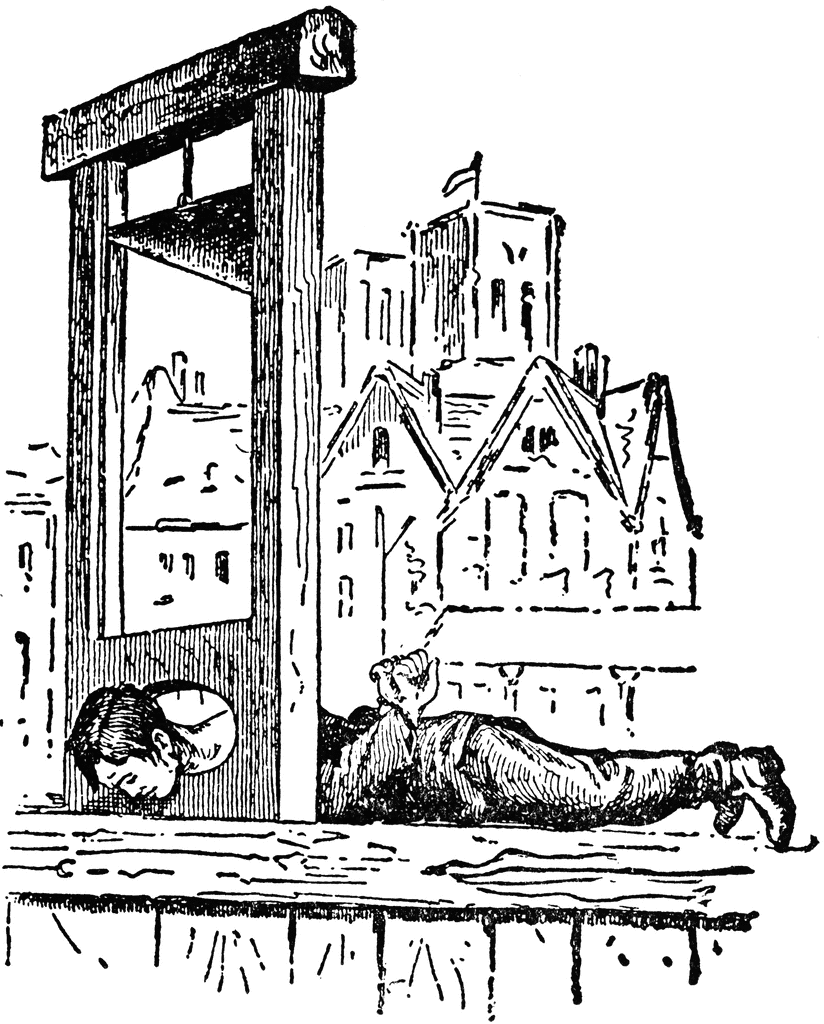
Not that there's anything wrong with that in this case. It's just once this stuff starts, it's kind of hard to stop.
..after President Obama denounced Wall Street bonuses as "shameful" on Thursday, the way was clear for the rest of the political class to pour gasoline on the bonfire being prepared for the offending bankers. Senator Chris Dodd, former "friend" of mortgage banker Angelo Mozilo, ranted that the Treasury should somehow confiscate the bonuses.
Senator Claire McCaskill rolled out legislation to put a compensation cap of $400,000 on executives whose firms receive bailout money. She also proposes creating a court to restrain their "massive self-indulgences." The Senator from Missouri then spoke of "a bunch of idiots on Wall Street." Insofar as the Congress is blithely waving more than $800 billion of cats-and-dogs "stimulus" spending into the air, the American people can be forgiven for asking who are the greater fools.
New York Attorney General Andrew Cuomo has begun a formal investigation into the bonuses and the negotiating details of Bank of America's takeover of Merrill Lynch. In short, Mr. Cuomo is putting BofA head Ken Lewis and Merrill's John Thain in the legal crosshairs. Watching this spectacle, Mr. Obama should consider that there may be a price for letting the populist flames burn out of control during a deep recession.
In our experience, political nuance has never been the strong suit of Wall Street executives. John Thain's year-end bonuses to Merrill Lynch executives, whatever their rationale, reflected an acute case of political tin ear. If the excesses of his office-decorating take this Wall Street practice the way of the dodo, we won't weep.
Yet the hard truth remains that whether on Wall Street or across the American business landscape, compensation levels are a business judgment made under the pressure of competition. The "idiots" notwithstanding, Wall Street has lots of highly talented financial minds and mobility among firms based on compensation is routine.
If Congress is going to start setting legal limits on salaries and bonuses in the U.S., it is going to drive talent out of Bank of America and these other banks and into institutions without such limits, perhaps abroad. The same goes for Attorney General Cuomo's implied threat of prosecutions...
Sweet Cthulhu's slimy tentacles, let the bastards walk. Please. And slam the damned door on their backsides on their way out.
These geniuses did a damned good job of destroying democracy here in the USA for eight years under Bu$hie. When it became obvious their republican water bearers were lepers to the America they prey on, they did a damned good job of buying the democrats. They've walked off with billions- maybe trillions, we'll never really know- of shareholder, investor, and taxpayer money.
They're trying to sabotage any government rescue of anyone else.
They're destroying this country.
Let the bastards walk. Before we really get French.
Not that there's anything wrong with that in this case. It's just once this stuff starts, it's kind of hard to stop.
It's because these people lie
We came to that conclusion quickly with Bu$hie.
Why is it so hard for liberal progressives to reach it concerning the Oborg?
[via Avedon via the Heretik]
It's the Hope and Faith bit of the Oborg song and dance. It's an old Sith Lord mind trick that seems to work every time. The really bad part is how the Unibama acts and talks like he doesn't understand the trick himself.
Why is it so hard for liberal progressives to reach it concerning the Oborg?
WASHINGTON — Treasury Secretary Timothy Geithner picked a former Goldman Sachs lobbyist as a top aide Tuesday, the same day he announced rules aimed at reducing the role of lobbyists in agency decisions...
[via Avedon via the Heretik]
It's the Hope and Faith bit of the Oborg song and dance. It's an old Sith Lord mind trick that seems to work every time. The really bad part is how the Unibama acts and talks like he doesn't understand the trick himself.
In hard times people turn to religion
This is the main reason why the religions would ensure hard times are here to stay.
Friday, January 30, 2009
"Pennies for the people, pounds for the powerful."
Stirling Newberry has figured it out:
The centrists get it. This political fight is between the "centrists" and the people. They want it all, they want it all, and they want it now. Liberals have to get bupkis before Obama gets a single Republican vote. If liberals were smart, they would draw the line here and tell President Obama that if he makes more concessions, they walk, and he gets nothing from them and will have to govern as a Republican from here on in. Last time that happened was NAFTA, and the Democrats are still smarting over how long they were out of power. So it won't happen now. So America, bend over and lube up, because you are about to feel the Unity Pony...
The UnDraft is Here for You "Volunteers"
They can't form a draft without making Barry a.k.a Lyndon Baines Obama. But they can suck in people who "volunteer" for other Service.
See Defense Department Directive 1404.10 [.pdf]
[tip o'teh tinfoil to Cryptogon]
Defense Department Establishes Civilian Expeditionary Workforce
By Gerry J. Gilmore
American Forces Press Service
WASHINGTON, Jan. 27, 2009 – The Defense Department is forming a civilian expeditionary workforce that will be trained and equipped to deploy overseas in support of military missions worldwide, according to department officials.
The intent of the program “is to maximize the use of the civilian workforce to allow military personnel to be fully utilized for operational requirements,” according to a Defense Department statement.
Deputy Defense Secretary Gordon England signed Defense Department Directive 1404.10, which outlines and provides guidance about the program, on Jan. 23.
Certain duty positions may be designated by the various Defense Department components to participate in the program. If a position is designated, the employee will be asked to sign an agreement that they will deploy if called upon to do so. If the employee does not wish to deploy, every effort will be made to reassign the employee to a nondeploying position.
The directive emphasizes, however, that volunteers be sought first for any expeditionary requirements, before requiring anyone to serve involuntarily or on short notice. Overseas duty tours shall not exceed two years.
Employees in deployable-designated positions will be trained, equipped and prepared to serve overseas in support of humanitarian, reconstruction and, if absolutely necessary, combat-support missions.
The program also is open to former and retired civilian employees who agree to return to federal service on a time-limited status to serve overseas or to fill in for people deployed overseas.
Program participants are eligible for military medical support while serving in their overseas duty station.
All participants will undergo pre- and post-deployment medical testing, including physical and psychological exams.
Defense civilians reassigned from their normal duty to serve overseas will be granted the right to return to the positions they held prior to their deployment or to a position of similar grade, level and responsibility within the same organization, regardless of the deployment length .
Families of deployed Defense Department civilian employees shall be supported and provided with information on benefits and entitlements and issues likely to be faced by the employee during and upon return from a deployment.
Defense civilian employees who participate in the expeditionary program shall be treated with high regard as an indication of the department’s respect for those who serve expeditionary requirements.
Expeditionary program participants’ service and experience shall be valued, respected and recognized as career-enhancing.
Participants who meet program requirements would be eligible to receive the Secretary of Defense Medal for the Global War on Terrorism.
See Defense Department Directive 1404.10 [.pdf]
[tip o'teh tinfoil to Cryptogon]
What is this "Recession" of Which You Speak?
For some, 2008 was a very good year:
Of course, being just plain evil helps one hell of a lot, too.
Despite a drop in its fourth-quarter earnings and collapsing oil prices, Exxon Mobil, the world’s largest publicly traded oil company, still managed to set a record as the most profitable American corporation ever last year...
“Exxon kept its head when everyone else was going crazy going to alternatives and drilling more,” said Mr. Flynn, at Alaron Trading. “But Exxon knew after every boom comes a bust and focused on the future.”
Of course, being just plain evil helps one hell of a lot, too.
It's time for a little Shock Doctrine of our own
Krugman is correct, and many of the Oborg have the idea now too:
The health care industry still has jobs. Some form of single payer national policy would be a great way to make sure it kept generating jobs and kept American workers working.
...Rahm Emanuel, the White House chief of staff, has declared that “you never want a serious crisis to go to waste.” Indeed. F.D.R. was able to enact Social Security in part because the Great Depression highlighted the need for a stronger social safety net. And the current crisis presents a real opportunity to fix the gaping holes that remain in that safety net, especially with regard to health care.
And Mr. Obama really, really doesn’t want to repeat the mistakes of Bill Clinton, whose health care push failed politically partly because he moved too slowly: by the time his administration was ready to submit legislation, the economy was recovering from recession and the sense of urgency was fading.
One more thing. There’s a populist rage building in this country, as Americans see bankers getting huge bailouts while ordinary citizens suffer.
I agree with administration officials who argue that these financial bailouts are necessary (though I have problems with the specifics). But I also agree with Barney Frank, the chairman of the House Financial Services Committee, who argues that — as a matter of political necessity as well as social justice — aid to bankers has to be linked to a strengthening of the social safety net, so that Americans can see that the government is ready to help everyone, not just the rich and powerful.
The bottom line, then, is that this is no time to let campaign promises of guaranteed health care be quietly forgotten. It is, instead, a time to put the push for universal care front and center. Health care now!
The health care industry still has jobs. Some form of single payer national policy would be a great way to make sure it kept generating jobs and kept American workers working.
Thursday, January 29, 2009
Disequilibrated Planet
In case you forgot because of all the snow this winter

There are also big changes going on in the far north
The newbies in Michigan all complain about the winter because we've had a few subzero nights.
Ten thousand years ago there were wooly mammoths and a polar ice cap down to the Ohio River.

Nobody notices that of the native American flora, bald cypress survives winter cold down to -35oF. Their old growth forests are in the swamps of Louisiana- but you can grow them just fine in Michigan, too. It's just the last forests in Michigan got wiped out by the kilometer of ice 20,000 years ago.
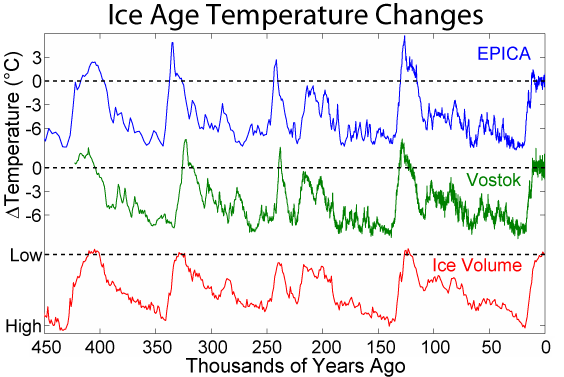
Not to dismiss the seriousness of sudden global warming. but swinging the pendulum the other direction could be equally or more disasterous as well.
There are also big changes going on in the far north
...Temperatures are rising in the North Atlantic, and the permafrost soil in Siberia, Canada and Alaska is softening. According to the Intergovernmental Panel on Climate Change (IPCC), the Arctic is subject to "stronger and faster warming than any other region."
Arctic animal and plant species must adjust to far more extreme changes than elsewhere -- or face the threat of extinction. It is not surprising that the polar bear has become a symbol of climate change.
People also live in the Arctic region. The Inuit are the ancestral settlers of the north. They number about 100,000 and are scattered across Alaska, Canada, Greenland and Siberia. Their familiar habitat is sinking as the permafrost soil softens.
Some stand to benefit from the end of the ice era. As if awakening from a deep sleep, the five nations bordering the Arctic -- the United States, Russia, Canada, Norway and Denmark -- are already grasping for new riches:
* As the wheat farming zone shifts farther to the north in Siberia, the Russians are looking forward to rich harvests.
* Farmers in Greenland recently began growing potatoes and broccoli, making the territory less dependant on shipments from the south.
* US aluminum producer Alcoa plans to build a huge aluminum smelter near Greenland's capital city, Nuuk. Hydroelectric power from melting glaciers will provide the electricity for the plant.
* As the ice melts, previously impassable shipping routes become navigable. Large amounts of money and effort are already being poured into expanding ports like Murmansk, Churchill and Hammerfest.
* Most of all, the Arctic is releasing unimagined amounts of resources, especially oil and gas, but also various ores.
...From the pragmatists' standpoint, the Arctic Ocean is opening up at just the right time. Exploding prices are fueling an onslaught on the riches of the North. The British-Dutch energy conglomerate Shell, for example, spent a record sum of $2 billion (€1.4 billion) for licenses in the Chukchi Sea north of the Bering Strait.
Energy multinational BP recently spent $1 billion (€700 million) for oil exploration rights in the pack ice in Canada's Mackenzie River estuary region. A $16.2 billion (€11.3 billion) pipeline will connect the new energy-producing region with areas to the south. The Danish company DONG Energy A/S began collecting seismic data in Disko Bay on the west coast of Greenland.
A forecast issued by the US Geological Survey (USGS) in July has ignited both fascination and greed. For the first time, the agency provided a detailed estimate of the Arctic region's oil and gas potential. The USGS concludes that the region north of the Arctic Circle holds the equivalent of 412 billion barrels of oil, or close to one-quarter of the world's undiscovered but technically reachable oil and gas reserves. This is significantly more than proven reserves in Saudi Arabia...
The newbies in Michigan all complain about the winter because we've had a few subzero nights.
Ten thousand years ago there were wooly mammoths and a polar ice cap down to the Ohio River.
...While an ice sheet on Antarctica began to grow some 20 million years ago, the current ice age is said to have started about 2.58 million years ago. During the late Pliocene the spread of ice sheets in the Northern Hemisphere began. Since then, the world has seen cycles of glaciation with ice sheets advancing and retreating on 40,000- and 100,000-year time scales called glacials (glacial advance) and interglacials (glacial retreat). The earth is currently in an interglacial, and the last glacial period ended about 10,000 years ago. All that remains of the continental ice sheets are the Greenland and Antarctic ice sheets...
Nobody notices that of the native American flora, bald cypress survives winter cold down to -35oF. Their old growth forests are in the swamps of Louisiana- but you can grow them just fine in Michigan, too. It's just the last forests in Michigan got wiped out by the kilometer of ice 20,000 years ago.
Not to dismiss the seriousness of sudden global warming. but swinging the pendulum the other direction could be equally or more disasterous as well.
The Accountability President
What is this "recession" of which you speak?

Smiling, happy people
Obama's Ba$e is going to love that with no strings attached.
The banks should not get one cent more from the taxpayers without total transparency, total control, and total accountability of how the money is spent by the Treasury.
But should and will are two very different animals.
Smiling, happy people
WASHINGTON -- Government officials seeking to revamp the U.S. financial bailout have discussed spending another $1 trillion to $2 trillion to help restore banks to health, according to people familiar with the matter...
Obama's Ba$e is going to love that with no strings attached.
The banks should not get one cent more from the taxpayers without total transparency, total control, and total accountability of how the money is spent by the Treasury.
But should and will are two very different animals.
Wednesday, January 28, 2009
Hold the cards close when you've got all the aces
The Moon suggests that Obama has no Afghanistan strategery, but I don't think that is the case at all.
I'm with Antifa:
Opium is also a great source of financial liquidity. The Amerikan banks want a capital flow from somewhere.
I'm with Antifa:
...The war in Afghanistan has nothing to do with Afghanistan. It has only to do with war. Any war. Anywhere. Any reason at all will do.
It's a jobs program.
From Congress to Pentagon to Defense Industry . . . the old double play. The money flows by the hundreds of billions, keeping industry busy, keeping materiel flowing, keeping campaign coffers full, keeping jobs going in every single Congressional District in the nation. This sacred bastion of money and power behind the American government and American nation is the true shadow government. No American President will ever be permitted to shut it down...
Opium is also a great source of financial liquidity. The Amerikan banks want a capital flow from somewhere.
Ideas are another dangerous thing they have in the chocolate-making countries
Avedon is really pissed after reading Sam Stein and you probably will be too.
I like her comment:
Jude has the right idea, although that will probably get him on the "no-fly" list if DHS ever figures out his real name.
...Three days after receiving $25 billion in federal bailout funds, Bank of America Corp. hosted a conference call with conservative activists and business officials to organize opposition to the U.S. labor community's top legislative priority.
Participants on the October 17 call -- including at least one representative from another bailout recipient, AIG -- were urged to persuade their clients to send "large contributions" to groups working against the Employee Free Choice Act (EFCA), as well as to vulnerable Senate Republicans, who could help block passage of the bill.
Bernie Marcus, the charismatic co-founder of Home Depot, led the call along with Rick Berman, an aggressive EFCA opponent and founder of the Center for Union Facts. Over the course of an hour, the two framed the legislation as an existential threat to American capitalism, or worse.
"This is the demise of a civilization," said Marcus. "This is how a civilization disappears. I am sitting here as an elder statesman and I'm watching this happen and I don't believe it..."
I like her comment:
...France. Where everyone gets good healthcare. My, that's just absolutely barbaric, isn't it?
Jude has the right idea, although that will probably get him on the "no-fly" list if DHS ever figures out his real name.
Kinetic Analysis
After a quiet solstice period Swedish Meatballs Confidential is back, pointing to some of the best psyops in the main$tream. And still not work safe.
And pointing to some surprising veritas among the Faithful Christian Scientists:
Unfortunately, those non-kinetic solutions don't make money for the Gipper, do they?
In difficult economic times we must prioritize:
It's a no-brainer what gets cut out of that list.
And pointing to some surprising veritas among the Faithful Christian Scientists:
...Meanwhile, kinetic is moving in other directions, too. "Afghanistan's kinetic action" was the somewhat cryptic headline on a piece the other day in Stars and Stripes, the independent news source for the US military community.
The lead was a little more enlightening, if not heartening: "Taliban fighters have turned increasingly to roadside bombs and other deadly tactics to combat U.S. soldiers and other NATO-led troops in southern Afghanistan, military officials say."
With such a grim story, no wonder there was a resort to euphemism.
By contrast, a "nonkinetic" operation is one with no shooting or bombing.
Thus the Navy Times quoted Vice Adm. Bill Gortney, commander of 5th Fleet and Combined Maritime Forces, on efforts to combat piracy off the coast of Somalia: "The most effective measures we've seen ... are non-kinetic..."
Unfortunately, those non-kinetic solutions don't make money for the Gipper, do they?
In difficult economic times we must prioritize:
...Five programs account for half of the growth in weapons spending, Gates said. The five programs are Boeing’s Future Combat Systems; General Dynamics’ and Northrop Grumman’s Virginia-class attack submarines; Lockheed Martin’s F-35 Joint Strike Fighter; the Pentagon’s primary satellite-launch program, which is an effort shared by Lockheed Martin and Boeing; and a multi-contractor program to destroy the U.S. stockpile of chemical weapons.
It's a no-brainer what gets cut out of that list.
No Liquidity Problem
Where has all the opium related money been going since the War on Terror went to Afghanistan?
It's going to come as no surprise (to some), also via Cryptogon and the Reuters news agency:
It's going to come as no surprise (to some), also via Cryptogon and the Reuters news agency:
The United Nations’ crime and drug watchdog has indications that money made in illicit drug trade has been used to keep banks afloat in the global financial crisis, its head was quoted as saying on Sunday.
Vienna-based UNODC Executive Director Antonio Maria Costa said in an interview released by Austrian weekly Profil that drug money often became the only available capital when the crisis spiralled out of control last year.
“In many instances, drug money is currently the only liquid investment capital,” Costa was quoted as saying by Profil. “In the second half of 2008, liquidity was the banking system’s main problem and hence liquid capital became an important factor.”
The United Nations Office on Drugs and Crime had found evidence that “interbank loans were funded by money that originated from drug trade and other illegal activities,” Costa was quoted as saying. There were “signs that some banks were rescued in that way.”
Profil said Costa declined to identify countries or banks which may have received drug money and gave no indication how much cash might be involved. He only said Austria was not on top of his list, Profil said...
Tuesday, January 27, 2009
Unfriendly Natives
Brits Shoot at UFOs, Ex-official Says
January 27, 2009
United Press International
LONDON -- A former official with the British Ministry of Defense said military pilots in the country have been shooting at UFOs since the 1980s.
Nick Pope, former head of the Ministry of Defense's UFO project, said UFOs have been fired upon but none have been brought down or captured by the Royal Air Force, The Daily Telegraph reported Monday.
"There was a faction in the MoD who said 'We want to shoot down a UFO and that will resolve the issue one way or another,'" Pope said. "We know of cases where the order has been given to shoot down -- with little effect to the UFO."
Pope said pilots only fired upon UFOs in cases where the objects appeared threatening.
"In the case of UFOs, whether the object is causing a threat is very much a pilot's judgment call. The public won't know unless it comes down in a heavily populated area," he said.
[tip o'teh tinfoil to Noah]
One wonders if there's a difference between little and no effect.
Another thing: if the Brits have been doing it since the '8os, we've been doing it since the Battle of Los Angeles.

One wonders about the effect, and just how little it is still today.
The silence speaks volumes.
The obvious question and equally obvious answer
Over at The New York Pravda today, Bob Herbert asks it...
Because the Ba$e still owns all the ears in Washington, Bob. It's not simple "fecklessness". It is simple "corruption".
I'm glad I could clear that one up for you.
...it was Phil Gramm, John McCain’s economic guru, who told us last summer that the pain was all in our heads, that this was a “mental recession.”
The truth, of course, is that the country is hemorrhaging jobs and Americans are heading to the poorhouse by the millions. The stock markets and the value of the family home have collapsed, and there is virtual across-the-board agreement that the country is caught up in the worst economic disaster since at least World War II.
The Republican answer to this turmoil?
Tax cuts.
They need to go into rehab.
The question that I would like answered is why anyone listens to this crowd anymore. G.O.P. policies have been an absolute backbreaker for the middle class. (Forget the poor. Nobody talks about them anymore, not even the Democrats.) The G.O.P. has successfully engineered a wholesale redistribution of wealth to those already at the top of the income ladder and then, in a remarkable display of chutzpah, dared anyone to talk about class warfare.
A stark example of this unholy collaboration between the G.O.P. and the very wealthy was on display in the pages of this newspaper on Jan. 18. The Times’s Mike McIntire wrote an article about the first wave of federal bailout money for the financial industry, which was handed over by the Bush administration with hardly any strings attached. (Congress, under the control of the Democrats, should never have allowed this to happen, but the Democrats are as committed to fecklessness as the Republicans are to tax cuts.)
The public was told that the money would be used to loosen the frozen credit markets and thus help revive the economy. But as the article pointed out, there were bankers with other ideas. John C. Hope III, the chairman of the Whitney National Bank in New Orleans, in an address to Wall Street fat cats gathered at the Palm Beach Ritz-Carlton, said:
“Make more loans? We’re not going to change our business model or our credit policies to accommodate the needs of the public sector as they see it to have us make more loans.”
How’s that for arrogance and contempt for the public interest? Mr. Hope’s bank received $300 million in taxpayer bailout money.
The same article quoted Walter M. Pressey, president of Boston Private Wealth Management, which Mr. McIntire described as a healthy bank with a mostly affluent clientele. It received $154 million in taxpayer money.
“With that capital in hand,” said Mr. Pressey, “not only do we feel comfortable that we can ride out the recession, but we also feel that we’ll be in a position to take advantage of opportunities that present themselves once this recession is sorted out.”
Take advantage, indeed. That, in a nutshell, is what the plutocracy is all about: taking unfair advantage.
When the G.O.P. talks, nobody should listen. Republicans have argued, with the collaboration of much of the media, that they could radically cut taxes while simultaneously balancing the federal budget, when, in fact, big income-tax cuts inevitably lead to big budget deficits. We listened to the G.O.P. and what do we have now? A trillion-dollar-plus deficit and an economy in shambles.
This is the party that preached fiscal discipline and then cut taxes in time of war. This is the party that still wants to put the torch to Social Security and Medicare. This is a party that, given a choice between Abraham Lincoln and Ronald Reagan, would choose Ronald Reagan in a heartbeat.
Why is anyone still listening?
Because the Ba$e still owns all the ears in Washington, Bob. It's not simple "fecklessness". It is simple "corruption".
I'm glad I could clear that one up for you.
Monday, January 26, 2009
Happy Trails to You
There wouldn't be a government agency trying to do covert climate change now would there?
It's not like there aren't people advocating it either.
But believe it, real experts say it's a really bad idea. Not that's ever stopped a private contractor with an inside to a covert government agency that thinks it knows best.
It's not like there aren't people advocating it either.
But believe it, real experts say it's a really bad idea. Not that's ever stopped a private contractor with an inside to a covert government agency that thinks it knows best.
Sunday, January 25, 2009
Perspective from the Ice Age: La Niña
It's quiet. Too quiet.

Developing La Niña conditions are likely to continue into Northern Hemisphere Spring 2009.
When polar ice melts it takes a lot of heat out of the environment to melt it.
Most of the global warming observed has taken place at the poles. It can be easiest observed in the summers, which are warmer at the higher latitudes than ever measured before. Also, with the increased melting of both the thinner transient ice and the permafrost ice in the summer, more open water is exposed in the winter. In the past, this water was insulated under ancient ice. It takes a lot of heat out the environment when it freezes in the winter darkness.
Plus, over the last year the sun has been unusually quiet, causing a cooling effect.
That seems to have recently ended.
Greenhouse warming is real. In fact, some greenhouse warming allows life to exist here. It's just dangerous when unchecked.
But it's not a simple relationship at all. We live under a variable star. Over the last 5 million years or so the world's had about 5 ice ages, where the sun's activity got low enough to allow the arctic ice cap to extend as far south as the ohio river. Similarly it got active enough to melt all that ice, which is pretty incredible if you think about it.
If global warming alone got serious enough to melt the ice cap it would cause pretty incredibly destructive turmoil.
But a new ice age with a mile of ice over Michigan? Or Manhattan?
The point of this is not to stop our efforts to curtail CO2 emissions and human-caused global warming. The point of this is, however, that we should be very reluctant to fight global warming by interfering with the insolation of the planet. We can't predict what we might need in the future.
Developing La Niña conditions are likely to continue into Northern Hemisphere Spring 2009.
During December 2008, negative equatorial sea surface temperature (SST) anomalies strengthened across the central and east-central Pacific Ocean (Fig. 1).Correspondingly, the latest weekly SST index values were -0.3°C in Niño-1+2, -0.9°C in Niño 3, -1.1°C in Niño 3.4, and -0.7°C in Niño 4 (Fig. 2).
The subsurface oceanic heat content anomalies (average temperatures in the upper 300m of the ocean, Fig. 3)
also became increasingly negative as below-average temperatures at thermocline depth strengthened in the central and eastern Pacific (Fig. 4).
Convection remained suppressed near the International Date Line, and became more persistent near Indonesia during December. Low-level easterly winds and upper-level westerly winds also strengthened across the equatorial Pacific Ocean. Collectively, these oceanic and atmospheric anomalies reflect the development of La Niña.
Nearly all of the recent forecasts for the Niño-3.4 region indicate a continuation of below-average SSTs through the first half of 2009, with at least one-half predicting La Niña conditions throughout the period (Fig. 5).While the magnitude of cooling remains uncertain, NOAA’s official La Niña threshold (3-month average of the Niño-3.4 index less than or equal to -0.5°C) is expected be met at least through January-March 2009. Therefore, based on current observations, recent trends, and model forecasts, La Niña conditions are likely to continue into the Northern Hemisphere Spring 2009...
When polar ice melts it takes a lot of heat out of the environment to melt it.
Most of the global warming observed has taken place at the poles. It can be easiest observed in the summers, which are warmer at the higher latitudes than ever measured before. Also, with the increased melting of both the thinner transient ice and the permafrost ice in the summer, more open water is exposed in the winter. In the past, this water was insulated under ancient ice. It takes a lot of heat out the environment when it freezes in the winter darkness.
Plus, over the last year the sun has been unusually quiet, causing a cooling effect.
That seems to have recently ended.
Greenhouse warming is real. In fact, some greenhouse warming allows life to exist here. It's just dangerous when unchecked.
But it's not a simple relationship at all. We live under a variable star. Over the last 5 million years or so the world's had about 5 ice ages, where the sun's activity got low enough to allow the arctic ice cap to extend as far south as the ohio river. Similarly it got active enough to melt all that ice, which is pretty incredible if you think about it.
If global warming alone got serious enough to melt the ice cap it would cause pretty incredibly destructive turmoil.
But a new ice age with a mile of ice over Michigan? Or Manhattan?
The point of this is not to stop our efforts to curtail CO2 emissions and human-caused global warming. The point of this is, however, that we should be very reluctant to fight global warming by interfering with the insolation of the planet. We can't predict what we might need in the future.
On Deep Racketeering
Werewolves of Wall Street
Frank Rich is right. Bu$hie's Ba$e is just as much to blame as Bu$hie himself for the economic mess we're into:
Then again, where we find ourselves depends not only on the perception of where we are but of how we got there. For your consideration, Bernie Madoff:
Now there's a non-reality based oversimplification for you. It's not because of the ultimate cosmic power he held, head of NASDAQ and writing the rules that would ensure he wouldn't be easily prosecuted. And of course, he must have acted alone, despite unpopular unfortunate employees of the SEC, analysts, and common ordinary people shouting from the rooftops for the last ten years about how his practices were driving the American economy off a cliff.
The thought that this was intentional, and co-ordinated, and supposed to happen falls into the realm of the unthinkable, that only the fools who've been shouting it over the rooftops for the last ten years would consider.
...on Feb. 10, 2007, when, on another frigid day, he announced his presidential candidacy in Springfield, Ill. Citing “our mounting debts” and “hard choices,” he talked of how “each of us, in our own lives, will have to accept responsibility” and “some measure of sacrifice.” His campaign, he said then, “has to be about reclaiming the meaning of citizenship.” But the press, convinced that Obama was a sideshow to the inevitable Clinton-Giuliani presidential standoff, didn’t parse his words all that carefully, and neither did a public still maxing out on its gluttonous holiday from economic history. However inadvertently, Time magazine had captured the self-indulgent tenor of the times when, weeks earlier, it slapped some reflective Mylar on its cover and declared that the 2006 Person of the Year was “You.”
It was in keeping with the unhinged spirit of the boom that three days after Obama’s Springfield declaration, a Wall Street baron, Steven Schwarzman of the Blackstone Group, a private equity and hedge fund, celebrated his 60th birthday with some 350 guests in the vast Seventh Regiment Armory on Manhattan’s East Side. To appreciate the degree of ostentation and taste, you need only know that Rod Stewart was the headliner, at an estimated cost of $1 million.
That same week the National Association of Realtors told less well-heeled Americans not to fret about its report that median home prices had fallen in 73 metro areas during the final quarter of 2006. “The bottom appears to have already occurred,” said one of the N.A.R. economists. Another predicted: “When we get the figures for this spring, I expect to see a discernible improvement in both sales and prices.”
We have discerned what happened to those sales and prices ever since. As for the Blackstone Group, it went public four months after its leader’s 60th birthday revels. Its shares have since lost 85 percent of their value, and Schwarzman’s bash has become a well-worn symbol of our deflated Gilded Age.
Yet the values of the bubble remain entrenched even as Obama takes office. In the upper echelons, we can find fresh examples of greed and irresponsibility daily even without dipping into the growing pool of those money “managers” who spirited victims to Bernie Madoff.
Last week’s object lesson was John Thain, the chief executive of Merrill Lynch. He was lionized as a rare Wall Street savior as recently as September, when he helped seal the deal that sped his teetering firm into the safe embrace of Bank of America on the same weekend Lehman Brothers died. Since then we’ve learned that even as he was laying off Merrill employees by the thousands, he was lobbying (unsuccessfully) for a personal bonus as high as $30 million and spending $1.22 million of company cash on refurbishing his office, an instantly notorious $1,405 trashcan included.
Thain resigned on Thursday. Only then did we learn that he doled out billions in secret, last-minute bonuses to his staff last month, just before Bank of America took over and just before the government ponied up a second bailout to cover Merrill’s unexpected $15 billion fourth-quarter loss. So far American taxpayers have spent $45 billion on this mess, and that’s only our down payment.
In less lofty precincts of the American economic spectrum, the numbers may be different but the ethos has often been similar. As Wall Street titans grabbed bonuses based on illusory, short-term paper profits, so regular Americans took on all kinds of debt wildly disproportionate to their assets and income. The nearly $1 trillion in unpaid credit-card balances is now on deck to be the next big crash.
This debt-ridden national binge of greed and irresponsibility washed over our culture not just through the Marie Antoinette antics of a Schwarzman and a Thain but in mass forms of conspicuous consumption and entertainment. Cable networks like Bravo, A&E, TLC and HGTV produced an avalanche of creepy programming catering to the decade’s housing bubble alone — an orgiastic genre that might be called Subprime Pornography. Some of the series — “Flip This House,” “Flip That House,” “Sell This House,” “My House Is Worth What?” — still play on even as more and more house owners are being flipped into destitute homelessness.
The austerity of Obama’s Inaugural Address seemed a tonal corrective to the glitz and the glut. The speech was, as my friend Jack Viertel, a theater producer, put it, “stoic, stern, crafted in slabs of granite, a slimmed-down sinewy thing entirely evolved away from the kind of Pre-Raphaelite style of his earlier oration.” Some of the same critics who once accused Obama of sounding too much like a wimpy purveyor of Kumbaya now faulted him for not rebooting those golden oldies of the campaign trail as he took his oath. But he is no longer campaigning, and the moment for stadium cheers has passed.
If we’ve learned anything since the election, it is this: We have not remotely seen the bottom of this economy, and no one has a silver bullet to arrest the plunge, the hyped brains in the new White House included. Most economists failed to anticipate the disaster, after all, and our tax-challenged incoming Treasury Secretary may prove as evanescent as past saviors du jour. As we applauded Thain in September, we were also desperately trying to convince ourselves that Warren Buffett’s $5 billion investment in Goldman Sachs would turn the tide, and that Hank Paulson, as Newsweek wrote in a cover story titled “King Henry,” would be the “right man at the right time.”
Obama couldn’t give us F.D.R.’s first inaugural address because we are not yet where America was in 1933 — in its fourth year of downturn after the crash of ’29, with an unemployment rate of 25 percent. But no one knows for sure that we cannot end up there...
Then again, where we find ourselves depends not only on the perception of where we are but of how we got there. For your consideration, Bernie Madoff:
...Although hardly a household name, he secured a longstanding role as an elder statesman on Wall Street, allowing him to land on important boards and commissions where his opinions helped shape securities regulations. Along the way, he snared a coveted spot as the chairman of a major stock exchange, Nasdaq.
And his employees say he treated them like family.
There was, of course, another side to Mr. Madoff, who is 70. Reclusive, at times standoffish and aloof, this Bernie rarely rubbed elbows in Manhattan’s cocktail circuit or at Palm Beach balls. This Bernie was quiet, controlled and closely attuned to his image, down to the most minute details.
He was, for instance, an avid collector of vintage watches and took time each morning to match his wedding ring — he owned at least two — to the platinum or gold watch band he was wearing that day.
Per his directives, the décor in his firm’s New York and London offices was stark. Black, white and gray — or “icily cold modern,” as one frequent visitor to the New York operation described it.
Despite nurturing a familial atmosphere in his offices, he installed two cameras on the small trading floor of the firm’s London operations so he could monitor the unit remotely from New York.
This Bernie also ran a money management business on the side for decades that he kept hidden far from colleagues, competitors and regulators.
While he managed billions of dollars for individuals and foundations, he shunned one-on-one meetings with most of his investors, wrapping himself in an Oz-like aura, making him even more desirable to those seeking access.
So who was the real Bernie Madoff? And what could have driven him to choreograph a $50 billion Ponzi scheme, to which he is said to have confessed?
An easy answer is that Mr. Madoff was a charlatan of epic proportions, a greedy manipulator so hungry to accumulate wealth that he did not care whom he hurt to get what he wanted.
But some analysts say that a more complex and layered observation of his actions involves linking the world of white-collar finance to the world of serial criminals.
They wonder whether good old Bernie Madoff might have stolen simply for the fun of it, exploiting every relationship in his life for decades while studiously manipulating financial regulators...
Now there's a non-reality based oversimplification for you. It's not because of the ultimate cosmic power he held, head of NASDAQ and writing the rules that would ensure he wouldn't be easily prosecuted. And of course, he must have acted alone, despite unpopular unfortunate employees of the SEC, analysts, and common ordinary people shouting from the rooftops for the last ten years about how his practices were driving the American economy off a cliff.
The thought that this was intentional, and co-ordinated, and supposed to happen falls into the realm of the unthinkable, that only the fools who've been shouting it over the rooftops for the last ten years would consider.
Saturday, January 24, 2009
Life in Laputa

Being President instead of preznit means you can have a Blackberry if you want to:
...The battle over whether the president could keep his BlackBerry has been fueled to a large degree by Mr. Obama himself, who mentioned it again and again. He would not take no for an answer. In an interview this month, he worried aloud, “They’re going to pry it out of my hands.”
Mr. Obama received his BlackBerry on Tuesday, but officials declined to specify what kind. In a conversation with reporters on Thursday evening, he said, “I don’t think it’s actually up and running yet.”
Throughout the transition, several of his aides talked openly about Mr. Obama’s obsession with keeping his BlackBerry. And some of them, when speaking privately, said they were eager to have his device taken away so the case could be closed...
Bu$hie had handlers. The man spent 8 years in office hearing only what said handlers wanted to tell him. He was famous for his isolation and insulation.
If Obama is wise he will fire these flappers immediately.

You Can Not Make This Stuff Up-
that is to say you can not make up how much the Company makes up stuff that doesn't exist but sounds "Truthy".
Maybe Obama should just stop listening to people like Robert Gates, too.
Maybe Obama should just stop listening to people like Robert Gates, too.
The nomination of William Lynn as Deputy Secretary of Defense has placed Barack Obama under the burn of political heat just days into the presidency.
Having lobbied the government on behalf of the defense industry giant Raytheon, Lynn's appointment violates the newly-instituted ethics guidelines that the president applied to his staff shortly after taking office. Questioned about the transgression, the White House said Lynn was being granted a waiver.
But there is a second layer to the Lynn issue that also is leaving a bad taste in the mouths of Democrats, good government groups and Republicans eager to cry hypocrisy. Raytheon is no mom-and-pop defense contractor shop. It is the type of industry behemoth that protesters of the Iraq invasion bemoaned for profiting off of the war and encouraging militarization. And as the man who led "the company's strategic planning and [oversaw] the government relations activity," Lynn was intimately involved.
Takeover Finesse
Russ Baker:
There's much more here you need to become familiar with if you aren't already.
There's a problem with the kind of $ystem the Bu$hies want in their vision of the new world order. Their $ystem is one that countless other racketeers can profit off of nicely. So nicely, as in the case of Madoff's, it clogs up the the plumbing, and requires some outside help.
But not too much help. It's a Bu$h family minion that still runs the D.o'D. It's a financial advocate of Bu$hie economic policy that still runs the Treasury.
The Company will only show restraint until it perceives the market has stabilized. At that point, Obama will be faced with a policy dysfunction similar to that which made Carter's a single term presidency. Such a dysfunction is guaranteed, because Poppy Bu$h has virtually handpicked much of the Obama cabinet.
And let's face it, even if these guys weren't into sabotage, they're incompetent at anything other than stealing power.
But now that everyone knows race is no longer a factor in Amerika, everyone knows that the political $ystem works- Obama was $elected, wasn't he?- everyone knows that thinking otherwise is just a lot of conspiracy theory, Amerika won't be disturbed by the mainstreaming of the remaining politically active people of America that worked to overturn the Cheneyburton faction of the Company.
Which, you may remember, actively brushed off Poppy and his Consigliere and their faction of the Company shortly after Iraq was invaded. The new Dear Leader didn't need the Old Man's advice anymore, having Darth Rumsfeld and Darth Cheney in the house. Little Boots paid for that with some humiliation. Like Nixon, he forgot he wasn't really Der Decider.
One wonders if Obama will suffer from the similar delusion of actually thinking he's in charge. If he does, his honeymoon will end sooner rather than later. It will also end far more spectacularly than if he does what he's told by Gates and associates.
Then Jebbie, Poppy's favorite, will ascend the throne.
That certainly won't make things work any better, but by then the Company will have an even tighter grip on the mind of Amerika.
...A more profound explanation for the rise of George W. Bush came as I studied the concerted effort to convince the public that he was independent of, and often in disagreement with, his father. The reason for this, it turned out, was that exactly the opposite was true. W. may have been bumptious where his father was discreet, but in fact the son hewed closely to a playbook that guided his father and even his grandfather.
Over much of the last century, the Bushes have been serving the aims of a very narrow segment from within America's wealthiest interests and families -- typically through involvement in the most anti-New Deal investment banking circles, in the creation of a civilian intelligence service after World War II, and in some of that service's most secretive and still-unacknowledged operations.
Through declassified documents and interviews, I unearthed evidence that George W. Bush's father, the 41st president of the United States, had been working for the intelligence services no less than two decades before he was named CIA director in 1976. Time and again, Bush 41 and his allies have participated in clandestine operations to force presidents to do the bidding of oil and other resource-extraction interests, military contractors and financiers. Whenever a president showed independence or sought reforms that threatened entrenched interests, this group helped to ensure that he was politically attacked and neutralized, or even removed from office, through one means or another.
We are not dealing here with what are commonly dismissed as "conspiracy theories." We are dealing with a reality that is much more subtle, layered and pervasive -- a matrix of power in which crude conspiracies are rarely necessary and in which the execution or subsequent cover-up of anti-democratic acts become practically a norm.
In 1953, 23 years before he became CIA director as a supposed neophyte, George H.W. Bush began preparing to launch an oil-exploration company called Zapata Offshore. His father, investment banker Prescott Bush, had just taken a Senate seat from Connecticut; and his father's close friend Allen Dulles had just taken over the CIA. A staff CIA officer, Thomas J. Devine, purportedly "resigned" to go into the oil business with young George.
Bush then began to travel around the world. His itineraries had little apparent relationship to his limited and perennially unprofitable business enterprises. But they do make sense if the object was intelligence work. When his company at last put a few oil rigs in place, they ended up in highly sensitive spots, such as just off Castro's Cuba before the Bay of Pigs invasion.
As part of his travels, Bush senior even appeared in Dallas on the morning of the Kennedy assassination, although he would famously claim that he could not recall where he was at that historic moment. After leaving the city, he called the FBI with a false tip about a possible assassin, pointedly emphasizing that he was calling from outside Dallas. It is also intriguing to learn that an old friend of Bush's, a White Russian émigré with intelligence connections, shepherded Lee Harvey Oswald upon his return to America in the year preceding the assassination. In any event, when Lyndon Johnson replaced Kennedy, the oilmen and the intelligence-military establishment once again had a friend in the White House.
The pattern continued. New evidence suggests that Bush senior and his associates in the intelligence services, far from being the loyalists to Richard Nixon they claimed to be, had turned on the 35th president early in his administration, unceasingly working to weaken and eventually force him out. These efforts culminated in what appears to have been a deliberately botched Watergate office burglary -- led by former CIA officers.
Ironically, Nixon's career had been launched with the quiet backing of Wall Street finance figures upset with the man Nixon would defeat, a leading congressional supporter of banking reform, and Prescott Bush himself had played a key role. Yet, when Nixon finally achieved the presidency, he became surprisingly resistant to pressure from the very power centers that had helped him get to the top. He turned a deaf ear to the demands of the oil industry, battled with the CIA and cut the Pentagon out of the loop as he (and his aide Henry Kissinger) negotiated secretly with Moscow and Beijing.
These acts estranged Nixon from those who felt he had betrayed his sponsors -- men who had the means to do him in. Bush senior, it turns out, was closely allied with the surprising number of White House officials with covert ties to the intelligence service that surrounded Nixon. Through it all, Bush senior would routinely claim to be "out of the loop," as he would later pretend during the Iran-Contra scandal of the Reagan era, although we know that as vice president he was at the center of that and other abuses of power.
None of this let up after Nixon was forced to resign. His pliant successor, Gerald Ford, brought in young staffers named Richard Cheney and Donald Rumsfeld, and the two participated in the so-called Halloween massacre, which saw the administration veer in a far-right direction on foreign policy, a development that paved the way for the appointment of Bush senior as CIA director. This happened just as Congress was launched into the deepest investigation ever of intelligence abuses, and public voices were clamoring to reopen official inquiries into the assassinations of John F. Kennedy, his brother, Robert F. Kennedy and Martin Luther King Jr.
Then came Jimmy Carter, whose plans to reform the CIA were an echo of JFK's intent to scatter the CIA to the winds after the ruinous Bay of Pigs invasion. When Carter defeated Ford, ousted Bush from the CIA helm and sought to bring the intelligence juggernaut under control, he ended up deeply compromised by complex financial shenanigans orchestrated by figures from the same intelligence circles -- and undermined by the crisis with Iran, exacerbated by covert dissident CIA elements tied to Bush. Carter was a one-term president, defeated by a ticket with none other than George H.W. Bush, backed by a phalanx of CIA officers, as vice president. And then Bush senior became president himself.
Bill Clinton apparently grasped the pattern. He cultivated a friendly relationship with the elder Bush and instituted virtually no significant reforms in, or issued challenges to, either the intelligence or military establishments.
All this is relevant today because the furtive forces and pressures that haunted, and ultimately dominated, these past presidents have not abated.
Indeed, what the presidency of George W. Bush truly represented was the unfettered, most reckless manifestation of the objectives this group has pursued for many decades...
There's much more here you need to become familiar with if you aren't already.
There's a problem with the kind of $ystem the Bu$hies want in their vision of the new world order. Their $ystem is one that countless other racketeers can profit off of nicely. So nicely, as in the case of Madoff's, it clogs up the the plumbing, and requires some outside help.
But not too much help. It's a Bu$h family minion that still runs the D.o'D. It's a financial advocate of Bu$hie economic policy that still runs the Treasury.
The Company will only show restraint until it perceives the market has stabilized. At that point, Obama will be faced with a policy dysfunction similar to that which made Carter's a single term presidency. Such a dysfunction is guaranteed, because Poppy Bu$h has virtually handpicked much of the Obama cabinet.
And let's face it, even if these guys weren't into sabotage, they're incompetent at anything other than stealing power.
But now that everyone knows race is no longer a factor in Amerika, everyone knows that the political $ystem works- Obama was $elected, wasn't he?- everyone knows that thinking otherwise is just a lot of conspiracy theory, Amerika won't be disturbed by the mainstreaming of the remaining politically active people of America that worked to overturn the Cheneyburton faction of the Company.
Which, you may remember, actively brushed off Poppy and his Consigliere and their faction of the Company shortly after Iraq was invaded. The new Dear Leader didn't need the Old Man's advice anymore, having Darth Rumsfeld and Darth Cheney in the house. Little Boots paid for that with some humiliation. Like Nixon, he forgot he wasn't really Der Decider.
One wonders if Obama will suffer from the similar delusion of actually thinking he's in charge. If he does, his honeymoon will end sooner rather than later. It will also end far more spectacularly than if he does what he's told by Gates and associates.
Then Jebbie, Poppy's favorite, will ascend the throne.
That certainly won't make things work any better, but by then the Company will have an even tighter grip on the mind of Amerika.
RoundUp for the Netroots
The Company really, really doesn't like this free speech thing.
Yet another lawsuit designed to shut down the essence of the internet, news and information.
There are not that many Americans who actually pay attention to what's going on in the world around them, and after this election the Bush faction of the Company wants there to be even less.
Yet another lawsuit designed to shut down the essence of the internet, news and information.
There are not that many Americans who actually pay attention to what's going on in the world around them, and after this election the Bush faction of the Company wants there to be even less.
Friday, January 23, 2009
Hating Bridges and Buildings and Trees and Roads and Schools
...and loving lots of money for their generous banking friends.
That's Larry Summers:
Read it all for the links and hope Peter DeFazio has the foresight to stay out of small airplanes
That's Larry Summers:
Earlier this week, Rep. Jim Oberstar (D-MN) explained that funding for mass transit infrastructure projects was nixed from the stimulus proposal in order to make room for tax cuts. Despite the fact that tax cuts already comprise a bulky 33 percent of the stimulus (compared to only 7.5 percent for transportation infrastructure), conservatives are pressuring President Obama to include even more.
Tonight on the Rachel Maddow Show, Rep. Peter DeFazio (D-OR) said the amount of infrastructure spending in the legislation is “not enough.” He argued that if the Republicans are recycling failed ideas of the past, “we don’t need to buy them off with $300 billion in tax cuts.” DeFazio said Democrats in Congress originally proposed more for infrastructure spending, but the effort was shot down by Obama advisers...
...Maddow noted Obama speaks “very highly” of infrastructure. “If there’s a distance between him and his advisers,” she said, then that’s a problem. DeFazio responded, “He needs to know it, and that’s why I’m speaking out.”
Read it all for the links and hope Peter DeFazio has the foresight to stay out of small airplanes
It takes two to tangle
It's no surprise the remaining Republicans are trying to assert their right to date-rape.
He hasn't begun to hear it. This is the main reason Roosevelt's first 100 days had only limited success: Republican resistance in Congress and the Supreme Court. Does Obama have the spine to do what needs to be done anyway?
Krugman:
It's not just going to be the economy either. The pro-torture brigade is currently up in arms and disinformation in response to Obama's break in the War on Terra.
Of course, in the fine print there's the disclaimer:
That's the only proper response to people whose first reaction is to throw you in prison, torture, and kill you. For profit.
Just days after taking office vowing to end the political era of "petty grievances," President Obama ran into mounting GOP opposition yesterday to an economic stimulus plan that he had hoped would receive broad bipartisan support.
Republicans accused Democrats of abandoning the new president's pledge, ignoring his call for bipartisan comity and shutting them out of the process by writing the $850 billion legislation. The first drafts of the plan would result in more spending on favored Democratic agenda items, such as federal funding of the arts, they said, but would do little to stimulate the ailing economy.
The GOP's shrunken numbers, particularly in the Senate, will make it difficult for Republicans to stop the stimulus bill, but the growing GOP doubts mean that Obama's first major initiative could be passed on a largely party-line vote -- little different from the past 16 years of partisan sniping in the Clinton and Bush eras...
He hasn't begun to hear it. This is the main reason Roosevelt's first 100 days had only limited success: Republican resistance in Congress and the Supreme Court. Does Obama have the spine to do what needs to be done anyway?
Krugman:
...In response to an unprecedented economic crisis — or, more accurately, a crisis whose only real precedent is the Great Depression — Mr. Obama did what people in Washington do when they want to sound serious: he spoke, more or less in the abstract, of the need to make hard choices and stand up to special interests.
That’s not enough. In fact, it’s not even right.
Thus, in his speech Mr. Obama attributed the economic crisis in part to “our collective failure to make hard choices and prepare the nation for a new age” — but I have no idea what he meant. This is, first and foremost, a crisis brought on by a runaway financial industry. And if we failed to rein in that industry, it wasn’t because Americans “collectively” refused to make hard choices; the American public had no idea what was going on, and the people who did know what was going on mostly thought deregulation was a great idea.
Or consider this statement from Mr. Obama: “Our workers are no less productive than when this crisis began. Our minds are no less inventive, our goods and services no less needed than they were last week or last month or last year. Our capacity remains undiminished. But our time of standing pat, of protecting narrow interests and putting off unpleasant decisions — that time has surely passed.”
The first part of this passage was almost surely intended as a paraphrase of words that John Maynard Keynes wrote as the world was plunging into the Great Depression — and it was a great relief, after decades of knee-jerk denunciations of government, to hear a new president giving a shout-out to Keynes. “The resources of nature and men’s devices,” Keynes wrote, “are just as fertile and productive as they were. The rate of our progress towards solving the material problems of life is not less rapid. We are as capable as before of affording for everyone a high standard of life. ... But today we have involved ourselves in a colossal muddle, having blundered in the control of a delicate machine, the working of which we do not understand.”
But something was lost in translation. Mr. Obama and Keynes both assert that we’re failing to make use of our economic capacity. But Keynes’s insight — that we’re in a “muddle” that needs to be fixed — somehow was replaced with standard we’re-all-at-fault, let’s-get-tough-on-ourselves boilerplate.
Remember, Herbert Hoover didn’t have a problem making unpleasant decisions: he had the courage and toughness to slash spending and raise taxes in the face of the Great Depression. Unfortunately, that just made things worse...
It's not just going to be the economy either. The pro-torture brigade is currently up in arms and disinformation in response to Obama's break in the War on Terra.
Of course, in the fine print there's the disclaimer:
...Although the Pentagon has said that dozens of released Guantánamo detainees have “returned to the fight,” its claim is difficult to document, and has been met with skepticism...
That's the only proper response to people whose first reaction is to throw you in prison, torture, and kill you. For profit.
Thursday, January 22, 2009
The Legacy of Little Boots
Ed Encho waxes rude over at The Existentialist Cowboy.
The *only* reason Bu$hCo-Cheneyburton & Associates did not start a global thermonuclear conflagration was that they couldn't figure out how to profit off it.
But even that wasn't enough for Cheney, who really wanted to do it just for the Hell of it.
Poppy wouldn't let him, 'cause his darlin' son Jebbie hadn't had his turn yet.
The *only* reason Bu$hCo-Cheneyburton & Associates did not start a global thermonuclear conflagration was that they couldn't figure out how to profit off it.
But even that wasn't enough for Cheney, who really wanted to do it just for the Hell of it.
Poppy wouldn't let him, 'cause his darlin' son Jebbie hadn't had his turn yet.
Wednesday, January 21, 2009
Exceptional Story
Some people don't understand why I don't have Faith in the Free Market. What they don't understand is how the $ystem, isn't- for you and me, anyway.
Mark Mitchell at Deep Capture:
It's because recriminations and accountability is all part of the the tired partisan politics of the past. Hope and Change and Faith and Reconciliation without Prosecution are what's needed. For Obama's Ba$e and their lackeys, anyway.
Mark Mitchell at Deep Capture:
Bernard L. Madoff was once the chairman of the NASDAQ stock exchange. He was one of the most important market makers on Wall Street. And he managed what was, by some estimates, the largest hedge fund on the planet.
Yes, Bernard Madoff was an impressive man. That much was clear even before we learned that his $50 billion Ponzi scheme may have been orchestrated in cahoots with the most powerful, sophisticated, and indiscriminately murderous organized crime syndicate the world has ever known.
Charles Gasparino (citing “speculation” from investigators) reported last week on CNBC that the Russian Mafia might have been partners in Madoff’s larcenous fund business. Or perhaps the Mob had an even greater interest in Madoff’s market making operation, as some of our sources have told us in recent weeks.
Either way, there is a certain cachet.
But it wasn’t just pierogies and pistol-packing wiseguys in purple suits. Mr. Madoff was also a dedicated public servant, volunteering countless hours at the Securities and Exchange Commission.
Indeed, Madoff seems to have written many of the SEC’s rules. For example, Madoff was the principal author of an SEC rule that exempted market makers (i.e. Madoff) from various regulations governing short sellers (i.e. Madoff’s friends).
Madoff’s rule ensured that market makers (Madoff) could, among other things, engage in so-called “naked short selling.” To sell “naked” is to sell stock that one does not actually possess. That is “phantom stock,” according to the SEC Chairman and many others.
Sometimes, short sellers (who profit when shares lose value) offload massive amounts of phantom stock to drive down prices, destroy pubic companies, or even crash the market. That is why there used to be restrictions.
At any rate, I don’t think Madoff had an office at the SEC. He certainly was not employed there. But the SEC was glad to have Madoff write a rule exempting Madoff from the rules. The formal name of the rule is, “the option market maker exception to Rule 203(b)1,” but the SEC was so thankful that it named the rule after the great man himself.
It was called, “The Madoff Exception.”
After Madoff wrote that rule, market makers (e.g., Madoff) proceeded to “rent” their exemption to hedge funds (i.e. friends-of-Madoff).
It remained against the law for hedge funds to sell phantom stock to manipulate the markets. It was also against the law for market makers to help hedge funds orchestrate such schemes. But under the Madoff regulatory regime, unscrupulous short sellers (i.e. friends-of-Madoff) could engage in this illegal activity so long as they did so with the illegal connivance of a law-breaking market maker (i.e. Madoff).
A few months ago, this naked short selling was implicated–by numerous academics, the U.S. Chamber of Chamber of Commerce, the Secretary of the Treasury, the CEOs of Wall Street’s biggest banks, respected law firms, John McCain, Hillary Clinton, and numerous congressmen – in the near total collapse of the American financial system.
The SEC has not prosecuted anybody for this. After all, there is an “exception.”
It is unclear whether the SEC will continue to name this “exception” after a man who might have absconded with 50 billion dollars (a sum that exceeds the gross domestic product of Pakistan) in league with the Russian Mob, an organization that is said to be in the market for a nuclear bomb – in addition to narcotics, sex slaves and, yes, phantom stock.
In any case, the major news organizations seem to have lost interest.
It's because recriminations and accountability is all part of the the tired partisan politics of the past. Hope and Change and Faith and Reconciliation without Prosecution are what's needed. For Obama's Ba$e and their lackeys, anyway.
Only cynics ask silly questions!
It seems there are a few unfashionable people left at The New York Pravda, and they're letting some of those cynical practicioners of the dismal science give voice:
Some of the better questions:
Then there's the infamous Dr. Krugman himself, a most vocal cynic of the Bu$h era, still keenly aware of those old partisan divisions that constitute the world for those of us who ate the red pill instead of the blue one:
That's awfully shrill, sir. Aren't you engaging in the tired old politics of the past instead of the shiny new era of the spotlessempty open mind?
Sir, you have a partisan prejudice that makes you think that if the government- the taxpayers- take the risk, the bankers shouldn't reap their fair profits! You penalize the bankers and the shareholders who treated the depositors' securities like a wad of cash at Los Vegas! Politics of the past!
Sir, you are failing to engage in Hope and Change! "Bait and switch" is an old political tactic of the past. Our new President has pointedly said he's breaking with all the old poisoned past tactics. Even though he's got the same old usta-bees in charge.
You obviously cynically aren't taking him at his word!
I humbly submit it's not a single word, "nationalization", that this crew fears, sir.
It's a phrase they all fear the most despite all their high sounding rhetoric: "I won't get a piece of the action".
Some of the better questions:
1. Ordinary taxpayers would like an answer to this question: Why have they been billed more than $45 billion to rescue Citigroup from failure when, as president of the Federal Reserve Bank of New York, you were its primary supervisor? Three major problems led to Citigroup’s downfall: bad investment policy; overexpansion, which overwhelmed Citigroup’s management; and an inadequate capital base. Why was Citigroup’s supervision inadequate to deal with these problems?
2. The Treasury and Federal Reserve have been selecting which companies in American industry and finance will get taxpayer money. What criteria do you use to decide?
3. During the banking crisis of the late 1980s, assets of failed savings and loans were acquired by the government’s Resolution Trust Corporation. The trust corporation then sold off the assets in an orderly fashion. Would you consider requesting Congress to revive the Resolution Trust Corporation, so you would not have to decide which companies to save and which not to save? Would you consider re-establishing the trust corporation now for commercial banks that are likely to fail?
— ANNA JACOBSON SCHWARTZ, an economist at the National Bureau of Economic Research and the author, with Milton Friedman, of “A Monetary History of the United States, 1867 to 1960”
...
1. In the past, you have praised the “resiliency” of the American financial system. But a resilient financial system would demand that banks maintain stricter capital standards in normal times so that when a crisis hits, they don’t all have to tighten lending at the same time. What exactly did you mean by “resiliency”?
— ROBERT SHILLER, professor of economics at Yale
...
1. This country has long benefited from the world’s confidence in our financial markets. Are financial regulatory reforms necessary now to restore investors’ confidence and revive our economy?
2. Should debt securities that are held by regulated banks and pension funds be rated by multiple independent credit reports that have been commissioned by a federal agency, or should we continue to let the issuers of debts decide who will rate their risks?
3. Should large financial institutions incur higher reserve requirements or other regulatory penalties when they become “too big to fail”?
— ROGER B. MYERSON, a professor of economics at the University of Chicago and a winner of the 2007 Nobel Memorial Prize in Economic Sciences
Then there's the infamous Dr. Krugman himself, a most vocal cynic of the Bu$h era, still keenly aware of those old partisan divisions that constitute the world for those of us who ate the red pill instead of the blue one:
Old-fashioned voodoo economics — the belief in tax-cut magic — has been banished from civilized discourse. The supply-side cult has shrunk to the point that it contains only cranks, charlatans, and Republicans...
That's awfully shrill, sir. Aren't you engaging in the tired old politics of the past instead of the shiny new era of the spotless
...But recent news reports suggest that many influential people, including Federal Reserve officials, bank regulators, and, possibly, members of the incoming Obama administration, have become devotees of a new kind of voodoo: the belief that by performing elaborate financial rituals we can keep dead banks walking.
To explain the issue, let me describe the position of a hypothetical bank that I’ll call Gothamgroup, or Gotham for short.
On paper, Gotham has $2 trillion in assets and $1.9 trillion in liabilities, so that it has a net worth of $100 billion. But a substantial fraction of its assets — say, $400 billion worth — are mortgage-backed securities and other toxic waste. If the bank tried to sell these assets, it would get no more than $200 billion.
So Gotham is a zombie bank: it’s still operating, but the reality is that it has already gone bust. Its stock isn’t totally worthless — it still has a market capitalization of $20 billion — but that value is entirely based on the hope that shareholders will be rescued by a government bailout.
Why would the government bail Gotham out? Because it plays a central role in the financial system. When Lehman was allowed to fail, financial markets froze, and for a few weeks the world economy teetered on the edge of collapse. Since we don’t want a repeat performance, Gotham has to be kept functioning. But how can that be done?
Well, the government could simply give Gotham a couple of hundred billion dollars, enough to make it solvent again. But this would, of course, be a huge gift to Gotham’s current shareholders — and it would also encourage excessive risk-taking in the future. Still, the possibility of such a gift is what’s now supporting Gotham’s stock price.
A better approach would be to do what the government did with zombie savings and loans at the end of the 1980s: it seized the defunct banks, cleaning out the shareholders. Then it transferred their bad assets to a special institution, the Resolution Trust Corporation; paid off enough of the banks’ debts to make them solvent; and sold the fixed-up banks to new owners.
The current buzz suggests, however, that policy makers aren’t willing to take either of these approaches. Instead, they’re reportedly gravitating toward a compromise approach: moving toxic waste from private banks’ balance sheets to a publicly owned “bad bank” or “aggregator bank” that would resemble the Resolution Trust Corporation, but without seizing the banks first...
Sir, you have a partisan prejudice that makes you think that if the government- the taxpayers- take the risk, the bankers shouldn't reap their fair profits! You penalize the bankers and the shareholders who treated the depositors' securities like a wad of cash at Los Vegas! Politics of the past!
...In my example, Gothamgroup is insolvent because the alleged $400 billion of toxic waste on its books is actually worth only $200 billion. The only way a government purchase of that toxic waste can make Gotham solvent again is if the government pays much more than private buyers are willing to offer.
Now, maybe private buyers aren’t willing to pay what toxic waste is really worth: “We don’t have really any rational pricing right now for some of these asset categories,” Ms. Bair says. But should the government be in the business of declaring that it knows better than the market what assets are worth? And is it really likely that paying “fair value,” whatever that means, would be enough to make Gotham solvent again?
What I suspect is that policy makers — possibly without realizing it — are gearing up to attempt a bait-and-switch: a policy that looks like the cleanup of the savings and loans, but in practice amounts to making huge gifts to bank shareholders at taxpayer expense, disguised as “fair value” purchases of toxic assets...
Sir, you are failing to engage in Hope and Change! "Bait and switch" is an old political tactic of the past. Our new President has pointedly said he's breaking with all the old poisoned past tactics. Even though he's got the same old usta-bees in charge.
You obviously cynically aren't taking him at his word!
...Why go through these contortions? The answer seems to be that Washington remains deathly afraid of the N-word — nationalization. The truth is that Gothamgroup and its sister institutions are already wards of the state, utterly dependent on taxpayer support; but nobody wants to recognize that fact and implement the obvious solution: an explicit, though temporary, government takeover. Hence the popularity of the new voodoo, which claims, as I said, that elaborate financial rituals can reanimate dead banks.
Unfortunately, the price of this retreat into superstition may be high. I hope I’m wrong, but I suspect that taxpayers are about to get another raw deal — and that we’re about to get another financial rescue plan that fails to do the job.
I humbly submit it's not a single word, "nationalization", that this crew fears, sir.
It's a phrase they all fear the most despite all their high sounding rhetoric: "I won't get a piece of the action".
Tuesday, January 20, 2009
Up is not anti-Downism Anymore!
“What the cynics fail to understand is that the ground has shifted beneath them — that the stale political arguments that have consumed us for so long no longer apply...”
They say Obama lacked a sense of humor, but saying the political arguments of the past no longer apply is one of the funniest lines I've ever heard, comparable to the "End of History" phrase the Bu$hies used to sling around.
Monday, January 19, 2009
True Color Behind the Silver Lining
The Dark Wraith continues to shed light on the kind of Change we're getting:
The Dark Wraith sees the cloud looming behind the silver lining.
I'm glad somebody does.
I have one respectful disagreement in his evaluation of George W. Bush. Bu$hie's no imbecile. Look at the crimes he's gotten away with.
May I offer one final suggestion for those who doubt Mr. Obama's true color, so to speak.
Today was the Martin Luther King national holiday.
Anyone familiar with events since 1968 might recall hearing how Dr. King's family no longer accepts that James Earl Ray assasinated Dr. King.
Perhaps it is time for a new President to re-open the investigation.
But I wouldn't bet on it.
...Having already taken an initial shot at Obama's choice for Secretary of the Department of Education by recommending a reading of Greg Palast's article, "Obama Slam-Duncans Education," readers here might want to get some more details about just how outrageously loathsome Chicago Public Schools Superintendent Arne Duncan is by reading Andy Kroll's article, "The Duncan Doctrine: The Military-Corporate Legacy of the New Secretary of Education."
...Congratulations. You suckered the Left, you suckered the progressives, you even suckered some conservatives. You suckered a damaged, hurting, wanting nation with your rhetoric. I would use harsh language to describe those who voted for you, but I just cannot bring myself to do that; not now, anyway. The American people were so desperate to escape the spiral of decay into which this country had been falling because of the Bush Administration that they simply could not see the awful maw of an imprudent choice standing before them in the fineries of salvation and rectitude you so masterfully wore.
...You are not an imbecile; you ought to know better. Take a hard look at your cabal about whom I have already written and warned: Zionist thug Rahm Emanuel; paramilitary law enforcement enabler Eric Holder; AIPAC and Project for the New American Century maven Dennis Ross; Chicago slumlord Valerie Jarrett; Israeli military violence apologist Joseph "I Am a Zionist!" Biden; agri-business shill Tom Vilsack; war management flop Robert Gates; and Federal Reserve Open Market Committee bagman Timothy Geithner, to name just a few. And let us not forget your comfort level with a couple of the worst of the Bush people serving as holdovers: that wrecking ball of privacy rights, Robert Mueller, from whom you could demand resignation (oh, yes you could), and monetary policy failure Ben Bernanke, whose tenure you could repudiate for his staggering mismanagement and malfeasance (thereby eviscerating him and the other Fed Governors of any backing to proceed with yet another round of catastrophically bad, "accommodative" monetary policy). You even plan to corporatize and militarize NASA.
How many ways through these choices can you flout the principles and dismiss the hopes of your wide base of support before people see you for what you really are?
That rhetorical question need not be answered: for years, George W. Bush did it to honest, decent, genuine conservatives. You will have perhaps not as many, but quite a few, to do the same to honest, decent, genuine liberals and other progressive sorts...
The Dark Wraith sees the cloud looming behind the silver lining.
I'm glad somebody does.
I have one respectful disagreement in his evaluation of George W. Bush. Bu$hie's no imbecile. Look at the crimes he's gotten away with.
May I offer one final suggestion for those who doubt Mr. Obama's true color, so to speak.
Today was the Martin Luther King national holiday.
Anyone familiar with events since 1968 might recall hearing how Dr. King's family no longer accepts that James Earl Ray assasinated Dr. King.
Perhaps it is time for a new President to re-open the investigation.
But I wouldn't bet on it.
Business is Booming
The Pentagon has its own Works Progress Administration:

As far as they're concerned, Bork was right: a return to Imperial Amerikan values does require a Depression at home.
As far as they're concerned, Bork was right: a return to Imperial Amerikan values does require a Depression at home.
Sunday, January 18, 2009
"...a white Al-Qaeda..."
Or as Maasanova likes to say, Al-CIAda:
Massanova sites people like Rense and Alex Jones saying things I haven't included here, so perhaps his disinformation discriminator is a bit off.
Perhaps with the fall of the NeoCons, we've seen the last of the Michael Chertoffs.
After all, could it be there are NeoLiberals that would view it as their patriotic duty to spread the Free Market gospel the same way Chertoff wanted to spread the Company way.
...The Fox and Friends news models have recently warned America of an new impeding, dangerous threat to the United States via Great Britain and Europe. As if the threat of Al Qaeda, or as some like to say 'Al CIA-da,' could not have gotten anymore cartoonish, we are now supposed to be on the look out for the 'white Al Qaeda.'
The reports of the white Al Qaeda primarily stemmed from an obscure article from The Scotsman, with the wild claim that around 1,500 British non-Muslim have converted to Islam and been recruited by Al Qaeda. The claims appear largely unsubstantial and aside from Lord Carlile, and independent reviewer of anti-terrorism legislation, their sources are vague and unnamed. In fact, the entire article reeks of fear mongering propaganda, much like the Fox and Friends report...
It was only three years ago when two British SAS soldiers were arrested in Basra after impersonating Arabs and shooting Iraqi policemen. A dramatic, but unsuccessful rescue attempt was staged as British Army tanks crushed a prison wall, only to find the prisoners were being detained elsewhere. The whole incident was a nightmare public relations debacle for the British but went largely unreported here in the mainstream media.
Ironically, the Scotsman was one of the main media outlets that tried to explain away the claim that the two SAS soldiers were more than likely staging false flag terror attacks. I would think that the British press would be quick to downplay the fact that they could have homegrown terrorism from people not normally thought to engage in terrorist activities operating in the UK. I would also think that the British press would rather not give anymore conspiracy theory fodder to those that think that the 7/7 bombings were an inside job carried out by British intelligence.
...Here we have what looks to be typical Al Qaeda training video that American intelligence just happened to stumble upon, and yet the Fox news models give us zero background on the video. By the way, If you don't know the story behind the questionable authenticity of the Al Qaeda tapes or Al Qaeda in general then you should read this and this.
We also have a certain subtle talking point in the mainstream media that supporters of presidential candidate Congressman Dr. Ron Paul are dangerous, and could be prone to violent acts of homegrown acts of terrorism. Well, many Ron Paul supporters are young, white and idealistic, just like those crafty 'white Al Qaeda,' except that there is zero evidence that a Ron Paul supporter would be prone to violent and homegrown acts of terrorism!
To add to all of this nonsense, we had the most dangerous man in America, Department of Homeland Security Director Michael Chertoff, confirming that yes he believes in the 'white Al Qaeda', and that he also believes that America faces the threat of homegrown terrorists. And finally we have the Violent Radicalisation and Home Grown Terrorism Prevention Act (also known as the 'though-crime bill'), which is soon going to be voted on, and possibly passed by our cowardly and mostly treasonous Congress. This bill, which uses vague, Orwellian-esqe language, is know by civil activists as the 'Patriot Act Lite...'
Massanova sites people like Rense and Alex Jones saying things I haven't included here, so perhaps his disinformation discriminator is a bit off.
Perhaps with the fall of the NeoCons, we've seen the last of the Michael Chertoffs.
After all, could it be there are NeoLiberals that would view it as their patriotic duty to spread the Free Market gospel the same way Chertoff wanted to spread the Company way.
Inauguration of the Faithful

This is not Hope and Change we're seeing regardless of exchanging the faux cowboy boots for an afro sheen.
Robert Scheer:
...Why rush to throw another $350 billion of taxpayer money at the Wall Street bandits and their political cronies who created the biggest financial mess since the Great Depression? And why should we taxpayers be expected to double our debt exposure when the 10 still-secret bailout contracts made in the first round are being kept from the public?
We don’t have time, President-elect Barack Obama’s key economic adviser, Lawrence Summers, insisted in a letter to Congress on Monday, promising that the new infusion would not be squandered as was the first installment. But given that Summers is personally as responsible for this meltdown as anyone, why should we trust him on this? Yes, it sounds wonderfully bipartisan that Obama is backing President Bush’s request for spending the money now, short-circuiting congressional inquiry, but it was just that sort of bipartisan politics that created this nightmare.
How insulting that we must now accept Summers’ assurance that the Obama administration will “move quickly to reform a weak and outdated regulatory system to better protect consumers, investors and businesses.” This from the guy who, as President Bill Clinton’s treasury secretary, pushed the deregulation legislation making the subsequent financial crimes of Wall Street legal. The “toxic derivatives” that we taxpayers are now forced to purchase from the Wall Street hustlers were deliberately shielded from all government regulation, thanks to the Commodity Futures Modernization Act, which Summers got Congress to pass in the closing days of the Clinton administration with the same urgency that he now pushes for the new Wall Street handout.
Back then, Summers was a disciple of Robert Rubin, who just last week resigned from his director’s position at Citigroup, the financial conglomerate that grew to unmanageable and corrupt proportions thanks to the empowering legislation that Rubin initiated when he was Clinton’s first treasury secretary. Rubin has been paid more than $115 million plus stock options at Citigroup, and despite his horrid record is a close Obama adviser. It is one of the great swindles of U.S. financial history that Citigroup was bailed out with $45 billion in a deal that could eventually cost taxpayers an additional $269 billion to guarantee those toxic assets that would have been illegal if not for the legislation backed by Rubin and Summers.
How did Obama allow himself to become ensnared with the very same folks who are the most culpable? His treasury secretary nominee, Timothy Geithner, is another Rubin protégé, who, as head of the New York Fed, worked tirelessly with Rubin to concoct the Citigroup bailout. When candidate Obama gave his major economic address back on March 27, he couldn’t have been clearer in condemning the deregulation that Rubin and Summers had engineered:“Unfortunately, instead of establishing a 21st century regulatory framework, we simply dismantled the old one—aided by a legal but corrupt bargain in which campaign money all too often shaped policy and watered down oversight. In doing so, we encouraged a winner-take-all, anything-goes environment that helped foster devastating dislocations in our economy.”
"How did Obama allow himself to become ensnared with the very same folks who are the most culpable? " What do people think becoming the most powerful person in the most powerful un-Empire in the world is all about?
Meanwhile, those of us with the witch-sight watch as the Free Marketeers prepare to dismantle the remains of the New Deal as they play their Unity tune.
Avedon:
...I really, really wish Obama would stop using language that suggests that he thinks the Republicons are right about Social Security. Social Security is paid for. Social Security is not the thing that is sucking the life out of our economy. It's the people who keep attacking "entitlements" who are doing that. There are a lot of big, systemic things that need to be addressed if we are really going to restore our economy to something most of us can live with. (And in the meantime, it sure wouldn't hurt to quit wasting money on crap like this.) We need people to be talking about why those big social programs are good for the economy, not reinforcing the Village-Republicon consensus. For dog's sake, people, Britain had just been through the Great Depression and had the hell bombed out of it by the Nazis and was not just broke but in debt and they still managed to create the NHS...

Why does watching the Oborg NeoLibs remind me of Mars Attacks? It's seeing the aliens disintegrate the Faithful as they laugh saying "We come in peace!"
Saturday, January 17, 2009
Torture is a Crime
So we can't call it that, right?
What will the children say?
The children will say: prosecute the bastards. Every one of them. Because if we don't, they willtorture interrogate the innocent to justify their stranglehold on power keep the Homeland secure again.
What will the children say?
The children will say: prosecute the bastards. Every one of them. Because if we don't, they will
Recipe for disaster

Pure dementia:
...President-elect Barack Obama is riding a powerful wave of optimism into the White House, with Americans confident he can turn the economy around but prepared to give him years to deal with the crush of problems he faces starting Tuesday, according to the latest New York Times/CBS News Poll...

Don't worry, campers. Given the new Ba$e for Barack, he won't raise taxes- on the Right Sort of people, anyway!
If he does, too, he's creative enough to frame it in a way the middle amerikans won't even notice- selective service for your first born sons and daughters, perhaps for those that can't afford to send them to college, anyway.
Comfortably numb, you won't feel a thing.
Good Question
Was the 2008 election fixed and if not, why not?
This sort of answers it all:

ninakat has it.
This sort of answers it all:
ninakat has it.
...nothing has changed and that voter fraud is alive and well. But this time around, the PTB had pre-selected Obama to win -- his campaign contributions were almost double that of McCain's for example, and that amount of money surely didn't come from the grassroots (see chart below) -- so in fact, this was a psy-ops coup: Americans being hypnotized into believing the hope/change rhetoric. This quashed the cries of foul-play as if election fraud was somehow magically eliminated overnight, regardless of the fact that there was zero evidence of substantial reforms in voting.
So, as it turns out, Obama actually DID receive the majority of votes. The people fell for this charade. The result is that the general population has been lulled into a false sense of security about the true state of democracy in this country. A brilliant move by the PTB.
The charade s unsustainable though, because Obama will just continue everything as it was before, albeit with a few crumbs of change (closing Guantanamo, and reversing some of Bush's presidential directives) in an attempt to quell dissent. How long that might last is up for debate.
My guess is that the economic woes of the country are going to accelerate to a critical level this year, and that something will need to happen to divert attention -- another false flag event and/or major war, which will keep Obama in the driver's seat whilst taking the heat off him concurrently.
A Suggestion and a List
Here's a list of cronies that ought to do some time with Dear Leader. Not likely, but one can always wish...
Back to Business as Usual
The Free Market rides again!
Well, yes, taking advantage of the situation, it's what the Free Market is all about.
It's also why trying to salvage the economy by giving the banks all the unregulated money they want first is like trying to save your children from a lion by offering the lion your right arm first.
At the Palm Beach Ritz-Carlton last November, John C. Hope III, the chairman of Whitney National Bank in New Orleans, stood before a ballroom full of Wall Street analysts and explained how his bank intended to use its $300 million in federal bailout money.
“Make more loans?” Mr. Hope said. “We’re not going to change our business model or our credit policies to accommodate the needs of the public sector as they see it to have us make more loans.”
...Congress approved the $700 billion rescue plan with the idea that banks would help struggling borrowers and increase lending to stimulate the economy, and many lawmakers want to know how the first half of that money has been spent before approving the second half. But many banks that have received bailout money so far are reluctant to lend, worrying that if new loans go bad, they will be in worse shape if the economy deteriorates.
Indeed, as mounting losses at major banks like Citigroup and Bank of America in the last week have underscored, regulators are still searching for ways to stabilize the banking system. The Obama administration could be forced early on to come up with a systemic solution, getting bad loans off balance sheets as a way to encourage banks to begin lending, which most economists say is essential to get businesses and consumers spending again.
Individually, banks that received some of the first $350 billion from the Treasury’s Troubled Asset Relief Program, or TARP, have offered few public details about how they plan to spend the money, and they are not required to disclose what they do with it. But in conversations behind closed doors with investment analysts, some bankers have been candid about their intentions.
Most of the banks that received the money are far smaller than behemoths like Citigroup or Bank of America. A review of investor presentations and conference calls by executives of some two dozen banks around the country found that few cited lending as a priority. An overwhelming majority saw the bailout program as a no-strings-attached windfall that could be used to pay down debt, acquire other businesses or invest for the future.
Speaking at the FBR Capital Markets conference in New York in December, Walter M. Pressey, president of Boston Private Wealth Management, a healthy bank with a mostly affluent clientele, said there were no immediate plans to do much with the $154 million it received from the Treasury.
“With that capital in hand, not only do we feel comfortable that we can ride out the recession,” he said, “but we also feel that we’ll be in a position to take advantage of opportunities that present themselves once this recession is sorted out...”
Well, yes, taking advantage of the situation, it's what the Free Market is all about.
It's also why trying to salvage the economy by giving the banks all the unregulated money they want first is like trying to save your children from a lion by offering the lion your right arm first.
Subscribe to:
Posts (Atom)