... For instance, according to the famous Morris Dees, whose Southern Poverty Law Center pulls in some $40 million a year mainly from the hate crime industry, my home state of Virginia has 31 organized hate groups. Now as much as I have criticized Republican Virginia in print as one of the stupidest and cruelest damned places in America, and though the ANSWP commander Bill White lives in Roanoke, Virginia, even I don't believe there are anywhere near 31 organized hate groups here, and certainly none that are beating people in some unseen alley. Hell, ANSWP by its own count, presently has 227 members nationwide, and picks up maybe 30 more virtual members monthly via the Internet. Not too many people get beaten up in alleys by Internet Nazi wannabes who think Swastika bling is cool looking stuff.
But when it comes to beating folks up, this country has nearly a million people legally authorized to beat, kidnap at gunpoint (arrest) and kill if deemed necessary, a large portion of which exercise the first two of these rights thousands of times daily. At last count in 2002 America had 14,254 law enforcement agencies employing 675,734 sworn officers and 294,854 civilians. With the "war on terror," heaven only knows how many have been added.
Public protest usually provides a glimpse into this force, and every year we see more smuggled videotapes that somehow seldom make the news. Jumpy footage of ordinary folks beaten with wooden clubs, shocked with Tasers, and riddled with rubber bullets, even while on their knees praying. Elderly protesters of Miami's free trade zone were Maced in the face and dragged across the ground in handcuffs and a female reporter testified she was forced to strip before male cops. People who bother to find and watch these videos on the Internet keep saying the same thing over and over again: "This is not America." Unfortunately, it is...
Four-fifths of the American Nazi's platform is attractive to white working Americans (the other 20%, anti-Semitism and racist, come with the package and conveniently offer someone to blame). American Nazis promote bringing all foreign jobs back to America, the nationalization of Wal-Mart, reestablishing small farms and the supremacy of working class whites. Be thankful working class Americans are not yet exposed to it in significant numbers. But as push comes to shove, and working mooks discover that the bottom has completely dropped out of all their presumed security and civil liberties, they will be ripe for the kind of change not being offered by either major party in this country.
to the Discriminating bidder.
Scientists at the institute directed by J. Craig Venter, a pioneer in sequencing the human genome, are reporting that they have successfully transplanted the genome of one species of bacteria into another, an achievement they see as a major step toward creating synthetic forms of life...
His goal is to make cells that might take carbon dioxide out of the atmosphere and produce methane, used as a feedstock for other fuels. Such an achievement might reduce dependency on fossil fuels and strike a blow at global warming...
...Biologists have long been able to move useful genes into bacteria and other organisms in a process called genetic engineering. The idea of synthetic biology is to carry out genetic engineering in a more extensive and systematic way.
Synthetic biologists, who held their third annual meeting in Zurich, Switzerland, this week, hope to create biochemical processes and then choose the gene sequences that will direct these processes and build the DNA from scratch. The scientists’ goal is to select and reorder the genetic machinery developed by evolution just as an engineer might assemble an efficient circuit board from existing components.
Dr. Venter hopes to lay the basis for a new approach to synthetic biology by first synthesizing whole genomes in the laboratory and then making them take control of, or “boot up,” a living cell. His new report accomplishes the second of the two steps, at least in Mycoplasma. His team, which includes a distinguished biologist, Hamilton Smith, purified the full DNA from one kind of Mycoplasma and showed that it could take control of another, making the host cell switch over to producing proteins specified by the inserted DNA. Dr. Smith said he was not sure whether the inserted genome destroyed the host genome or just made the cell divide, assigning the two genomes to different daughter cells.
Booting up cells with new genomes is a major limitation in synthetic biology, Dr. Venter said. With that hurdle now crossed, it will be possible to “design cells in future to manufacture new types of fuel and break our dependency on oil and do something about carbon dioxide going into the atmosphere...”
Dr. Venter is more colorful and less publicity shy than most academic biologists. But he has many solid achievements to his credit. They have so far been in sequencing, or decoding, genomes.
He pioneered methods for sequencing the first bacterium, Haemophilus influenzae, and raced the government to a draw in sequencing a draft version of the human genome in June 2000. Though unable to produce a complete version because he was forced out of Celera, the company he headed, Dr. Venter devised a better method than his government-supported rivals, one that has become the standard way to sequence genomes.
Dr. Venter has always sought academic credit by publishing his results in scientific journals and now directs a nonprofit research laboratory in Rockville, Md., the J. Craig Venter Institute. But he has another foot firmly planted in the commercial world. He has set up, and the Venter Institute largely owns, Synthetic Genomics, whose goal is to make alternative fuels to oil and coal. He has also applied for far-reaching patents on the uses of synthetic life forms.
The report today may be less significant if his research team is unable to repeat the success in more useful organisms than the Mycoplasma bacterium. Dr. Church said a quite similar experiment with Escherichia coli, a standard laboratory organism, was accomplished in 1958 by two French scientists, François Jacob and E. L. Wollman...


VIENNA, Austria - Afghanistan produced dramatically more opium in 2006, increasing its yield by nearly 50 percent from a year earlier and pushing global opium production to a new record high, a U.N. report said Tuesday.
The annual report also found that the estimated level of global drug use has remained more or less unchanged for the third year, although cannabis use continues to decline in North America.
Afghanistan's opium production increased from about 4,500 tons in 2005 to 6,700 tons in 2006, according to the 2007 World Drug Report released by the Vienna-based U.N. Office on Drugs and Crime. Opium is the main ingredient for heroin...

Shortly after 9/11, Senator Bob Graham, the chairman of the Senate Intelligence Committee, called for “a symbiotic relationship between the intelligence community and the private sector.” They say you should be careful what you wish for.
In the intervening years a huge espionage-industrial complex has developed, as government spymasters outsourced everything from designing surveillance technology to managing case officers overseas. Today less than half of the staff at the National Counterterrorism Center in Washington are actual government employees, The Los Angeles Times reports; at the C.I.A. station in Islamabad, Pakistan, contractors sometimes outnumber employees by three to one.
So just how much of the intelligence budget goes to private contracts? Because that budget is highly classified, and many intelligence contracts are allocated without oversight or competitive bidding, it seemed we would never know. Until last month, that is: a procurement executive from the Office of the Director of National Intelligence gave a PowerPoint presentation at a conference in Colorado and let slip a staggering statistic — private contracts now account for 70 percent of the intelligence budget...


...As it happened, the dot-com bubble had burst shortly before 9/11, cutting loose a generation of technology entrepreneurs who, when the government came calling, were only too happy to start developing new data-mining algorithms and biometric identification programs. New startups began sprouting in the suburbs around Washington. The number of “contractor facilities” cleared by the National Security Agency grew from 41 in 2002 to 1,265 in 2006. It was a gold rush, a national security bubble.
Seeing this emerging market, the traditional Beltway Bandits — military-industrial giants like Boeing, Lockheed Martin and Northrop Grumman — established intelligence and homeland security divisions. At Booz Allen Hamilton, a consulting firm one former C.I.A. official called “the shadow intelligence community,” revenue has doubled since 2000.
...one (very big) contractor, and one (very big) contract. In 2002, Science Applications International Corporation, a San Diego behemoth with more than 40,000 employees and $8 billion in annual revenue, received a $280 million contract from the National Security Agency to modernize its systems for sifting through the vast flows of information it intercepts. The project was called Trailblazer. By 2005, costs had ballooned to over $1 billion and the system had still not gotten off the ground. One C.I.A. veteran familiar with the program has declared it “a complete and abject failure.”
Trailblazer was a notorious boondoggle, but it wasn’t the biggest. That prize goes to the Future Imagery Architecture, a contract Boeing won before 9/11, in 1999, to develop a new generation of spy satellites that could photograph targets from space.
Inexperienced at building satellites with optical lenses, Boeing started missing deadlines and exceeding cost estimates almost immediately. By the time the Pentagon took the program away from Boeing in 2005, it was five years behind schedule and had cost $10 billion, including $4 billion in cost overruns. For contractors, this sort of failure is seldom punished — it’s often rewarded. Many contracts are “cost plus,” meaning there will be no penalty if a contractor wildly exceeds the initial projection. Better still, a contractor can break something, then bid for the job of putting it back together. When the N.S.A. wanted to create another program, ExecuteLocus, to replace Science Applications International’s failed Trailblazer, it needed a contractor to build it. Who got the job? Science Applications.
The orthodoxy of privatization — that it’s the government that’s mired by inefficiency and a lack of competition — has been turned on its head in the intelligence industry. However patriotic, contractors must ultimately answer to their shareholders and the bottom line. There’s more than one way to read Lockheed Martin’s recent advertising slogan: “We never forget who we’re working for.”
It’s not just the money that flows out the door, either: it’s also the people, as the companies offer hefty raises to government employees who join their ranks. A recent report from the Office of the Director of National Intelligence found that “contractors recruit our own employees, already cleared and trained at government expense, and then ‘lease’ them back to us at considerably greater expense.”
This process — called “bidding back” — has created a brain drain. Two-thirds of the Department of Homeland Security’s senior officials and experts have departed for private industry. Michael Hayden, the C.I.A. director, worries that his agency has become “a farm team for these contractors.”
The revolving door helps firms score more contracts. Federal law prohibits executive branch officials from lobbying former colleagues after leaving public office — but just for the first year. Can a government acquisitions officer who might someday like a job at a contractor really evaluate the contractor’s bid objectively?
William Black Jr. left the National Security Agency in 1997, after a 38-year career, to become a vice president at Science Applications. He returned to the agency as deputy director in 2000, and shortly thereafter the Trailblazer contract was awarded to his former employer. Nothing illegal here, but is there not at least the appearance of a conflict of interest? The good news is that Congress seems to have finally caught on to the scale of the problem. The intelligence authorization bill that passed the House last month included an amendment that would require the director of national intelligence to submit a report on the functions performed by contractors, the ways contracts are vetted, and the savings associated with outsourcing. The Senate Intelligence Committee explicitly chided the spy agencies earlier this month for “increasing reliance on contractors.” In response, the C.I.A. announced that it would pare the number of contractors by 10 percent...

In the black gloop of down-beat news on global warming and Iraq, we sometimes forget that, in at least one respect, we are living through a shimmering moment of progress that should fill us with awe. The twenty-first century is - as the science writer Ronald Bailey puts it - an era of Liberation Biology. Every week now, scientists are steadily defusing the diseases that have cut human life short for millennia, and stolen from us the grandparents we never knew or the lovers who died too soon. They are setting us free.
Only yesterday, it was revealed by Yale University scientists that they have been able to make it possible for primates with severe Parkinson's disease to walk, move and eat unaided, by injecting them with human neural stem cells. The implications for further research into humans are obvious - and dazzling.
Even those of us who are not privileged to be scientists can get the gist of what is happening. In 1998, researchers were first able to isolate embryonic stem cells - immature cells taken from human embyros that are no bigger than a speck of dust. These cells matter because they have the potential to develop into many different types of tissue. Scientists are now slowly trying to discover which molecular signals make them develop in different ways.
If they can unlock this code - if they can make the cells grow into whatever we need - they will be able to transplant nerve cells into broken spines, making the lame walk. They will be able to inject insulin-producing cells into diabetics. They will be able to generate motor neurone cells to treat Parkinson's. And on the list goes, each one freeing millions of humans from misery.
But - incredibly - there is a large slice of humanity who stubbornly refuses to see any of this as progress. Instead, they see it as a massacre.
The religious backlash against Liberation Biology has been viciously successful, holding back scientific progress in almost every part of the world. In Nigeria, Islamic Mullahs have this year successfully prevented the World Health Organisation from finally eradicating polio from the human condition, by claiming the vaccine is part of an "anti-Islamic plot" and ordering their congregations to refuse it...
...In the US, President Bush again pledged this week to veto legislation sent to him by Congress that would permit federal funds to be used for stem-cell research. And - lest we Europeans get smug - Britain is about to introduce new laws restricting the development of 'hybrid embryos' that will slowly strangle life-saving research.
This is all part of an old story: the conflict between science and religion. For all the prattling by bishops that there is "no incompatibility here", in reality they are based on fundamentally contrasting ways of understanding the world. Science is based on strict empirical observation of the world, and deductions based on reason from it. Faith is based on divine revelation (that is, hallucination), or following the words of men who claim to have experienced it.
This battle has been playing out every since modern science developed. The religious damned vaccinations, autopsies, IVF, and even the introduction of pasturised milk. Today, they are trying to halt the latest wave of Liberation Biology because they claim that blastocysts - hollow spheres of cells almost invisible to the naked eye - are "human beings," and therefore cannot be harvested for life-saving stem cells.
What fact or reason can they point to, to make this point? There are none. We can see through empirical observation that blastocysts have no brains, no thoughts, no capacity to feel pain. So the religious ignore empirical fact. Instead, they say that an invisible, intangible thing called "the soul" magically appears at the moment of conception. How do they know? They just do. Okay?
These beliefs have animated the hardcore evangelical base in the US to fight to retard and supress research - and they have won. If they can delay research in America - which is the world's laboratory, due to its pro-science Enlightenment constitution - they can do it anywhere...
...That the Bush administration, and specifically its military commanders, decided to begin using the term "Al Qaeda" to designate "anyone and everyeone we fight against or kill in Iraq" is obvious. All of a sudden, every time one of the top military commanders describes our latest operations or quantifies how many we killed, the enemy is referred to, almost exclusively now, as "Al Qaeda."
But what is even more notable is that the establishment press has followed right along, just as enthusiastically. I don't think the New York Times has published a story about Iraq in the last two weeks without stating that we are killing "Al Qaeda fighters," capturing "Al Qaeda leaders," and every new operation is against "Al Qaeda."
The Times -- typically in the form of the gullible and always-government-trusting "reporting" of Michael Gordon, though not only -- makes this claim over and over, as prominently as possible, often without the slightest questioning, qualification, or doubt. If your only news about Iraq came from The New York Times, you would think that the war in Iraq is now indistinguishable from the initial stage of the war in Afghanistan -- that we are there fighting against the people who hijacked those planes and flew them into our buildings: "Al Qaeda."
What is so amazing about this new rhetorical development -- not only from our military, but also from our "journalists" -- is that, for years, it was too shameless and false even for the Bush administration to use. Even at the height of their propaganda offensives about the war, the furthest Bush officials were willing to go was to use the generic term "terrorists" for everyone we are fighting in Iraq, as in: "we cannot surrender to the terrorists by withdrawing" and "we must stay on the offensive against terrorists."
But after his 2004 re-election was secure, even the President acknowledged that "Al Qaeda" was the smallest component of the "enemies" we are fighting in Iraq:
"A clear strategy begins with a clear understanding of the enemy we face. The enemy in Iraq is a combination of rejectionists, Saddamists and terrorists. The rejectionists are by far the largest group. These are ordinary Iraqis, mostly Sunni Arabs, who miss the privileged status they had under the regime of Saddam Hussein -- and they reject an Iraq in which they are no longer the dominant group. . . .
"The second group that makes up the enemy in Iraq is smaller, but more determined. It contains former regime loyalists who held positions of power under Saddam Hussein -- people who still harbor dreams of returning to power. These hard-core Saddamists are trying to foment anti-democratic sentiment amongst the larger Sunni community. . . .
"The third group is the smallest, but the most lethal: the terrorists affiliated with or inspired by al Qaeda."
And note that even for the "smallest" group among those we are fighting in Iraq, the president described them not as "Al Qaeda," but as those "affiliated with or inspired by al Qaeda." Claiming that our enemy in Iraq was comprised primarily or largely of "Al Qaeda" was too patently false even for the President to invoke in defense of his war.
But now, support for the war is at an all-time low and war supporters are truly desperate to find a way to stay in Iraq. So the administration has thrown any remnants of rhetorical caution to the wind, overtly calling everyone we are fighting "Al Qaeda." This strategy was first unveiled by Joe Lieberman when he went on Meet the Press in January and claimed that the U.S. was "attacked on 9/11 by the same enemy that we're fighting in Iraq today". Though Lieberman was widely mocked at the time for his incomparable willingness to spew even the most patent falsehoods to justify the occupation, our intrepid political press corps now dutifully follows right along...
...Making matters much worse, this tactic was exposed long, long ago. From the Christian Science Monitor in September, 2005:
"The US and Iraqi governments have vastly overstated the number of foreign fighters in Iraq, and most of them don't come from Saudi Arabia, according to a new report from the Washington-based Center for Strategic International Studies (CSIS). According to a piece in The Guardian, this means the US and Iraq "feed the myth" that foreign fighters are the backbone of the insurgency. While the foreign fighters may stoke the insurgency flames, they make up only about 4 to 10 percent of the estimated 30,000 insurgents."
And in January of this year, the Cato Institute published a detailed analysis -- entitled "The Myth of an al Qaeda Takeover of Iraq" -- by Ted Galen Carpenter, its vice president for defense and foreign policy studies, documenting that claims of "Al Qaeda in Iraq" is "a canard that the perpetrators of the current catastrophe use to frighten people into supporting a fatally flawed, and seemingly endless, nation-building debacle."
What is always most striking about this is how uncritically our press passes on government claims...
seem prepared to do far too little.President Bush has turned the executive branch into a two-way mirror. They get to see everything Americans do: our telephone calls, e-mail, and all manner of personal information. And we get to see nothing about what they do.
Everyone knows this administration has disdained openness and accountability since its first days. That is about the only thing it does not hide. But recent weeks have produced disturbing disclosures about just how far Mr. Bush’s team is willing to go to keep lawmakers and the public in the dark.
That applies to big issues — like the C.I.A.’s secret prisons — and to things that would seem too small-bore to order up a cover-up.
Vice President Dick Cheney sets the gold standard, placing himself not just above Congress and the courts but above Mr. Bush himself. For the last four years, he has been defying a presidential order requiring executive branch agencies to account for the classified information they handle. When the agency that enforces this rule tried to do its job, Mr. Cheney proposed abolishing the agency.
Mr. Cheney, who has been at the heart of the administration’s darkest episodes, has bizarre reasons for doing that. The Times reported that the vice president does not consider himself a mere member of the executive branch. No, he decided the vice president is also a lawmaker — because he is titular president of the Senate — and does not have to answer to the executive branch. That is absurd, but if that’s how he wants it, we presume Mr. Cheney will stop claiming executive privilege to withhold information from his fellow congressmen.
Since the 9/11 attacks, Mr. Bush has tried to excuse his administration’s obsession with secrecy by saying that dangerous times require greater discretion. He rammed the Patriot Act through Congress with a promise that national security agencies would make sure the new powers were not abused.
But on June 14, The Washington Post reported that the Federal Bureau of Investigation potentially broke the law or its own rules several thousand times over the past five years when it used the Patriot Act to snoop on domestic phone calls, e-mail and financial transactions of ordinary Americans.
We knew that Attorney General Alberto Gonzales was not protecting anybody’s rights or America’s reputation. It turns out that John Rizzo, the man charged with safeguarding the Constitution at the Central Intelligence Agency, isn’t either. After serving as the C.I.A.’s deputy general counsel or acting general counsel for the entire Bush administration, he was nominated as general counsel more than a year ago. But the Republican chairman of the Senate Intelligence Committee, Pat Roberts of Kansas, would not schedule even a pro forma confirmation hearing because the Democrats wanted documents that the C.I.A. wanted to keep, well, secret.
Last week, the committee held that hearing under Democratic leadership, and Mr. Rizzo kept insisting that he shouldn’t, couldn’t, wouldn’t give away any secrets. But he was still illuminating — in a scary way.
When he was asked his view of the administration’s infamous decision to define torture so narrowly that it allowed widespread abuse of prisoners, he merely said the policy was “overbroad” for the circumstances, raising the troubling question of when he thinks it would not be overbroad to torture prisoners. Mr. Rizzo also refused to say whether the United States had ever sent a prisoner to another country knowing he would be tortured. He made it sound like he was safeguarding secrets, but we suspect the real reason was that the answer is “yes.”
Meanwhile, Mr. Rizzo, Mr. Bush, Mr. Cheney and the rest of the administration are still stonewalling about the existence of C.I.A. prisons. Earlier this month, the Council of Europe, a 46-nation human rights group, provided new, persuasive evidence of secret American prisons in Eastern Europe where prisoners were kept naked in cramped cells, subjected to hot or freezing blasts of air and subjected to water-boarding, or simulated drowning. American rights groups released a list of 39 men they say disappeared into secret prisons.
Incredibly, the lies and secrecy shrouding this administration are not enough for Mr. Rizzo. Sounding an awful lot like Mr. Bush and Mr. Cheney, he told the senators, “Far too many people know far too much.”
Governments have to keep secrets. But this administration has grossly abused that trust, routinely using claims of national security to hide policies that are immoral and almost certainly illegal, to avoid embarrassment, and to pursue Mr. Bush’s dreams of an imperial presidency.
...Last weekend the latest custodians of the fiasco, our new commander in Iraq, Gen. David Petraeus, and our new ambassador to Baghdad, Ryan Crocker, took to the Sunday shows with two messages we'd be wise to heed.
The first was a confirmation of recent White House hints that the long-promised September pivot point for judging the success of the "surge" was inoperative. That deadline had been asserted as recently as April 24 by President Bush, who told Charlie Rose that September was when we'd have "a pretty good feel" whether his policy "made sense." On Sunday General Petraeus and Mr. Crocker each downgraded September to merely a "snapshot" of progress in Iraq. "Snapshot," of course, means "Never mind!"
The second message was more encoded and more ominous. Again using similar language, the two men said that in September they would explain what Mr. Crocker called "the consequences" and General Petraeus "the implications" of any alternative "courses of action" to their own course in Iraq. What this means in English is that when the September "snapshot" of the surge shows little change in the overall picture, the White House will say that "the consequences" of winding down the war would be even more disastrous: surrender, defeat, apocalypse now. So we must stay the surge. Like the war's rollout in 2002, the new propaganda offensive to extend and escalate the war will be exquisitely timed to both the anniversary of 9/11 and a high-stakes Congressional vote (the Pentagon appropriations bill).
General Petraeus and Mr. Crocker wouldn't be sounding like the Bobbsey Twins and laying out this coordinated rhetorical groundwork were they not already anticipating the surge's failure...
...Precipitous withdrawal is also a chimera, since American manpower, materiel and bases, not to mention our new Vatican City-sized embassy, can't be drawn down overnight. The only real choice, as everyone knows, is an orderly plan for withdrawal that will best serve American interests. The real debate must be over what that plan is. That debate can't happen as long as the White House gets away with falsifying reality, sliming its opponents and sowing hyped fears of Armageddon. The threat that terrorists in civil-war-torn Iraq will follow us home if we leave is as bogus as Saddam's mushroom clouds. The Qaeda that actually attacked us on 9/11 still remains under the tacit protection of our ally, Pakistan...
Darfur conflict heralds era of wars triggered by climate change, UN report warns
· Drought and advancing desert blamed for tensions
· Chad and southern Africa also at risk from warming
Julian Borger, diplomatic editor
Saturday June 23, 2007
The Guardian
The conflict in Darfur has been driven by climate change and environmental degradation, which threaten to trigger a succession of new wars across Africa unless more is done to contain the damage, according to a UN report published yesterday.
"Darfur ... holds grim lessons for other countries at risk," an 18-month study of Sudan by the UN Environment Programme (UNEP) concludes.
With rainfall down by up to 30% over 40 years and the Sahara advancing by well over a mile every year, tensions between farmers and herders over disappearing pasture and evaporating water holes threaten to reignite the half-century war between north and south Sudan, held at bay by a precarious 2005 peace accord.
The southern Nuba tribe, for example, have warned they could "restart the war" because Arab nomads - pushed southwards into their territory by drought - are cutting down trees to feed their camels.
The UNEP investigation into links between climate and conflict in Sudan predicts that the impact of climate change on stability is likely to go far beyond its borders. It found there could be a drop of up to 70% in crop yields in the most vulnerable areas of the Sahel, an ecologically fragile belt stretching from Senegal to Sudan. "It illustrates and demonstrates what is increasingly becoming a global concern," said Achim Steiner, UNEP's executive director. "It doesn't take a genius to work out that as the desert moves southwards there is a physical limit to what [ecological] systems can sustain, and so you get one group displacing another."
He also pointed to incipient conflicts in Chad "at least in part associated with environmental changes", and to growing tensions in southern Africa fuelled by droughts and flooding.
Estimates of the dead from the Darfur conflict, which broke out in 2003, range from 200,000 to 500,000. The immediate cause was a regional rebellion, to which Khartoum responded by recruiting Arab militias, the janjaweed, to wage a campaign of ethnic cleansing against African civilians. The UNEP study suggests the true genesis of the conflict pre-dates 2003 and is to be found in failing rains and creeping desertification. It found that:
· The desert in northern Sudan has advanced southwards by 60 miles over the past 40 years;
· Rainfall has dropped by 16%-30%;
· Climate models for the region suggest a rise of between 0.5C and 1.5C between 2030 and 2060;
· Yields in the local staple, sorghum, could drop by 70%.
In the Washington Post, the UN secretary-general, Ban Ki-moon, argued: "Almost invariably, we discuss Darfur in a convenient military and political shorthand - an ethnic conflict pitting Arab militias against black rebels and farmers. Look to its roots, though, and you discover a more complex dynamic. Amid the diverse social and political causes, the Darfur conflict began as an ecological crisis, arising at least in part from climate change."
In turn, the Darfur conflict has exacerbated Sudan's environmental degradation, forcing more than two million people into refugee camps. Deforestation has been accelerated while underground aquifers are being drained.
A peace deal signed last year by rebels and the Khartoum government broke down, but this month President Omar al-Bashir said he would accept the deployment of a joint UN and African Union force. He has reneged on similar pledges, but UN diplomats are hopeful this one will stick. However, the UNEP report warns that no peace will last without sustained investment in containing environmental damage and adapting to climate change. Mr Steiner said: "Simply to return people to the situation there were in before is a high-risk strategy."
The G8 summit ended in Germany with consensus over the severity of the climate change problem but no agreement on how it should be contained. A common approach is supposed to be negotiated under UN auspices at the end of the year.
to people that want to use them all over the world.
is the blood of those who think violence will solve the deterioration of their world.
If you could turn off the atmosphere's ability to scatter overwhelming sunlight, today's daytime sky might look something like this ... with the Sun surrounded by the stars of the constellations Taurus and Gemini. Of course, today is the Solstice. Traveling along the ecliptic plane, the Sun is at its northernmost position in planet Earth's sky, marking the astronomical beginning of summer in the north. Accurate for the exact time of today's Solstice, this composite image also shows the Sun at the proper scale (about the angular size of the Full Moon). Open star cluster M35 is to the Sun's left, and the other two bright stars in view are Mu and Eta Geminorum. Digitally superimposed on a nighttime image of the stars, the Sun itself is a composite of a picture taken through a solar filter and a series of images of the solar corona recorded during the solar eclipse of February 26, 1998 by Andreas Gada.

or the other. This was the only one with the sun in the 'right' place. The astronomer writing the caption simply called it "one of Stonehenge's massive standing stones".
would laugh at this erudite ignorance.


...All wanted to avoid a fire sale in the troubled mortgage-securities market, but at the same time, not get stuck with an exploding liability that could result in steep losses. The day ended with deals that appeared to have forestalled a meltdown. But questions remained about how successful they were and whether they had merely delayed the inevitable.
As the morning unfolded, lenders to two hedge funds at a unit of Bear Stearns, the investment bank, tried to ascertain what they could expect if they auctioned off mortgage securities with a face value of up to $2 billion. The solicitations were hastily withdrawn when investors reacted with little enthusiasm. But by the end of the day, some of the less-risky securities did change hands.
At the same time, several lenders, including JP Morgan Chase, Goldman Sachs and Bank of America, reached deals with Bear Stearns that forestalled a need to sell securities in the open market. It appeared that some lenders pulled back over concerns about the effect that a large liquidation would have on bond prices and investor confidence. While the securities involved represent a fraction of the market, a liquidation could have forced a bigger sell-off while setting a lower price...
He said it would take time — perhaps several days — for potential buyers to drill down into some of the more complex securities in order to value them before any bids could be prepared. From 33 to 45 percent of the $2 billion in C.D.O.’s on offer by the funds early yesterday were investments in other C.D.O.’s, according to officials who have seen the bid lists.
One worry about the possible unwinding of the Bear funds is that it will cascade into larger liquidations by other investors who hold similar securities at far higher prices. Accounting rules require investment banks to mark the value of the investments to the price of similar assets trading in the market. Many mortgage-related securities, and C.D.O.’s in particular, do not trade frequently, making them hard to value.
“I think people are nervous and trying to figure out what the best course of action is here,” said Jeffrey Gundlach, chief investment officer at the TCW Group, an investment management company with $85 billion in mortgage- and asset-backed securities. “Do you want to be the first one out and perhaps cause the lows to be hit in the market, or do you want to wait and see how this all plays out?”
In fact, rather than aggressively selling the assets it has seized, Merrill is quietly showing it to a small group of potential buyers, according to a person briefed on the process.
Such an approach helps to keep the pricing of the securities under wraps, allowing Wall Street firms to avoid marking down their own stakes. Keeping the sales price quiet also means that the firms may not have to add collateral immediately to shore up their portfolios...

“Yes, there was too much leverage in the market. Yes, there was too much appetite for risk and yes, that risk was underpriced,” said Mark Adelson, a senior analyst at Nomura Securities in New York. “But there has not been a lick of spillover of this situation in the corporate bond market or stock markets so I don’t think people need to start hoarding food, water and ammunition because the end is coming.”
China and the Chest Thumpers
The latest blame China bill, unveiled last week in the Senate, is not as bad as earlier proposals...
The senators behind the bill — Democrats Max Baucus and Charles Schumer and Republicans Charles Grassley and Lindsey Graham — bristle at being labeled protectionist, in part because they generally agree that free trade is superior to trade constraints...
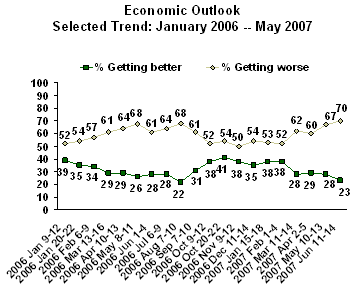
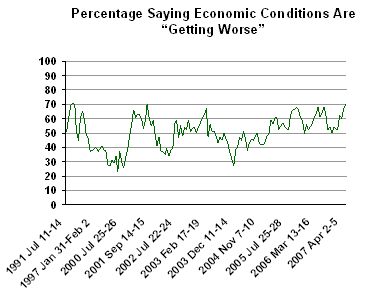
70 percent:
Number of Americans who believe that the economy is getting worse, according to a new Gallup poll, “the most negative reading in nearly six years.”


...The last time Americans held such negative views was in early September 2001, just before the terrorist attacks on Sept. 11...
So will Iraq be Blair's epitaph?
By Nick Assinder
Political correspondent, BBC News website
...What he had always done - and this is what it may all boil down to in the end, he once again suggested - was what he believed was the right thing...
there was that single word that has hung over everything Mr Blair has done or tried to do since 2003.
It was, perhaps unsurprisingly, Tory MP Edward Leigh who gave the most brutal assessment of exactly what Iraq had meant for the prime minister who, he confessed, had been "brilliant" in some areas of his leadership.
Only that one word would be written on Tony Blair's political tombstone, and the prime minister was in denial about it, he suggested.
Did he never allow a smidgeon of doubt to cross his mind that it may have been a mistake, was he ever haunted by the dead or was he too full of self belief to allow any of that, asked Mr Leigh.
Clearly stung, the prime minister said, of course he felt the weight of the responsibility, he was a human being. But he had done what he believed was the right thing.
Then he delivered what has been his default defence of that war.
It is rubbish to suggest the ordinary Arab did not want the democracy they had been given.
"Of course they want it. What country has ever chosen not to be a democracy, it's just nonsense, it's what oppressive people do to justify their oppression, they say democracy and freedom are western values. It's just rubbish, they're universal values of the human spirit and they always will be," he said...
... Tony Blair is expected to join one of the most exclusive groups of businessmen in the world after he leaves Downing Street.
The PM is being lined up for a highly lucrative position with the Carlyle Group - an American-based investment giant with strong links to the White House and the defense industry.
The firm has been nicknamed "The Ex-Presidents Club" because it has had a host of former world leaders on its books including George Bush Senior, his former secretary of state James Baker and former British PM John Major. There a also a large number of former US Army top brass.
Mr. Blair has been keeping quiet about his plans after his departure from Number 10...
But sources in the City have revealed that he is "seriously considering" a high-profile role with Carlyle - which manages $30billion (£20billion) of investments worldwide.
The job could net Mr. Blair up to £500,000 a year for only a few days work a month giving speeches and making "networking" trips on behalf of the company.

In 2006 Democratic pols raced around their little fiefdoms or would-be fiefdoms pulling the updated equivalent of the president's rhetorical 9/11-Saddam scam. Just as he never explicitly linked the two, they never quite said, if installed in the majority, they would end this farce of a war in Iraq. But they implied it. They dangled "change" and "new directions" and all manner of muscular confrontations with the executive warmonger.
Then they surprised themselves by winning, which only complicated things. Oh Jesus, what now? They had the wolf by the ears, yet no better idea of what to do then when they were merely promising -- well, sort of promising -- they would do something.
So they proceeded to do what all majoritarian charlatans do when the governmental going gets tough: they engaged battle with resolutions and non-binding pronunciamentoes and blustered and bluffed. They made much noise, accompanied by some merriment and hope in the land. There was an uptick in Congress' approval rating.
Then they broke off from battle, pleading there really wasn't much they could do. They had read the legislative rules and U.S. Constitution, it seems, and discovered a slim majority was no better, really, than a sizable minority, and that the president had this thing called veto power. They would have to back-burner the war issue and move on to domestic matters. So as reported yesterday, "It has been nearly three weeks since Democrats have held a formal Iraq debate or voted on an Iraq proposal in the House or Senate. Not since they assumed the majority in January has there been such a lull."
And lordy lord guess what? "During the three weeks, Congressional approval ratings have fallen." So now they're back, full of bombast again, and this time going whole hog with ... nasty letters. "The American people cannot and should not have to wait until later this year for changes in your flawed Iraq policy," wrote the speaker and Senate majority leader to the president with an insincerity that staggers.
But that bluster is only the half of it. Let's consider their intervening bluster -- that of pausing all that problematic war stuff so they could roll up their sleeves and advance much-needed domestic legislation.
Really? Damn, guys, that's a helluva trick. Somehow, suddenly and miraculously, the presidential veto no longer applied? Somehow a slim majority was now more powerful against a reactionary minority than it was yesterday? Somehow progressive domestic legislation was doable, although antiwar legislation wasn't?
And let us not forget that as long as this country spends two-billion dollars a week on someone else's civil war, any domestic advances, no matter how politically attractive, are simply, absolutely, undeniably unaffordable. The circus barkers know that, meaning they knew their domestic diversion was as impotent as their antiwar bluster.
For six months the "progressive community" has been scammed, fleeced and insulted by the "progressive" powers that be. At least the halfwitted Republican Congress first presented itself to voters in all its halfwitted glory, and, true to its word, proceeded to advance halfwitted domestic legislation and halfwitted wars. Republican pols may have hoodwinked and bamboozled voters as to the wisdom of their priorities, but they said what they were going to do and they did it.
The Republican Congress proved the power of democratic stupidity. The Democratic Congress is merely proving the impotence of democratic fraud...
...Trent Lott said yesterday, “talk radio is running America." Well, it may not be running America, but it is competing with the big money boyz to run the Republican party and having some success. The big money boyz are coming to regret the monster they created...
...Trent Lott is railing at the out of control rightwing talk radio hosts and Timmeh himself said this on Tucker yesterday:
RUSSERT: Traditionally, Hispanic voters in the 50s and 60s, smaller number obviously, were Republican. Strong family values. Now it`s trending more and more Democratic. The new registrants are overwhelmingly Democratic. And what the political advisers of the president are saying, we cannot afford to have another block like African-Americans, and Hispanic Americans. If we have Hispanics and blacks voting ten to one Democratic, we are in trouble.

Iran Strategy Stirs Debate at White House
By HELENE COOPER and DAVID E. SANGER
Published: June 16, 2007
WASHINGTON, June 15 — A year after President Bush and Secretary of State Condoleezza Rice announced a new strategy toward Iran, a behind-the-scenes debate has broken out within the administration over whether the approach has any hope of reining in Iran’s nuclear program, according to senior administration officials.
The debate has pitted Ms. Rice and her deputies, who appear to be winning so far, against the few remaining hawks inside the administration, especially those in Vice President Dick Cheney’s office who, according to some people familiar with the discussions, are pressing for greater consideration of military strikes against Iranian nuclear facilities.
In the year since Ms. Rice announced the new strategy for the United States to join forces with Europe, Russia and China to press Iran to suspend its uranium enrichment activities, Iran has installed more than a thousand centrifuges to enrich uranium. The International Atomic Energy Agency predicts that 8,000 or so could be spinning by the end of the year, if Iran surmounts its technical problems.
Those hard numbers are at the core of the debate within the administration over whether Mr. Bush should warn Iran’s leaders that he will not allow them to get beyond some yet-undefined milestones, leaving the implication that a military strike on the country’s facilities is still an option.
Even beyond its nuclear program, Iran is emerging as an increasing source of trouble for the Bush administration by inflaming the insurgencies in Iraq, Afghanistan, Lebanon and in Gaza, where it has provided military and financial support to the militant Islamic group Hamas, which now controls the Gaza Strip.
Even so, friends and associates of Ms. Rice who have talked with her recently say she has increasingly moved toward the European position that the diplomatic path she has laid out is the only real option for Mr. Bush, even though it has so far failed to deter Iran from enriching uranium, and that a military strike would be disastrous...
* The IAEA has condemned the US over a report written by a congressional committee on the nuclear situation in Iran. The leaked report was called erroneous and misleading in a letter sent to Peter Hoekstra. Allegations in the report of why an inspector was dismissed were branded outrageous and dishonest. One unnamed western diplomat called it deja vu of the false reports made by the US administration to justify the invasion of Iraq.
* IAEA officials complain that most U.S. intelligence shared with the U.N. nuclear watchdog agency about Iran's nuclear programme proved to be inaccurate, and none has led to significant discoveries inside Iran.
* On 10 May 2007, Agence France-Presse, quoting un-named diplomats, reported that Iran had blocked IAEA inspectors when they sought access to the Iran's enrichment facility. Both Iran and the IAEA vehemently denied the report. On 11 March, 2007, Reuters quoted International Atomic Energy Agency spokesman Marc Vidricaire, "We have not been denied access at any time, including in the past few weeks. Normally we do not comment on such reports but this time we felt we had to clarify the matter...If we had a problem like that we would have to report to the (35-nation IAEA governing) board ... That has not happened because this alleged event did not take place."


...The accounts were provided by officials at the State Department, White House and the Pentagon who are on both sides of the debate, as well as people who have spoken with members of Mr. Cheney’s staff and with Ms. Rice. The officials said they were willing to explain the thinking behind their positions, but would do so only on condition of anonymity...
... The issue was raised at a closed-door White House meeting recently when the departing deputy national security adviser, J. D. Crouch, told senior officials that President Bush needed an assessment of how the stalemate over Iran’s nuclear program was likely to play out over the next 18 months, said officials briefed on the meeting.
In response, R. Nicholas Burns, an under secretary of state who is the chief American strategist on Iran, told the group that negotiations with Tehran could still be going on when Mr. Bush leaves office in January 2009. The hawks in the room reported later that they were deeply unhappy — but not surprised — by Mr. Burns’s assessment, which they interpreted as a tacit acknowledgment that the Bush administration had no “red line” beyond which Iran would not be permitted to step.
But conservatives inside the administration have continued in private to press for a tougher line, making arguments that their allies outside government are voicing publicly. “Regime change or the use of force are the only available options to prevent Iran from getting a nuclear weapons capability, if they want it,” said John R. Bolton, the former United States ambassador to the United Nations.
Only a few weeks ago, one of Mr. Cheney’s top aides, David Wurmser, told conservative research groups and consulting firms in Washington that Mr. Cheney believed that Ms. Rice’s diplomatic strategy was failing, and that by next spring Mr. Bush might have to decide whether to take military action.
The vice president’s office has declined to talk about Mr. Wurmser’s statements, and says Mr. Cheney is fully on board with the president’s strategy...
...In a June 1 article for Commentary magazine, the neoconservative editor Norman Podhoretz laid out what a headline described as “The Case for Bombing Iran.”
“In short, the plain and brutal truth is that if Iran is to be prevented from developing a nuclear arsenal, there is no alternative to the actual use of military force — any more than there was an alternative to force if Hitler was to be stopped in 1938,” Mr. Podhoretz wrote.
...Iran is far behind the North Koreans; it is believed to be three to eight years away from its first weapon, American intelligence officials have told Congress. Conservatives argue that if the administration fails to establish a line over which Iran must not step, the enrichment of uranium will go ahead, eventually giving the Iranians fuel that, with additional enrichment out of the sight of inspectors, it could use for weapons.
To date, however, the administration has been hesitant about saying that it will not permit Iran to produce more than a given amount of fuel, out of concern that Iran’s hard-liners would simply see that figure as a goal.
In the year since the United States made its last offer to Iran, the Iranians have gone from having a few dozen centrifuges in operation to building a facility that at last count, a month ago, had more than 1,300...


Sixteen gallons of oil. That's how much the average American soldier in Iraq and Afghanistan consumes on a daily basis -- either directly, through the use of Humvees, tanks, trucks, and helicopters, or indirectly, by calling in air strikes. Multiply this figure by 162,000 soldiers in Iraq, 24,000 in Afghanistan, and 30,000 in the surrounding region (including sailors aboard U.S. warships in the Persian Gulf) and you arrive at approximately 3.5 million gallons of oil: the daily petroleum tab for U.S. combat operations in the Middle East war zone.
Multiply that daily tab by 365 and you get 1.3 billion gallons: the estimated annual oil expenditure for U.S. combat operations in Southwest Asia. That's greater than the total annual oil usage of Bangladesh, population 150 million -- and yet it's a gross underestimate of the Pentagon's wartime consumption.
Such numbers cannot do full justice to the extraordinary gas-guzzling expense of the wars in Iraq and Afghanistan. After all, for every soldier stationed "in theater," there are two more in transit, in training, or otherwise in line for eventual deployment to the war zone -- soldiers who also consume enormous amounts of oil, even if less than their compatriots overseas. Moreover, to sustain an "expeditionary" army located halfway around the world, the Department of Defense must move millions of tons of arms, ammunition, food, fuel, and equipment every year by plane or ship, consuming additional tanker-loads of petroleum. Add this to the tally and the Pentagon's war-related oil budget jumps appreciably, though exactly how much we have no real way of knowing.
And foreign wars, sad to say, account for but a small fraction of the Pentagon's total petroleum consumption. Possessing the world's largest fleet of modern aircraft, helicopters, ships, tanks, armored vehicles, and support systems -- virtually all powered by oil -- the Department of Defense (DoD) is, in fact, the world's leading consumer of petroleum. It can be difficult to obtain precise details on the DoD's daily oil hit, but an April 2007 report by a defense contractor, LMI Government Consulting, suggests that the Pentagon might consume as much as 340,000 barrels (14 million gallons) every day. This is greater than the total national consumption of Sweden or Switzerland...
...To ensure itself a "reliable" source of oil in perpetuity, the Pentagon will increase its efforts to maintain control over foreign sources of supply, notably oil fields and refineries in the Persian Gulf region, especially in Iraq, Kuwait, Qatar, Saudi Arabia, and the United Arab Emirates. This would help explain the recent talk of U.S. plans to retain "enduring" bases in Iraq, along with its already impressive and elaborate basing infrastructure in these other countries.
The U.S. military first began procuring petroleum products from Persian Gulf suppliers to sustain combat operations in the Middle East and Asia during World War II, and has been doing so ever since. It was, in part, to protect this vital source of petroleum for military purposes that, in 1945, President Roosevelt first proposed the deployment of an American military presence in the Persian Gulf region. Later, the protection of Persian Gulf oil became more important for the economic well-being of the United States, as articulated in President Jimmy Carter's "Carter Doctrine" speech of January 23, 1980 as well as in President George H. W. Bush's August 1990 decision to stop Saddam Hussein's invasion of Kuwait, which led to the first Gulf War -- and, many would argue, the decision of the younger Bush to invade Iraq over a decade later.
Along the way, the American military has been transformed into a "global oil-protection service" for the benefit of U.S. corporations and consumers, fighting overseas battles and establishing its bases to ensure that we get our daily fuel fix. It would be both sad and ironic, if the military now began fighting wars mainly so that it could be guaranteed the fuel to run its own planes, ships, and tanks -- consuming hundreds of billions of dollars a year that could instead be spent on the development of petroleum alternatives.

When will Democratic leaders stop dissing their base? David Obey is making a habit of it.
Earlier this year, the Wisconsin veteran, who heads up the House Appropriations Committee called anti-war workers, “idiot liberals” for calling for a cut off in funds for Bush’s Iraq disaster. This week, Obey told advocates for youth to grow up and stop complaining about the millions of dollars his committee intends to shovel to deadly, discredited abstinence-only programs.
House Democrats will likely vote today to increase abstinence-only miseducation programs to $140 million, a larger increase than any put forward in the last three years of the Republican Congress. Obey told NPR it’s all about pragmatism: the Appropriations Bill faces a veto threat from the President, and House Democrats need all the support they can get from Republicans. And there are quid pro quos: to secure a proposed $27 million increase for the family planning program Title X anti-choicers need to be bought off with $27 million for deadly abstinence.
“It’s about people acting like adults and realizing that you can’t just hold your breath until you get your own way,” Obey told Morning Edition June 14th.
But that $27 million increase represents just a ten percent growth in the budget for Title X; it’s a 30 percent increase for abstinence only. Besides, most sane Americans were expecting the purportedly pro-choice Democratic majority to cut off funding for this boondoggle not increase it.
Anyone who read Michael Reynolds’ excellent piece on the Abstinence Gluttons knows the myriad ways in which these censorship programs stink. As a congressionally mandated report recently concluded, they’re bad health policy, bad fiscal policy, and should be ended. As Reynolds’ documented in depth, federal funding of “abstinence” also gifts billions of dollars to GOP partisans who not only mess with young minds but also campaign against Democrats and progressive priorities.
As James Wagoner, president of Advocates for Youth told the Air Americans last week, the GOP gravy train was bad enough. “Now it’s switched tracks and became a Democratic train. Obey can now stand tall and say that he is now one of the biggest funders of the Radical Right in America.”
It’d be bad enough if it were just Obey, but progressive caucus members including Nita Lowey and Barbara Lee who sit on both the Appropriations and the Health and Human Services subcommittee (also chaired by Obey) that put forward this proposal are complicit. Democrats enjoy a 37:29 majority on Appropriations. What they push moves. The battle goes to the Senate next, where the 15:14 split on appropriations is much tighter. Speaking of senators, Hillary Clinton is talking up a storm on the campaign trail about her support for Title X. So far she’s remained mum about millions more for sex-miseducation.
“We are not your pawns,” youth activists told House Democrats on the eve of the Committee’s vote. Wagoner has some glum young progressive organizers in his office to explain the Democratic majority to. Said Wagoner “as an activist you expect to fight this in a conservative republican congress, but I can’t tell you how infuriated, how angry I feel, having witnessed Democratic allies sell us out.”
Thus Wagoner and his team join the anti-war activists. Bravo Democrats you’re swelling the ranks of pissed-off, enraged, “liberal idiots.”


WASHINGTON, June 14 — Senate leaders announced an agreement this evening to put a comprehensive immigration bill back on track for further debate and possible passage.
Senators Harry Reid, the Democratic majority leader from Nevada, and Mitch McConnell, the Republican minority leader from Kentucky, agreed on a timetable for the bill and for a limited number of amendments to be offered.
The agreement, coming after President Bush’s pledge earlier today to provide $4.4 billion for border security, revives a bill that had stalled in the Senate and was all but given up for dead...
The measure would tighten border security, put many of the 12 million or so illegal immigrants in the country on a path to eventual legal status and create a guest-worker program.
The additional money for border security is intended to assuage Republicans who have strongly criticized the plan as amnesty for illegal immigrants...
And their bad ideas get back up and walk- or run- again lots faster.

was totally unrelated to the arms we've given Sunni groups to fight Al Qaeda!
(if a somewhat hungover one after his latest liason with the Iron Frau)....The official explanation for why Pace would not be asked to serve another term were patently ridiculous. Here is how Defense Secretary Robert Gates explained the move to replace Pace with Admiral Michael Mullen:[not- Bu$hCo won that one today], and has sent that very same Alberto Gonzales to Capitol Hill to testify under these brutal conditions. So, can anyone believe they really care about a few tough questions for Peter Pace?
``I think that the events of the last several months have simply created an environment in which I think there would be a confirmation process that would not be in the best interests of the country,'' Gates said. ``I wish it were not necessary to make a decision like this. But I think it's a realistic appraisal of where we are.''
This is an administration that is currently holding onto an attorney generalwho just received a "no confidence" vote from a majority of the U.S. Senate, including six Republicans
...As the Bork case led inexorably to the Clinton impeachment, so can the case before the Court profoundly criminalize and poison the country's political process with calls for retribution on the part of many who will never believe--never--that Scooter merits criminal punishment or, God forbid, incarceration...
This is one of my favorite right wing gambits: threatening to pitch such a sustained and over-the-top partisan tantrum that the whole country will regret not letting them have their way. For instance, this was the subtext of the Florida recount.
"You thought impeachment was bad... if Al Gore moves into Bush's house we will make his life --- and the country's --- so miserable they will rue the day he took the oath of office. We will never --- never --- accept that Gore won this election. Make it easy on yourselves, people. Do the smart thing. Let the Republicans have their way."
...The media, of course, fed into this with all their hand wringing about how we needed to hurry up and decide because "god knows what will happen if we don't." Of course, we knew exactly what would happen: the right wing would have an epic fit that made the Clinton years look like utopia. I think for a lot of people it was a sense of relief that the Republicans would finally be appeased, (which is, of course, impossible.) Certainly, the punditocrisy sold that idea but instead of presenting it honestly, they wrote columns about how Bush was the right choice because he was a uniter not a divider, forgetting to mention that he and his cronies were the ones who created the divisions in the first place and threatened to deepen them if they didn't get their way.
You can see why Democrats are gunshy with these people. They are thugs, as Horowitz's letter, in surprisingly crude fashion, illustrates. (No wonder they didn't want them made public.) They are saying straight-up that if Scooter has to go to jail they are going to the mattresses...
...It's interesting that when they are called out on anything they have a long memory and seethe with a desire for revenge. There is no attempt at self-evaluation no examining the acts that got them into trouble.
Part of this may come from a feeling of entitlement and part may come from contempt for process.
There is, I've felt for YEARS, among Republicans, especially those from a business background, that their ends are all that count and any opposition to those ends are to be crushed at the earliest possible opportunity.
The nation, the Constitution, American tradition is of no use to them if any of these are a perceived hindrance to their ends.
The tactic they've developed in recent years is that lacking ALL power they'll use whatever they have to insure that the opposition fails. Whether that harms the interest of the nation is of no interest to them. The frivolous use of impeachment of Clinton was, arguably, their most heinous act, the trivialization of impeachment.
I believe that there are some conscientious Democrats who don't want to impeach Bush simply because they don't want impeachment to become a FEATURE of government. The functional crippling of the nation if the Congress is controlled by one party and the White House by the other.
The power of impeachment is supposed to be used to get rid of office holders whose acts are an egregious misuse of power, necessary to keep the executive branch in check. When Republicans impeached Clinton they, in affect, took impeachment off the table and out of the Constitution as a check against an out of control executive.
The Republicans have adopted Leninist tactics and given our irresponsible media and a lax public, I see no way to reverse this dangerous republic destroying trend.
Within hours of the Senate vote to kill its comprehensive immigration reform bill, the lobbyist for software giant Oracle Corporation had already declared that Silicon Valley's proposal for more guest workers was still alive. "We don't think it's dead," Robert Hoffman told the San Francisco Chronicle. Microsoft Corporation CEO Steve Ballmer threatened to move more high-tech jobs out of the country if electronics corporations didn't get more contract migrant labor. Other corporate spokespeople also announced they were looking for ways to revive the Senate bill in which they'd invested so much political capital.
Immigrant communities and union activists had been in the streets for months, trying to stop the same bill. In San Francisco alone, seven were arrested in the office of Sen. Diane Feinstein (D-California) during the recess that preceded the June 7 vote. Dozens more debated the senator in front of her home the morning after the arrests. Around the country, similar demonstrations did what they could to kill the bill. The National Day Labor Organizing Network called it a "cynical and mean-spirited effort of those senators that seek to poison the immigration reform debate yet again," and warned, "we are fearful that an insufficient Senate bill cannot be adequately repaired in the House of Representatives or in a conference session."
It was no surprise that many greeted the (perhaps temporary) death of comprehensive immigration reform as a necessary move to protect immigrants themselves. These groups saw in the bill a threat of more contract labor programs, more enforcement and raids, greater militarization of the border and erosion of basic due-process rights. Filipinos for Affirmative Action, voicing a criticism common in Asian American and Latino communities, said the bill "moved away from permanent, family-based immigration toward a temporary employment system."
As debate in the Senate proceeded, even the bill's promise of legalization for the nation's 12 million undocumented residents proved so restrictive that only a small percentage eventually would have qualified. Migrants without status would have had to place their families in jeopardy just to apply.
After the vote in the Senate defeating cloture, killing the bill at least for the moment, John Sweeney, head of the AFL-CIO, declared it "plagued by anti-family, anti-worker provisions," and called it " doomed at the onset. The bill abandoned long-standing US policy favoring the reunification of families and failed to protect workers' most basic rights."
Despite the fact that the bill was brokered by the Bush administration, many of its proponents were not Republicans, but liberal Democrats, most prominently Sen. Edward Kennedy (D-Massachusetts). Supporting it was a network of lobbyists referred to in the press as "immigration advocates," large employers, and conservative think tanks. For two years this alliance advocated a strategy of trading legalization of undocumented immigrants for increased immigration enforcement and guest-worker programs. The National Immigration Forum and the DC umbrella group it initiated, the Coalition for Comprehensive Immigration Reform, were key players in this strategy. Behind them was the Essential Worker Immigration Coalition, which brought together over 40 of the largest corporate trade and manufacturing associations in the country, under the aegis of the US Chamber of Commerce. EWIC head John Gay, also head of the National Restaurant Association, chairs the NIF board.
These Washington groups supported all the compromise bills embodying the legalization/enforcement/guest-worker tradeoff, beginning with the original Kennedy/McCain bill in 2005. The same argument was used to justify them all: "It's not possible to get legalization without including more enforcement and guest-worker programs." While the groups occasionally disagreed with individual provisions of the proposals that followed, they not only agreed with the basic structure and architecture of these bills, but became their ardent advocates in meetings around the country.
As the proposals moved through negotiations with the administration and Congressional Republicans, legalization schemes became more restrictive, enforcement provisions more ferocious, and contract labor schemes more extensive. Yet, the recently defeated Senate compromise was greeted as a "good starting point." Even at the end, the DC groups called on immigrant communities to urge defeat of "bad" amendments to it, while continuing to urge senators to support the comprehensive immigration reform, or tradeoff, framework.
While Congress considered this series of proposals, the Bush administration embarked on a series of highly publicized immigration raids and workplace firings, to put pressure on immigrant communities and unions to accept its reform program. The bills themselves called for giving the Immigration and Customs Enforcement agency, part of the Department of Homeland Security, more enforcement authority to conduct these raids. The administration, for instance, proposed that employers be required to fire any worker whose Social Security number didn't match the agency's database. Although Bush never actually issued this regulation, and the bills obviously hadn't passed, ICE and employers began using it as the basis for enforcement actions...

BAGHDAD -- U.S. military officials here are increasingly envisioning a "post-occupation" troop presence in Iraq that neither maintains current levels nor leads to a complete pullout, but aims for a smaller, longer-term force that would remain in the country for years...
Such a long-term presence would have four major components. The centerpiece would be a reinforced mechanized infantry division of around 20,000 soldiers assigned to guarantee the security of the Iraqi government and to assist Iraqi forces or their U.S. advisers if they get into fights they can't handle.
Second, a training and advisory force of close to 10,000 troops would work with Iraqi military and police units. "I think it would be very helpful to have a force here for a period of time to continue to help the Iraqis train and continue to build their capabilities," Odierno said.
In addition, officials envision a small but significant Special Operations unit focused on fighting the Sunni insurgent group al-Qaeda in Iraq. "I think you'll retain a very robust counterterror capability in this country for a long, long time," a Pentagon official in Iraq said.
Finally, the headquarters and logistical elements to command and supply such a force would total more than 10,000 troops, plus some civilian contractors.
The thinking behind this "post-occupation" force, as one official called it, echoes the core conclusion of a Joint Chiefs of Staff planning group that last fall secretly considered three possible courses in Iraq, which it categorized as "go big," "go home" and "go long." The group's recommendation to reshape the U.S. presence in order to "go long" -- to remain in Iraq for years with a smaller force -- appears to carry weight in Baghdad, where some of the colonels who led that planning group have been working for Army Gen. David H. Petraeus, the top U.S. commander in Iraq since February...
U.S. officials also calculate that underneath the anti-American rhetoric, even Shiite radicals such as cleric Moqtada al-Sadr don't really want to see a total U.S. pullout, especially while they feel threatened by Sunni insurgents. Also, officials think any Iraqi government will prefer to keep a small U.S. combat force to deter foreign intervention.
, could it?

Appropriately famous for its broad ring of obscuring dust and hat-like appearance, the Sombrero Galaxy (aka spiral galaxy M104) is featured in this unique composite view that spans the electromagnetic spectrum, from three major space-based observatories. Exploring the Sombrero's high-energy x-ray emission (blue), the Chandra contribution highlights the pervasive, tenuous, hot gas that extends some 60,000 light-years from the galaxy's center. Hubble's optical view (green) shows the more familiar emission from the Sombrero's population of stars, seen from a nearly edge-on perspective and noticeably bulging at the galaxy's bright core. The broad ring of dust that blocks light in other bands, glows in the infrared contribution (red) from the Spitzer Space Telescope. The Sombrero Galaxy is about 28 million light-years away, near the southern edge of the extensive Virgo cluster of galaxies.


If you’ve recently flipped to Lou Dobbs on CNN or opened the pages of a liberal political journal like The American Prospect, you might have the impression that America in the Bush years has slipped into a kind of Dickensian darkness, a period of unbridled greed and economic deprivation on a scale not seen in this country since the Great Depression. Like so many things in politics, this has some basis in truth, but only some. To compare Bush’s America with Herbert Hoover’s — or Lyndon Johnson’s, for that matter — is to engage in not very helpful hyperbole...

From Nancy Pelosi, who should know better, for heaven's sakes:
“Science is a gift of God to all of us and science has taken us to a place that is biblical in its power to cure,” said Speaker Nancy Pelosi, Democrat of California, arguing for the bill’s passage. “And that is the embryonic stem cell research.”
One: This is a gratuitous insult to all thinking persons. Science is a process of inquiry that has enabled us to understand something about the nature of physical reality in a detailed fashion. It has taken centuries of hard, meticulous, and often backbreaking work to acquire this knowledge; the history of science is filled with failure, frustration, and fragmentary, provisional understandings. The relatively rare breakthroughs - Newton's laws, Darwin's natural selection, Einstein's theory of relativity - are achieved only through enormous effort, not miracles. This is no gift from God but a quintessentially human endeavor.
Secondly, the kind of pandering, meaningless bullshit Pelosi mouthed will convince no one. But it does make clear how little a leading Democrat understands religious tropes in a modern political context. The rightwing retort is obvious: "God nowhere demands the sacrifice of human children for research. That's the ethics of Mengele, not Jesus." And from there, the "conversation" devolves quickly into idiotic arguments about when a fertilized egg becomes a human life. And the importance of the research, its potential benefits that are needed now, are forgotten.
Pelosi's breathtakingly stupid comment merely indicates how far behind, still, Democrats are in developing a modern political rhetoric for their values and ideas...


Auto Chiefs Make Headway Against a Mileage Increase
WASHINGTON, June 6 — Automobile companies seem to be making progress in tamping down Democratic proposals for tougher fuel economy requirements, an issue that pits powerful Democrats from Michigan against some national leaders of their own party.
The chief executives of General Motors, Ford and Chrysler had lunch with Senate Democrats on Wednesday, less than a week before the Democratic leaders hope to bring a sprawling energy bill to the Senate floor.
The executives argued that the bill’s proposal to increase mileage requirements for cars and light trucks would be impossible to meet and would gravely damage the automobile industry.
It would increase the average mileage requirement for passenger cars to 35 miles a gallon by 2020, up from 27.5 miles a gallon now, and would apply to light trucks and sport utility vehicles as well...
"Do I really have the right to complain about torture or extra-legal detentions in China when we Americans do the same in Guantánamo Bay, Cuba?
"The moment we did feel a threat, after 9/11, we held people without trial, and beatings were widespread enough that more than 110 of our prisoners died in custody in places like Abu Ghraib, Bagram and Guantánamo."
There’s nothing partisan in what Kristof wrote. He is a connoisseur of the obvious,but it needs being said over and over again: the current administration has authorized, condoned, and promoted torture. Torture is now officially sanctioned policy of the United States. Heckuva job Bushie, Cheney, Gonzales, and your enablers in the government (Dems included) and the media.
Thanks for calling bullshit, Nick. Keep it up.

[The Democratic] Congress is more unpopular among Democrats than Republicans.

BAE accused of secretly paying £1bn to Saudi prince
· Money for 'marketing services' on arms deal
· £30m payments a quarter
· Sanctioned by MoD
David Leigh and Rob Evans
Thursday June 7, 2007
The Guardian
The arms company BAE secretly paid Prince Bandar of Saudi Arabia more than £1bn in connection with Britain's biggest ever weapons contract, it is alleged today.
A series of payments from the British firm was allegedly channelled through a US bank in Washington to an account controlled by one of the most colourful members of the Saudi ruling clan, who spent 20 years as their ambassador in the US.
It is claimed that payments of £30m were paid to Prince Bandar every quarter for at least 10 years.
It is alleged by insider legal sources that the money was paid to Prince Bandar with the knowledge and authorisation of Ministry of Defence officials under the Blair government and its predecessors. For more than 20 years, ministers have claimed they knew nothing of secret commissions, which were outlawed by Britain in 2002.
An inquiry by the Serious Fraud Office (SFO) into the transactions behind the £43bn Al-Yamamah arms deal, which was signed in 1985, is understood to have uncovered details of the payments to Prince Bandar. But the investigation was halted last December by the SFO after a review by the attorney general, Lord Goldsmith. He said it was in Britain's national interest to halt the investigation, and that there was little prospect of achieving convictions. Tony Blair said he took "full responsibility" for the decision.
However, according to those familiar with the discussions at the time, Lord Goldsmith had warned colleagues that British "government complicity" was in danger of being revealed unless the SFO's corruption inquiries were stopped.
The abandonment of the investigation provoked an outcry from anti-corruption campaigners, and led to the world's official bribery watchdog, the OECD, launching its own investigation.
The fresh allegations may also cause BAE problems in America, where corrupt payments to foreign politicians have been outlawed since 1977.
The allegations of payments to Prince Bandar is bound to ignite fresh controversy over the original deal and the aborted SFO investigation.
The Saudi diplomat is known to have played a key role with Mrs Thatcher in setting up Britain's biggest ever series of weapons deals.
For more than 20 years Al-Yamamah, Arabic for "dove", has involved the sale of 120 Tornado aircraft, Hawk warplanes and other military equipment. According to legal sources familiar with the records, BAE Systems made cash transfers to Prince Bandar every three months for 10 years or more. BAE drew the money from a confidential account held at the Bank of England that had been set up to facilitate the Al-Yamamah deal. Up to £2bn a year was deposited in the accounts as part of a complex arrangement allowing Saudi oil to be sold in return for shipments of Tornado aircraft and other arms.
Both BAE and the government's arms sales department, the Defence Export Services Organisation (Deso), allegedly had drawing rights on the funds, which were held in a special Ministry of Defence account run by the government banker, the paymaster general.
Those close to Deso say regular payments were drawn down by BAE and despatched to Prince Bandar's account at Riggs bank in Washington DC...

...When Keynes returned from Versailles in 1919 he wrote an attack on the treaty that ended the first world war. In The Economic Consequences of the Peace he warned that punishing Germany and demanding crippling reparations would jeopardise Europe's stability and the building of German democracy. He confronted politicians, on both sides of the Atlantic, puffed up with the vanity of victory and convinced that the German menace had been laid to rest. He was right and they were wrong.
For the past six years Washington's whirling dervishes have reduced Anglo-American foreign policy to a frenzy of bullying hatred of anyone to whom they take a dislike. One half of this neoconservative agenda is heading for the rocks, American dominance in the Middle East following a stunning victory over a Muslim state. But the other half is alive and well, pushing ahead with the missile defence system bequeathed by the Reagan administration.
This so-called star wars is militarily unproven and, with the end of the cold war, of no apparent urgency. But it is astronomically expensive and, as such, has powerful support within America's industry-led defence community. When Dick Cheney was finding George Bush a defence secretary in 2000, Donald Rumsfeld's chief qualification was his enthusiasm for space-based defence. Hence America's 2002 renunciation of the anti-ballistic missile treaty. Hence the installation of defence systems in Poland and the Czech Republic, in defiance of what was promised to Russia at the end of the cold war. Hence Rumsfeld's frequent jibes against old Europe in favour of "new".
Vladimir Putin's reactive threat this week to retarget his missiles at west Europe was reckless and stupid. Just when nuclear disarmament is again a live issue and his old enemy, Nato, faces defeat in Afghanistan, he tossed red meat to the Pentagon (and Whitehall) hawks. He strengthened the case for a new British Trident and encouraged an arms race that he knows his own country can ill afford, just as it can ill afford to send Europe frantically seeking alternative energy supplies...
The issue's the Game, and the fortunes to be made or lost by people like Secretary Supertanker who play it.
...You look at him and you can’t help thinking how bizarre it is that this particular political figure, perhaps the most qualified person in the country to be president, is sitting in a wing chair in a hotel room in Manhattan rather than in the White House.
He’s pushing his book “The Assault on Reason.” I find myself speculating on what might have been if the man who got the most votes in 2000 had actually become president. It’s like imagining an alternate universe.
The war in Iraq would never have occurred. Support and respect for the U.S. around the globe would not have plummeted to levels that are both embarrassing and dangerous. The surpluses of the Clinton years would not have been squandered like casino chips in the hands of a compulsive gambler on a monumental losing streak.
Mr. Gore takes a blowtorch to the Bush administration in his book. He argues that the free and open democratic processes that have made the United States such a special place have been undermined by the administration’s cynicism and excessive secrecy, and by its shameless and relentless exploitation of the public’s fear of terror.
The Bush crowd, he said, has jettisoned logic, reason and reflective thought in favor of wishful thinking in the service of an extreme political ideology. It has turned its back on reality, with tragic results.
So where does that leave Mr. Gore? If the republic is in such deep trouble and the former vice president knows what to do about it, why doesn’t he have an obligation to run for president? I asked him if he didn’t owe that to his fellow citizens.
If the country needs you, how can you not answer the call?
He seemed taken aback. “Well, I respect the logic behind that question,” he said. “I also am under no illusion that there is any position that even approaches that of president in terms of an inherent ability to affect the course of events.”
But while leaving the door to a possible run carefully ajar, he candidly mentioned a couple of personal reasons why he is disinclined to seek the presidency again.
“You know,” he said, “I don’t really think I’m that good at politics, to tell you the truth.” He smiled. “Some people find out important things about themselves early in life. Others take a long time.”
He burst into a loud laugh as he added, “I think I’m breaking through my denial.”
I noted that he had at least been good enough to attract more votes than George W. Bush.
“Well, there was that,” he said, laughing again. “But what politics has become requires a level of tolerance for triviality and artifice and nonsense that I find I have in short supply.”
...Bush and Cheney and crew have not squandered the people's money, they have stolen it. The worth of Mr. Cheney's Halliburton stocks have gone from under $200,000 to over $8 million. That is quite a coup...
...I would correct Al on one point: the Bushies are not dreamy eyed idealists who acted on an extreme ideology.
They are businessmen, trying to make a buck every which way, and if they have to make nice with the preachers and make up stories about terrorist boogeymen to get money out of wallets, and set Iraqi babies on fire to get money out of Iraqis wallets, they will do so.
They are no more ideologues than Tony Robbins or any other huckster with a late night infomercial.
The Bushies mistake was underestimating American and Iraqi intelligence by a more than a few points.
The difference between Bush and his dad is the difference between a mugger and a con man. Both steal your wallet, but you say thank you to the con man and hope to do business with him again...
There is one point missing: Maybe Vice President Gore would have read and taken serious the memo claiming "Bin Laden determined to strike in the US" and would have saved another 3000 lives...
Gore would've been the best assurance this country could have had that the terrorist threat in the nine months before September 11, 2001 wouldn't have unfolded to the tragedy we ultimately endured at Bush's hand. Given that, he still would've been dogged by endless costly and fruitless investigations, and baseless, trivial accusations from the imbeciles on the right. Regardless of our standing in the world at his hand, regardless of the good he would've done - he would've been hounded and jeered the entire way without cause.
At least.
BERLIN (Reuters) - Russian President Vladimir Putin said on Saturday U.S. plans to install a missile defense system in Europe increased the chances of a nuclear conflict.
Moscow is alarmed by U.S. plans to deploy parts of a global missile defense system in Poland and the Czech Republic and last week it tested a new intercontinental ballistic missile it said could ensure the country's security for the next 40 years.
"The missile shield only creates the theoretical illusion that one is protected, but the possibility that a nuclear conflict is unleashed is actually greater," Putin told Germany's Der Spiegel magazine in an interview to be published on Sunday.
Washington says it wants to avert attacks from "rogue states" such as Iran, which the West suspects of wanting to get an atomic bomb, but Russia sees a threat to its own security...

BEIJING (Reuters) - China has branded a U.S. warning against using its toothpaste as irresponsible, saying low levels of diethylene glycol (DEG) were not harmful.
"So far we have not received any report of death resulting from using the toothpaste. The U.S. handling (of this case) is neither scientific nor responsible," China's General Administration of Quality Supervision, Inspection and Quarantine said in a statement posted on its Web site over the weekend.
"All the toothpaste exported to the United States had been registered by the U.S. Food and Drug Administration for marketing in the States."
The U.S. Food and Drug Administration issued the warning on Friday after toothpaste containing DEG was detected in a shipment seized at the border...

It has been responsible for a number of mass poisonings:
* The most infamous incident was the 1937 Elixir Sulfanilamide disaster in the USA, in which 107 people died after taking sulfanilamide dissolved in diethylene glycol [Calvery HO, Klumpp TG (1939). "The toxicity for human beings of diethylene glycol with sulfanilamide". South Med J 32 (11): 1105-9]. This episode was the impetus for the Federal Food, Drug, and Cosmetic Act of 1938.
One man stops a $475 million Iraq contract.
“A federal judge yesterday ordered the military to temporarily refrain from awarding the largest security contract in Iraq. The order followed an unusual series of events set off when a U.S. Army veteran filed a protest against the government practice of hiring what he calls mercenaries.”
The contract, worth about $475 million, calls for a private company to provide intelligence services to the U.S. Army and security for the Army Corps of Engineers on reconstruction work in Iraq. The case, which is being heard by the U.S. Court of Federal Claims, puts on trial one of the most controversial and least understood aspects of the Iraq war: the outsourcing of military security to an estimated 20,000 armed contractors who operate with little oversight.
Brian X. Scott, a 53-year-old Colorado man, filed the complaint in early April. He argues that the military’s use of private security contractors is “against America’s core values” and violates an 1893 law that prohibits the government from hiring quasi-military forces.
IraqSlogger has more.
Most people have reacted enthusiastically to Al Gore’s new book, “The Assault on Reason.” He seems to have hit a nerve with his assessment of what ails our democracy – the unchecked power of special interests backed by big money, the pervasive influence of mindless and addictive television, and the relentless triumph of image and style over content, which makes us read more articles about John Edwards’ haircuts than about our failing education system. “Gore understands our problems,” as one reviewer put it, “as does no other politician of our time.”
But not everyone shares that view...
Ironically, of course, these reviews actually illustrate Gore’s central point. They cast him as a liberal monster who aims to suppress free speech, or they make fun of his writing, his sighs or his professorial manner, rather than focusing on his arguments. They aim to win with image and rhetoric, not content.
Which is great as entertainment, but not so great for understanding issues that really matter: how and why we’ve slipped from first to sixth in global business competitiveness, why our infant mortality rate ranks down there with Latvia’s, or why the Chinese are graduating more engineers every year than we are.
Surely a good share of the extreme animus against Al Gore comes from the far right, who seem to hate him viscerally, and from powerful business interests with no particular desire for widely ranging debate amongst an informed public. These interests like to paint Gore – and his idea of government that would use rather than abuse knowledge – as the products of some kind of demented science-crazed lunacy bent on shackling the human spirit with equations or computer programs, and luring us into a scientifically planned hell-on-earth.
Unfortunately, this kind of image seems to resonate with other fears that people have about science. And I wonder if this resonance doesn’t explain, at least in part, why Gore has in the past been demonized in this way so effectively.
Implicit in Gore’s argument is the notion that science shouldn’t merely be a source of knowledge about, say, the environment, or the hazards or potential benefits of nuclear energy, and so on, but should also be seen as a source of knowledge about how social systems function — including political systems. Especially important, in his view, is the way the human mind is susceptible to modern techniques of persuasion, based on scientific insights from psychology and neuroscience. Surely we ought to use science not only to manipulate people, but also to bolster our republic and make it function better?
Many people seem to think that science should have boundaries. They’re O.K. if it stays in the familiar realms of physics, chemistry, biology and geology. But there’s an innate distrust when science begins poking around our lives, thoughts and behavior, and near alarm at the idea that science might possibly show that we, like the rest of nature, obey law-like regularities – even if we might learn from them and in so doing help ourselves...
...Bush swore to do "everything in [his] power" to undo the damage wrought by Clinton's two terms in office, including selling off the national parks to developers, going into massive debt to develop expensive and impractical weapons technologies, and passing sweeping budget cuts that drive the mentally ill out of hospitals and onto the street.
During the 40-minute speech, Bush also promised to bring an end to the severe war drought that plagued the nation under Clinton, assuring citizens that the U.S. will engage in at least one Gulf War-level armed conflict in the next four years.
"You better believe we're going to mix it up with somebody at some point during my administration," said Bush, who plans a 250 percent boost in military spending. "Unlike my predecessor, I am fully committed to putting soldiers in battle situations. Otherwise, what is the point of even having a military?"
On the economic side, Bush vowed to bring back economic stagnation by implementing substantial tax cuts, which would lead to a recession, which would necessitate a tax hike, which would lead to a drop in consumer spending, which would lead to layoffs, which would deepen the recession even further...
The speech was met with overwhelming approval from Republican leaders.
"Finally, the horrific misrule of the Democrats has been brought to a close," House Majority Leader Dennis Hastert (R-IL) told reporters. "Under Bush, we can all look forward to military aggression, deregulation of dangerous, greedy industries, and the defunding of vital domestic social-service programs upon which millions depend. Mercifully, we can now say goodbye to the awful nightmare that was Clinton's America."
"For years, I tirelessly preached the message that Clinton must be stopped," conservative talk-radio host Rush Limbaugh said. "And yet, in 1996, the American public failed to heed my urgent warnings, re-electing Clinton despite the fact that the nation was prosperous and at peace under his regime. But now, thank God, that's all done with. Once again, we will enjoy mounting debt, jingoism, nuclear paranoia, mass deficit, and a massive military build-up."
An overwhelming 49.9 percent of Americans responded enthusiastically to the Bush speech.
"After eight years of relatively sane fiscal policy under the Democrats, we have reached a point where, just a few weeks ago, President Clinton said that the national debt could be paid off by as early as 2012," Rahway, NJ, machinist and father of three Bud Crandall said. "That's not the kind of world I want my children to grow up in."
"You have no idea what it's like to be black and enfranchised," said Marlon Hastings, one of thousands of Miami-Dade County residents whose votes were not counted in the 2000 presidential election. "George W. Bush understands the pain of enfranchisement, and ever since Election Day, he has fought tirelessly to make sure it never happens to my people again."
Bush concluded his speech on a note of healing and redemption.
"We as a people must stand united, banding together to tear this nation in two," Bush said. "Much work lies ahead of us: The gap between the rich and the poor may be wide, be there's much more widening left to do. We must squander our nation's hard-won budget surplus on tax breaks for the wealthiest 15 percent. And, on the foreign front, we must find an enemy and defeat it."
"The insanity is over," Bush said. "After a long, dark night of peace and stability, the sun is finally rising again over America. We look forward to a bright new dawn not seen since the glory days of my dad."

Tim Griffin, formerly right hand man to Karl Rove, resigned Thursday as US Attorney for Arkansas hours after BBC Television ‘Newsnight’ reported that Congressman John Conyers requested the network’s evidence on Griffin’s involvement in ‘caging voters.’ Greg Palast, reporting for BBC Newsnight, obtained a series of confidential emails from the 2004 Bush-Cheney campaign. In these emails, Griffin, then the GOP Deputy Communications Director, transmitted so-called ‘caging lists’ of voters to state party leaders.
Experts have concluded the caging lists were designed for a mass challenge of voters’ right to cast ballots. The caging lists were heavily weighted with minority voters including homeless individuals, students and soldiers sent overseas.
Conyers, Chairman of the House Judiciary Committee investigating the firing of US Attorneys, met Thursday evening in New York with Palast. After reviewing key documents, Conyers stated that, despite Griffin’s resignation, “We’re not through with him by any means.”
Conyers indicated to the BBC that he thought it unlikely that Griffin could carry out this massive ‘caging’ operation without the knowledge of White House Deputy Chief of Staff Rove...
"There is only one thing for it then--to learn. Learn why the world wags and what wags it. That is the only thing which the mind can never exhaust, never alienate, never be tortured by, never fear or distrust, and never dream of regretting..."
-T.H. White, The Once and Future King
No Hell below us,
above us only sky...
-John Lennon, Imagine