Nor, in fact, has he or she been caught.
...The 899 deaths in 2007 surpassed the previously highest death toll in 2004, when 850 U.S. soldiers were killed. The total for 2007 could rise slightly; occasionally the military reports new casualties a few days after they occur. The military reported the non-combat related death of a soldier on Sunday...
"Motorists Against Detection, the vigilante anti-speed camera group have announced a summer of MADness which will see them target for destruction all speed cameras in the UK. It’s now going to be a period of zero tolerance against all speed cameras, said their campaigns director Capt Gatso. (((A remote descendant of General Ludd, I reckon.)))
"The group claims speed cameras are just money-making machines and they have given the authorities long enough to prove their worth. The first camera to fall in the summer campaign is in south east London on the A2 at the Sun in the Sands roundabout on-slip heading northbound towards the Blackwall Tunnel.
"Capt Gatso, the group's campaigns director, (((he's a multitalented guy))) said: "We have completely pulled it out of the ground, it is now lying flat. You can see some of our handiwork posted on www.speedcam.co.uk...


...The pathetic organization known as "al Qaeda," in its never-ending quest to be part of everything evil President Bush wants it to be involved in, has declared that it was definitely involved in the assassination, and major news networks are repeating this as gospel. Sooner or later, al Qaeda is going to announce that it was involved in the assassinations of Presidents Lincoln and Kennedy, and we'll finally get some closure on those matters.
Bin Laden Killed Bhutto? How Blind Can We Be?
The shorthand being bandied about in the news that al-Qaeda is responsible for the assassination of Benazir Bhutto is so sloppy, so lacking in nuance or understanding of the dynamics of Pakistan, and so self-centered in its reference to America's enemy as to be almost laughable.
Several U.S. defense and intelligence experts are quoted today dismissing even the possibility that President Pervez Musharraf, Pakistani government forces, or other domestic elements could be involved, a conclusion that flies in the face of the country's history and ignores the obvious beneficiaries.
Retired Marine Gen. Anthony Zinni, commander of U.S. Central Command during the Clinton administration, told The Washington Post that there is "no doubt in my mind" that the murderers are linked to al-Qaeda. In an interview with Time magazine, he elaborated: "[T]hey're the only ones who gain from this.... I really think they're trying to ignite Pakistan into the kind of chaos they need to survive."
Former CIA official and National Security Council staffer Bruce Riedel, now at the Brookings Institution, is spouting the same theory, telling Newsweek that the assassination was "almost certainly the work of Al Qaeda or Al Qaeda's Pakistani allies...Their objective is to destabilize the Pakistani state, to break up the secular political parties, to break up the army so that Pakistan becomes a politically failing state in which the Islamists in time can come to power much as they have in other failing states."
To be sure, al-Qaeda has found sanctuary in Pakistan since its founding in 1988. Key al-Qaeda lieutenants such as Khalid Sheikh Mohammed, the Sept. 11 organizer, have operated from there. Before Sept. 11, Pakistan was a source of recruits and financing and technical support for al-Qaeda. And since Sept. 11, "al Qaeda" has been tied to various attempts to kill President Musharraf and to attacks on Pakistani Army and intelligence facilities - attacks that have increased in frequency and consequence since the central government sought to control the lawless border region. The thinking is that al-Qaeda has been trying to preserve its freedom of operations and to build relations with like-minded affiliates and Pakistani jihadis.
That said, al-Qaeda -- at least the movement led by and associated with Osama bin Laden -- is in terms of power and importance at the bottom of a long list of anti-democratic factions in Pakistan, including malcontents in the active and retired military, renegade intelligence and secret service elements, radical Islamic political parties, extremist Sunni movements, indigenous terrorist organizations and Afghan and Pakistani "Taliban" movements.
To say that "al-Qaeda" is responsible for Bhutto's assassination -- suggesting Osama bin Laden and an external force -- is to ignore all those political and religious factions inside the country that had the motives and resources to kill the former prime minister. Some of those factions in the government, the military or the intelligence services were likely privy to Bhutto's movements, and they could have actively schemed, if not played a direct role, in getting the suicide attacker to the right place at the right time.
Musharraf, of course, will say that he "warned" Bhutto of the dangers. Though, given that Bhutto's father, another former prime minister, was hanged by a military dictatorship and her two brothers were killed under suspicious circumstances, she no doubt already understood the landscape of domestic threats.
Meanwhile, U.S. intelligence officials are trying to verify the claim, via an Italian website, that al-Qaeda was behind the killing. Mustafa Abu al Yazid, al-Qaeda's commander in Afghanistan, allegedly told a reporter: "We have terminated the most precious American asset which vowed to defeat [the] mujahedin." The website reported that the call to assassinate Bhutto came from al-Qaeda's second-in-command, Ayman Zawahiri.
This claim of responsibility is highly suspect. And, if al-Qaeda were involved at all, it's less likely to have dictated decisions than to have been used by domestic factions pursuing their own power objectives. Those factions almost universally have an interest in labeling all lawlessness and terrorism "al Qaeda" activity.
Given Pakistan's history, it is unlikely that the true perpetrators will ever be brought to justice. For the United States though, the al-Qaeda bogey-man has the negative effect of affirming support for Musharraf and his martial law, while ignoring the various extremists who represent the true existential threat to the country. We should not let our al-Qaeda fixation blind us, just as the Soviet threat did in Iran in the 1970s, to the realities that Pakistan could implode of its own accord.
A rash of attacks on abortion and family planning clinics has struck Albuquerque this month, the first such violence there in nearly a decade.
Two attacks occurred early Tuesday at two buildings belonging to Planned Parenthood of New Mexico, according to Albuquerque police and fire officials. An arson fire damaged a surgery center the organization uses for abortions, and the windows of a Planned Parenthood family planning clinic 12 blocks away were smashed, the officials said...

"Nothing will, God willing, happen. Just wanted you to know, if it does, in addition to the names in my letter to Musharraf of October 16, I would hold Musharraf responsible. I have been made to feel insecure by his minions. And there is no way what is happening, in terms of stopping me from taking private cars or using tinted windows or giving jammers or four police mobiles to cover all sides, could happen without him."
Could you vote for a man who abides by Moronish wisdom?
Timothy Garton Ash
Thursday December 27, 2007
The Guardian
In this season of goodwill, I have been trying to think of a kinder adjective to describe "of or pertaining to the revelation of the angel Moroni". Moronish? Moronical? The angel Moroni allegedly appeared in the 1820s to a young American treasure hunter called Joseph Smith, and led him to some golden plates buried on a hillside near his home in western New York. Allegedly written in an otherwise unknown language called Reformed Egyptian, and deciphered with the aid of two stones called Urim and Thummim, these texts became the Book of Mormon, regarded by Mormons as divine revelation alongside the Bible. "Mormon", Smith explained in a letter to a newspaper, derives from the Reformed Egyptian word mon, meaning good, "hence with the addition of more, or the contraction mor, we have the word Mormon; which means, literally, more good".
In this holy book, North America was described as "a land which is choice above all other lands" (II Nephi 1:5), and 19th-century Americans were assured, in a kind of retrospective prophecy, that "it shall be a land of liberty" (II Nephi 1:7). What is more, if the Native Americans converted to the true faith, they would have the chance to become again "a white and a delightsome people" (II Nephi 30:6). (The official online version has corrected this to "a pure and a delightsome people".) Adherents of this Church of Jesus Christ of Latter-day Saints can, by their own strenuous efforts and good works, themselves aspire to become gods. Failing that, they can aspire to become the next best thing - president of the United States.
...Romney's Mormonism is a problem for many evangelical Christians from the religious right, who would otherwise be his natural constituency. Instead, they might prefer the Southern Baptist Mike Huckabee, who merely takes the book of Genesis literally.
To fend off this threat, Romney delivered a speech this month that drew the line in another place, not between Mormons and true Christians but between everyone of faith and the godless rest. Only the former, he implied, can be true Americans: "We should acknowledge the creator as did the founders - in ceremony and word." "You can be certain of this," he attempted to reassure US voters, "any believer in religious freedom, any person who has knelt in prayer to the Almighty, has a friend and ally in me ... we do not insist on a single strain of religion - rather, we welcome our nation's symphony of faith."
So it really doesn't matter what irrational belief you have as long as you have some irrational belief. The one thing apparently putting you beyond the pale, disbarring you from full belonging to the national community, is to claim that science-based reason suggests, with a degree of probability verging on certainty, that there is no Almighty. The Romney formula is EBA - Everyone But Atheists.
...This will not lose him many Republican votes, but as a recipe for a free country it's unacceptable. At the very least, religious politicians in free countries must find a language that gives equal footing in the public square to those of all faiths and those of none. Even in Britain we encounter these attempts to suggest that "faith" is somehow intrinsically superior to a lack of religious belief. Just before Christmas the former home secretary Charles Clarke emailed me the text of a lecture he had delivered on this subject. Clarke's lead proposition was that "first and foremost, faith is generally a force for good".
Whether as a historical or contemporary statement, this does not hold up. Since for most of history most men and women have had some faith, and even in the modern world most still do, almost everything done by humans to humans, or to the natural world, has been justified by one faith or another: a lot of very good things; and a lot of very bad things. It's as ahistorical to deny that people have done what we secular liberals would consider to be good out of what they believed to be religious motivation, as it is to deny that people have done terrible things out of what they believed to be religious motivation.
My position on this is empirical: by their fruits ye shall know them. Maybe one day everyone will become convinced of the scientific truths of Darwinism, although science itself is throwing up evidence suggesting some sort of religious instinct is, so to speak, hard-wired. The battle of ideas over what is ultimately true must continue to be fought. In the meantime, it matters less what our politicians believe in that religious corner of their minds and more what they do. If they consistently come up with the right policies, while believing themselves to be a Mormon, a Catholic or a Muslim, we should support them. If they come up with the wrong policies, despite being a scientific atheist, we should oppose them.
Dec. 26 (Bloomberg) -- Fifty-five million years ago the world's climate was catastrophically changed when volcanoes melted natural gas frozen in the seabed. Now Japan plans to drill for the same icy crystals to end its reliance on imported energy.
Billions of tons of methane hydrate, frozen chunks of chemical-laced water buried in sediment some 3,000 feet under the Pacific Ocean floor, may help Japan win energy independence from the Middle East and Indonesia. Japanese engineers have found enough ``flammable ice'' to meet its gas use demands for 14 years. The trick is extracting it without damaging the environment.
Japan is joining the U.S. and Canada in test drilling for methane even as scientists express concerns about any uncontrolled release of the frozen chemical. Some researchers blame the greenhouse gas for triggering a global firestorm that helped wipe out the dinosaurs.
``Methane hydrate was a key cause of the global warming that led to one of the largest extinctions in the earth's history,'' says Ryo Matsumoto, a University of Tokyo scientist who has studied frozen gas since 1987. ``By making the best use of our wisdom, knowledge and technology, we should be able to utilize this wisely as a new energy.''
...rapped within sheets of ice up to 500 meters (1,640 feet) thick is an estimated 40 trillion cubic feet of crystalline methane encased in an ocean trench called the Nankai Trough, 30 miles (50 kilometers) off the coast of the main Honshu Island.
``Reserves aren't as much as Saudi Arabia's or Russia's, but they will contribute to us cutting our heavy dependence on imports,'' says Yoshifumi Hashiba, deputy director of the trade ministry's petroleum and natural gas division.
Exploiting the Nankai Trough depends on developing technical know-how through a test project in Canada's frozen north, says Kenichi Yokoi, team leader of the methane hydrate research project at state-controlled Japan Oil, Gas and Metals National Corp., known as Jogmec.
``Test production in Canada's permafrost is the key to provide clues and determine how methane hydrate can be tapped for mass production,'' says Yokoi. ``Conventional drilling technologies won't be applied for methane hydrate exploitation.''
... The most efficient method has proved ``depressurizing,'' which requires deep bore holes being drilled into the ice sheets. Pressure within the chamber is reduced by a pump, causing gaseous methane to separate from the water and ascend to the well head.
... Commercial exploitation of methane hydrate is economically viable when oil trades above $54 a barrel, Japan's government estimated two years ago. The trade ministry is targeting 2016 to start production, corresponding with the scheduled completion of the 16-year government-led test project.
While governments are attracted to an abundant clean fuel, drilling risks disturbing the seabed and triggering an uncontrolled release, says Matsumoto of the University of Tokyo.
``A mass release of methane into the sea and the atmosphere is a risk for global warming,'' he says. ``Massive landslides at the ocean floor must be avoided when drilling at the Nankai Trough.''
Undersea landsides triggered by volcanoes that occurred more than fifty million years ago resulted in the release of methane hydrate, contributing to global warming that lasted tens of thousands of years, says Matsumoto...
Michael Vlahos is principal professional
staff at the Johns Hopkins
Applied Physics Laboratory. For over
20 years, his teaching and scholarship
have been marked by singularly
creative thinking about world change,
the Internet, culture, and war. Since
2001, Dr. Vlahos’s primary focus
has been to help the defense world
understand and respond effectively
to the Muslim world in the context of
broader shifts in society and identity.
A graduate of Yale College and holder
of a Ph.D. from the Fletcher School of
Law and Diplomacy, Tufts University,
Dr. Vlahos has written eight books
and monographs, among the latter
Terror’s Mask: Insurgency Within
Islam (2002) and Culture’s Mask:
War and Change After Iraq (2004).
He has also published more than
80 articles. His forthcoming book,
Fighting Identity , will be published by
Praeger in 2008.
I. NARRATIVE BOUND
We are at the mercy of our own, rigid (nation-state) “rule sets.”
The “fit” between us and the enemy works to his advantage.
America paradoxically comes to embrace the role of enabler.
American denial—the threat of our identity defeated—immobilizes us.
II. TRANSCENDENCE VS. MANAGEMENT
They are overflowing with identity-power—ours is in short supply.
War for them is a celebration of identity—battle is a transcendence.
The American Way of War has been transformed into a management ethos.
In the war of identities, we are a hook to their fit— and our identity is weaker.
III. TECHNOLOGY
Western technology becomes their identity-enhancer, their mobilization.
Western technology is worked selectively to shape their “fit.”
A looser and less rigid culture of war means more adaptability, more creativity.
The U.S. response as “technical solution” is a waste that works against us.
The American Wayof Warhas been transformed
into a management ethos.
...We Americans, 21st-century Romans, find ourselves ineffective against the barbarians we call non-state actors. the non-state fighters are like Melville’s Moby Dick: they “heap” us, they task us. Yet we can achieve nothing against them.
Something is happening here, and we need to take it onboard. But doing so means throwing off our narcissism and certainty of entitlement. It is a heavy burden to shrug off. But shrug it we must.
...the “american Way of War” enshrines triumph through military “transformations.” they are divine tokens of our superiority. Even better, “like-us” challenges from others are met by all-out U.S. out-performance.
German combined arms innovation between the world wars led to “Patton beats Rommel.” Ditto Japanese carrier aviation. Ditto Soviet atomic rockets.
Ditto too the Soviets’ vaunted “military-technical revolution.” How we outdid them! But our paradigm of military “revolution” is steadfastly both technology-driven and self-focused. the american way of war is all about “like-us” or “kin-enemies” also doing like us. We always win out in the end, and win big.
Today’s transformation, however, has nothing to do with us, except perhaps in how the new innovators take on our technologies—and target our vulnerabilities. The innovators here are emerging societies and alternative communities—not “kin-enemies” but aliens, “stranger-enemies.” They drive this transformation of war.
Since classical antiquity there have been two eras in which non-state actors dominated war. One was the time of antiquity’s end, from the 5th to the 7th centuries. The second was at the end of the Middle ages and the very beginning of modernity, in the 13th and 14th centuries. these were tumultuous times, of course, but also periods in which identity was shifting and migrating…these were transition periods, between-times, bridging old establishments to new. consider what
was happening:
°¥ International relationships were marked by migrations of peoples, economic big changes, and “outside” shocks like grand pandemics and abrupt climate change.
°¥ Societies were shaken by new ideas and new movements, leading to new collective consciousnesses and thus new identities.
°¥ The very nature of ruling authority was shifting in people’s minds, moving rapidly from established forms to new claims.
…
We have entered another such world environment. The key features of non-state ascendance in war are—
°¥ Ineffectiveness of the nation-state order in deploying and using military force.
°¥ Greater energy and battle focus among nonstate actors than nation-states.
°¥ Selective technology equalizations that, combined with tactical creativity, make non-state fighters equal to our Soldiers on the battlefield.
...In war we focus on the enemy and how to defeat him. We pay little attention to how our needs and expectations shape war, and almost none to how our relationship with
the enemy shapes war’s outcome.
The way we do things in war now works against us. This is because how we do things now “fits” enemy practice in ways that make non-state resistance more productive. Our battle “fit” with the enemy actually advances their goals. But we cannot
admit this because we are committed to the belief that what we do is the only possible recipe for “victory.”
We are stuck working against ourselves.
Thus our “fit” with the enemy fills us with uncertainty and hesitation. We not only cannot control the outcome of military intervention, but we cannot describe practically how to achieve “victory” or even military effectiveness. For example, we are told—years after we were promised a military victory in Iraq—that “success” now is not really military, but political. Does this mean we “win” (after tens of thousands of casualties) when the insurgents we were fighting finally take political power?
The “american Way of War” is locked into a sacred dramatic narrative culminating in “victory.”
This is because american wars are at root celebrations of identity. Victory is the fulfillment of war’s liturgy, where sacrificing the purest among us somehow
renews and strengthens us….
……however we spin our non-state wars, we feel we have lost, because in terms of our expectations and mythos, we have. Perceived battle and campaign failure in turn creates even higher levels of anxiety and greater loss of confidence. this is pure strategic opportunity for all-or-nothing non-state fighters.
...the wars of our non-state “between-times” are, above all, wars of identity. Because we put our faith in controlling rule-sets where technology is the talisman of victory, we cannot see how identity-power instead is the decisive factor in war today.
Identity-power has come into full play. It is not simply that Western military units are forced to fight the enemy’s war, and in the enemy’s battle environment. Far more significantly, we fight as world managers against mythic heroes sacrificing themselves for “the river” of their particular humanity. Entering into their “fit” means also entering into a world where we cannot escape the role they create for us in their grand drama.
In their drama of identity, the role we play—evil, weak, even inhuman—is central to a cultural ritual almost primitive in its emotional intensity and passionate symbolism. We come (on the surface at least) bearing “policy” and “administration” into a world (as described in classic ethnographies) of primitive warfare.
But that warfare is primitive only in the sense that its connection to the sacred ties today’s fighters to the earliest human societies. In terms of how such
warfare affects us, it is highly sophisticated. To an extent undreamed of in classical war, where we “fit” an enemy mirror-image of ourselves, in the
stranger-milieu we are at their mercy. Furthermore, our weapons’ sophistication is less a factor today than it has been in two centuries—due in part to a surprising leveling of technology. In the warrior face-to-face, their meaning trumps our meaning.
Their passion and piety overrules our dispassion and reason...
... above all they make us their enablers.
In the new “fit,” we become agents of their story.
Moreover, our world authority legitimates and anoints them among those they seek to convert. We become their secret weapon.
Why can we not see this? Here, the enemy creates another paradox: by challenging our own identity, they pull us into an emotional co-dependency. We may have gone in thinking clinical experience, clinical outcome. But their riposte is a manhood challenge.
Their very resistance inflames our nation’s spiritual need to prove its battle-worthiness and warrior ethos. We cannot resist their challenge. they
hook us into their “fit”. . . and we are finished.
We are finished because our angry lash-out makes us even better helpmates. Practically, this means that we sustain what motivates them—the evil other, the american dark enemy. Yet we also ratify their necessary story: that they are the frontline struggle against the evil invaders of Islam.
…But here is where our great nation faces a deadly vulnerability. As we fight identity, we are not merely weakening our own. We should also be mindful of how few of our own—like late Rome and late Byzantium—are willing to fight for us.
We have assigned the entirety of our security to a demographic slice, a society of Soldiers, a noble warrior-class. It is superbly equipped and lavishly accoutered, yet, notwithstanding and above all, it is so small. and it is also all we have.
What Romans discovered in the later 4th century is that risking such an army is existentially dangerous.
The emperor Julian took Rome’s most superb army ever into the place of the two rivers, the place we call Iraq. There, he lost that army. Fourteen years later, a scratch-built force and a bad leader lost whatever was left at Adrianople—the beginning of the end.
The mind-numbingly huge world of emerging global non-state humanity can suck us dry as surely as 4th-century Iraq did Rome, and with equally prefigured consequences. We, in contrast, are no longer prepared to do battle collectively, as a people, like in prehistorical times. Some of us are, and they fight daily for us.
This is the lesson, is it not? Fighting our enemies’ fight means fighting their identity and helping them on the path to realization. But their path may also be our road to ruin. We must conserve our strength and so preserve our way of life.
This war has been a warning. We should take it.
...Huckabee has close ties with the Christian Reconstructionist or Dominionist branch of the Christian right. The Dominionist movement, which seeks to cloak itself in the mantle of the Christian faith and American patriotism, is small in numbers but influential. It departs from traditional evangelicalism. It seeks to redefine traditional democratic and Christian terms and concepts to fit an ideology that calls on the radical church to take political power. It shares many prominent features with classical fascist movements, at least as such movements are defined by the scholar Robert O. Paxton, who sees fascism as “a form of political behavior marked by obsessive preoccupation with community decline, humiliation, or victimhood and by compensatory cultures of unity, energy, and purity, in which a mass-based party of committed nationalist militants, working in uneasy but effective collaboration with traditional elites, abandons democratic liberties and pursues with redemptive violence and without ethical or legal restraints goals of internal cleansing and external expansion.”
Dominionism, born out of Christian Reconstructionism, seeks to politicize faith. It has, like all fascist movements, a belief in magic along with leadership adoration and a strident call for moral and physical supremacy of a master race, in this case American Christians. It also has, like fascist movements, an ill-defined and shifting set of beliefs, some of which contradict each other. Paxton argues that the best way to understand authentic fascist movements, which he says exist in all societies, including democracies, is to focus not on what they say but on how they act, for, as he writes, some of the ideas that underlie fascist movements “remain unstated and implicit in fascist public language” and “many of them belong more to the realm of visceral feelings than to the realm of reasoned propositions.”
Dominionism teaches that American Christians have been mandated by God to make America a Christian state. A decades-long refusal by most American fundamentalists to engage in politics at all following the Scopes trial has been replaced by a call for Christian “dominion” over the nation and, eventually, over the Earth itself. Dominionism preaches that Jesus has called on Christians to actively build the kingdom of God on Earth. America becomes, in this militant Biblicism, an agent of God, and all political and intellectual opponents of America’s Christian leaders are viewed, quite simply, as agents of Satan. Under Christian dominion, America will no longer be a sinful and fallen nation but one in which the Ten Commandments form the basis of our legal system, in which creationism and “Christian values” form the basis of our educational system, and the media and the government proclaim the Good News to one and all. Labor unions, civil rights laws and public schools will be abolished. Women will be removed from the work force to stay at home, and all those deemed insufficiently Christian will be denied citizenship.
Baptist minister Rick Scarborough, founder of Vision America and a self-described “Christocrat,” who attended the Texas fundraiser, has endorsed Huckabee. Scarborough, along with holding other bizarre stances, opposes the HPV (human papillomavirus) vaccine on grounds that it interferes with God’s punishment of sexual license. And Huckabee, who once advocated isolating AIDS patients from the general public and opposed increased federal funding in the search for a cure, comes out of this frightening mold...
...Huckabee has publicly backed off from this extreme position, but he remains deeply hostile to gays. He has used wit and humor to deflect reporters from his radical views about marriage, abortion, damnation, biblical law, creationism and the holy war he believes we are fighting with Islam. But his stances represent a huge step, should they ever become policy, toward a theocratic state and the death of our open society. In the end, however, I do not blame Huckabee or the tens of millions of hapless Christians-40 percent of the Republican electorate-who hear his words and rejoice. I blame the corporate state, those who thought they could disempower and abuse the working class, rape the country, build a rapacious oligarchy and never pay a political price.
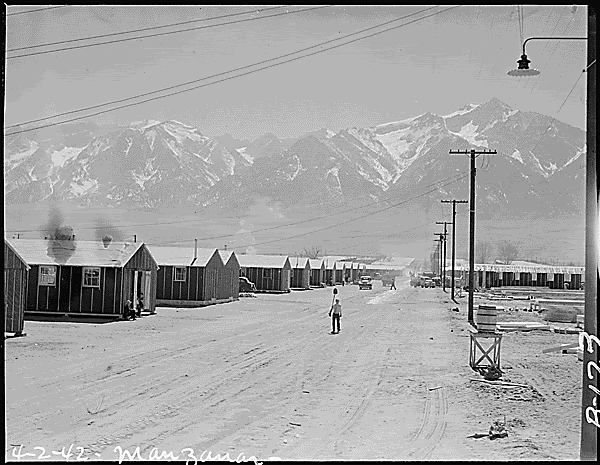
A newly declassified document shows that J. Edgar Hoover, the longtime director of the Federal Bureau of Investigation, had a plan to suspend habeas corpus and imprison some 12,000 Americans he suspected of disloyalty.
Hoover sent his plan to the White House on July 7, 1950, 12 days after the Korean War began. It envisioned putting suspect Americans in military prisons.
Hoover wanted President Harry S. Truman to proclaim the mass arrests necessary to “protect the country against treason, espionage and sabotage.” The F.B.I would “apprehend all individuals potentially dangerous” to national security, Hoover’s proposal said. The arrests would be carried out under “a master warrant attached to a list of names” provided by the bureau.
The names were part of an index that Hoover had been compiling for years. “The index now contains approximately twelve thousand individuals, of which approximately ninety-seven per cent are citizens of the United States,” he wrote.
“In order to make effective these apprehensions, the proclamation suspends the Writ of Habeas Corpus,” it said.
Habeas corpus, the right to seek relief from illegal detention, has been a fundamental principle of law for seven centuries. The Bush administration’s decision to hold suspects for years at Guantánamo Bay, Cuba, has made habeas corpus a contentious issue for Congress and the Supreme Court today.
The Constitution says habeas corpus shall not be suspended “unless when in cases of rebellion or invasion, the public safety may require it.” The plan proposed by Hoover, the head of the F.B.I. from 1924 to 1972, stretched that clause to include “threatened invasion” or “attack upon United States troops in legally occupied territory.”
After the terrorist attacks of Sept. 11, 2001, President Bush issued an order that effectively allowed the United States to hold suspects indefinitely without a hearing, a lawyer, or formal charges. In September 2006, Congress passed a law suspending habeas corpus for anyone deemed an “unlawful enemy combatant...”
...Hoover’s plan called for “the permanent detention” of the roughly 12,000 suspects at military bases as well as in federal prisons. The F.B.I., he said, had found that the arrests it proposed in New York and California would cause the prisons there to overflow.
So the bureau had arranged for “detention in military facilities of the individuals apprehended” in those states, he wrote.
The prisoners eventually would have had a right to a hearing under the Hoover plan. The hearing board would have been a panel made up of one judge and two citizens. But the hearings “will not be bound by the rules of evidence,” his letter noted...
...Hoover’s July 1950 letter was addressed to Sidney W. Souers, who had served as the first director of central intelligence and was then a special national-security assistant to Truman. The plan also was sent to the executive secretary of the National Security Council, whose members were the president, the secretary of defense, the secretary of state and the military chiefs.
...This morning on CNN, 9/11 Commission Chairman Thomas Kean said there is “no question” the CIA was aware that its now-destroyed videotapes depicting severe interrogations were among evidence being sought by 9/11 Commission investigators, and the destruction of the tapes was an attempt to “impede our investigation”:
"We asked for every single thing that they had. And then my vice chairman, Lee Hamilton, looked the director of the CIA in the face, and said, Look, even if we haven’t asked for something, if it’s pertinent to our investigation, make it available to us. And our staff asked again and again of their staff and the tapes were not given to us. So, there was no question.[…]
"I mean, no question that we again and again and again asked for everything, and we needed it, and we weren’t given it. And so, the only conclusion we can draw is it was withheld from us. And that can only be seen to me as an attempt to impede our investigation..."

Tattered Standard of Duty on Wall Street
WITHOUT trust, there can be no free-market capitalism. Capitalism took root in Europe when wealthy families had excess income to invest, and they entrusted their money to managers who would treat their funds with due care.
Such standards of care required that those handling someone else’s money behave with extreme rigor and honesty. The standards, which came to be known as fiduciary duty, were the same duty a court required of, say, a trustee dealing with the property of a widow or a child.
Trustees always had to behave with the interests of the trustor uppermost — there could be no conflict of interest or even the appearance of one. Every relevant fact about an investment and a trusteeship had to be disclosed. As the law came to be interpreted in the United States, the trustee had to disclose every fact or belief that might influence an intelligent, reasonable investor.
These laws were codified in state and federal courts after revelations of stock market corruption before and during the crash of 1929. There could be no material deception and no “scheme or artifice to defraud.” The investor’s interests always had to be superior to those of the investment bank, financial adviser or broker.
For a good long time after World War II, the laws of fiduciary duty were observed. But by the 1980s, the law started to break down in a major way. There had been small scandals in the 1950s and ’60s. But by the end of the 1980s, the Drexel Burnham/Michael Milken junk-bond scandals had exploded, revealing that deception was routinely practiced against the buyers of junk bonds.
Then came the closely related savings-and-loan scandals, leaving taxpayers defrauded in a major way. Then we weathered the high-tech scandals of the late 1990s, in which the bluest of the blue-chip brokerage firms and investment banks placed excessive valuations on companies that they peddled to investors. These investors were often in a trustor-trustee relationship, they suffered losses on a scale never before seen and yet almost no one was punished.
Now, we have the collateralized mortgage obligations and their attendant losses in the subprime mortgage mess. The problem is a familiar one: basic hocus-pocus about what the securities were worth. Of course, there was boilerplate in all of the offerings saying that anything could happen. But that boilerplate is so ubiquitous, and covers so much, that it has come to mean nothing. What did mean something was the name of the underwriter selling the securities. If it was a big name, a name redolent of power and antiquity, a buyer could assume that it could be trusted.
Of course, as we know now, that turned out to be wrong.
The biggest of the big names were among the most aggressive in betraying their clients’ trust, as I see it. Some of the biggest names were selling securities that they — apparently — barely understood themselves. In so doing, they exposed their buyers, and their stockholders, to immense losses. (Think Merrill Lynch, Bear Stearns, Lehman Brothers and many others.) Other major players, including Goldman Sachs, were aggressively shorting the very same sort of products they were underwriting.
Now, Goldman can spin this as “risk management” and insist that it was doing it to protect its stockholders. (Remember, though, that Goldman’s lushly compensated traders and executives get a far larger share of the pie than we pitiful stockholders do.) But selling short the same securities or very similar ones that they were peddling to the clients is extremely hard to reconcile with basic fairness.
Goldman asserts that it did nothing wrong in its handling of C.M.O.’s, saying that most of the entities that bought them were highly sophisticated and capable of making their own investment decisions. Goldman declined to show me a list of its large buyers. It also offered no opinion on what its duties might be to small investors who were ultimately exposed to the C.M.O.’s it sold to larger entities.
Goldman emphatically says its short sales and similar trades were normal hedging operations. The firm declined to show me a chart of the scale of its short sales over the past several years.
After talking to Goldman, I was very impressed with how sure it is of its position. The people there are the ultimate salesmen. But the enviable and phenomenal self-assurance of any one investment bank is not the point. The point is this: Don’t expect the securities firms, or the securities laws, to help clients who suffered huge losses.
BASICALLY, a crossroads was passed in the Drexel/Milken scandals. Although hundreds and perhaps thousands of men and women were profiting from misconduct, only a few people, including Mr. Milken himself, went to prison. And even he emerged from prison a very rich man (and by what I see here in Los Angeles, a model citizen).
Today, in the midst of the mortgage mess, we see people breaching their fiduciary duty and getting away with it. A few may lose their jobs and wander off to a wealthy retirement. But the ordinary stockholders of the banks and mortgage companies are staggered. Entities that sought a marginally better return on their money and were sold exposure to the C.M.O.’s are pauperized because of the losses. And there are reports that Wall Street is expecting $38 billion in bonuses this year.
I keep hearing well-meaning people say that America is not a nation if it doesn’t have control over its borders. But are we a nation if there is no meaningful restraint on what people can do with an offering statement and a computer screen inside our borders? We surely cannot remain a republic under law if there is no law except the axiom from “Richard II” that “they well deserve to have, that know the strong’st and surest way to get.”
If you have not read this article by Robert Parry at Consortium News, do so. It's relatively long, and you might already know every last little detail Mr. Parry mentions; but I'll bet most of you—as informed as you are compared to the average American—had no idea.
Mr. Parry takes awhile to get to what turns into slow-motion jaw-drop stuff, but once he gets down to it, the past 30 years of Democrat/Republican wrangling might make a little more sense.
By the time you're finished, you might hate Bill Clinton, but you have to remember to spread this bitterness around: a whole cabal of Democrats, including the now-idolized Al Gore, were involved and kept the disgusting status quo rolling right along clear into this 21st Century...
2008 Election Cycle:
Finance/Insurance/Real Estate:
Long-Term Contribution Trends
Donations to Democrats $79,749,633
Donations to Republicans $66,274,624
Top 20 Senators
1 Clinton, Hillary (D) $12,302,928
2 Obama, Barack (D) $9,834,870
3 Dodd, Christopher J (D) $5,212,168
4 McCain, John (R) $5,208,827
5 Biden, Joseph R Jr (D) $1,321,819
...Just a few weeks ago, Scripps Howard News Service and Ohio University released a little-noticed study showing that one-third of Americans now “believe in a broad smorgasbord of conspiracy theories” revolving around government complicity in everything from the 9/11 attacks to the Kennedy assassination. The same survey last year found that “anger against the federal government is at record levels.”
It would be easy to chalk up these troubling findings to the unending propaganda of fear. America has been experiencing the searing blast of politicized terror warnings and breaking-news graphics for the better part of six years now, and populations living under such constant government and media shock treatment can go a wee bit berserk.
But while many of these conspiracy theories are offensive and factually unsupported, the underlying paranoia and loathing are not surprising, and the feelings are not motivated merely by a fear of the next bogeyman around the corner. The sentiments are symptoms of a deep crisis of confidence in our public institutions—a crisis that is a predictable reaction to a government that now all but admits it breaks laws, hides information and disregards the public.
We have seen troops sent to war based on manipulated intelligence. We have discovered phones wiretapped without warrants. Just last week, we found out the CIA destroyed tapes of potentially illegal torture sessions. So many scandals now plague the government, it is hard to remember them all. And they have all happened with almost no consequences for the perpetrators.
Nonetheless, every era has its sensational scandals, and so it is probably the mundane that has heated the public’s low-grade disgust into a simmering boil. After all, what we see our government and our representatives quietly do every day tells us far more than even the headline-grabbing controversies.
Industries essentially bribe politicians with campaign contributions. Government employees regularly move into six-figure jobs lobbying for the industries they once regulated. Presidential candidates of both parties take time off from their small-town stump speeches about the middle class to hold big corporate fundraisers in New York penthouses and D.C. law firms. All of it is legal and treated as ho-hum by the media.
Then there is the bureaucracy, the faceless monolith whose civil service protections and multiyear appointment terms were supposed to prevent it from becoming what it is today: an increasingly important cog in the corrupt machine...
In Scripps Howard’s report on its poll findings, some experts voiced astonishment at the anger being expressed by the country. But really, we should be baffled if public opinion were any different. Considering what’s going on, is anyone actually stunned that America is enraged? Is anyone really confused about why so many believe the government conspires against the public?
...Apologists for the mortgage industry claim, as Mr. Greenspan does in his new book, that “the benefits of broadened home ownership” justified the risks of unregulated lending.
But homeownership didn’t broaden. The great bulk of dubious subprime lending took place from 2004 to 2006 — yet homeownership rates are already back down to mid-2003 levels. With millions more foreclosures likely, it’s a good bet that homeownership will be lower at the Bush administration’s end than it was at the start.
Meanwhile, during the bubble years, the mortgage industry lured millions of people into borrowing more than they could afford, and simultaneously duped investors into investing vast sums in risky assets wrongly labeled AAA. Reasonable estimates suggest that more than 10 million American families will end up owing more than their homes are worth, and investors will suffer $400 billion or more in losses.
So where were the regulators as one of the greatest financial disasters since the Great Depression unfolded? They were blinded by ideology...
...Mr. Greenspan dismissed as a “collectivist” myth the idea that businessmen, left to their own devices, “would attempt to sell unsafe food and drugs, fraudulent securities, and shoddy buildings.” On the contrary, he declared, “it is in the self-interest of every businessman to have a reputation for honest dealings and a quality product.”
It’s no wonder, then, that he brushed off warnings about deceptive lending practices, including those of Edward M. Gramlich, a member of the Federal Reserve board. In Mr. Greenspan’s world, predatory lending — like attempts to sell consumers poison toys and tainted seafood — just doesn’t happen.
But Mr. Greenspan wasn’t the only top official who put ideology above public protection. Consider the press conference held on June 3, 2003 — just about the time subprime lending was starting to go wild — to announce a new initiative aimed at reducing the regulatory burden on banks. Representatives of four of the five government agencies responsible for financial supervision used tree shears to attack a stack of paper representing bank regulations. The fifth representative, James Gilleran of the Office of Thrift Supervision, wielded a chainsaw.
Also in attendance were representatives of financial industry trade associations, which had been lobbying for deregulation. As far as I can tell from press reports, there were no representatives of consumer interests on the scene...
...According to the bill, “homegrown terrorists” can be anyone who “… intimidate(s) or coerce(s) the United States government, the civilian population … or any segment thereof, in furtherance of political or social belief,” a definition broad enough to include Americans who organize mass marches on Washington to “coerce” changes in government policy.
The bill defines “violent radicals” as Americans who “…promot(e) extremist belief system(s) for the purpose of facilitating ideologically based violence to advance political, religious or social change…” - in other words, Americans who have not yet done anything illegal but who, commissioners believe, have thoughts that might lead to violence.
The bill does not target all thoughts (belief systems) that might result in violence, but only thoughts leading to “… force or violence … to promote political, religious or social beliefs,” which is exactly the kind of violence that might result whenever people gather to demonstrate for or against important issues, such as the Iraq war or abortion.
For at least 18 months this “Homegrown-Terrorism and Extremist Belief Commission” will be required to hold congressional hearings around the country, to uncover Americans with “political, religious or social” concerns who commissioners think might be “extreme” and/or potentially violent, whether any of these Americans has committed a crime or not. Virtually any politically, socially or religiously active person or group could be targeted by the commission to find out who is, and who is not, one of the “hidden enemy” among us.
Witnesses who refuse to testify can expect to be held in “contempt of Congress,” as former members of the Bush administration like Harriet Myers have learned recently, and jailed. Witnesses who do testify but say things that commissioners or their staff think are not true can be charged with perjury, or lying to a federal official, as “Scooter” Libby found out. Either way, noncooperative witnesses can face up to a 10-year sentence.
Members of suspect political, religious and social groups, or Americans who might even know people the commission suspects - which certainly will include nonmainstream political parties, certain public advocacy groups, some churches and many mosques - can expect the “commissioners” will want to know … “are you now, or have you ever been … associated with extremists, violent radicals or homegrown terrorists?”
For those who do remember history, this should sound uncomfortably familiar. These are the kinds of questions Americans were compelled to answer when testifying before another “legislative commission” during the anti-communist McCarthy-era witch-hunts...
Fire in National Security Council staff office
The Lede is following the fire at the Eisenhower Executive Office Building in Washington with frequent updates during the day, in chronological order — scroll to the bottom of the post for the latest additions.
Maybe the whole building will PANCAKE suddenly and we'll find Hugo Chavez's passport in the rubble. Then we can attack.

Blackwater's Bu$ine$$
Jeremy Scahill
Gunning down seventeen Iraqi civilians in an incident the military has labeled "criminal." Multiple Congressional investigations. A federal grand jury. Allegations of illegal arms smuggling. Wrongful death lawsuits brought by families of dead employees and US soldiers. A federal lawsuit alleging war crimes. Charges of steroid use by trigger-happy mercenaries. Allegations of "significant tax evasion." The US-installed government in Iraq labeling its forces "murderers." With a new scandal breaking practically every day, one would think Blackwater security would be on the ropes, facing a corporate meltdown or even a total wipeout. But it seems that business for the company has never been better, as it continues to pull in major federal contracts. And its public demeanor grows bolder and cockier by the day.
Rather than hiding out and hoping for the scandals to fade, the Bush Administration's preferred mercenary company has launched a major rebranding campaign, changing its name to Blackwater Worldwide and softening its logo: once a bear paw in the site of a sniper scope, it's now a bear claw wrapped in two half ovals--sort of like the outline of a globe with a United Nations feel. Its website boasts of a corporate vision "guided by integrity, innovation, and a desire for a safer world." Blackwater mercenaries are now referred to as "global stabilization professionals." Blackwater's 38-year-old owner, Erik Prince, was No. 11 in Details magazine's "Power 50," the men "who control your viewing patterns, your buying habits, your anxieties, your lust.... the people who have taken over the space in your head."
...The dirty open secret in Washington is that Blackwater has done its job in Iraq, even if it has done so by valuing the lives of Iraqis much lower than those of US VIPs. That badass image will serve it well as it expands globally.
Prince promises that Blackwater "is going to be more of a full spectrum" operation. Amid the cornucopia of scandals, Blackwater is bidding for a share of a five-year, $15 billion contract with the Pentagon to "fight terrorists with drug-trade ties." Perhaps the firm will join the mercenary giant DynCorp in Colombia or Bolivia or be sent into Mexico on a "training" mission. This "war on drugs" contract would put Blackwater in the arena with the godfathers of the war business, including Lockheed Martin, Northrop Grumman and Raytheon.
In addition to its robust business in law enforcement, military and homeland security training, Blackwater is branching out. Here are some of its current projects and initiatives:
§ Blackwater affiliate Greystone Ltd., registered offshore in Barbados, is an old-fashioned mercenary operation offering "personnel from the best militaries throughout the world" for hire by governments and private organizations. It also boasts of a "multi-national peacekeeping program," with forces "specializing in crowd control and less than lethal techniques and military personnel for the less stable areas of operation."
§ Prince's Total Intelligence Solutions, headed by three CIA veterans (among them Blackwater's number two, Cofer Black), puts CIA-type services on the open market for hire by corporations or governments.
§ Blackwater is launching an armored vehicle called the Grizzly, which the company characterizes as the most versatile in history. Blackwater intends to modify it to be legal for use on US highways.
§ Blackwater's aviation division has some forty aircraft, including turboprop planes that can be used for unorthodox landings. It has ordered a Super Tucano paramilitary plane from Brazil, which can be used in counterinsurgency operations. In August the aviation division won a $92 million contract with the Pentagon to operate flights in Central Asia.
§ It recently flight-tested the unmanned Polar 400 airship, which may be marketed to the Department of Homeland Security for use in monitoring the US-Mexico border and to "military, law enforcement, and non-government customers."
§ A fast-growing maritime division has a new, 184-foot vessel that has been fitted for potential paramilitary use...
...Meanwhile, Blackwater is deep in the camp of GOP presidential candidate Mitt Romney. Cofer Black is Romney's senior adviser on counterterrorism. At the recent CNN/YouTube debate, when Romney refused to call waterboarding torture, he said, "I'm not going to specify the specific means of what is and what is not torture so that the people that we capture will know what things we're able to do and what things we're not able to do. And I get that advice from Cofer Black, who is a person who was responsible for counterterrorism in the CIA for some thirty-five years." That was an exaggeration of Black's career at the CIA (he was there twenty-eight years and head of counterterrorism for only three), but a Romney presidency could make Blackwater's business under Bush look like a church bake sale...

...at least four White House lawyers pondered the question of burning evidence of their crimes by deleting video tapes (I believe there are copies) of the CIA torture on Abu Zubaydah and Abd al-Rahim al-Nashiri:
One former senior intelligence official with direct knowledge of the matter said there had been “vigorous sentiment” among some top White House officials to destroy the tapes. The former official did not specify which White House officials took this position, but he said that some believed in 2005 that any disclosure of the tapes could have been particularly damaging after revelations a year earlier of abuses at Abu Ghraib prison in Iraq.
The WH lawyers involved were Miers, Bellinger, Gonzales and Addington. Miers and Gonzales are lightweights. I don't know about Bellinger, but Addington has been the heavyweight on the team all along. Being Cheney's henchmen he explained the general overall strategy:
"We're going to push and push and push until some larger force makes us stop."
But what if no larger force appears?
The process is well known:
What happened here was the gradual habituation of the people, little by little, to being governed by surprise; to receiving decisions deliberated in secret; to believing that the situation was so complicated that the government had to act on information which the people could not understand, or so dangerous that, even if he people could understand it, it could not be released because of national security.
That text applies to torture laws, the FISA changes, the Patriot Act and the War on Iraq budgets that still fly through Congress without any significant protest.
But it was written in 1955 and is an interview with an intellectual German about the 1930s/40s. The Goebbels strategy was "push and push and push" too. Back then the larger force appeared only in a very bloody fight over Stalingrad and even after that took years to succeed.
It is the creeping process that is alarming. It is still going on, strong. Several of the last Billmon posts warned about this.
The recent offhanded use of the words "bureau procedures" by the veteran reporter Walter Pincus to describe serious enacted laws really set off my alarm bells...
...Although done without fanfare, it is an absolutely vital step to refer to laws prohibiting torture as mere procedures. It is masterful. It is well over 51% of the victory, for it quietly and adroitly hollows out those laws. They no longer quite apply, and laws that no longer quite apply -- quite effectively no longer exist...
...Now that the restraints against torture have been effectively removed, the next steps will be easy. In the coming few years, this Mueller fellow will eventually be replaced with someone who is not hampered by regard for defunct laws, who can rule his domain within the empire by fiat and decree.
The same process is taking place in every domain of government. Inch by inch, decrepit laws like habeas corpus and quaint concepts like freedom of speech, honest elections, freedom of movement and assembly, and personal privacy become first hollow procedures, then dumb laws, and finally treason. In the vacuum left when laws become dumb, only Strong Men can hold society together.
America set out on this course many long years ago, with the birth of the National Security State after Dubya Dubya Two. We are approaching the flowering time.
The true nature of the Unitary Executive is the Führer Prinzip, rule by a hierarchy of Strong Men, each ruling their domain with absolute authority. This is precisely the slippery slope of legalized gangsterism rising in America, blithely overlooked by its consumers, the majority of whom still believe they live in a free society.
They don't. They have built their own prison, and elected their own jailers. They are living in a nation of hollow laws, a nation of procedures on their way to becoming dumb laws left on the books only for comic effect. Mute laws, stupid laws, quaint laws for the era before empire, for the era before Strong Men.
The Unitary Executive is rule by thuggery, by fiat, and by raw power. But it is not the cause of America's fall. No, it is the last symptom of America's internal rot, of the merger of unchecked corporate and institutional power with the institution of government itself. The businessman, the soldier, the priest, and the politician are standing forth now as the Strong Men who will ultimately save the nation from dumb laws like that "goddammed piece of paper" the Constitution.
The American populace made room for Strong Men by neglecting the duties of citizenship in favor of life as consumers. They made Strong Men necessary by letting crooks run the banks and towers of corporate power, and shysters write the laws. They demand Strong Men and Messiahs on every hand now to extricate themselves from the consequences of living beyond their means, beyond restraint, beyond moderation or common sense...
Another Milestone on the Road to Serfdom
Very rarely, I read a press account and see the footprint of a new world—there it is, lurking amidst the smudged black ink in the thin column. Sometimes it is a technological breakthrough that promises to make life easier, safer, or longer. But sometimes it is a redefinition of the parameters of human society. And sometimes it’s downright frightening. Time to pull it out of the banality of that newsprint and think.
And it happened on Sunday morning. The article is by Eric Lichtblau, James Risen and Scott Shane, and it’s called “Wider Spying Fuels Aid Plan for Telecom Industry.”...
...What Lichtblau, Risen and Shane are describing is the dawn of a new National Surveillance State in the United States, a public-private partnership. And the object of this partnership—which emerges as a criminal conspiracy, quite literally, between telecom companies and the Bush Administration—is to watch and listen to you and everything you do. Of course, they will say it’s about “terrorists,” or about “narcotics traffickers.” And indeed every authoritarian and wannabe totalitarian system from the dawn of time has cast its snooping on citizens in just these terms. No problems with the honest citizen, they say, it’s the criminals and the enemies we’re after. We need your cooperation. But the technology used makes no such distinction—it is snooping on everyone...
So the United States intelligence agencies in cahoots with major telecom providers are intercepting and reviewing your communications. This is occurring without warrants. And the legal community is in accord: it was criminal conduct. And that’s why the Bush Administration is frantically pushing right now for immunity: to ensure that its collaborators face no adverse consequences from their criminal acts. What kind of society does this sound like?
Now let’s tack on one further extremely disturbing fact. One telecom company said “no.” It was Qwest. The Qwest response to overtures was simple: “We’d love to work with you on this. But you do need to change the law so we can do it legally.” Apparently as soon as that happened, Qwest lost a series of important government contracts. And the next thing you know, the Justice Department was feverishly working on a criminal investigation looking at Qwest’s CEO on insider trading allegations—amidst very strange dealings between the Justice Department and the federal judge hearing the case. Of course, this is all the purest coincidence. Or maybe not. What kind of society does this sound like?
This is not the America we used to live in. It is not a nation that stood as a bulwark for civil liberties. It is a nation with an executive who is drunk on power. An executive who refuses to respect the legal constraints established by the Constitution, and even the criminal law.
As dawn turned to midmorning in the era of technology, thinkers agreed that the great threat facing mankind was the threat of a totalitarian rule. They saw the vision that Orwell transcribed, in which human freedom would be horribly constrained as the species assumed the role accorded to cogs in some massive machine. This was hard for Americans to envision—they were born and lived in a country that knew and seriously guarded civil liberties. But those who traveled abroad saw the evidence plainly enough, especially in the twenties and thirties, as totalitarian states rose and enslaved their peoples. Then fascism rose and fell. And after it, the efforts to build a Marxist-Leninist world imploded as well. But it’s wrong to suppose on the basis of these failed nightmare-utopias that the threat Orwell envisioned had passed. It has merely moved on, to a new form.
How would America and its market system behave in the face of such a threat? In the mind of some, like Hayek and Mises, the forces of the market would restrain an overreaching government and would serve to maximize human freedom. We needed to be on guard, of course, against the rise of monopolies and preserve the competitive edge. And we have to adhere rigorously to a principle of legality. As Mises reminds us, it is the centering of power in the hands of a few men and not in the rule of law, that presents the gravest threat to individual freedom in the market economies.
I don’t object to private businesses, including those in the telecommunications sector, cooperating with government, including the intelligence services. They should do so, of course, to promote society’s interest in collective security. But this cooperation needs to occur within the boundaries of the law, and it must respect the rights of their customers, and more broadly of the citizenry. What the Bush Administration and the telecoms did was wrong, and both should be held to account for their wrongdoing. That’s the way a state committed to the rule of law works.
The question is now before the Senate for a vote on the telecom amnesty bill. As usual, the White-Flag Democrats are abandoning opposition to the Administration’s initiative and are laying the foundation for it to be steamrolled through the Senate. Harry Reid’s conduct in particular has been reprehensible and spineless. This vote is a milestone on the road to serfdom. It’s time to put up a roadblock instead. Write or phone your senator immediately and advise them that you oppose the grant of amnesty for warrantless surveillance to telecommunications companies and that you expect them to do the same.
...The argument began during the Democratic debate, when the moderator — Carolyn Washburn, the editor of The Des Moines Register — suggested that Mr. Edwards shouldn’t be so harsh on the wealthy and special interests, because “the same groups are often responsible for getting things done in Washington.”
Mr. Edwards replied, “Some people argue that we’re going to sit at a table with these people and they’re going to voluntarily give their power away. I think it is a complete fantasy; it will never happen.”
This was pretty clearly a swipe at Mr. Obama, who has repeatedly said that health reform should be negotiated at a “big table” that would include insurance companies and drug companies.
On Saturday Mr. Obama responded, this time criticizing Mr. Edwards by name. He declared that “We want to reduce the power of drug companies and insurance companies and so forth, but the notion that they will have no say-so at all in anything is just not realistic.”
Hmm. Do Obama supporters who celebrate his hoped-for ability to bring us together realize that “us” includes the insurance and drug lobbies?
O.K., more seriously, it’s actually Mr. Obama who’s being unrealistic here, believing that the insurance and drug industries — which are, in large part, the cause of our health care problems — will be willing to play a constructive role in health reform. The fact is that there’s no way to reduce the gross wastefulness of our health system without also reducing the profits of the industries that generate the waste.
As a result, drug and insurance companies — backed by the conservative movement as a whole — will be implacably opposed to any significant reforms. And what would Mr. Obama do then? “I’ll get on television and say Harry and Louise are lying,” he says. I’m sure the lobbyists are terrified.
As health care goes, so goes the rest of the progressive agenda. Anyone who thinks that the next president can achieve real change without bitter confrontation is living in a fantasy world.
Which brings me to a big worry about Mr. Obama: in an important sense, he has in effect become the anti-change candidate.
There’s a strong populist tide running in America right now. For example, a recent Democracy Corps survey of voter discontent found that the most commonly chosen phrase explaining what’s wrong with the country was “Big businesses get whatever they want in Washington.”
And there’s every reason to believe that the Democrats can win big next year if they run with that populist tide. The latest evidence came from focus groups run by both Fox News and CNN during last week’s Democratic debate: both declared Mr. Edwards the clear winner.
But the news media recoil from populist appeals. The Des Moines Register, which endorsed Mr. Edwards in 2004, rejected him this time on the grounds that his “harsh anti-corporate rhetoric would make it difficult to work with the business community to forge change.”...